


Could your new garden boundary result in a council enforcement notice before the postmix has even set? When you live in a protected zone, the standard rules of permitted development often don't apply. You must know exactly what fence can I have in a conservation area to avoid legal headaches and the high cost of mandatory removal.
It's frustrating to deal with complex planning permissions or the fear of getting height limits wrong. You want a secure, high-quality boundary without the risk of council fines or long delays. We provide the direct facts you need to balance local heritage requirements with your practical needs for privacy and security. This guide simplifies the entire process so you can order your fence panels and posts with total confidence.
We will explain the crucial differences between 1m and 2m height limits and how Article 4 directions might restrict your specific project. You'll also find a list of approved styles, including traditional timber panels and trellis, that satisfy local standards while protecting your property's value.
Key Takeaways
- Understand why conservation status limits your permitted development rights and when you must submit a formal planning application for new boundaries.
- Discover exactly what fence can I have in a conservation area by learning the critical 1-metre and 2-metre height restrictions for different property boundaries.
- Identify council-approved styles like traditional timber picket and closeboard panels that meet strict heritage character requirements.
- Navigate the local planning process in Essex and London efficiently by securing expert pre-application advice before purchasing materials.
- Source high-grade timber fence panels and professional installation services to ensure your project complies with all local regulations and lasts for years.
Understanding Fencing Restrictions in UK Conservation Areas
A Conservation area (United Kingdom) is a designated zone recognized for its special architectural or historic interest. These areas exist to protect the heritage and visual integrity of a neighbourhood. Unlike standard residential zones where you have broad "permitted development" rights, conservation areas have stricter controls. The core objective is simple. The local authority wants to preserve or enhance the existing character of the street. This means any change to the exterior of your property undergoes careful review.
You might think a new fence is a minor change. However, local councils view boundaries as essential parts of the "street scene." In a standard street, you can often install any timber panel you like. In a conservation zone, the local authority monitors these changes to prevent "creeping suburbanisation." They want to ensure your property remains consistent with its historical context. If you are asking what fence can I have in a conservation area, you must start by acknowledging that your choices are limited by the area's history.
Why Councils Regulate Your Boundary Treatments
Maintaining the visual street scene is a top priority for conservation officers. The impact of a fence is significant because it is often the first thing people see from the pavement. Inappropriate materials can devalue a historic area. For example, modern plastic or composite fencing often clashes with Victorian or Edwardian brickwork. These materials look out of place and can lead to a rejection of your plans. Stick to traditional timber fence panels and posts to stay compliant. When you repair an existing boundary, councils usually expect "like-for-like" replacements. This means using the same wood species, height, and design as the original structure to maintain continuity.
The Role of the Conservation Officer
A conservation officer is a specialist advisor who works for the local council. Their opinion often carries more weight than a standard planning officer when dealing with heritage assets. They assess whether your proposal harms the area's significance. To find out if your home is affected, check the conservation area maps on your local Essex or London council website. Most authorities in Romford and surrounding boroughs provide interactive digital maps for residents. You can quickly see if your property falls within a protected boundary. The preservation or enhancement of the area's character serves as the primary legal test for all proposed boundary changes. If your new fence doesn't meet this test, the council will likely refuse permission.
Planning Permission vs. Permitted Development for Fences
Standard residential properties usually benefit from "permitted development" rights. These rights let you build or replace fences without asking the council for permission. In a conservation area, these rights are often limited or removed entirely. You must understand specific height thresholds to avoid council enforcement action. According to official UK government guidance, the exact location of your boundary dictates which rules apply to your project.
The 1-Metre and 2-Metre Height Limits
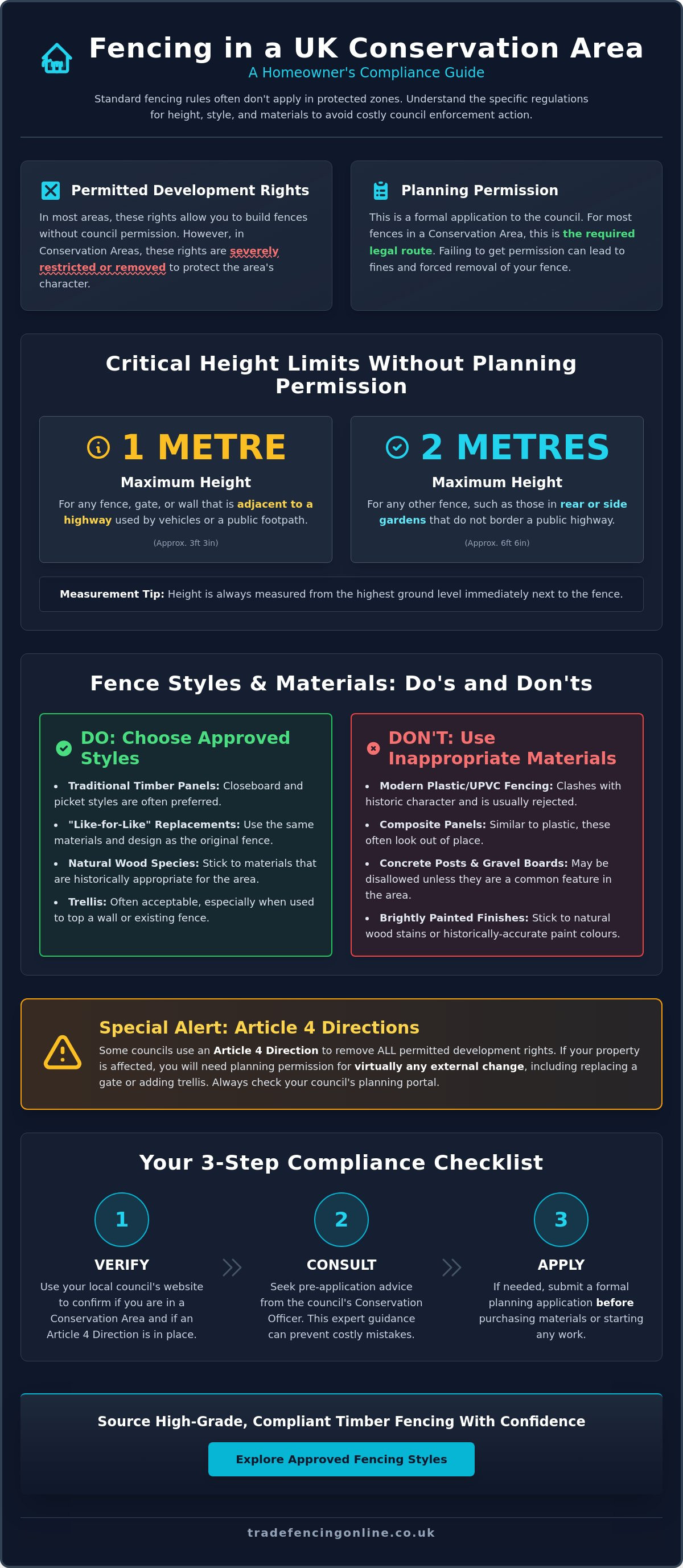
The council splits fencing rules into two categories based on proximity to public space. If your fence is "adjacent to a highway," the maximum height allowed without permission is 1 metre. A highway includes any public road, footpath, or bridleway. Corner plots are particularly tricky because they often face two different roads. If you want a taller boundary in these areas, you must submit a planning application. For rear or side boundaries that don't face a road, the limit is usually 2 metres. This is roughly 6ft 6in. However, don't just buy standard panels and assume they're legal. When determining what fence can I have in a conservation area, height is your first hurdle. Always measure from the highest point of the ground immediately next to the fence. This is the standard measurement planning officers use during inspections.
Article 4 Directions Explained
Councils use Article 4 Directions to protect the specific architectural character of a neighbourhood. These legal orders override your standard permitted development rights. They're very common in historic parts of London and Essex. When an Article 4 is in place, you need permission for almost any external change. This includes replacing a gate or adding new trellis to an existing wall. Always check your property status on the local planning portal before ordering fencing supplies. If you build without checking, the council can force you to take the structure down at your own expense. Many areas in boroughs like Havering, Redbridge, and Epping Forest have these directions active. If you're unsure about the rules for your specific street, booking professional fencing installation can help you navigate local requirements safely. You should also remember that demolition is regulated. You often need permission to remove an existing fence over 1 metre high if it's next to a highway. Planning officers want to ensure the replacement style is as good as, or better than, the original boundary.
Approved Fencing Styles for Historically Significant Zones
Choosing the right materials is just as important as following height limits. When you ask what fence can I have in a conservation area, the answer almost always involves natural timber. Conservation officers rarely approve modern alternatives like plastic, composite, or heavy concrete. These materials often look out of place next to period brickwork or traditional landscapes. Timber is the standard because it ages naturally and matches the historical character of most UK conservation zones. You need a solution that provides security without disrupting the visual heritage of your street.
Traditional Picket and Pointed Pale Fencing
Picket fencing is the gold standard for front gardens in protected areas. Conservation officers favour open-slat designs because they maintain visibility and don't "close in" the street scene. To keep a traditional look, ensure the spacing between pales is roughly equal to the width of the pales themselves. This creates a balanced, rhythmic appearance that councils prefer. Stick to heights under 1 metre for these front boundaries. This ensures you comply with highway rules while maintaining the property’s original boundary line. Pointed or rounded tops are typical for Victorian and Edwardian properties, providing a classic finish that requires little debate from planners.
Using Closeboard and Lap Panels Correctly
For rear gardens where privacy is the priority, closeboard fencing is a sturdy and neutral choice. It provides a solid barrier while still using traditional construction methods. It's important to select fence panels that blend with the local environment rather than standing out. Pressure-treated timber in natural brown or green hues is usually the safest bet. The choice of fence posts also plays a major role in the final aesthetic. While concrete posts are durable, they often look too industrial for a heritage zone. Timber posts are almost always preferred in conservation settings because they maintain a consistent, period-accurate look across the entire boundary.
Trellis and Decorative Toppers
Adding a trellis to the top of a fence or wall is an effective way to gain height without creating a heavy, oppressive feel. Councils often view trellis more favourably than solid panels because it allows light and air to pass through. This "permeability" is a key factor in many planning decisions. You can use decorative toppers to soften the appearance of a 2-metre rear boundary. Ensure you match the trellis pattern to the architectural era of your house. Square trellis often suits more modern or simplified designs, while diamond patterns are frequently found in older, more ornate gardens. This small detail shows the council you've considered the area's specific character.
Navigating the Application Process in Essex & London
Living in Romford or surrounding Essex boroughs means you deal with specific local authorities like Havering or Redbridge. Each council has its own set of expectations for heritage zones. Before you submit a formal application, you should gather evidence. Take clear photos of your existing boundary and neighbouring fences. If your neighbours have a specific style that has already been approved, use this as a precedent. It shows the council that your project fits the established street scene. Determining exactly what fence can I have in a conservation area is easier when you can point to existing, approved examples on your own street.
Seeking pre-application advice is a smart move. Most councils charge a fee for this service, but it saves time and money in the long run. A conservation officer will review your initial ideas and tell you if they meet local standards. This feedback allows you to adjust your plans before you pay the full application fee. In the UK, a standard householder application typically takes about eight weeks for a decision. Costs vary significantly between different local authorities, so check your council's website for their current fee schedule.
Consulting Your Local Council (Havering, Redbridge, Essex)
Havering Council is particularly diligent about preserving the character of Romford's historic pockets. You should use the national Planning Portal for your online submission. It streamlines the process and ensures all required documents are attached correctly. Many homeowners find the technical requirements and paperwork overwhelming. Professional fencing installers often handle the practical side of these projects, ensuring the materials and heights meet the exact specifications discussed with the council. If you want a hassle-free project, order our professional fencing installation services to ensure your new boundary is built to the highest trade standards.
What to Include in Your Fencing Application
Your application needs more than just a basic description. You must provide a block plan showing the property boundaries and the exact location of the new fence. Include elevation drawings that show the height and design from the front and side views. You also need to submit a "Design and Access Statement." This document explains why you chose a specific style and how it preserves or enhances the area's character. If you are replacing a damaged boundary, highlight the "like-for-like" nature of the work. This is often the quickest path to approval. Clearly stating that you are using traditional timber panels and posts helps the officer understand what fence can I have in a conservation area that meets their strict criteria. Be specific about the wood type and any finishes or stains you plan to use to avoid follow-up questions.
Sourcing Heritage-Grade Fencing Supplies in Romford
Buying the right materials is the final step in securing your property boundary. Once you know what fence can I have in a conservation area, you must source timber that meets council expectations. Low-grade wood or mismatched styles can result in a rejected installation. Romford Fencing Ltd is the leading supplier of heritage-grade fencing in Romford, acting as a total solution provider for all protected zone projects. Our inventory focuses on traditional aesthetics and structural integrity. This ensures your project passes inspection and stands the test of time. Quality materials are an investment in your property's value and legal standing.
We understand the pressure of meeting strict planning conditions. Planning officers often look for specific timber grades and traditional construction methods. Using the wrong materials can lead to costly delays or enforcement notices. We help you avoid these issues by supplying trade-standard goods that fit the historical context of London and Essex neighbourhoods. Our products are chosen for their reliability and classic appearance. We provide everything you need to complete a compliant boundary project without unnecessary friction.
High-Quality Timber Panels and Posts
We sell pressure-treated timber fence panels and fence posts designed for long-term performance. This treatment is essential for compliance with local longevity standards. It prevents premature rot and insect damage. Our range includes picket pales for front gardens and sturdy closeboard panels for rear privacy. We also supply gravel boards to keep your timber away from ground moisture. For a complete installation, we stock all necessary ironmongery and gates. Matching your gate to your fence style is a common requirement in conservation areas. We also provide postmix and cement to ensure every post is set securely. If you need to level a sloping garden, our railway sleepers offer a traditional way to build retaining structures that planners approve. We even offer artificial grass for homeowners looking to refresh their garden landscape while maintaining a clean, heritage-appropriate look.
Reliable Local Delivery and Support
Efficient logistics are a core part of our service. We offer fast delivery to Romford, Basildon, Chelmsford, and across East London. This keeps your project on schedule and reduces downtime on site. We provide trade accounts for contractors and developers who need bulk pricing for large heritage sites. Our professional reputation is built on reliability and deep knowledge of the local area. We don't just sell products; we provide the materials that help you maintain the historic character of your neighbourhood. Our team is ready to help you select the right components for your specific planning requirements. We also offer professional fencing installation to ensure your project is completed to the highest trade standard. CONTACT US TODAY for a quote on your conservation-approved fencing project.
Secure Your Conservation Area Boundary Today
Living in a protected zone doesn't mean you can't improve your property boundaries. You now understand that following the 1-metre and 2-metre height rules is essential for legal compliance. Traditional timber styles like picket and closeboard panels are the most reliable choices to satisfy a conservation officer. Knowing exactly what fence can I have in a conservation area allows you to plan your project without the risk of legal delays or council fines.
We are an established Romford supplier with a professional reputation for quality and reliability. We offer fast delivery across Essex and East London to keep your garden project on schedule. Trade and public accounts are available to ensure you get the best value on heritage-grade materials. Our range is designed to meet strict local standards while providing the privacy and security you need.
BROWSE OUR RANGE OF CONSERVATION-READY FENCE PANELS
Start your project with confidence and secure your garden today with materials that respect your property's history.
Frequently Asked Questions
Do I need planning permission for a fence in a conservation area?
Yes, you often need planning permission if your permitted development rights have been restricted or if you exceed height limits. While standard rules apply, many conservation areas have Article 4 directions that remove these automatic rights. Always check with your local council before starting work to avoid enforcement notices. This ensures your project remains legal and compliant with heritage standards.
Can I replace an old fence "like-for-like" without permission?
You can usually replace a fence like-for-like if the design, material, and height remain identical to the original structure. However, if the old fence already exceeded height limits or if an Article 4 direction is in place, you might still need formal consent. Local authorities prefer traditional timber materials that preserve the street's character. Always verify your specific property status to ensure the replacement doesn't trigger a council inspection.
How high can a fence be in a conservation area UK?
The height limit is 1 metre if the fence is adjacent to a highway and 2 metres for other boundaries. A highway includes roads, footpaths, and public bridleways. If you want to install a taller boundary, you must submit a planning application to the local council. Determining what fence can I have in a conservation area depends heavily on these measurements, so take accurate readings from the highest point of the ground.
What happens if I put up a fence in a conservation area without permission?
The council can issue an enforcement notice requiring you to remove or modify the fence at your own expense. Building without permission in a protected zone is a serious matter and can lead to legal action or fines. You may also face difficulties when trying to sell your property if the boundary work lacks the necessary paperwork. It is much more efficient to secure approval before ordering your materials.
Are concrete fence posts allowed in conservation areas?
Concrete fence posts are often discouraged by conservation officers because they lack a traditional appearance. Planners generally prefer timber posts that match the heritage aesthetic of the neighbourhood. While they are durable, concrete posts can look too industrial next to historic brickwork. Stick to pressure-treated timber posts to ensure your project enhances the area's character rather than detracting from it.
Does a trellis count towards the total fence height?
Yes, a trellis is considered part of the overall height of the boundary structure. If your fence is 1.8 metres high and you add a 0.3 metre trellis, the total height is 2.1 metres. This would exceed the standard 2-metre permitted development limit for rear gardens. You must include the trellis in your measurements when asking what fence can I have in a conservation area to stay within legal limits.
How do I find out if my house is in a conservation area?
You can find this information by searching your local council's website for their conservation area maps. Most authorities in Essex and London provide digital tools where you can enter your postcode to check your status. You can also contact the local planning department directly for confirmation. Knowing your status is the first step before purchasing any fencing supplies or starting installation work.
Can I paint my fence a specific colour in a conservation area?
You should stick to neutral, natural wood stains or colours that are traditionally found in your specific neighbourhood. Some conservation areas have strict guidelines regarding paint colours to maintain a uniform street scene. Bright or modern shades may lead to complaints or council intervention. Using a clear or dark oak preservative is usually a safe choice that planners will support without issue.