


Choosing the right fence panels for your garden can feel overwhelming. With so many styles, sizes, and treatments to consider, it is easy to feel unsure where to start. Are pressure-treated panels worth the extra cost over dip-treated? What size do you need? And what about the essential extras like posts and gravel boards? Getting these details wrong can lead to a fencing project that costs more time and money than necessary.
This guide removes the guesswork. We provide the essential, no-nonsense information you need to make a confident decision for your property. We will cover the key differences between popular panel types, explain the long-term value of quality materials, and help you create a complete shopping list for your entire project. By the end, you will have all the details required to select quality, long-lasting fencing that perfectly suits your garden and your budget, supplied by a trusted local expert.
Understanding the Main Types of Garden Fence Panels
Choosing the right garden fencing is a crucial decision for your property's security, privacy, and overall appearance. The UK market offers many types of garden fence panels, but most fall into a few key categories. Each style offers a different balance of privacy, durability, and aesthetics, so you must consider your garden's look and the primary purpose of your new fence. This section breaks down the most popular options to help you identify the best fence panels for your needs.
Closeboard Fence Panels (Featheredge)
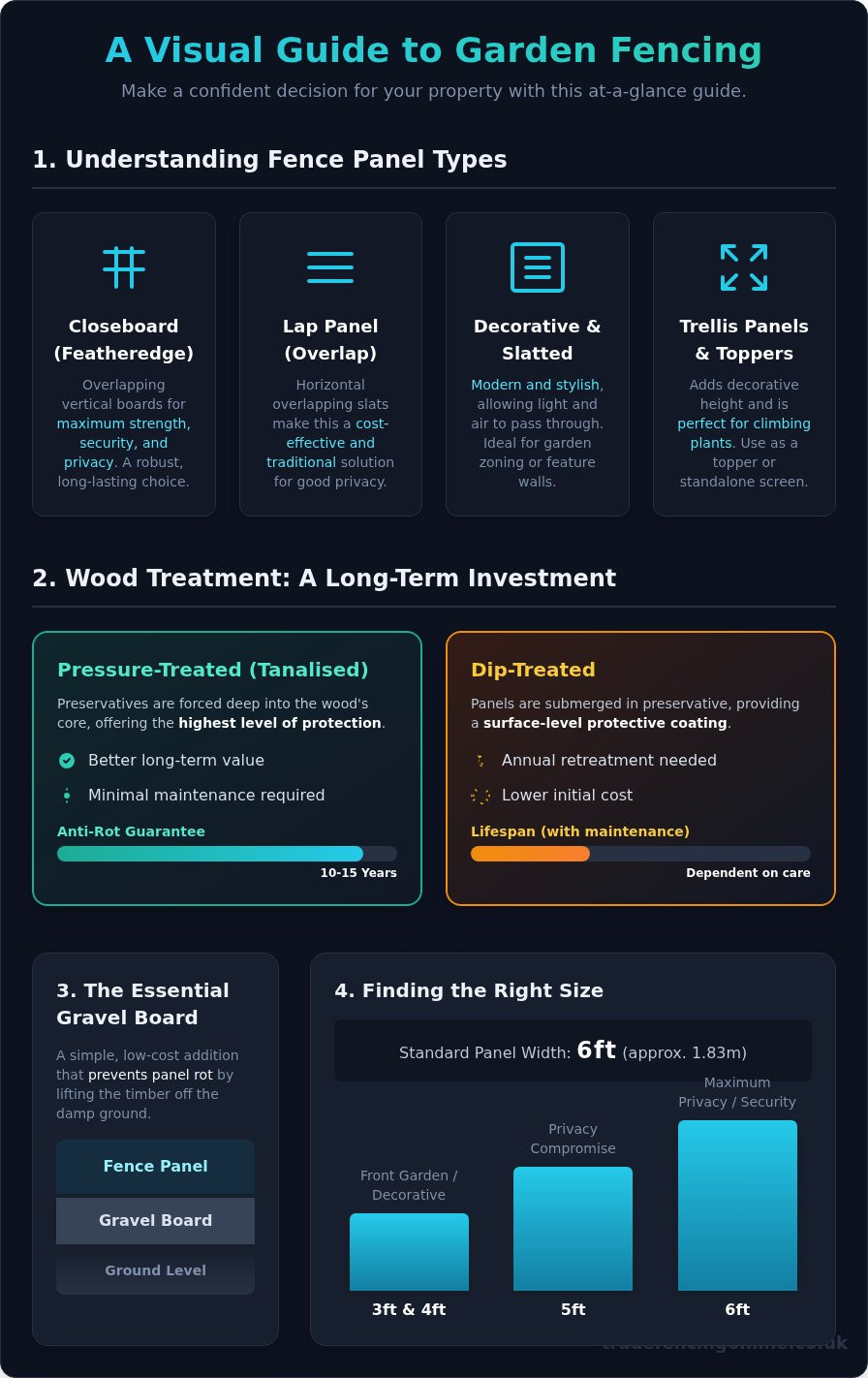
Known for exceptional strength and durability, Closeboard panels are one of the most robust fencing options available. They are constructed from overlapping vertical timber boards, often pressure-treated for a long lifespan. This solid design offers excellent privacy and security, making it a very popular choice for boundary fences that need to withstand the elements. Its traditional, heavy-duty build provides peace of mind and a classic look.
Lap Fence Panels (Waney Edge or Overlap)
Lap fence panels are a highly cost-effective and traditional solution for marking garden boundaries. Constructed with horizontal overlapping slats held within a sturdy frame, they provide good privacy and are a common budget-friendly choice for homeowners across the UK. While not as heavy-duty as Closeboard, they are ideal for general garden use and offer a classic, reliable fencing solution without a high price tag.
Decorative and Slatted Panels
For a contemporary garden design, decorative and slatted panels provide a modern, stylish look. Panels with horizontal slats, for example, create clean lines and a sense of space. Unlike solid panels, they allow more light and air to pass through, making them feel less imposing. They are perfect for zoning different areas within a garden, screening a patio, or creating a standout feature wall.
Trellis Panels and Toppers
Trellis is a versatile option that can add height and a decorative finish to a standard fence. It is ideal for supporting climbing plants, allowing you to create a living wall that enhances both beauty and privacy over time. Trellis can be used as a standalone screening panel where full privacy is not required or as a topper integrated with Closeboard or Lap panels to increase height without blocking sunlight.
Choosing the Right Material and Treatment
The treatment your timber fence panels receive is one of the most critical factors determining their lifespan and durability. A quality treatment protects the wood from the UK's damp climate, preventing rot, fungal decay, and insect attack. Understanding the difference between treatment types is not just a technical detail; it is essential for making a sound long-term investment. Choosing the correct treatment from the outset is a key part of planning your fence installation, as it directly impacts future maintenance costs and the overall life of your fence.
Pressure-Treated (Tanalised) Fence Panels
Pressure treatment, also known as tanalisation, offers the highest level of protection. During this industrial process, wood preservatives are forced deep into the grain of the timber under extreme pressure. This provides comprehensive, long-lasting defence against decay right to the core of the wood. Although the initial cost is higher than dip-treated alternatives, these panels are often supplied with a 10 to 15-year anti-rot guarantee, delivering far better value over the long term with minimal maintenance required.
Dip-Treated Fence Panels
Dip treatment is a surface-level application where panels are briefly submerged in a preservative solution. This method provides a protective coating and is a more budget-friendly initial option. Often identifiable by their golden-brown colour, dip-treated panels require regular upkeep. To maintain their protective properties and prevent rot, you will need to apply a high-quality wood preservative annually. This makes them suitable for customers who are prepared for routine maintenance in exchange for a lower upfront cost.
The Importance of Using Gravel Boards
Regardless of the treatment you choose, installing a gravel board is essential for maximising the life of your fence. A gravel board is a barrier-made of either timber or concrete-that sits between the bottom of the fence panel and the damp ground. This simple component prevents the panel from having direct contact with wet soil and standing water, which is the primary cause of premature rot. Using a gravel board is a low-cost, high-impact measure to protect your investment and ensure your fence lasts for years to come.
Size Matters: Selecting the Correct Panel Dimensions
Choosing the correct dimensions is a critical step in any fencing project. Before you place an order, you must consider both the width and the height of the fence panels you require. An incorrect measurement can lead to wasted materials, project delays, and unnecessary costs. While panel width is largely standardised, the height you choose depends entirely on the purpose of your new fence. Always measure your space accurately to ensure a perfect fit.
Standard Fence Panel Width
In the UK, the industry standard width for a fence panel is 6 feet (approximately 1.83m). This uniform measurement is essential as it dictates the correct spacing for your fence posts, ensuring a secure and professional installation. This standardisation simplifies the planning and purchasing process for both homeowners and trade professionals. All our panels are manufactured to this standard size, guaranteeing compatibility with standard posts and gravel boards.
Common Fence Panel Heights
The height of your fence should be determined by its primary function, whether for decoration, privacy, or security. We supply a full range of quality fence panels to meet any requirement.
- 3ft (0.9m) & 4ft (1.2m): These lower panels are ideal for front gardens or for creating decorative boundaries within a larger space. They are perfect for marking property lines without blocking light or creating a harsh visual barrier.
- 5ft (1.5m): A popular mid-height option that provides a good degree of privacy for back gardens without feeling too enclosed. It is a great compromise for overlooked gardens where a full 6ft fence might feel too restrictive.
- 6ft (1.8m): This is the most common choice for rear garden boundaries. A 6ft fence offers maximum privacy and is the standard for creating a secure outdoor space, making it safe for children and pets.
A Note on UK Planning Permission
It is essential to be aware of local regulations before installing a new fence. As a general rule, you do not need planning permission for a fence up to 2 metres (6ft 6in) high in a back garden. However, for any fence that is adjacent to a highway or a public footpath, the height is often restricted to just 1 metre (3ft 3in).
These rules can vary between local authorities. If you are in any doubt, we strongly advise you to check with your local council's planning department before starting work. This simple check can prevent costly disputes or being forced to remove the fence later.
Essential Components: What Else Do You Need for Your Fence?
Choosing the right fence panels is the first step, but a complete, long-lasting fence requires a full system of components. To ensure a smooth installation and a professional finish, it is essential to plan for every part you will need. Getting all your supplies in one order saves time, money, and hassle on delivery.
Planning ahead prevents delays and ensures your fence is built to last. We are your one-stop-shop for all quality fencing supplies, providing everything required to get the job done right.
Fence Posts: Wood vs. Concrete
Fence posts are the structural backbone of your fence. Wooden posts offer a traditional, seamless appearance that perfectly complements timber panels. For maximum durability and a maintenance-free solution, slotted concrete posts are the superior choice. They are completely rot-proof and will outlast any timber alternative. Remember to choose a post that is at least 2ft taller than your panel to allow for secure fixing into the ground.
Gravel Boards: The Unsung Hero
A gravel board is a protective barrier fitted beneath your fence panel, preventing direct contact with damp ground. This simple addition is the most effective way to protect timber from rot and dramatically extend its lifespan. We supply pressure-treated timber gravel boards to match wooden posts and robust concrete gravel boards for use with concrete systems. It is a small investment that delivers significant long-term value.
Fixings and Post Mix
Securing your fence correctly is critical for its strength and stability. Don't forget these essential items for a professional installation:
- Fence Clips or Brackets: Used to securely attach your panels to the posts.
- Post Mix: A fast-setting concrete mix, often called Postcrete, designed for setting posts in the ground quickly and securely.
- Screws and Bolts: Ensure you have the correct size and type for your chosen fixings.
- Tools: A spirit level is essential for ensuring your posts and panels are perfectly straight.
At Trade Fencing Online, we stock a complete range of ironmongery and accessories. Find everything you need to complete your project in one place.
How to Measure Your Garden for New Fence Panels
Accurate measurements are the key to a successful fencing project. Taking the time to measure your garden correctly ensures you order the right amount of materials, preventing costly over-ordering or project delays caused by a shortfall. This simple process saves you both time and money, and guarantees a professional finish for your new boundary.
All you need to get started is a tape measure, some wooden pegs or stakes, and a ball of string. Follow these straightforward steps to plan your project with confidence and get the exact number of fence panels and posts required.
Step 1: Mark Out Your Fence Line
First, establish a clear and straight line for your new fence. Hammer a peg into the ground at the start point and another at the end point of your intended fence run. Run a string line tightly between these two pegs to create a visual guide. This simple action is crucial for ensuring your posts are perfectly aligned and your finished fence is straight. Before proceeding, clear any obstructions along this line, such as overgrown bushes, rocks, or old fence remnants.
Step 2: Measure the Total Length
With your string line in place, use a tape measure to determine the total length of the boundary from the first peg to the last. For accuracy, keep the tape measure straight and taut. This is the single most important measurement you will take. We recommend measuring in both feet and metres to avoid confusion when ordering. Write down the total length clearly so you can refer to it for your calculations.
Step 3: Calculate Panels and Posts Needed
Now you can calculate the exact number of posts and fence panels you need. Standard fence panels in the UK are 6 feet (approximately 1.83 metres) wide. To find the number of panels required, simply divide the total length of your fence run by the panel width.
For example, for a 60ft fence line: 60 ÷ 6 = 10 panels.
For posts, the rule is one post per panel, plus one extra post to finish the run. So, for 10 panels, you will need 11 posts. This ensures that every panel is supported at both ends. Once you have your final numbers, you are ready to order.
Your Final Checklist for Choosing Fence Panels
Choosing the right fence is a straightforward process when you have the right information. The key to a successful project lies in understanding the different materials, taking accurate measurements, and planning for all essential components, from posts to gravel boards. Armed with this knowledge, you can confidently select the ideal fence panels that offer the right blend of privacy, security, and style for your garden.
When you are ready to buy, choosing a dependable supplier is just as important. As the trusted local supplier for Essex and East London, Trade Fencing Online is your one-stop shop for everything fencing. We keep a wide range of quality panels, posts, and gravel boards in stock, ensuring you can get what you need without delay. Take advantage of our free local delivery options to make your project even more cost-effective and convenient.
Shop our full range of quality fence panels with fast local delivery.
Secure your garden and enhance your property today.
Frequently Asked Questions
What is the most durable type of fence panel?
For maximum durability, choose heavy-duty pressure-treated fence panels like Closeboard or Featheredge. These are built for strength and longevity. The ultimate durability comes from the complete system. Using concrete posts and concrete gravelboards will significantly outlast timber posts, protecting your panels from ground moisture and rot. This combination provides the most robust and long-lasting fencing solution available, ensuring a quality boundary for years to come.
How long do wooden fence panels last?
The lifespan of wooden fence panels depends on the type of treatment and maintenance. Pressure-treated (tanalised) panels typically last for 10-15 years, as the preservative is forced deep into the timber. Dip-treated panels have a shorter lifespan of around 5-10 years and require more regular treatment to protect them from rot and decay. Regular upkeep and using a gravelboard to keep the panel off the ground will extend its service life.
Do I need to paint or treat new fence panels?
If your panels are pressure-treated, they do not require immediate treatment for protection. The preservative is already infused into the wood. However, applying a quality fence treatment after the first year can enhance the colour and add an extra layer of water-repellency. Dip-treated panels should be treated within the first six months and then annually to ensure they are protected against the elements and to prevent rot.
Can I attach a fence panel to a wall?
Yes, you can fix a fence panel directly to a brick or masonry wall. The standard method is to secure a timber wall plate or batten vertically to the wall using appropriate screws and wall plugs. You can then attach the fence panel to this timber batten using standard fence clips or screws. This creates a secure and neat finish where your fencing run meets a building or garden wall.
Which way should fence panels face, in or out?
Traditionally, the "good" or smooth side of the fence panel faces outwards, towards your neighbours or the public. This is considered common courtesy, but there is no legal requirement to do so. The posts and rails are on your side of the boundary. For a solution that avoids this issue entirely, consider installing "good on both sides" panels, which have the same finish on the front and back, providing an excellent view for both properties.
What is the easiest type of fencing to install for a DIY project?
Lap panels are generally the easiest type of fencing to install for a DIY project. These fence panels are lightweight compared to Closeboard panels, making them easier to handle and lift into position. They are designed to slot simply into both concrete and timber slotted posts, which streamlines the installation process significantly. This makes them an ideal choice for a quick, straightforward, and cost-effective garden boundary update.