


A report from MyBuilder in April 2026 reveals that 26% of UK homeowners now prefer renovating their current property rather than moving. When space is at a premium, the right small garden fencing ideas are essential to prevent your outdoor area from feeling like a dark, boxed-in cage. You want a private retreat, but standard panels often block out the sun and make tight spaces feel even smaller. It's a frustrating balance to strike, especially when you're dealing with maintenance in narrow gaps or overlooking neighbours.
This guide provides a direct look at how to use breathable structures and horizontal lines to make your garden feel significantly larger and brighter. You'll learn which fence panels and trellis options maximise light while maintaining total security. We'll also preview the latest 2026 trends in low-maintenance materials and explain how to stay within UK height regulations. From durable gravel boards to stylish gates, you'll find everything you need to create an airy, spacious garden with products that are easy to have delivered to your door.
Key Takeaways
- Learn how slatted panels and trellis toppers prevent a cramped feel by letting light and air flow through your garden.
- Discover small garden fencing ideas that use horizontal lines to trick the eye into seeing a wider, more open space.
- See why choosing 4ft or 5ft panels rather than standard 6ft heights can stop your courtyard from feeling like a dark box.
- Understand why gravel boards are non-negotiable for protecting your timber panels from rot in shaded, damp corners.
- Get professional advice on sourcing durable fencing supplies with efficient delivery across Essex and East London.
Why Small Garden Fencing Requires a Strategic Approach
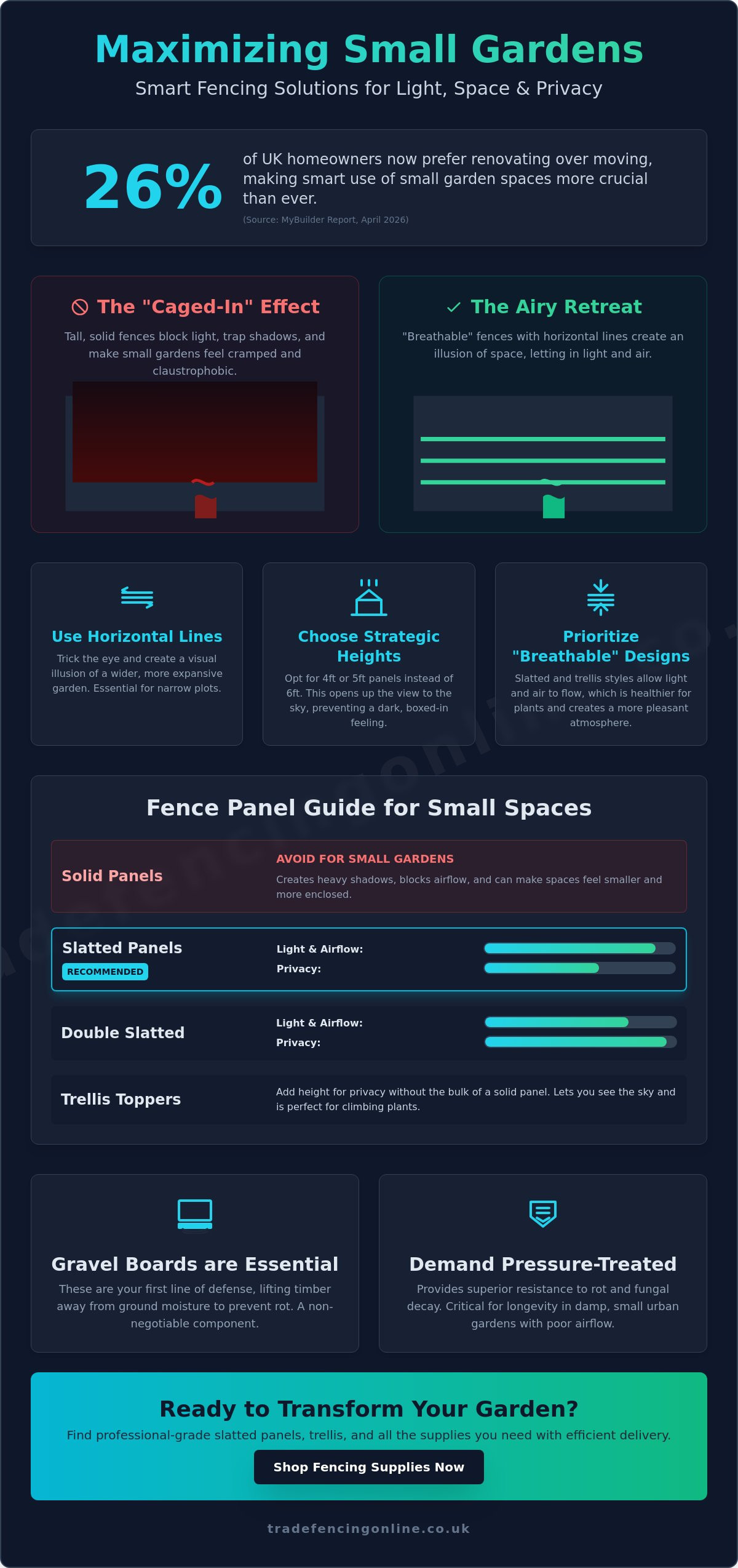
Small garden fencing isn't just about marking a property line. It's a functional tool used to manage light and security in tight quarters. In compact areas, many homeowners instinctively choose tall, solid panels to maximise privacy. This often results in a "caging effect." Solid, dark boundaries trap shadows and make a small plot feel like a storage crate rather than an outdoor retreat. Effective small garden fencing ideas focus on "breathable" structures. These designs provide a clear boundary while maintaining an airy, open feel.
The orientation of your fence panels also changes how you perceive space. Horizontal lines are generally superior to vertical lines for narrow plots. Horizontal slats lead the eye along the perimeter of the garden, creating a visual illusion of extra width. Vertical lines tend to draw the eye up and down, which can highlight the height of the walls and make a small space feel even more enclosed. Choosing trade-quality materials like pressure-treated timber panels and durable gravel boards is essential. In narrow gardens, access for repairs is difficult. You want a professional-grade installation that won't require frequent, awkward replacements in a cramped environment. Understanding different types of fencing helps you select a style that balances these practical needs with your aesthetic goals.
The Balance Between Privacy and Light
Solid fence panels cast long, dense shadows that can dominate a small garden. These shadows often kill off lawns and prevent sun-loving plants from growing. You don't always need a 6ft solid wall to feel secure. "Sight-shielding" can be achieved through semi-solid designs that break up the line of sight without blocking every ray of sun. There's a psychological benefit to this approach. Being able to see glimpses of light or movement through a boundary reduces the feeling of claustrophobia. It makes the garden feel like part of a larger environment rather than a disconnected box.
Maximising Your Garden's Visual Footprint
The height of your boundary dictates the visual volume of your garden. In many tiny courtyards, 4ft or 5ft panels topped with a trellis work better than a standard 6ft panel. This lower height opens up the view of the sky and allows more natural light to reach the ground. Your fencing should act as a neutral backdrop rather than a distracting focal point. Using muted colours or natural wood finishes allows the fence to recede into the background, making your plants and furniture the stars of the show. For a detailed look at how to secure your property effectively, view our guide on fencing as a total solution for UK homes.
Slatted and Trellis Panels: The Best Options for Space
Standard solid panels are often too heavy for compact plots. Slatted panels are a superior alternative. The narrow gaps between the timber slats allow both light and wind to pass through. This reduces wind loading on your fence posts and prevents the garden from feeling like a dark, airless box. This is particularly important for small garden fencing ideas where every centimetre of light counts. For front gardens or internal zoning, picket fencing remains the king of open-plan design. It provides a clear boundary without obstructing the street view or blocking low-level sunlight. If you need total privacy without sacrificing airflow, double slatted panels are the best choice. These use offset slats on both sides to block the line of sight while still letting air circulate freely through the boundary.
The Rise of Horizontal Slatted Fencing
Horizontal slatted fencing is a modern staple for contemporary gardens. These panels lead the eye along the boundary, creating a visual illusion of extra length. It's a simple trick that makes a short garden feel much deeper than it is. Always opt for pressure-treated timber for these installations. Small urban gardens in Essex and London often have damp microclimates with restricted airflow. Treated wood resists rot and fungal decay far better than basic dip-treated options. Our guide to double slatted fence panels explains how these systems provide high-level privacy from both sides by using staggered slats to obstruct the view.
Using Trellis to Soften Boundaries
Adding a trellis topper is a professional way to increase height without the bulk of a full-height solid panel. These toppers allow you to see the sky while maintaining privacy from neighbouring windows. They also act as the perfect framework for "living walls." Climbing plants like clematis or jasmine can grow through the lattice, turning a hard boundary into a soft, green feature. Square lattice often provides a cleaner, more contemporary look in modern small gardens compared to traditional diamond patterns. To ensure your fence lasts, always combine your panels and trellis with concrete or timber gravel boards. Keeping timber off the damp ground is one of the fundamental principles of garden design that ensures your investment stays durable and looks professional for years.
If you're ready to upgrade your boundaries, check our latest stock of high-quality fence panels for fast local delivery.
Visual Tricks: Using Height and Colour to Expand Space
Strategic design choices can make a compact plot feel significantly larger. Many homeowners default to 6ft panels for privacy. In tiny courtyards, this often creates a claustrophobic atmosphere. Using 4ft or 5ft panels is one of the most effective small garden fencing ideas for opening up a space. Lower boundaries allow more sky to be visible, which immediately reduces the "boxed-in" sensation. Consistency is also vital. Using the same fencing style across all three boundaries creates a seamless look. This prevents the garden from feeling fragmented and small.
The "Receding Colour" theory is a powerful tool for visual expansion. Some sources suggest painting fences white to reflect light, but this is often impractical in urban Essex and East London. White surfaces show dirt, soot, and algae quickly; they require constant maintenance to look presentable. Instead, choose dark greys, deep olives, or charcoal tones. These dark, muted colours cause the boundary to recede visually. The fence "disappears" into the shadows of the plants, making the garden feel like it extends further than it actually does. For a professional finish, ensure your panels are supported by high-quality fence posts and gravel boards to maintain a clean, level line.
Choosing the Right Height for Your Plot
Always follow UK planning regulations when planning your boundary. In England, rear and side fences must not exceed 2 metres in height without planning permission. If your fence is next to a highway used by vehicles, the limit is 1 metre. For internal garden divisions, 3ft picket panels are ideal. They define specific zones, such as a seating area or a vegetable patch, without blocking the view. If your garden is on a slope, use the "step-down" technique. This involves keeping each panel level while dropping the height of the next panel to follow the terrain. It creates a structured, professional appearance rather than an awkward, slanted line.
Colour Palettes for Compact Spaces
Choosing between natural wood and painted finishes depends on your maintenance goals. Factory-treated timber generally lasts longer and requires less upkeep than DIY paint jobs. For a north-facing small garden that receives little direct sun, light-coloured wood can help brighten the area. Pressure-treated timber in "green" or "brown" finishes provides a trade-standard look that resists rot. Buying pre-treated timber is the most efficient choice for busy homeowners. It ensures the preservative reaches deep into the wood fibres, providing a durable foundation that doesn't need immediate painting or staining.
Practical Essentials: Posts and Gravel Boards for Small Plots
In the narrow terraced gardens common across Essex and East London, the foundation of your fence is just as critical as the panels. When implementing small garden fencing ideas, you must account for tight boundaries and limited access. Choosing the right support system ensures your fence stays level and secure without encroaching on your usable patio or lawn space. For these compact plots, a "slimline" approach is often best. Using recessed concrete posts allows the panel to sit flush within the post, saving valuable inches compared to traditional timber configurations.
Securing fencing in tight corners or against existing brick walls requires precision. In shared boundaries, you often have to work around established structures or neighbouring trees. Using high-quality ironmongery and the correct postmix ensures a rigid finish even when you can't dig a standard-sized hole. If you're dealing with a particularly restricted space, consider using wall-mounted brackets to fix panels directly to masonry where a post won't fit. This maintains the boundary line without cluttering the ground level and keeps the visual lines of the garden clean.
Concrete Posts in Small Gardens
Deciding between wood and concrete is a major part of any project. Our guide to fence posts highlights that concrete is the industry standard for durability in damp urban soil. However, concrete can look "heavy" in a small garden. You can soften this look by painting the posts with masonry paint to match your timber panels. This creates a unified, modern aesthetic that feels less industrial. For a fast installation in narrow borders, use professional postmix and cement to set your posts quickly. This reduces the time spent working in cramped conditions and provides an immediate, solid foundation.
The Role of Gravel Boards
Gravel boards are a non-negotiable component for any professional installation. These boards act as a barrier between the ground and the bottom of your fence panel. By lifting the timber off the damp soil, gravel boards extend the life of a panel by up to 5 years. You can choose between wooden or concrete versions depending on your style. Concrete boards are incredibly durable and won't rot, while wooden boards offer a more natural look for traditional plots. Check our list of essential fencing supplies to ensure you have the right boards for your specific plot.
Ready to start your project? Shop our full range of professional fencing supplies for fast local delivery today.
Quality Fencing Supplies for Essex and East London Gardens
Romford Fencing Ltd is the established specialist for trade and public customers across Essex. We provide heavy-duty products designed to withstand the UK climate. Unlike mass-produced panels from big-box retailers, our "Trade Quality" timber is thicker and more resilient. This is vital when implementing small garden fencing ideas in high-traffic urban areas. You need boundaries that stay secure and look professional for years without sagging or warping. Our reputation is built on providing substance over style; we let our track record of reliable service speak for itself.
Navigating narrow streets in East London and Essex requires local logistical expertise. We offer fast delivery tailored to these specific environments. We ensure your fence panels, posts, and gravel boards arrive on time and are placed exactly where you need them. Our team understands the constraints of terraced housing and shared access routes. This local knowledge removes the friction often associated with national delivery services. We focus on getting your materials to the site with minimal fuss so you can begin your installation without delay.
Serving Romford, Essex, and Beyond
We are the leading fencing suppliers near me for customers in Romford and the surrounding region. Our trade counter provides expert advice on everything from postmix quantities to ironmongery selection. If you have questions about which gate or trellis best suits your plot, our staff offer pragmatic, straightforward solutions. We provide specific logistical incentives for local Essex and East London postcodes, ensuring you get the best value on both products and transport.
Next Steps for Your Small Garden Project
Start by measuring your boundary accurately to determine how many panels you need. Don't forget to include your fence posts and gravel boards in the final count. It's more efficient to order your ironmongery, fixings, and postmix in a single transaction to avoid mid-project delays. Our small garden fencing ideas are backed by a full inventory of professional-grade stock ready for immediate dispatch. We provide a total solution for your boundary needs, from initial supply to professional fencing installation.
BROWSE OUR FULL RANGE OF FENCE PANELS ONLINE.
Upgrade Your Garden Boundary Today
We've covered how horizontal slats and trellis toppers prevent a cramped feel while maintaining privacy. You now understand how receding colours and strategic heights can visually double your outdoor space. These small garden fencing ideas only work when backed by trade-quality materials that stand the test of time. Investing in professional-grade panels and gravel boards prevents the need for frequent, difficult repairs in narrow plots where access is limited.
Romford Fencing Ltd provides high-quality supplies at competitive prices. We specialize in fast local delivery across Romford, Essex, and East London. Our reputation is built on dependable service and durable products that outlast standard retail options. Whether you need a single gate or a full perimeter of slatted panels, we have the stock ready for your project. Our team is committed to helping you find the most efficient solution for your specific property needs.
For those who also manage commercial presentations and events, Coker Exhibition Systems Ltd (CokerExpo) provides specialist exhibition displays and professional flooring solutions to ensure your brand presentation is just as impressive as your new garden.
SHOP OUR FULL RANGE OF FENCE PANELS FOR FAST ESSEX DELIVERY
Start your project today and turn your compact garden into a bright, spacious, and secure retreat.
Frequently Asked Questions
What is the best type of fence for a very small garden?
Slatted panels are the most effective choice for compact spaces. These structures balance the need for a clear boundary with the requirement for natural light. Unlike solid panels that create heavy shadows, slatted designs allow sunlight to filter through the gaps. This prevents the "caging effect" and keeps the garden feeling airy. It is one of the most popular small garden fencing ideas for modern urban plots.
How can I make my small garden feel more private without blocking light?
Install trellis toppers or double slatted panels to achieve privacy without losing brightness. Trellis adds height to a boundary while remaining visually light. If you need total seclusion, double slatted panels use staggered timber lengths to block the line of sight from both sides. This setup maintains essential airflow and light transmission, ensuring your garden remains private but doesn't feel like a dark box.
Do horizontal fence panels make a garden look bigger?
Horizontal lines lead the eye along the perimeter, which creates a visual illusion of extra width and length. This technique is similar to using horizontal stripes in interior design to expand a room. By drawing the gaze across the garden rather than upwards, horizontal panels make the boundaries feel further away. This simple design choice is a proven way to maximise the perceived footprint of a small plot.
Can I install a 6ft fence in a small garden without planning permission?
In England, you don't need planning permission for a rear or side fence if it stays under 2 metres in height. Since 6ft is approximately 1.83 metres, it usually falls within these regulations. However, fences next to a highway used by vehicles must not exceed 1 metre. Special rules apply if your property is a listed building or located in a conservation area, so check with your local authority before starting.
Are slatted fence panels good for privacy?
Standard slatted panels have small gaps that allow some visibility, but double slatted versions offer complete privacy. These panels use offset slats on the front and back to obstruct the view entirely. You get the aesthetic benefit of a modern, slatted look without the worry of neighbours seeing in. They're an excellent investment for terraced housing where privacy is often a primary concern for homeowners.
Should I choose wood or concrete posts for a small garden?
Concrete posts offer superior durability in damp urban environments and won't rot over time. In a small garden, recessed concrete posts are a smart choice because they allow the panel to sit flush, saving valuable inches of space. Timber posts provide a more natural, unified look but require more maintenance. If you choose concrete, you can paint it to match your panels to reduce its visual weight.
What colour should I paint my fence to make the garden look larger?
Dark, muted tones like anthracite grey or deep olive are best for making boundaries "disappear." These receding colours cause the fence to blend into the shadows of your plants, which tricks the eye into seeing more depth. Avoid painting your fence white in urban areas like Essex or London. White surfaces show dirt and algae quickly, making the garden feel cluttered and high-maintenance rather than spacious.
How do I stop my small garden from feeling 'boxed in'?
Avoid using 6ft solid panels on every side and opt for 4ft or 5ft panels topped with trellis instead. This lower solid height opens up the view of the sky and lets more light reach the ground. Using consistent small garden fencing ideas across all boundaries also helps. A unified style prevents the space from looking fragmented, which makes the entire garden feel like one large, cohesive room.