


What if everything you've been told about owning the fence on the left side of your garden is completely wrong? It's a common myth that often leads to heated disputes, and according to 2023 property industry reports, boundary disagreements remain a leading cause of legal friction between UK neighbours. You want to replace your old panels, but the fear of accidentally breaking a rule or receiving a council fine for exceeding height limits is a genuine concern. You need facts, not local hearsay, before you buy your gravelboards and posts.
This guide helps you master garden boundary rules uk so you can complete your project with total confidence. We'll debunk the T-mark myths and explain exactly how the 2-metre height restriction applies to your property. You'll learn how to check your deeds and select the right height panels to stay compliant. We'll provide a clear overview of ownership responsibilities and help you choose the correct materials to ensure your boundary is secure, legal, and built to last.
Key Takeaways
- Debunk common ownership myths and learn how to use your property’s Title Deeds to identify exactly which fence falls under your responsibility.
- Master the standard 2-metre height limit and specific garden boundary rules uk regarding front garden fences and highway restrictions.
- Understand your legal rights for fence maintenance, including the rules on painting your side or hanging heavy items on a neighbour's boundary.
- Discover planning permission loopholes for trellis screens and how to use permitted development rights to increase your garden's privacy legally.
- Choose the correct professional supplies, like 6ft panels and concrete gravel boards, to build a durable boundary that meets all UK standards.
Establishing Ownership: Which Garden Fence is Your Responsibility?
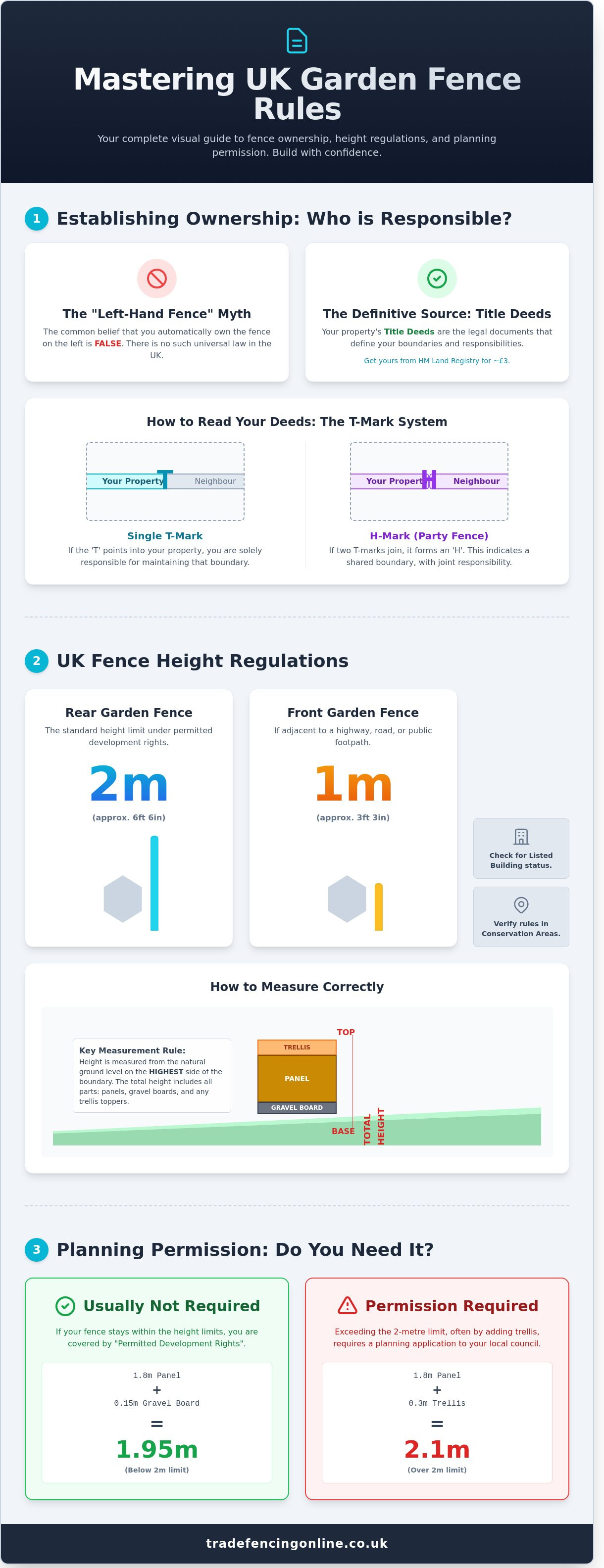
Understanding garden boundary rules uk starts with your property deeds. Many homeowners believe the fence on the left belongs to them by default. This is a myth. No universal law dictates fence ownership based on its position. Ownership is determined by the legal boundaries set when the land was first divided and sold.
You must check your Title Deeds to identify your responsibilities. These documents usually include a scaled plan of your property. Look for symbols known as T-marks. A T-mark pointing into your land indicates the boundary feature is your responsibility to maintain. If you see two T-marks joined together, forming an H-mark, the boundary is shared. This is known as a party wall or party fence. When dealing with shared structures, you should refer to the Party Wall etc. Act 1996. This legislation governs how you and your neighbour manage shared boundaries and prevents unnecessary disputes.
The Truth About T-Marks and Deeds
T-marks are standard in modern Romford developments. They provide clear evidence of who owns what. Older Essex properties often lack these markings on original plans. If your deeds are silent, ownership often falls to the person who has historically repaired the fence. Don't guess. If you've lost your original deeds, contact HM Land Registry. You can download a copy of your title register and plan for a small fee, usually around £3 per document.
The "Good Side" vs the "Bad Side" Debate
There's a common belief that the smooth side of a fence must face your neighbour. This isn't a legal requirement. You can technically face the rails and posts whichever way you prefer. Most homeowners choose to face the good side outward as a social courtesy. It provides a cleaner look for the street or the neighbour's view. If you want a solution that satisfies both parties, consider installing double slatted fence panels. These panels look identical from both sides. They offer a high-quality finish and excellent privacy without the "good side" argument. It's a pragmatic choice for any modern garden.
UK Fence Height Regulations: The 2-Metre Rule and Planning Permission
Most residential properties in the UK fall under permitted development rights. This means you don't usually need planning permission for a rear garden fence if it stays below a certain height. The 2-metre rule is the threshold for most UK residential planning exemptions. If you plan to install a structure taller than 2 metres (approximately 6ft 6in), you must submit a planning application to your local council before work begins. These garden boundary rules uk ensure that tall structures don't unfairly block light or privacy for neighbours.
Specific restrictions apply to listed buildings and conservation areas, which are common across East London. If your home is listed, you'll likely need listed building consent for any new boundary. In conservation areas, Article 4 directions might be in place to restrict permitted development rights. Always check with your local planning department in boroughs like Havering or Barking and Dagenham to confirm local bylaws. You should also review the official government guidance on the Party Wall Act if your new fence involves foundations near a neighbour's building.
Measuring Your Fence Height Correcty
Height is measured from the natural ground level on the highest side of the boundary. If your garden is on a slope, you cannot measure from the lower ground to gain extra height. The total height calculation includes every part of the structure. Concrete or timber gravel boards and decorative trellis toppers are part of this measurement. If you put a 300mm trellis on top of a 1.8m panel, your total height is 2.1m. This exceeds the limit and requires permission.
Front Gardens and Visibility Splays
Rules for front gardens are more restrictive than rear boundaries. If a fence is adjacent to a highway, including footpaths and roads, the maximum height allowed without planning permission is 1 metre (3ft 3in). Visibility for drivers makes these rules stricter in busy Romford streets. Clear sightlines are vital for safety at junctions and driveway entrances. Local councils can issue enforcement notices to remove fences that create "blind spots" for motorists.
Hedges are treated differently than solid timber structures. There's no set legal height for a hedge under garden boundary rules uk, but they must not obstruct the public highway. If a hedge becomes a nuisance or blocks significant light, the High Hedges Act 2003 allows councils to intervene. For a permanent and compliant solution, browse our range of quality fencing to find panels that fit within legal height limits while maintaining your privacy.
Maintenance and Rights: What You Can and Cannot Do
Understanding garden boundary rules uk is vital before you pick up a paintbrush or a hammer. Ownership dictates your level of control. If your neighbour owns the fence, you have no legal right to alter it. This includes the side facing your garden. You cannot paint, stain, or even attach a trellis without their explicit consent. Under the Criminal Damage Act 1971, applying any treatment to property that isn't yours is technically a crime. Always talk to your neighbour first to avoid unnecessary conflict.
Boundary maintenance often becomes a flashpoint during bad weather. When a storm destroys a fence, the legal responsibility for repair sits with the owner identified on the property deeds. If the fence is shared, often marked with a 'T' mark on both sides of the boundary line in the deeds, both parties share the cost. Don't assume your neighbour must fix a dilapidated fence immediately; there is no general law requiring a homeowner to fence their land or maintain it to a specific aesthetic standard unless it's a safety hazard.
Altering a Neighbour’s Property
Painting a neighbour’s fence without permission is a common mistake. Even if you use a high-quality wood preserver, it's an alteration of their property. Secure a written boundary agreement before starting any work. This document acts as a record of consent and helps you avoid future legal issues. If a neighbour refuses to repair a dangerous structure, you can't take matters into your own hands. Instead, consult the official advice on how to resolve neighbour disputes to find a mediated solution. This keeps your relationship intact and follows the correct legal path.
Leaning and Hanging: Protecting the Structure
Don't lean heavy items against a boundary fence. Piling soil for a raised bed or stacking heavy sleepers against a neighbour's panel causes the timber to rot and the posts to lean. Traditional lap panels are particularly vulnerable to this pressure. They're designed for privacy, not as retaining walls. If you want to create a garden feature, install your own independent fence posts inside your boundary line. This ensures your garden projects don't compromise the integrity of the existing fence.
Weight management is key to fence longevity. Heavy-duty closeboard panels handle wind and minor attachments better than thin slats, but they still have limits. Hanging heavy wet planters can pull the nails from the rails. If the fence belongs to your neighbour, these actions are trespass. Always keep your features self-supporting to stay within garden boundary rules uk and prevent structural failure.
Dealing with nature requires a pragmatic approach. You're legally allowed to trim overhanging branches back to the boundary line, but you must offer the clippings back to the owner. Don't just toss them over the fence. For encroaching roots, you can cut them at the boundary, provided it doesn't kill the tree. If the tree is protected by a Tree Preservation Order (TPO), you'll need council permission before touching a single twig.
Planning Permission Loopholes and Trellis Rules
Understanding the legal height limits is vital for any homeowner. Under standard garden boundary rules uk, you can usually install a fence up to 2 metres high without needing planning permission. This falls under "permitted development" rights. If your property borders a public highway or footpath, this limit drops to 1 metre. It's a common mistake to assume that "temporary" structures or additions don't count towards these measurements. Local planning authorities look at the total height from the ground up, regardless of whether the structure is fixed or removable.
The Trellis Topper Strategy
Many homeowners think adding a trellis to the top of a 2-metre fence is a clever way to bypass the law. It isn't. Legally, the trellis is part of the fence structure. If your solid panel is 1.8 metres and you add a 0.6-metre trellis topper, your total height is 2.4 metres. This requires planning permission. Trellis toppers are the most popular way to add decorative height while remaining friendly with neighbours. They provide "soft" privacy by obscuring views without creating a harsh, solid wall. This often prevents formal complaints, even if the total height slightly exceeds 2 metres, as they don't block as much light as a solid board.
When Planning Permission is Guaranteed
You must apply for planning permission from your local council if your project meets any of the following criteria:
- The fence, wall, or gate exceeds 2 metres in height from ground level.
- The structure is over 1 metre tall and stands next to a highway used by vehicles.
- Your property is a listed building or sits within the curtilage of one.
- The boundary forms a link with a listed building's wall.
Check with your local planning office if you're unsure, especially in areas like Essex where conservation rules vary between boroughs. Romford and surrounding councils are particularly strict about highway visibility and sightlines for drivers. If you're planning major works, a quick phone call can save you the cost of tearing down a new installation. If you need more height without the paperwork, consider planting fast-growing shrubs or pleached trees behind the fence line. These are often classed as landscaping rather than "structures" and aren't subject to the same rigid 2-metre cap under garden boundary rules uk.
Don't risk a fine or an enforcement notice. Stick to the 2-metre rule or get your application in early to avoid disputes. For high-quality materials that meet standard regulations, choose a supplier that knows the UK market inside out.
Building a Compliant Boundary with Quality Fencing Supplies
Understanding garden boundary rules uk is only half the job. You need the right materials to build a fence that stays within the law and stands up to the British weather. Most homeowners choose 6ft panels because they provide maximum privacy without exceeding the standard 2-metre height limit for rear gardens. Staying at or below 6ft (1.83m) usually removes the need for planning permission, making it the safest choice for a hassle-free installation.
Concrete gravel boards are essential for ground-level compliance and longevity. These boards sit at the base of your fence, acting as a barrier between the timber panel and the damp earth. They prevent moisture from soaking into the wood, which stops premature rot. Using a gravel board also allows you to reach the desired height precisely while keeping the main panel protected. It is a simple addition that adds years to the life of your boundary.
For a secure and legal installation, you must use the correct ironmongery. Cheap fixings rust quickly and can cause panels to sag or fail during high winds. We recommend using galvanised nails, heavy-duty brackets, and high-quality bolts. These components ensure your fence remains a permanent, stable fixture that won't lean into a neighbour's property or become a safety hazard.
Standard Sizes for UK Gardens
6ft (1.83m) panels are the standard for rear boundaries across the UK. To achieve this height professionally, many installers combine a 5ft 6in panel with a 6-inch concrete gravel board. This combination hits the 6ft mark exactly while keeping the timber off the wet ground. For front gardens, remember that rules are stricter; fences often cannot exceed 1 metre if they are next to a highway. Always check your specific requirements before ordering your materials.
Why Choose Romford Fencing Ltd?
We provide trade-quality materials directly to the public at unmatched prices. As a trusted supplier with 5-star customer reviews, we focus on reliability and value. We offer free local delivery options across Romford, Basildon, and East London, ensuring your supplies arrive when you need them. Our team understands the local market and provides the professional-grade gear required for a long-lasting boundary. We don't do fuss; we just deliver quality goods that get the job done.
Ready to start your project? You can order a complete fencing kit from Trade Fencing Online today. Our kits include everything you need for a legal and sturdy installation, from posts and panels to gravel boards and fixings. Your one-stop-shop for everything Fencing is just a click away. FOR QUALITY FENCING, CALL ROMFORD FENCING LTD TODAY OR EMAIL OUR TEAM.
Secure Your Property With Compliant Fencing
Understanding garden boundary rules uk is the first step toward a secure and legal property line. Always verify ownership via your title deeds and remember that fences over 2 metres typically require planning permission under the 2015 General Permitted Development Order. Selecting the right materials ensures your boundary stands the test of time while remaining fully compliant with local regulations. Don't risk disputes or fines by guessing the law. Follow these straightforward guidelines for a hassle-free installation.
Trade Fencing Online is the home of quality garden fencing. As a trusted Romford supplier with 5-star reviews, we provide trade-quality materials at unmatched prices. We offer free local delivery options to help you get started on your project immediately. Our stock is designed for durability and ease of installation so you get professional results without the fuss.
Shop our range of UK-compliant fence panels for fast local delivery
Get your garden project moving today.
Frequently Asked Questions
Do I own the fence on the left or right in the UK?
There is no universal legal rule that says you own the fence on the left or right of your property. You must check your property's Title Deeds or the Land Registry transfer document to identify the legal owner. Look for a 'T' mark on the boundary line; the stem of the 'T' points towards the owner responsible for that boundary. If the deeds are silent, the boundary is often a shared responsibility known as a party fence wall.
Can I put a 7ft fence in my back garden?
You cannot install a 7ft fence without first obtaining planning permission from your local authority. UK planning regulations restrict rear garden fences to a maximum height of 2 metres, which is approximately 6.56 feet. If you exceed this height without consent, you risk receiving an enforcement notice. These notices require you to lower the structure to the legal limit at your own expense.
Is it illegal to have a fence higher than 2 metres?
It isn't a criminal offence, but it's a breach of planning control to exceed 2 metres without formal approval. Under the Town and Country Planning Act 1990, any fence over this limit requires permission from the council. For fences adjacent to a highway used by vehicles, the maximum height allowed without planning permission is lower at 1 metre. Always verify local restrictions before starting your project.
Can I attach things to my neighbour’s fence?
You must not attach anything to your neighbour's fence without their express permission. This includes hanging baskets, trellis, or outdoor lights. Doing so is technically considered criminal damage or trespass because the fence is their private property. If you want to change the look of your garden, it's better to install your own independent fence panels just inside your boundary line.
Does a trellis on top of a fence count towards the 2-metre height limit?
Yes, a trellis is legally part of the fence and counts towards the total height calculation. If your fence panel is 1.8 metres tall and you add a 0.4-metre trellis, the total height becomes 2.2 metres. This exceeds the limit set by garden boundary rules uk and requires planning permission. Don't assume decorative tops are exempt; the council treats the entire structure as one unit.
Who is responsible for a fence that falls into my garden?
The person identified as the owner in the Title Deeds is responsible for the fence and its maintenance. Check your Land Registry documents for 'T' marks to confirm who owns the boundary. If the fence is shared, both neighbours share the repair costs equally. If a neighbour's fence falls into your garden, they're liable for its removal and repair since it remains their property and responsibility.
Can I force my neighbour to repair their fence?
You generally can't force a neighbour to repair a dilapidated fence unless their Title Deeds contain a specific positive covenant. Most property owners have no legal obligation to keep a boundary fence in a good state of repair. If the fence becomes a safety hazard to the public, you can contact the local council. Otherwise, the most efficient solution is to build your own fence on your own land.
Do I need planning permission to replace an existing 6ft fence?
You don't need planning permission to replace an existing 6ft fence if the new one stays under the 2-metre height limit. Replacing a fence like-for-like is considered "permitted development" in most cases. If you intend to increase the height beyond 2 metres, or 1 metre next to a road, you'll need to apply for consent. Following garden boundary rules uk ensures you avoid disputes with the local planning office during your renovation.