


A single centimetre over the legal 1-metre height limit for front boundaries is often all it takes to trigger a council enforcement notice. It's a common frustration for UK homeowners who want to improve their property's look without the risk of fines or forced removals. You likely want a boundary that provides security and style, yet the fear of choosing the wrong material or breaching the Town and Country Planning Order 2015 stops many projects before they start. Nobody wants to invest in a new fence only to see it rot or fail within a few seasons because of poor quality timber.
This guide delivers the best front garden fencing ideas uk residents are using in 2026 to achieve high-end kerb appeal and maximum durability. We'll show you how to choose styles that match your home's architectural period while selecting professional-grade, rot-resistant materials that stand up to the British weather. From traditional closeboard to modern decorative panels, you'll get a clear roadmap to a legal, high-quality fence that's built to last. We'll also explain how to source trusted materials locally so you can start your project with total confidence and zero fuss.
Key Takeaways
- Learn how professional boundary demarcation boosts your home's kerb appeal while providing essential security for children and pets.
- Discover the best front garden fencing ideas uk, ranging from classic Victorian picket styles to contemporary horizontal slatted panels.
- Identify the most durable materials for your project, including why pressure-treated timber is essential for UK weather conditions.
- Ensure your project complies with UK planning laws by understanding height restrictions and identifying boundary ownership via 'T-marks'.
- Source trade-quality fencing supplies directly to achieve a professional finish with maximum durability and cost-efficiency.
Transforming Kerb Appeal: Why Front Garden Fencing Matters in the UK
Your front garden is the handshake of your home. It creates the first impression for every visitor and potential buyer. This isn't just about aesthetics; it's a strategic investment. Industry data suggests that high-quality kerb appeal can increase a UK property's market value by as much as 10%. A professional fence installation provides clear boundary demarcation, which is essential for defining ownership and preventing disputes. Beyond value, it offers a physical safety barrier for children and pets, keeping them away from the road while preventing stray animals from entering your space.
When you explore front garden fencing ideas uk homeowners often look for a balance between security and style. A well-chosen fence doesn't just block things out; it frames your property. It signals that the home is well-maintained and secure. This proactive approach to property management is a key factor in long-term value retention and neighbourhood security.
The 1-Metre Height Rule and Your Front Boundary
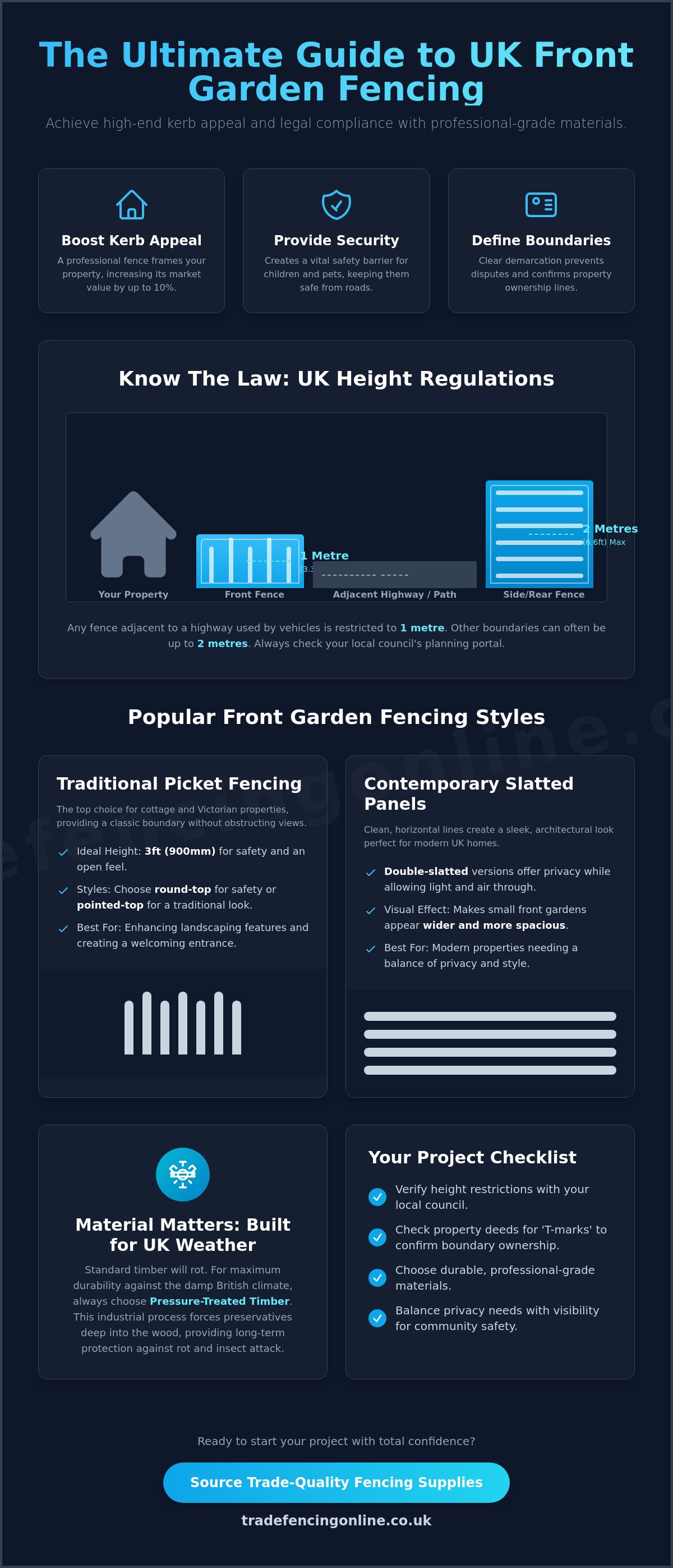
Under 2026 UK planning regulations, any fence or boundary wall adjacent to a highway used by vehicles is restricted to a maximum height of 1 metre unless you obtain specific planning permission. It's vital to understand the distinction between different boundary types. If your fence sits on a private drive that doesn't border a public path or road, you might be able to install taller panels up to 2 metres. However, most front gardens meet a public pavement, triggering the 1-metre limit. You should always consult UK fencing laws and check your local council's planning portal before ordering your panels to avoid costly enforcement notices. Verifying your property deeds will also confirm exactly where your ownership line starts and ends.
Balancing Privacy and Visibility
Total privacy screens aren't always the best choice for the front of a house. Solid, high panels can create a "fortress" look that feels unwelcoming and can actually aid intruders by providing a place to hide. Semi-solid panels, such as slatted or "hit and miss" styles, are often a superior choice for front gardens. These designs allow light to pass through and maintain a visual link with the street, which contributes to a safer community environment.
A well-maintained low-level fence improves street security through natural surveillance. It defines your space without cutting you off from the neighbourhood. Use low fencing to frame your landscaping features rather than hiding them. This keeps the entrance feeling open and bright while still providing a clear psychological and physical barrier. It's a pragmatic way to ensure your home looks inviting while remaining secure.
Popular Front Garden Fencing Styles for UK Homes
Choosing the right front garden fencing ideas uk involves balancing aesthetic appeal with functional security. The style you select defines your property's boundary and sets the tone for the entire building. UK homeowners typically choose between traditional timber designs and modern, streamlined panels to achieve this balance.Traditional Picket Fencing for Classic Kerb Appeal
Picket fencing remains the top choice for cottage-style and Victorian properties across the UK. These panels provide a clear boundary without blocking the view of your landscaping. Most homeowners opt for 3ft (900mm) picket panels. This height is the 'sweet spot' because it keeps pets and children safe while maintaining an open, welcoming feel. You can choose between round-top and pointed-top pales. Round-top pales offer a softer look and are often preferred for safety in high-traffic areas. Pointed-top pales provide a sharper, more traditional aesthetic. For a professional finish, link these styles to high-quality fencing components to ensure your front garden looks cohesive and remains durable against the British weather.Contemporary Slatted Panels for Modern UK Homes
Modern UK architecture often benefits from the clean lines of slatted fencing. These panels use horizontal timber slats to create a sleek, architectural look. Double-slatted versions are particularly effective. They offer high levels of privacy by staggering the slats, yet they still allow air and light to pass through. This prevents the fence from feeling like a solid, imposing wall. Horizontal lines work well in small front gardens. They draw the eye along the boundary, making compact spaces appear wider than they are. To complete the look, match your slatted panels with modern driveway gates and high-quality ironmongery. This creates a unified appearance that significantly boosts property value.Using Trellis and Toppers to Soften Boundaries
Trellis panels are versatile tools for front garden design. You can use a full-height trellis to support climbing plants like Clematis or Star Jasmine, which thrive in the UK climate. Alternatively, adding a 1ft trellis topper to a low brick wall or a solid fence panel adds elegance without sacrificing security. It's vital to stay within legal limits when adding height. Planning permission rules for fences generally state that front garden boundaries shouldn't exceed 1 metre in height if they are adjacent to a highway. Using lattice work or trellis allows you to add decorative flair and support greenery while staying compliant with these local regulations.Closeboard and Lap Panels for Maximum Durability
While often reserved for rear gardens, closeboard and lap panels are becoming more common in front gardens where privacy is the priority. Closeboard fencing is constructed from overlapping vertical feather-edge boards, making it incredibly sturdy. Lap panels offer a more cost-effective alternative. Both styles provide a solid barrier against wind and noise, which is ideal for homes on busy roads. If you need a reliable boundary that lasts for years, consider these heavy-duty options. You can find a wide range of durable solutions at Trade Fencing OnlineChoosing the Right Materials: Timber vs. Concrete
Choosing the right materials is the most critical decision for your project. It determines how often you'll need to pick up a paintbrush and how soon you'll need to replace the entire run. High-quality trade-grade materials ensure panels don't warp or fail after a single wet UK winter. When exploring front garden fencing ideas uk, you must balance initial costs against long-term durability and kerb appeal. Pressure-treated timber is essential for any component in contact with the ground to prevent premature failure.
The Case for Pressure-Treated Timber Panels
Tanalised or Jakcure treatment involves placing timber in a vacuum chamber to force chemical preservatives deep into the wood grain, providing a projected lifespan of up to 25 years without the need for annual retreating. While dip-treated panels cost less at the point of purchase, they require frequent painting and often fail within 5 to 7 years. You can identify high-quality fence panels by checking the thickness of the slats and the sturdiness of the rebated frame. Professional-grade panels use galvanized or stainless steel fixings. This prevents unsightly rust streaks from ruining your garden's appearance as the metal reacts with the rain.
Trade-grade materials are built to a higher specification than standard DIY store stock. They feature more vertical supports and thicker timber sections. This prevents the bowing effect often seen in cheaper lap panels after a period of heavy rain and sun. Investing in quality materials now prevents the cost and hassle of emergency repairs in the near future.
Concrete vs. Wooden Posts for Front Gardens
The choice of fence posts defines the strength of your front boundary. Concrete is the pragmatic choice for longevity, especially in the heavy clay soils found across Essex and London. Clay retains moisture for long periods, which accelerates rot in timber posts at the ground level. Concrete posts and gravel boards offer the ultimate protection against damp. They ensure the wooden panel never touches the wet earth, significantly extending the life of the timber.
Gravel boards are a vital addition for any front garden fencing ideas uk. These 150mm or 300mm high boards sit at the base of the fence to prevent soil, mulch, and rain splash from soaking into the main panel. Using concrete gravel boards with timber panels is the industry standard for a durable boundary. This combination provides the natural aesthetic of wood with the structural integrity of stone.
If you prefer the look of a full timber run, use 100mm x 100mm pressure-treated wooden posts. To achieve a high-end finish, add decorative wooden post caps. These aren't just for show; they protect the exposed end grain from water ingress. A well-installed timber post in a well-drained hole can last 15 years, but concrete will easily double that lifespan with zero maintenance.
Planning Your Project: Heights, Boundaries, and Legal Requirements
Accurate measurement is the foundation of a cost-effective fencing project. Guessing your requirements leads to expensive waste or mid-job delays. Before you order any materials, check your property deeds for the "T-mark" symbol. This mark is a legal indicator on your Title Plan. If the "T" sits on your side of the boundary line, you generally own the fence and are responsible for its upkeep. Confirming this prevents disputes with neighbours and ensures you're investing in your own property.
Calculating your materials requires precision beyond just counting panels. For a standard run, you need one more post than the total number of panels. Most professional installs require two 20kg bags of Postmix per post to ensure stability in UK soil conditions. If you're looking for front garden fencing ideas uk homeowners trust for longevity, don't skip the gravel boards. These protect the base of your panels from ground moisture, extending the life of your timber by several years.
Measuring Your Front Boundary Correctly
Front gardens rarely sit on perfectly flat ground. If your boundary slopes, you'll need to "step" your panels. Measure the total length of the run and divide it by the width of your chosen panel, typically 1.83m for standard UK sizes. You must include the width of your posts in this calculation. Forgetting to account for 100mm or 75mm posts over a 15-metre run will leave you short of space for your final panel. Use this fencing supplies checklist to verify you have every bracket, screw, and post cap required before the delivery truck arrives.
When Do You Need Planning Permission?
The rules for frontages differ significantly from rear gardens. In the UK, you can usually build a fence up to 2 metres high in a back garden under permitted development. However, for front boundaries adjacent to a highway used by vehicles, the limit is 1 metre. If you want to go higher, you must submit a formal planning application to your local council. This rule applies even if you're replacing a tall, overgrown hedge. While a hedge can legally stand at 3 metres, a replacement fence must still follow the 1-metre height restriction.
Specific areas have even tighter controls. If your home is a listed building or sits within a conservation area, such as parts of Romford or Gidea Park, "Article 4 Directions" may be in place. these directions remove your permitted development rights. In these zones, you might need permission for any change to the appearance of your frontage. Always check with your local planning office to avoid a costly enforcement notice. When browsing front garden fencing ideas uk, remember that compliance is just as important as kerb appeal.
Get everything you need for a professional installation at Trade Fencing Online today.
Quality Fencing Supplies: Why Choose Romford Fencing Ltd
Romford Fencing Ltd is a trusted supplier providing trade-quality materials to both the public and professional contractors. We focus on delivering value through straightforward pricing and high-grade products. Our inventory is built for the UK climate, ensuring your investment lasts for years. We provide direct access to the same materials used by professional installers across the region. Our stock supports a wide range of front garden fencing ideas uk, from minimalist designs to high-security boundaries.
Our expertise in the Essex and East London residential market allows us to stock products that suit local architectural styles. We offer competitive pricing on bulk orders of panels, posts, and gravel boards. This makes us the preferred choice for large-scale renovations and routine repairs alike. We pride ourselves on being your one-stop-shop for everything fencing. Our reputation is built on reliability and efficiency, backed by 5 star reviews from satisfied customers.
Our Range of Front Garden Panels
Selecting the right materials is a vital step when exploring front garden fencing ideas uk for your property. We stock a variety of styles to suit any aesthetic. Our picket fencing is perfect for a traditional, open feel. For homeowners seeking a contemporary edge, our slatted panels offer clean lines and modern appeal. We also provide heavy-duty traditional closeboard panels for those prioritizing security and privacy.
- Sustainable Timber: We source all wood from sustainable, high-quality suppliers.
- Durability: Our gravel boards protect panels from ground moisture, extending their lifespan.
- Custom Gates: We build bespoke gates to match your chosen fencing style perfectly.
Every product in our range meets strict quality standards. We don't compromise on the thickness or treatment of our timber. This ensures your front garden remains secure and attractive through every season. It's our commitment to quality that sets us apart from standard DIY retailers.
Fast Delivery Across Essex and East London
We understand that timing is critical for any construction project. Our local delivery service is designed to keep your work on schedule without unnecessary delays. We offer Free Local Delivery Options for qualifying orders, providing savings on transport costs. Our delivery fleet regularly serves Romford, Dagenham, Hornchurch, and the wider Essex region. We've built a logistics network that's fast and reliable.
Landscaping professionals and fencing contractors can open a trade account with us. This provides access to streamlined ordering processes and consistent support for ongoing projects. We simplify the procurement process so you can focus on the installation. FOR QUALITY FENCING, CALL ROMFORD FENCING LTD TODAY OR EMAIL OUR TEAM. We're the home of quality garden fencing, dedicated to serving the local community with professional-grade supplies.
Upgrade Your Property Boundary for 2026
Choosing the right front garden fencing ideas uk transforms your home's exterior while providing essential security. You've identified how material choice affects long-term maintenance and why adhering to the 1-metre height limit for road-side boundaries is vital for UK planning compliance. Selecting durable timber or robust concrete gravelboards ensures your investment lasts for years. A well-planned project increases property value and creates a clear, professional boundary for your home.
Romford Fencing Ltd is a trusted local Essex supplier with a reputation built on 5-star customer reviews. We provide trade-quality materials at competitive prices to ensure your project stays on budget without compromising on strength. Our team understands the specific requirements of UK homeowners and provides the reliable service you expect from an established industry expert. We're your one-stop-shop for everything fencing, from traditional closeboard panels to essential ironmongery.
Shop our range of quality fence panels for your front garden today. It's time to give your property the professional finish and kerb appeal it deserves.
Frequently Asked Questions
How high can a front garden fence be in the UK without planning permission?
You can install a front garden fence up to 1 metre high without planning permission if it's next to a highway or a footpath. If the fence isn't adjacent to a road, the height limit is 2 metres under permitted development rights. These rules apply to the total height from the ground, including any gravelboards or trellis toppers you add to the structure.
Do I need planning permission to replace an old front fence with a new one?
You don't need planning permission to replace an existing fence if the new one is the same height or lower than the original. If you want to increase the height beyond the 1 metre limit for roadside boundaries, you'll need to submit a formal application. This rule remains the same even if you're using modern front garden fencing ideas uk to improve your home's security and kerb appeal.
What is the most durable type of wood for a front garden fence?
Pressure-treated Siberian Larch and Western Red Cedar are the most durable choices for UK gardens. These timbers contain natural oils and tannins that resist rot and insect attacks for 20 to 30 years. Using UC4 treated timber for posts is essential because this specific treatment grade is designed for wood in permanent contact with wet ground. It's a reliable choice for long-term performance.
Can I put a 6ft fence in my front garden if it's not near a road?
You can install a 6ft fence in a front garden as long as the boundary doesn't touch a public highway, pavement, or footpath. UK planning laws allow structures up to 2 metres high, which is roughly 6ft 6in, in these specific set-back locations. If your property line is right against a public path, you must stick to the 1 metre height limit or apply for a planning variation.
Which side of the fence should face the neighbour in the UK?
There's no legal requirement stating which way a fence must face, but it's standard trade practice to put the "good" side facing your neighbour. This means the structural posts and horizontal rails stay on your side of the boundary. You should check your property deeds or the Title Register at HM Land Registry to see if there are specific covenants regarding fence ownership and maintenance.
Is it better to use concrete or wooden posts for a front garden?
Concrete posts are better for longevity because they won't rot, warp, or decay in damp soil conditions. They provide a sturdy foundation that often lasts 25 years or more without maintenance. Wooden posts offer a more traditional look for your front garden fencing ideas uk but require regular chemical treatments to prevent ground rot. Many homeowners now use concrete gravelboards with wooden panels to prevent the timber from touching wet earth.
How much does it cost to install a new front garden fence in 2026?
Expect to pay between £75 and £130 per linear metre for a professional fence installation in 2026. For a standard 10-metre front boundary, total costs usually range from £750 to £1,300 including materials and labour. Premium materials like composite or hardwood will increase these figures by 50% or more. These estimates are based on current UK construction inflation trends and average contractor rates.
What are the rules for fencing in a conservation area?
You must apply for planning permission for any new fence or wall if your property is in a conservation area or is a listed building. Local authorities often use Article 4 directions to remove permitted development rights to protect the historic character of the neighbourhood. This means even a standard 1-metre fence might be rejected if it doesn't match the local aesthetic. Always contact your local planning department before buying materials.