


Under-ordering by just one bag of post-mix or a single gravelboard can effectively double your project costs when you factor in a second delivery charge. It's a frustrating mistake that stalls garden renovations across the UK every weekend. You likely already know that a sturdy fence depends on getting the foundations right, but the confusion between 6ft imperial panels and 1.83m metric measurements makes ordering more difficult than it should be. Using a reliable fencing materials calculator uk framework ensures you don't overspend on waste or get caught out by missing components.
We'll help you master the maths behind your garden project so you can order with total confidence. This guide explains how to calculate the exact number of panels, posts, and hidden essentials required for a professional, long-lasting finish. You'll learn the precise ratio of post-mix bags required per hole and how to build a shopping list ready for delivery in Essex or East London. We're providing the clear, pragmatic steps you need to ensure your materials arrive in one go, saving you both time and money.
Key Takeaways
- Calculate your fence run using the 1.83m industry standard to ensure you order the exact number of panels and posts required.
- Identify "hidden" essentials, including post-mix and ironmongery, to prevent project delays and avoid unexpected costs.
- Use a professional fencing materials calculator uk approach to account for gravel boards that protect your timber from ground rot.
- Learn the "stepping" method for sloping gardens to determine if your project requires longer 8ft posts for maximum stability.
- Turn your final measurements into a direct order for reliable delivery across Romford, Essex, and East London.
The Core Maths: Calculating Fence Panels and Posts for Your Run
Getting your measurements right is the difference between a smooth weekend project and a Tuesday afternoon spent chasing missing components. In the UK, the industry standard for fence panels is 6ft wide, which converts to exactly 1.83 metres. Using a fencing materials calculator uk requires you to work with these specific dimensions to ensure accuracy. If you're looking at different types of fencing, you'll find that while heights vary, the width remains consistent across most pre-made options.
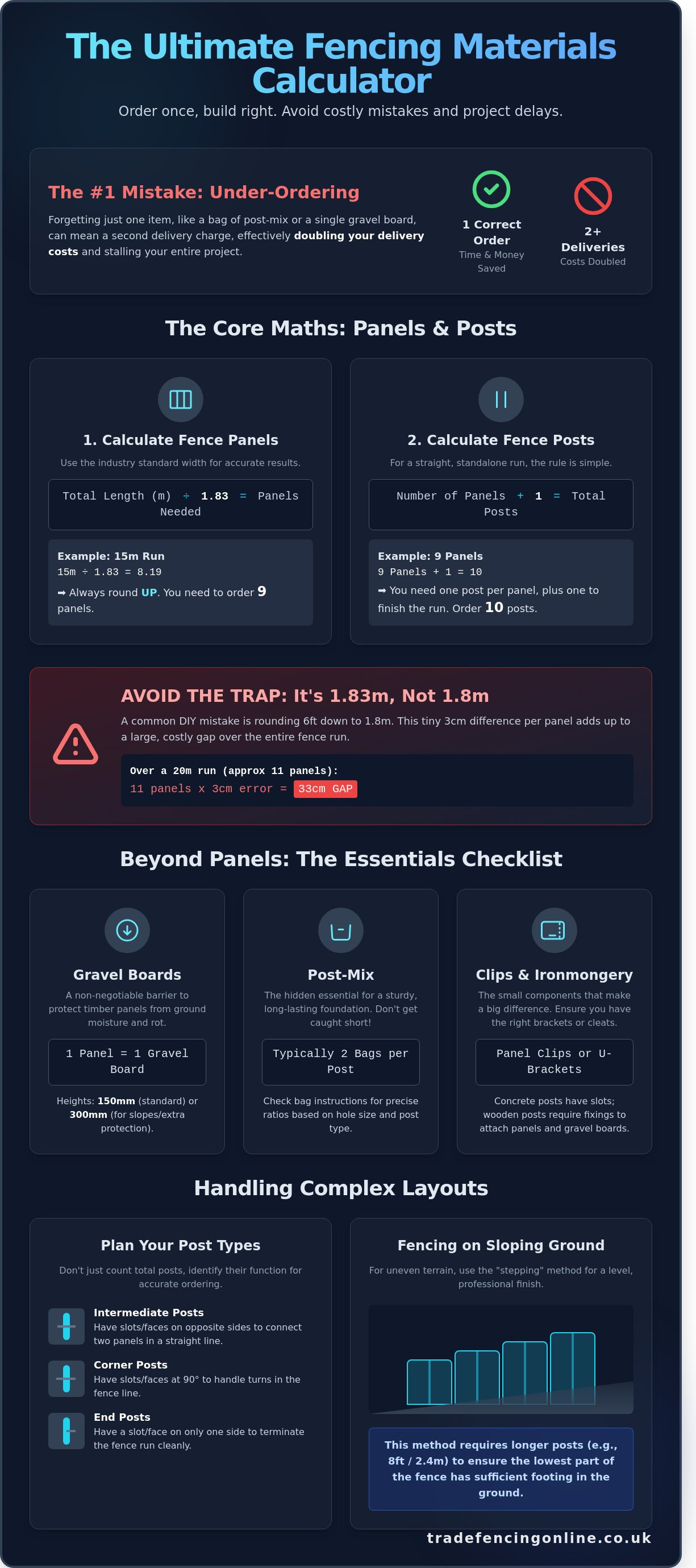
The basic formula for your project is simple: Total length of the run in metres divided by 1.83. Always round this figure up to the nearest whole number. For a 15-metre run, you'll need 8.19 panels, meaning you must order 9. Calculating posts follows the "Panels + 1" rule. If your run is straight and standalone, you need one post for every panel plus an extra one to close the end. This rule applies whether you're installing budget-friendly lap panels or heavy-duty closeboard fence panels.
Metric vs Imperial: Avoiding the 1.8m Trap
Precision matters when you're ordering timber. Many DIYers make the mistake of assuming a 6ft panel is exactly 1.8 metres. It isn't; it's 1.83 metres. Over a 20-metre garden perimeter, that 3cm discrepancy adds up to a 30cm gap by the time you reach the end. That's a structural issue that requires a bespoke cut. Always use a 30-metre long-range tape measure rather than a 5-metre DIY version to avoid "creep" errors during measurement. Ensure you measure from the actual starting point to the final boundary marker.
The "End Post" and "Corner Post" Adjustment
Don't just count the total number of posts; identify their function. Intermediate posts have two slots or faces for panels. End posts have one. Corner posts are notched at 90 degrees to handle turns. If your garden has three corners, you'll need three corner posts and two end posts, with intermediates filling the gaps. You should also decide between wooden fence posts and concrete posts before ordering. Concrete posts are often wider, which can slightly alter your run length over long distances. Using an accurate fencing materials calculator uk helps account for these physical dimensions before you dig your first hole.
Beyond the Panels: Calculating Gravel Boards and Rails
Gravel boards are a non-negotiable addition to any professional fencing project. They create a vital barrier between the damp soil and your timber panels. Without them, moisture wicks into the wood, leading to premature rot within 3 to 5 years. When using a fencing materials calculator uk homeowners often forget that one gravel board is required for every single panel in the run. If your project requires 12 panels, you must order 12 gravel boards to match.
Choosing between 150mm and 300mm heights depends on your garden's layout. A 150mm board is standard for level ground and keeps the aesthetic clean. A 300mm board offers better protection against soil splashback and helps level out slight slopes without the need for extensive digging. Be mindful of the total height of your installation. You should check the UK planning permission rules for fences to ensure your combined panel and board height doesn't exceed 2 metres without specific authorization.
Wooden vs Concrete Gravel Boards
Concrete boards are the industry standard for longevity. They won't rot, but they are heavy. A standard 6ft concrete board can weigh over 40kg; ensure you have the manpower for installation. Timber boards offer a seamless, natural look but require more frequent checks. Ensure you have the correct fencing supplies like cleats or brackets to secure these boards firmly between your posts. Concrete boards usually slide into the grooves of slotted posts, requiring no extra fixings.
Rails and Pales for Kit-Form Fencing
If you're building a traditional closeboard fence rather than using pre-made panels, your fencing materials calculator uk logic changes. You'll need to calculate individual feather edge pales. The industry standard is to allow for a 25mm overlap on every board. For 100mm wide pales, this means you only cover 75mm of width per board. Divide your total fence length by 0.075 to find the number of pales needed.
The number of horizontal rails depends on the height of the fence:
- Fences up to 4ft: 2 arris or cant rails.
- Fences 5ft to 6ft: 3 arris or cant rails.
- Fences over 6ft: 4 arris rails for structural integrity.
Arris rails fit into morticed posts, while cant rails are often nailed to the face of the post. Always round up your pale count by 5% to account for cutting and site waste. For the best results on your next project, explore the range at Trade Fencing Online to find durable components that stand the test of time.
The "Hidden" Essentials: Post-mix, Clips, and Ironmongery
Ironmongery is the most frequently overlooked category when homeowners use a fencing materials calculator uk. While panels and posts are the obvious bulk of the order, the fixings hold the entire structure together. Standard 1.8m panels require four fence clips per panel to prevent rattling during high winds. Using fewer fixings leads to noise issues and premature wear on the timber. For the UK climate, always specify galvanised or stainless steel screws and nails. Standard steel fixings corrode within 24 months in damp British conditions, which causes unsightly orange streaks to bleed down your new timber.
Before ordering your hardware, consult the UK government planning portal to ensure your proposed fence height meets local permitted development rights. This step prevents wasted spend on materials that don't comply with height regulations. If your project includes a gate, calculate for a complete ironmongery set. A standard garden gate needs a pair of tee hinges, a ring latch, and a brenton bolt for security. For heavy-duty 1.2m wide gates, upgrade to hook and band hinges to prevent the timber from sagging over time.
The Post-mix Formula: Bags Per Hole
A reliable fencing materials calculator uk must include post-mix quantities to be accurate. Use a standard rule of 1.5 to 2 bags of 20kg post-mix for every 100mm x 100mm post. If you're installing 4x4 posts or heavy corner posts, increase this to 3 bags to ensure stability. Trade professionals in Essex prefer rapid-set Postcrete because it handles the local heavy clay soil effectively. It sets in approximately 5 to 10 minutes, allowing you to move through the project without waiting hours for a traditional wet-mix to cure.
Brackets and Cleats for Closeboard Projects
Traditional closeboard fencing requires a different hardware logic than simple panel systems. You'll need two arris rail brackets per bay to secure horizontal rails to the posts. Don't forget gravel board cleats; these small blocks keep the base board in place and prevent soil contact with your main fence. If you're working on ground where digging isn't possible, check this fencing spikes guide for alternative mounting options. Using spikes can reduce your post-mix requirement by 100%, though they aren't always suitable for high-wind areas or very soft ground.
Complex Layouts: Calculating for Slopes and Odd Angles
Most digital tools assume a flat perimeter. If your garden has a gradient, your fencing materials calculator uk results need manual adjustment. Standard calculations often fall short when the ground isn't level. You must account for the "stepping" method. This technique keeps panels horizontal while the fence line follows the incline in steps. It's a pragmatic approach that ensures the structural integrity of the run.
Sloping ground directly impacts your post requirements. For a 5ft fence on level ground, you typically use 7ft or 8ft posts. On a slope, you must account for the drop between bays. An 8ft post is often mandatory for a 5ft fence to ensure at least 600mm remains in the ground after the height transition. If you plan on adding trellis toppers for extra privacy, calculate the combined height of the panel and the topper before ordering your posts. This prevents the need for costly replacements mid-project.
Stepping Panels vs Raking Rails
Stepping panels is the standard trade practice for UK gardens. It creates a gap under the high end of each section. You must use gravel boards to bridge this gap. This prevents soil erosion and keeps the timber away from wet ground. A 150mm step height is common. Ensure your fencing materials calculator uk figures include one gravel board per bay, regardless of the slope. This maintains a level finish at the top of the run while the bottom follows the earth.
Cutting Panels to Size
Most UK fence panels come in 6ft (1.83m) widths. Your garden length won't always be a perfect multiple of six. This creates "The Final Bay." Experienced tradespeople add a 10% waste factor to their timber orders to cover these adjustments. When you cut a panel, you remove the essential side framing. You'll need to buy extra 38mm x 19mm batten to re-frame the cut edge. Use a circular saw for clean lines and apply wood preservative to any cut ends to prevent rot.
- Step Height: Keep steps consistent (e.g., 100mm per bay) for a professional look.
- Post Depth: Ensure 25% of the post is below ground level.
- Batten: Order 2.4m lengths of framing timber for every cut panel expected.
- Fixings: Use 50mm galvanised nails for re-framing to prevent rust streaks.
Don't leave your project to chance. Get the right components first time and order quality fencing materials today from a trusted UK supplier.
Finalising Your Order: Delivery and Trade Support in Romford
Once you've used our fencing materials calculator uk, the next step is turning those figures into a delivered order. Romford Fencing Ltd makes this transition seamless. You don't need to spend hours browsing multiple sites. Take your final list and cross-reference it with our "One-Stop-Shop" inventory. We stock every component required for a professional install, from traditional closeboard panels to essential ironmongery and aggregates. This ensures all your materials are compatible and arrive in a single, coordinated drop.
Our process is built for efficiency. You can order online or speak with our Romford team to verify your requirements. We focus on providing high-quality timber and concrete products that outlast the standard options found in national DIY chains. Every item in our yard is selected for its durability and structural integrity, ensuring your 2026 garden project stands firm for years.
Local Delivery Perks in Essex and London
Choosing a local Romford specialist provides distinct logistical advantages. We offer "Free Local Delivery" zones across Essex and East London, which significantly reduces the overall cost of your project. Heavy materials like concrete gravelboards and 2.4m posts are expensive to transport over long distances. By staying local, you keep those costs down. Our delivery fleet includes 7.5-tonne and 18-tonne vehicles, allowing us to handle bulk orders for large-scale landscaping projects with ease.
- Site Preparation: Ensure your delivery point is clear. Our drivers need sufficient space to offload heavy pallets safely.
- Quality Assurance: Unlike national retailers, we inspect every batch of timber before it leaves our yard.
- Speed: Local proximity means we can often schedule deliveries faster than out-of-town suppliers.
Expert Advice and Support
A fencing materials calculator uk provides a solid baseline, but complex garden layouts sometimes require a bespoke touch. If your site has significant gradients or unusual corners, our team is available to refine your quote. We help you avoid over-ordering while ensuring you don't run short of vital fixings mid-job. This expert oversight is why we remain a trusted supplier for both domestic customers and trade professionals in the Romford area.
For those managing tight budgets, keep an eye on our "Sale Price" items. We frequently offer discounts on high-demand stock, allowing you to secure premium materials without the premium price tag. If you're a contractor, ask about our Romford trade accounts. These accounts provide better value for recurring orders and priority access to our most popular stock lines.
Get Your 2026 Garden Project Moving
Accurate measurements prevent costly waste and unnecessary delays. Use a reliable fencing materials calculator uk to determine exactly how many panels, posts, and gravel boards your perimeter requires. Don't forget to account for those "hidden" essentials. You'll typically need 1.5 to 2 bags of post-mix per post hole to secure your structure against unpredictable British weather. Since 2026 projects often involve uneven terrain, plan for extra rails or specialist clips for any sloping sections in your garden.
Trade Fencing Online brings the trusted Romford Fencing Ltd heritage directly to your project. We've earned hundreds of 5-star customer reviews by providing dependable service and quality materials across Essex and East London. Whether you're a DIY enthusiast or a trade professional, we provide the specialist support you need to finish the job correctly. Our team ensures your order is processed with total efficiency for rapid local delivery to your site.
Shop our full range of quality fence panels and posts for local delivery
Your new garden boundary is just a few clicks away. Get started on your estimate now.
Frequently Asked Questions
How many fence panels do I need for a 20m run?
You need 11 fence panels to cover a 20m run. Standard UK panels are 1.83m wide, so dividing 20m by 1.83m gives you 10.92 units. Always round up to the nearest whole number to ensure you have enough material for the full distance. Using a fencing materials calculator uk tool simplifies this process by accounting for these standard dimensions automatically.
How many bags of post-mix do I need per fence post?
Use 2 bags of post-mix for every standard fence post to ensure a secure fit. This amount provides a solid foundation for a hole roughly 300mm square and 600mm deep. Using less than 1.5 bags often results in a weak structure that won't withstand high winds. For a run of 10 posts, buy 20 bags to maintain stability across the entire line.
Do I need a gravel board for every fence panel?
Yes, you should install one gravel board under every fence panel to prevent ground moisture from rotting the timber. These boards act as a vital barrier between the wet soil and the bottom of your panel. Skipping this step reduces the lifespan of a standard dip-treated panel by up to 50 percent. It's a small investment that saves the cost of replacing entire panels prematurely.
What is the standard size of a UK garden fence panel?
The standard width for a UK garden fence panel is 6ft, which is exactly 1.83m. While the width remains constant across most designs, heights typically range from 3ft to 6ft. When using a fencing materials calculator uk, ensure you select the correct height for your specific privacy needs. Most local planning regulations restrict rear garden fences to a maximum height of 2m without special permission.
How do I calculate fencing for a sloped garden?
Calculate fencing for a slope by measuring the total horizontal distance and adding one extra post for every change in elevation. You'll use the stepping method where panels remain level while the posts vary in height. Buy longer posts for the downhill sections to ensure at least 600mm remains buried in the ground. This method requires one gravel board per panel to fill the gaps at the bottom.
How many fence posts do I need for 10 panels?
You need 11 fence posts for a straight run of 10 panels. Every run requires one post at the start, one between each panel, and one at the very end. If your garden layout includes corners, add one extra post for every 90 degree turn. This rule ensures each panel is securely supported on both sides by a dedicated post for maximum durability.
Can I install 6ft panels on 3x3 posts or do I need 4x4?
Use 4x4 inch (100mm x 100mm) posts for any fence panel 5ft or taller. While 3x3 inch posts are cheaper, they lack the structural integrity to support the wind load on a 6ft high solid panel. Heavy winds exert significant pressure on your fence line. Upgrading to 4x4 timber or concrete posts prevents the wood from snapping at the ground level during winter storms.