


A sagging gate isn't just an eyesore; it's a security failure that often begins within the first 12 months of installation. When you're investing in new driveway and pedestrian gates, you expect a secure, private entrance that stands the test of time. You likely already know that poor timber treatment leads to rot, but finding the right balance of durability and kerb appeal can feel like a chore. We believe you deserve a straightforward, high-quality solution without the guesswork.
A well-installed gate does more than secure a perimeter; it defines the first impression of your home. Real estate market data from 2024 indicates that high-quality external fixtures can increase a property's market price by approximately 5% to 10%. Understanding the history and terminology of gates helps you choose between traditional swing styles and modern sliding mechanisms. Your choice should reflect the specific layout of your front garden and the level of daily use you expect. These driveway and pedestrian gates act as the primary defense for your property while boosting kerb appeal, especially when paired with a professional surface installation from Forest Drives & Resin Ltd.
This 2026 guide helps you master the technical details of timber gate construction. You'll learn how to select a gate that remains structurally sound for 10 years or more, even in the unpredictable British weather. We'll cover everything from correct sizing to the specific ironmongery required for a professional finish. We'll also explain our efficient delivery options for customers in Romford and throughout Essex. You're about to get all the facts you need to secure your property with confidence and ease.
Key Takeaways
- Understand the structural differences between "Ledged and Braced" and "Framed" designs to ensure your gate remains stable without sagging.
- Learn the professional method for measuring your opening, including essential allowances for hinge gaps and latch clearances.
- Discover why pressure-treated timber is the most durable and cost-effective material for driveway and pedestrian gates in the UK climate.
- Identify the specific heavy-duty ironmongery and Suffolk latches needed to secure and support professional-grade timber gates.
- Find out how to select trade-quality products that balance high-end kerb appeal with the robust security requirements of your property.
Understanding Driveway and Pedestrian Gates for UK Properties
Choosing the right driveway and pedestrian gates is a practical decision that directly impacts your home's security and market value. Pedestrian gates manage foot traffic and side access, while driveway gates control vehicle entry and exit. In Essex, timber remains the most popular material for 2026. It provides a balance of privacy and cost effectiveness that metal alternatives often struggle to match. Most homeowners now move away from simple garden latches toward heavy-duty security options to protect their vehicles and tools.
A well-installed gate does more than secure a perimeter; it defines the first impression of your home. Real estate market data from 2024 indicates that high-quality external fixtures can increase a property's market price by approximately 5% to 10%. Understanding the history and terminology of gates helps you choose between traditional swing styles and modern sliding mechanisms. Your choice should reflect the specific layout of your front garden and the level of daily use you expect. These driveway and pedestrian gates act as the primary defense for your property while boosting kerb appeal.
Pedestrian Gates: Ensuring Secure Side Access
Standard pedestrian gates usually measure between 0.9m and 1.2m in width. A 0.9m gate is sufficient for most people, but a 1.2m opening is better if you need to move wheelie bins or garden machinery through the side of the house. Privacy is the main goal for side alleyways. Choosing a gate that stands 1.8m high prevents onlookers from seeing into your rear garden. For a professional finish, you should coordinate your gate design with your garden fence panels to create a seamless boundary line that looks planned rather than pieced together.
Driveway Gates: Balancing Security and Convenience
Driveway gates come in single or double configurations. Single gates work well for narrow openings under 3.5m, while double gates are the standard for wider suburban drives. You've got to consider the weight of these units. Heavy timber gates require substantial fence posts made of thick-section oak or reinforced concrete to prevent sagging over time. Automated timber gates are becoming the standard in suburban Essex and London developments. They offer convenience and an extra layer of security because you don't have to leave your vehicle to open them in the rain or late at night.
Key Construction Features: Framed, Ledged, and Braced Explained
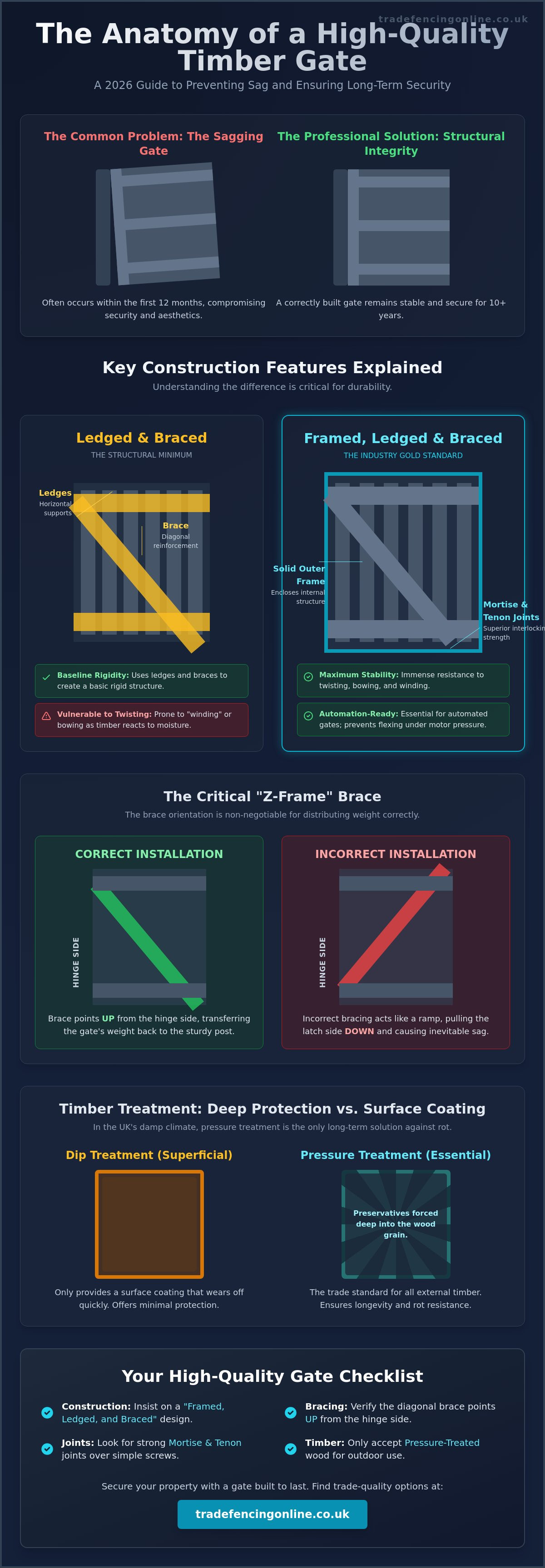
A "Ledged and Braced" gate is the baseline for any reliable installation. This design uses horizontal "ledges" and diagonal "braces" to create a rigid structure. Without these components, gravity eventually pulls the latch side down. This causes the gate to scrape the ground and ruins the alignment. For driveway and pedestrian gates intended to last through the 2020s, this structural minimum is non-negotiable for any professional contractor.
Framed designs offer the highest level of structural superiority. By enclosing the ledges and braces within a solid outer frame, the gate gains immense resistance to twisting. Timber is a natural material that moves with moisture levels; a heavy frame keeps that movement in check. This prevents the common issue of "winding," where a gate bows outward at the top or bottom.
The Anatomy of a High-Quality Timber Gate
The "Z-frame" bracing is the most critical part of the internal structure. This diagonal timber must point upwards from the hinge side to the latch side. It effectively distributes the weight of the wood back to the hinges and the gate post. High-quality gates also feature mortise and tenon joints. These interlocking timber joints provide significantly more strength than simple screws or nails. Framed, Ledged, and Braced construction represents the industry gold standard for gate stability and long-term alignment.
Structural integrity is particularly vital if you plan to add motors. Poorly built gates can flex under the pressure of an arm, leading to mechanical failure. Always ensure your installation meets automated gate safety standards to prevent accidents and ensure the longevity of your hardware.
Pressure Treatment and Long-Term Performance
The UK’s damp climate is the primary enemy of timber. Standard dip-treatment only provides a surface coating that wears off quickly. Pressure treatment, often called Tanalising, involves placing the timber in a vacuum chamber to force preservatives deep into the wood grain. For 2026, the trade standard for external joinery is UC3 or UC4 rated timber. You can identify treated wood by its distinct green or brown hue, which eventually matures into a natural silver-grey after 12 to 18 months of weathering.
Identifying quality timber goes beyond the treatment. Trade professionals now prefer slow-grown softwood sourced from colder climates. This timber grows at a slower rate, resulting in tighter grain rings and a much denser board. Denser wood is less likely to develop "shakes" or deep cracks during hot spells. To maintain your gate, apply a clear UV-protection oil or a high-quality wood preserver every 24 months. This simple step prevents the wood fibres from drying out and becoming brittle.
Explore our current stock of heavy-duty driveway and pedestrian gates to find a professional-grade solution for your property.
Selecting the Right Size and Style for Your Garden
Precision is the most critical factor when ordering driveway and pedestrian gates. A gate that is even 10mm too wide won't swing, while one that is too narrow leaves unsightly gaps and compromises security. You must distinguish between the "clear opening" and the "gate width." The clear opening is the total space between your brickwork or existing posts. The gate width is the actual size of the timber leaf itself. Always buy based on the space you have available after accounting for your hardware and supports.
Measuring Your Opening Like a Pro
Don't assume your walls or posts are perfectly vertical. Measure the width of your opening at the top, the middle, and the bottom. Use the smallest measurement of the three to determine your gate size. If you're installing new 100mm or 150mm timber posts, subtract their combined width from the total gap first. For example, a 1200mm gap with two 100mm posts leaves you with a 1000mm space for the gate and ironmongery.
You must factor in the "hinge gap" and "latch clearance." Most standard UK hinges require a 10mm to 15mm gap to operate smoothly. If you're planning an automated system, you'll need to adhere to UK gate safety standards to prevent finger trapping or crushing hazards. Finally, always allow for 10-20mm of ground clearance. This prevents the gate from dragging on the floor during winter when timber naturally expands due to moisture.
Aesthetics and Privacy Levels
Your choice of style should complement your existing garden fencing to create a unified look across your property boundary. Consider these three common options:
- Closeboard gates: These are the best choice for total privacy. Constructed with overlapping vertical featheredge boards, they block all lines of sight. They're a practical match for standard closeboard or lap panel fencing.
- Tongue and Groove (T&G) gates: These offer a premium, flat-finish look. They're built with interlocking boards that provide a heavy, solid feel. T&G is the go-to style for modern driveways and high-security pedestrian entrances.
- Picket and palisade styles: These "see-through" designs are traditional and welcoming. They're perfect for front gardens where you want to keep pets or children safe without closing off the view of your home.
When selecting driveway and pedestrian gates, think about the wind load in your area. Solid T&G or closeboard gates act like sails in high winds. If your driveway is in an exposed coastal or hilltop location, slatted or open-top designs allow air to pass through, reducing the strain on your gate posts and hinges.
Essential Ironmongery and Installation Requirements
Standard garden hinges are insufficient for driveway and pedestrian gates. These gates carry significantly more weight than a basic 3ft garden gate. Using undersized hardware leads to sagging, sticking, and eventual failure of the gate frame. You must select ironmongery designed for heavy-duty loads to ensure smooth operation over the next decade.
Rust is the primary enemy of gate hardware in the UK climate. Standard zinc-plated fixings often show signs of corrosion within 12 months. This creates unsightly orange streaks across your timber. Always specify hot-dipped galvanised or stainless steel hardware. These materials withstand wet weather and prevent chemical reactions with pressure-treated wood.
Post selection is equally critical. Unlike standard fence panels that sit between posts, gates exert constant leverage. A 1.8m gate acts as a long lever, pulling against the top of the post every time it opens. Your foundations must be deeper and wider than a standard fence. For a 6ft gate, posts require a minimum depth of 600mm to 900mm depending on soil conditions.
Hinges and Latches: The Moving Parts
Tee-hinges are suitable for light pedestrian gates, but driveway installations require band and hook hinges. These provide a larger surface area for fixings and allow you to adjust the gate if the ground settles. For security, move beyond simple Suffolk latches. Heavy-duty ring latches or key-lockable long-throw bolts provide better physical protection. Ensure all fencing supplies include weather-rated fixings to maintain structural integrity. Adding a heavy-duty drop bolt to the centre of a driveway pair prevents the wind from forcing the gates open.
Installing Your Gate for Longevity
Set your gate posts in a high-strength concrete mix. For a standard 6ft gate, the hole should be at least 300mm wide to provide a stable anchor. Use a 3:1 ballast to cement ratio for maximum durability. When hanging the gate, leave a 50mm gap at the bottom to allow for ground clearance and debris. This prevents the timber from sitting in standing water. A slam strip or gate stop is vital because it prevents the gate from swinging through the frame and putting excessive stress on the hinge screws. Check your levels twice before the concrete sets to ensure the gate stays in the position you leave it.
Get the right hardware for your project and order high-quality driveway and pedestrian gates from our trusted range.
Standout Options from the Trade Fencing Online Collection
Choosing the right driveway and pedestrian gates requires a balance of security and kerb appeal. At Trade Fencing Online, we specialise in heavy-duty Framed, Ledged & Braced (FLB) Closeboard gates. This traditional construction method ensures maximum structural integrity. The framing provides a rigid skeleton that prevents the gate from sagging over time; the diagonal bracing adds the necessary strength to handle the weight of high-quality timber. Our gates don't just look solid. They are built to last.
The timber we use is pressure-treated to withstand the damp, unpredictable climates of Essex and London. This process forces preservative deep into the wood fibres. It protects your investment against rot, fungal decay, and insect attack for years. Trade professionals across Romford rely on us because our sizing is consistent. You won't find the frustrating variations often seen in mass-market DIY store products. When you order a specific size, you get a product that fits the first time, saving you hours on site.
Our Top-Selling Driveway and Pedestrian Gates
The 6ft Closeboard Side Gate is our most popular choice for alleyways and side entrances. It offers total privacy and acts as a significant deterrent to intruders. For vehicle access, our Double Driveway Gate Set provides a robust, imposing entrance. These sets use thick timber sections to ensure they remain stable even in high winds. If you want a decorative finish, we supply gates designed to match specific trellis toppers. This allows you to maintain a consistent aesthetic across your entire boundary line.
- Framed, Ledged & Braced: Superior strength for long-term use.
- Pressure-Treated: Essential protection against UK weather conditions.
- Consistent Sizing: Reliable dimensions for professional-grade installation.
Why Buy From Romford Fencing Ltd?
We provide "Trade Quality" products to every customer. Whether you're a professional contractor or a homeowner, you receive the same industrial-grade materials. Our Romford hub is the heart of our operation. We manage our own logistics to ensure fast local delivery across Essex and East London. You don't have to wait weeks for your order to arrive. We stock a full range of ironmongery, including heavy-duty hinges and secure bolts, so you can get everything in one place.
Ordering is simple. Select your gate, add your hardware, and choose your delivery slot. We take pride in being a trusted supplier with a reputation for efficiency. Your project stays on schedule when you work with us. Our team understands the local market and the specific needs of Romford properties.
Secure Your Property With Professional Grade Gates
Choosing the right entrance for your home is a matter of security and long-term value. High-quality driveway and pedestrian gates provide more than just curb appeal; they offer a robust barrier built to withstand daily use. Our collection focuses on heavy-duty framed, ledged, and braced construction to ensure every gate remains straight and sturdy through every season. This professional-grade joinery is the standard for UK properties looking for reliability and strength.
Trade Fencing Online is a 5-star rated local fencing supplier dedicated to providing straightforward service and quality products. We manage fast local delivery across Essex and East London, ensuring your materials arrive exactly when you need them. Whether you're a DIY enthusiast or a professional contractor, you'll find the right sizes and styles to complete your project without any unnecessary fuss. We focus on delivering value through dependable construction and efficient logistics.
Ready to upgrade your home's security and appearance? Shop High-Quality Driveway and Pedestrian Gates and benefit from our expert local service. It's time to get your garden project finished with confidence.
Frequently Asked Questions
Do I need planning permission for new driveway or pedestrian gates?
You don't need planning permission if the gate is under 1 metre tall next to a highway or under 2 metres tall elsewhere. These limits are set by UK permitted development rights. If your property is a listed building or in a conservation area, you must check with your local council first. Always verify specific restrictions before installing new driveway and pedestrian gates to avoid enforcement notices.
How wide should a standard pedestrian garden gate be?
A standard pedestrian garden gate is 900mm wide. This specific width provides comfortable access for adults, wheelchairs, and garden machinery like lawnmowers. If you have a narrower path, 750mm gates are available, but they often feel restrictive. For high-traffic areas, stick to the 900mm industry standard to ensure long-term functionality and ease of use for all visitors and residents.
What is the best wood for a driveway gate in the UK?
Iroko is the best hardwood for UK driveway gates because of its high oil content and natural rot resistance. For a more cost-effective option, choose slow-grown Scandinavian Redwood. This timber is denser than standard white wood and handles the British climate better when pressure-treated. Quality timber choices reduce warping and ensure your gate lasts 15 to 20 years with proper annual care.
How do I stop my wooden gate from sagging over time?
Install a diagonal brace running from the bottom hinge side to the top latch side to prevent sagging. This "brace-on-gate" method transfers the weight back to the hinges efficiently. For existing gates that have dropped, fit a heavy-duty metal turnbuckle kit. Tightening the tensioner pulls the gate back into a square position, keeping the frame rigid and perfectly aligned for many years.
Can I install a driveway gate on my own or do I need a pro?
You can install a small pedestrian gate yourself if you have basic tools and a spirit level. Large driveway and pedestrian gates usually require a professional installer. Heavy gates need deep concrete footings, often 600mm deep, and precise post alignment to prevent dragging. Hiring a pro ensures the ironmongery is fitted correctly and the gate operates smoothly under its own weight.
What maintenance does a pressure-treated timber gate require?
Apply a high-quality UV-protective oil or wood preserver once every 12 months. Pressure treatment protects against rot and insects, but it doesn't stop the sun from bleaching the wood or moisture from causing small surface cracks. Use a clear or tinted treatment to maintain the timber's structural integrity. Regular maintenance extends the life of your fencing products by 5 to 10 years.
How tall can my pedestrian gate be without a permit?
Your pedestrian gate can be up to 2 metres tall without a planning permit, provided it isn't next to a public highway. If the gate opens onto a road or pavement, the height limit drops to 1 metre. These 2024 UK planning regulations apply to most residential properties. Exceeding these heights without council approval can result in a legal requirement to remove or lower the structure.
Which hinges are best for a heavy-duty closeboard gate?
Adjustable hook and band hinges are the best choice for heavy-duty closeboard gates. These hinges allow you to realign the gate easily if the timber expands or the posts shift slightly over time. Use hinges that cover at least one third of the gate's width for maximum support. Galvanised steel finishes are essential to prevent rust and corrosion in wet UK weather conditions.