


Search interest for vertical gardening systems has surged by 400% as of May 2026, yet many homeowners still settle for flimsy units that buckle under the first sign of a heavy breeze. You likely want a garden trellis with planters that provides instant privacy from neighbours without rotting away after one season. We agree that a garden feature should be a solid investment, not a flat-pack headache that fails within months. It's time to stop treating these units as temporary decor and start viewing them as essential structural fencing.
This trade-expert guide will help you select a durable, integrated trellis planter that adds genuine structure to your outdoor space. We've analysed the 2026 market, including options from retailers like Aosom and Target where prices currently range from $41.39 to $158.99. You'll learn how to identify high-quality materials, avoid assembly struggles, and ensure your new feature stands firm against the elements. Here's how to secure a reliable, one-stop-shop solution for a garden that stays private and green for years to come.
Key Takeaways
- Learn how to use integrated units to create "garden rooms" and screen unsightly walls for instant privacy.
- Identify why trade-grade timber thickness is essential for long-term durability. Pick the right lattice style to balance privacy and plant support.
- Compare pressure-treated timber against metal and plastic alternatives. Ensure your garden trellis with planters can withstand the wind and rain.
- Select the right climbing plants like Roses or Clematis. These varieties provide the best coverage and fragrance for integrated units.
- Get trade-quality products delivered directly from a trusted Romford supplier. We provide reliable fencing solutions across Essex and London.
What is a Garden Trellis with Planter and Why Do You Need One?
A garden trellis with planters is a self-contained unit that combines a heavy-duty base planting box with a vertical support system. Think of it as a mobile architectural structure designed specifically for plant support and privacy. Unlike standard fencing, these units don't require post-digging or concrete. They provide an immediate solution for screening unsightly walls or partitioning a patio into distinct "garden rooms." These integrated units are particularly effective for the 63.6% of gardeners who, as of May 2026, plan to expand their planting areas but face space or soil limitations.
Standalone units differ significantly from fence-mounted trellis panels. A standalone planter-trellis relies on the weight of the soil and plants in the base box to remain upright. This makes them ideal for renters or urban dwellers with balconies and paved courtyards. You get a "one-stop-shop" purchase that provides both the container and the vertical lattice in a single, manageable unit. It's a pragmatic choice for anyone who needs structure without the permanence of traditional construction.
The Functional Benefits of Integrated Planters
Privacy is the primary driver for most homeowners. You can achieve instant screening from neighbours without the need for planning permission or permanent post-setting. Because these units are portable, you can move your greenery if you decide to redesign your patio or move house. With search interest in vertical gardening up by 400% in 2026, these units are the most efficient way to maximise growth in narrow side-returns or small balconies. They turn dead space into a productive, green vertical accent.
Trellis vs. Traditional Fencing
While standard fence panels provide security, a garden trellis with planters offers a "softer" boundary. It allows light and air to pass through while still blocking the line of sight. This is essential for modern UK landscaping where "living walls" are a major trend. You might choose a planter-base over a trellis fixed to a wall when you want to avoid drilling into brickwork or when the wall itself is too weak to support heavy climbers.
Integration with existing fencing is a key advantage. You can place these units directly in front of an old, weathered fence to hide it without the cost of a full replacement. This creates a layered look that adds depth and rhythm to your garden borders. It's a reliable, cost-effective way to upgrade your garden's structure with minimal friction.
Key Features to Evaluate Before Buying
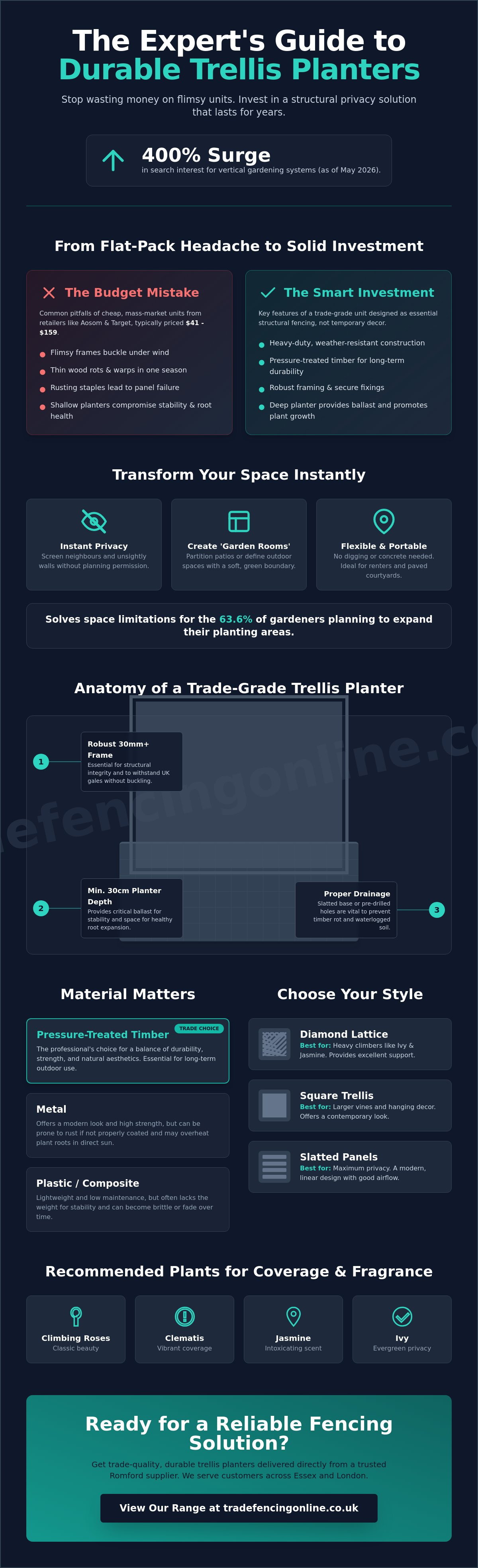
Structural integrity is the most common failure point for budget garden units. If a garden trellis with planters isn't heavy enough, it will likely blow over during a standard UK gale. Trade-grade timber thickness, specifically frames that are at least 30mm thick, is essential for long-term durability. Flimsy lattice panels found in many discount stores often use thin staples that rust and wood that warps within 12 months. Choosing a robust frame ensures your investment survives the winter seasons and supports the weight of mature climbing plants.
Root health depends entirely on the volume of the planter. We recommend a minimum depth of 30cm to provide enough soil for moisture retention and root expansion. Shallow boxes dry out quickly in the summer heat and don't provide the necessary ballast to keep a tall trellis stable. Proper drainage is equally vital. Without pre-drilled holes or a slatted base, water will pool at the bottom, leading to anaerobic soil and rapid timber rot. For those looking to secure high-quality materials, you can view our range of durable trellis options designed specifically for local weather conditions.
Choosing the Right Trellis Style
Diamond lattice is the traditional choice. Its tight weave provides excellent support for heavy climbers like Ivy or Jasmine. Vertical gardening techniques often favour this style for its inherent strength and aesthetic appeal. Square trellis offers a cleaner, more contemporary look. It's better suited for larger vines or hanging decorative pots. If privacy is your main goal, slatted panels are the superior option. These modern, linear designs block more of the line of sight while still allowing enough airflow to reduce the wind load on the structure.
Sizing for Your Space
Height is a critical factor for both privacy and safety. Standard units typically come in 4ft, 5ft, and 6ft heights. A 6ft unit provides instant screening from neighbours but catches significantly more wind. If you live in an exposed area, a lower 4ft unit or a heavy-duty 5ft model is often a safer choice. Always measure the footprint of the planter base before purchasing. Ensure it doesn't obstruct narrow walkways or patio corners. A well-proportioned unit should feel like a natural extension of your garden, not a bulky obstacle. In 2026, 42.8% of gardeners expect to spend more on their outdoor space, making it even more important to get these measurements right the first time.
Material Matters: Comparing Timber, Metal, and Plastic
Choosing the right material for your garden trellis with planters determines how long the structure remains standing. Timber is the professional standard for fencing projects because it offers the best balance of weight and durability. While metal units look sleek, they often lack the depth required for significant root growth and can become dangerously hot in direct sun. Plastic and composite options are low maintenance but frequently look cheap and become brittle during winter frosts. For a reliable, long-term feature, pressure-treated wood is the only logical choice. It provides the ballast needed to stay upright in the wind, which is crucial for growing vegetables in container gardens or heavy ornamental climbers.
Metal trellises are often sold as "rustproof," but as of May 2026, many budget units from stores like Walmart or Aldi rely on thin powder coatings that chip easily. Once the metal is exposed, rust sets in quickly. Timber doesn't have this problem. It's a traditional, reliable material that handles the UK's shifting humidity levels without structural failure. In 2026, the sustainable gardening market is projected to reach $1.8 billion. Timber fits this trend perfectly as it's a renewable resource, unlike plastic units which rely on petroleum-based manufacturing.
Why Pressure Treatment is Non-Negotiable
Untreated wood will rot within two seasons when in constant contact with damp soil. Pressure treatment involves a vacuum-pressure process that forces preservatives like Tanalith-E deep into the timber grain. This protects the unit from fungal decay and wood-boring insects. You can identify quality treatment by a slight green or brown hue in the wood. A pressure-treated planter has an expected lifespan of 10 to 15 years, whereas a basic untreated DIY kit may fail in less than three. It's a pragmatic investment for any gardener who values substance over style.
Maintenance Tips for Longevity
Even the best timber requires minimal care to reach its full lifespan. Check drainage holes annually. If they become blocked with silt, the base will waterlog and rot from the inside out. We recommend using a permeable membrane liner. This protects the wood from direct contact with wet soil while allowing water to escape. If you want to maintain the original colour, apply a UV-protective stain every two years. When applying stains, choose high-quality oil-based products. Oil penetrates deeper into the grain, providing a more resilient barrier against driving rain. Simple, direct maintenance keeps your garden feature functional for a decade or more.
Best Plants for Your Trellis Planter
Not all climbing species thrive in the confined root space of an integrated unit. You need plants that offer maximum vertical coverage without overwhelming the timber frame. Climbing Roses remain the standard for traditional gardens. They provide height and fragrance but require regular pruning to maintain their shape. Clematis is another top choice because it grows quickly and adapts to various light levels. If your goal is thick screening, Honeysuckle is superior. It attracts pollinators and creates a dense wall of foliage that blocks the line of sight effectively.
Star Jasmine (Trachelospermum jasminoides) is the modern choice for 2026. It stays green year-round, providing a permanent privacy barrier even in winter. This is a significant advantage over deciduous species that leave your garden exposed for half the year. With 63.6% of gardeners planning to expand their planting areas this year, choosing evergreen climbers ensures your vertical accents work hard for you throughout every season. Using a garden trellis with planters allows you to position these "living walls" exactly where they are needed most.
Planting for Privacy and Shade
To create a dense screen quickly, layer your planting. Combine a fast-growing deciduous vine with an evergreen base. This ensures immediate coverage while the permanent structure matures. Be mindful of weight management. Mature Wisteria or heavy Ivy puts immense strain on a garden trellis with planters. If you choose heavy species, install additional support wires to distribute the load across the frame. This prevents the lattice from bowing or snapping under the weight of the foliage as the plant matures over several years.
Placement and Stability
Matching plant choice to garden orientation is a pragmatic necessity. Roses and Star Jasmine need full sun to flower, while some Clematis varieties thrive in partial shade. Stability is the most overlooked factor. You must ballast the planter base with heavy soil, compost, or large stones. A top-heavy trellis acting as a sail in the wind will topple if the base is too light. Leave a gap of at least 10cm between the trellis and any brick walls. This allows for air circulation, which prevents mildew on the plants and rot on the timber. For professional-grade support systems, order your trellis and planter units from our Romford-based team today.
Why Trade Fencing Online is Your Trusted Supplier
Trade Fencing Online provides pragmatic, trade-quality solutions for your outdoor space. We design every garden trellis with planters to withstand the unpredictable British weather. Unlike high-street retailers that sell thin, decorative units, our products focus on structural integrity. We don't believe in "designer" markups or hidden fees. You get transparent, competitive pricing on every item. Our team understands fencing supplies inside out, ensuring you receive a product that is built to last. We are the home of quality garden fencing.
A major advantage of our units is how they integrate with your existing boundaries. Many competitors treat these as standalone furniture, but we view them as functional fencing extensions. You can place our trellis planters directly against an old fence to add height and privacy without a full replacement. This creates a layered, professional look while hiding weathered panels. It's an efficient way to modernise your garden with minimal friction. Your one-stop-shop for everything fencing is here to help you achieve a durable, attractive result.
The Romford Fencing Advantage
We operate from our established base in Romford. This location allows us to offer fast, reliable delivery across Essex and London. Our bulky planters arrive safely on our own vehicles, avoiding the damage often caused by third-party couriers. We stock professional-grade timber that is significantly thicker than the options found in local DIY sheds. This extra mass is vital for stability. Our 5-star reviews from both trade professionals and homeowners reflect our commitment to quality. When you buy from us, you're getting the same materials used by expert contractors.
Ordering Your Garden Trellis with Planter
Our website allows you to browse our full range and see real-time stock levels. You can easily combine your garden trellis with planters with other essential items like fence posts or gravel boards. This "one-stop-shop" approach saves you time and reduces delivery costs. If you're planning a larger garden renovation, don't guess the requirements. Contact our team for direct, expert advice on which structural elements will work best for your specific site conditions. We provide free local delivery options to make your project as cost-effective as possible. FOR QUALITY FENCING, CALL ROMFORD FENCING LTD TODAY OR ORDER ONLINE FOR IMMEDIATE PROCESSING.
Secure Your Garden Structure for 2026
Choosing a garden trellis with planters is more than an aesthetic upgrade; it's a structural investment in your home's privacy. We've established that trade-quality pressure treated timber is the only reliable choice for the UK's shifting climate. Avoid the frustration of flimsy high-street units that fail after one winter. By focusing on frame thickness and proper drainage, you ensure your vertical garden thrives for a decade or more. Pair your structure with evergreen climbers like Star Jasmine to maintain a solid boundary throughout every season.
Trade Fencing Online is your 5-Star Rated Trusted Supplier based in Romford. We provide professional-grade materials and offer Free Local Delivery Options to simplify your project. Don't settle for "designer" markups when you can get trade-grade durability at honest prices. Our team is ready to help you transform your patio or courtyard into a private, green sanctuary with minimal friction. It's time to stop worrying about the wind and start enjoying your garden.
Shop Our Range of Durable Garden Trellis and Planters today and build a garden that stands firm.
Frequently Asked Questions
Do garden trellis planters need to be fixed to a wall?
Freestanding units don't require wall fixing in most domestic gardens. The weight of the compost and plants provides sufficient ballast to keep the structure upright. However, if you choose a 6ft unit for a coastal or exposed site, we recommend a single galvanized bracket for safety. This prevents the "sail effect" during high-speed winter gales that can exceed 50mph.
What is the best wood for a trellis planter?
Pressure-treated softwood is the most pragmatic choice for a garden trellis with planters. It's treated with Tanalith-E to resist fungal decay and wood-boring insects for up to 15 years. While hardwoods like teak are durable, they are significantly more expensive. Standard pressure-treated timber offers the same level of rot resistance at a more commercial, value-oriented price point.
How do I stop my trellis planter from blowing over?
Use heavy ballast at the base of the planter box before adding any compost. We suggest a 10cm layer of large stones or broken bricks to lower the centre of gravity. This simple step makes the unit much harder to topple. For extra security, ensure the planter is at least 40cm wide to provide a stable footprint against sideways wind pressure.
Can I use a trellis planter for vegetables?
Trellis planters are excellent for growing vining vegetables like runner beans, peas, and cucumbers. This vertical method maximises your yield in small spaces and keeps the produce away from slugs and soil-borne diseases. Ensure the planter box is at least 30cm deep. This volume of soil holds the moisture and nutrients required for heavy-cropping vegetables throughout the summer.
How long will a pressure-treated trellis planter last?
A professionally pressure-treated unit has an expected lifespan of 10 to 15 years. The vacuum-pressure process ensures the preservatives reach the core of the wood fibres. This is far superior to "dip-treated" wood, which only has a surface coating. Without this deep protection, untreated timber will likely rot and fail within 36 months of being filled with damp soil.
Do I need to line my wooden planter?
Always use a permeable geotextile liner to protect the inner walls of the timber. It acts as a barrier between the wet soil and the wood while still allowing excess water to escape through the drainage holes. Don't use non-porous plastic liners. These trap stagnant water at the base, which causes anaerobic soil conditions and kills your plants within 10 to 14 days.
What size planter do I need for a climbing rose?
Climbing roses need a large planter with a minimum capacity of 60 litres. The box must be at least 45cm deep to accommodate the rose's deep-reaching root system. If the container is too small, the plant will become stressed and prone to mildew. A larger volume of soil also acts as a thermal buffer, protecting the roots from extreme temperature shifts.
Can I paint or stain my trellis planter?
You can stain or paint your trellis planter once the initial pressure treatment has dried. This usually takes about 28 days depending on the weather. Use a high-quality, oil-based exterior stain to maintain the natural wood grain while adding UV protection. We recommend a fresh coat every 2 years. This simple maintenance task keeps the unit looking professional and prevents the wood from silvering.