


A single loose splinter or a gap just an inch too wide can turn a peaceful afternoon in the garden into a stressful emergency. Many parents assume any boundary provides security, but rough-sawn timber and poorly spaced slats often create more risks than they solve. You want a space where your children can run freely without the constant fear of trapped limbs or climbing accidents. Choosing the right child safe garden fencing is about more than just marking a boundary. It's about creating a controlled, splinter-free environment that actually works for your family.
You don't have to sacrifice your garden's professional appearance to guarantee safety. This guide explains how to select and install secure perimeters that meet RoSPA's 1.0m minimum height recommendations while staying within UK planning regulations. We'll show you how to identify entrapment-free designs and select durable materials that stand up to years of use. Discover how to build a secure, long-lasting boundary that prevents escapes, protects against injuries, and adds genuine value to your property.
Key Takeaways
- Identify why "Planed All Round" (PAR) timber is the industry standard for eliminating splinter risks in play areas.
- Learn how chamfered edges and specific slat spacing prevent impact injuries and dangerous head or limb entrapment.
- Compare the best styles of child safe garden fencing, from traditional picket fences for internal zones to secure closeboard panels for boundaries.
- Secure your perimeter by following professional installation tips, such as setting posts 2ft deep for maximum structural stability.
- Evaluate the pros and cons of timber versus concrete posts to find the most durable and safe solution for your family garden.
What is Child Safe Garden Fencing?
Child safe garden fencing is a specialized boundary system designed to eliminate physical hazards in play areas. It is not a standard trade product. While typical garden fences focus on marking property lines or providing privacy, child-safe options prioritize the removal of sharp edges, splinters, and entrapment risks. This type of fencing creates a controlled environment where children can play without constant adult intervention. Integrating these secure boundaries is a core part of childproofing your garden effectively.
The primary difference between standard fencing and a child-safe system lies in the timber processing. Most commercial panels use rough-sawn timber. This material is functional for boundaries but carries a high risk of deep splinters. Professional child safe garden fencing utilizes Planed All Round (PAR) timber. This wood is machined to a smooth, tactile finish on every side. It removes the need for manual sanding and ensures that even if a child runs their hand along the fence, the risk of injury is minimal. Standard rough-sawn panels often require additional cladding or specific treatments to reach this safety level.
The Three Pillars of Fencing Safety
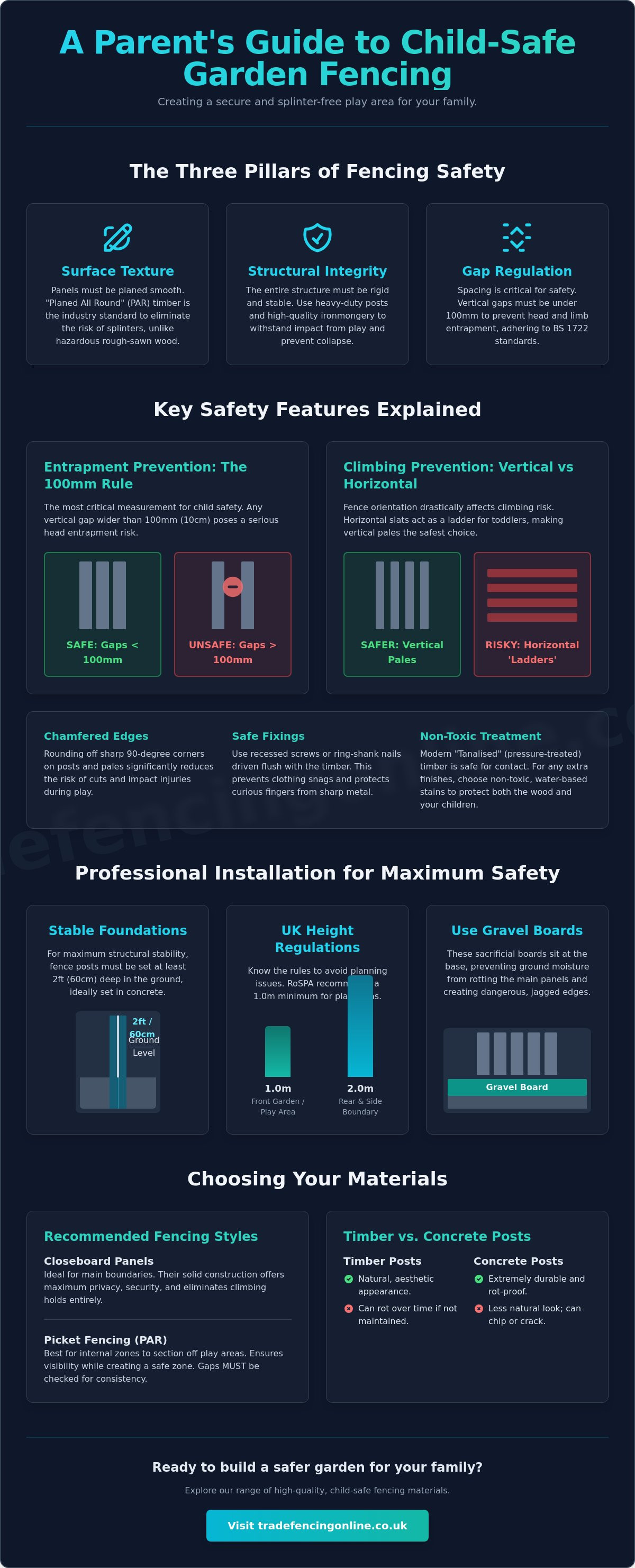
- Surface Texture: Every pale and rail must be planed smooth. This transition from rough-sawn to PAR timber is the most effective way to prevent skin injuries.
- Structural Integrity: Panels and gates must be rigid. We recommend using heavy-duty posts and high-quality ironmongery to ensure the structure can withstand impact play or children leaning on the pales.
- Gap Regulation: Spacing is critical. Gaps between pales should be narrow enough to prevent a child’s head, hands, or feet from becoming trapped. Following BS 1722 standards ensures these dimensions remain safe.
UK Safety Considerations for Families
UK building regulations set clear limits on fence heights. You can install rear and side fences up to 2 metres without planning permission, but front garden fences are restricted to 1 metre. For internal play zones, RoSPA recommends a minimum height of 1.0m to prevent toddlers from climbing over or toppling. Many parents find that solid 6ft panels feel too isolating. In these cases, adding a trellis topper is a practical solution. It maintains the height for security while allowing parents to supervise play from the house. For more details on choosing the right height and style, see our guide to fencing in the UK. This balance of visibility and containment is essential for a functional family garden.
Avoiding Splinters and Traps: Technical Safety Features
Standard trade fencing often prioritizes production speed over tactile safety. For child safe garden fencing, the "Planed Smooth" finish is a non-negotiable requirement. This machining process removes the raised grain and rough fibers that cause deep splinters. Beyond the surface texture, chamfered edges are essential for high-traffic play areas. By rounding off the sharp 90-degree corners of pales and posts, you significantly reduce the risk of impact injuries or cuts during high-energy games. Fixings also require attention. Use recessed screws or ring-shank nails driven flush into the timber to prevent clothing from snagging and to stop curious fingers from finding sharp metal edges.
Entrapment is a technical risk that many DIY installations overlook. The standard safety rule is to keep all vertical gaps under 100mm. This specific measurement is designed to prevent a child’s head from passing through the pales. It also ensures that smaller limbs cannot become wedged between the slats. If you are installing picket fencing, you must check every gap across the entire run for consistency. A single wide gap compromises the entire safety of the perimeter.
Timber Treatment and Child Safety
Modern pressure-treated timber used in the UK is safe for residential contact. These "Tanalised" products use copper-based preservatives that meet current safety standards for gardens. To maintain the integrity of these panels, always install gravel boards at the base of your fence. These boards isolate the main pales from ground moisture. This prevents the wood from rotting and becoming brittle, which is the most common cause of jagged, broken edges at a child's eye level. When applying additional finishes, select only non-toxic, water-based stains.
Eliminating Finger and Foot Traps
The orientation of your fence pales determines how easily a child can scale the boundary. Vertical slats are the superior choice for safety. Horizontal designs often provide natural "ladders" that encourage toddlers to climb. If your garden includes a swimming pool or pond, this security is even more critical. Robust fencing is a primary recommendation for CDC drowning prevention strategies. Ensure your gates are fitted with self-closing hinges and child-resistant latches positioned out of reach. Selecting high-quality fencing components ensures these safety features are built into your garden from day one.
Comparing Child-Friendly Fencing Styles
Choosing the right style of child safe garden fencing depends on whether you are securing the main boundary or creating an internal play zone. While safety is the priority, the design must also serve the garden's practical needs. Different styles offer varying levels of visibility, security, and climb resistance. A well-planned combination of these styles ensures your garden remains a functional family space without looking like a commercial playground.
Picket Fencing: The Traditional Play Area Solution
Picket fencing is the most effective choice for internal demarcation. It allows parents to separate play areas from hazards like ponds or vegetable patches while maintaining a clear line of sight. For safety, you must avoid pointed-top pales. Rounded or flat-top pales are the only suitable option for children's areas, as they remove the risk of injury if a child falls onto the fence. According to RoSPA's official fencing guidelines, these fences should be a minimum of 1.0m high to prevent toddlers from easily toppling over. If you want a more decorative finish, you can integrate trellis sections to soften the boundary while keeping the area visible.
Closeboard and Lap Panels: Boundary Security
When securing the perimeter of your property, you need a "no-escape" solution. Selecting robust fence panels like closeboard or featheredge provides maximum security and privacy. These solid panels are excellent for child safety because they present a flat, vertical surface with very few natural footholds. This design significantly reduces the chance of children attempting to climb the fence. To ensure the highest level of stability, combine these solid panels with concrete posts. This creates a permanent, immovable barrier that won't wobble or fail if children lean against it or use it during active play.
Modern Slatted Panels and Trellis Toppers
Modern garden designs often use slatted panels for a contemporary aesthetic. To keep these safe, always choose vertical slats. Horizontal slats act as a ladder, encouraging children to climb and potentially fall from height. If your existing fence is too low, adding a trellis topper is a professional way to increase the height. This prevents "over-the-top" escapes without blocking light or making the garden feel enclosed. It's a pragmatic way to upgrade your child safe garden fencing while maintaining the professional look of your property. These combinations provide a secure environment that stands up to the demands of a busy family home.
Installation Tips for a Secure Family Garden
Professional installation is the only way to guarantee your child safe garden fencing performs as intended. A fence that wobbles or leans creates a safety hazard regardless of the panel quality. The foundation is the most critical stage. You must set every post at a minimum depth of 2ft (600mm) into the ground. This depth ensures the structure can withstand the weight of the panels and any lateral pressure from active play. Using Postcrete provides a rock-solid base that prevents the fence from shifting or leaning over time.
Securing the Perimeter
When choosing your supports, consider the trade-offs between fence posts made of wood or concrete. Concrete posts are often preferred for child safety because they do not rot, snap, or splinter at the ground level. They provide a permanent, maintenance-free support system that keeps the panels rigid. If you choose timber posts, ensure they are pressure-treated and planed smooth to match your panels. After the installation is complete, perform a thorough walk-through. Check for protruding nails, sharp hardware, or splinters caused by tools during the build. Regular maintenance is required; inspect the perimeter every six months for loose pales or movement in the posts.
Safe Gate Systems
Gates are the most frequent point of failure in a secure garden. To prevent unauthorized exits, install high-level latches that remain out of reach for small children. We recommend using heavy-duty ironmongery that can withstand constant daily use without sagging. Self-closing hinges are a vital safety feature. They ensure the gate returns to a locked position automatically after every use, removing the risk of a gate being left ajar. For driveways, a gate that only opens inward is safer as it prevents it from swinging into a busy pavement or road.
Ground clearance is another vital factor to manage. Ensure there are no gaps at the base of the fence where a child or pet could crawl through. Installing gravel boards is the standard way to close these gaps while protecting the timber from ground moisture. This prevents the wood from becoming brittle and breaking at a child's height. If you want to ensure your boundary is installed to these exact specifications, you can view our fencing installation options to guarantee a professional, secure finish for your home.
Buy Child Safe Fencing in Essex and London
Romford Fencing Ltd is the preferred supplier for local trade and public projects across the region. We understand that child safe garden fencing requires a higher specification of materials than a standard boundary. Our inventory includes planed-smooth pales, rounded-top picket sections, and high-quality fence panels that meet strict tactile safety standards. We don't just sell timber; we provide the professional-grade ironmongery and support systems needed to build a secure play area. Every product in our range is selected for its durability and finish, ensuring your garden remains safe for years.
Logistics shouldn't be a barrier to your project. We offer fast local delivery across Essex and East London for all bulky fencing materials. Whether you need a single gate or a full perimeter of panels and posts, our delivery team ensures your items arrive in top condition. Our trade-grade hardware, including self-closing hinges and high-security latches, provides a professional standard of safety that standard DIY store alternatives often lack. We are a total solution provider for families who value substance and reliability.
Local Expertise in Romford and Beyond
We've served the Essex community as an established local expert for many years. Our team provides pragmatic advice on choosing the right panels for your specific garden layout. We understand the local planning requirements for front and rear boundaries in London and the surrounding boroughs. You can visit our Romford yard to inspect the quality of our planed-smooth timber in person. If you prefer the convenience of digital ordering, our online store allows you to arrange direct-to-door delivery with just a few clicks.
The Trade Fencing Online Advantage
We maintain a comprehensive stock of everything required for a professional installation. This includes everything from heavy-duty posts and gravel boards to post-mix and cement. We offer competitive pricing for high-specification safety fencing because we buy in bulk and pass the value to our customers. Our focus is on efficiency and reliability. We remove the friction from the purchasing process so you can focus on securing your home. Don't settle for rough-sawn trade panels when you can access professional, splinter-free solutions today.
Order Child-Safe Fencing Today and secure your garden with the region's trusted supplier.
Secure Your Garden Perimeter Today
Creating a secure play area requires specific technical standards to prevent injuries. You've seen that planed-smooth timber is essential for a tactile, splinter-free finish and that gap regulation under 100mm prevents dangerous entrapment. These features, combined with professional installation and deep-set posts, ensure your perimeter remains stable and effective for years. Investing in high-quality child safe garden fencing protects your family and maintains your property's professional appearance.
Romford Fencing Ltd provides trade-quality materials at competitive prices. Based in Romford, we offer expert local knowledge to help you select the most durable panels and posts for your specific layout. You'll benefit from our fast local delivery service across Essex and East London; this ensures your bulky materials arrive exactly when you need them. Don't settle for inferior trade panels that compromise on safety. Our stock is ready for immediate dispatch to help you complete your project without delay.
Shop Child-Safe Fencing and Panels at Trade Fencing Online. Build a garden where your children can play freely and safely today.
Frequently Asked Questions
What is the safest gap between fence pales for children?
The safest gap between fence pales is less than 100mm. This specific measurement is designed to prevent a child's head from passing through or becoming trapped. It also stops smaller limbs from getting wedged during active play. Maintaining this consistent spacing across your entire run of child safe garden fencing is essential for reliable perimeter security.
Is pressure-treated timber safe for kids to touch?
Modern pressure-treated timber is completely safe for children to touch. UK standards changed in 2004 to ensure that all residential preservatives are copper-based rather than arsenic-based. These "Tanalised" products are specifically approved for use in gardens and play areas. Once the timber is dry, it poses no risk from tactile contact during daily use.
How tall should a child-safe garden fence be?
A child-safe fence should be at least 1.0m high according to RoSPA recommendations for play areas. This height is sufficient to prevent toddlers from easily climbing over or toppling. For main boundaries, most parents prefer 1.8m (6ft) panels to ensure maximum security. Always ensure the height you choose doesn't include horizontal rails that could be used as climbing steps.
Are concrete or wooden posts safer for a family garden?
Concrete posts are the safer choice for a family garden because they provide superior structural stability. They don't rot, snap, or develop splinters at ground level like timber can. Concrete ensures the fence panels remain immovable even if children lean or play against them. This permanent support system removes the risk of the fence becoming loose or dangerous over time.
Can I make my existing fence child-safe?
You can upgrade an existing fence by sanding rough timber to a "planed smooth" finish. Adding a trellis topper is an efficient way to increase height and visibility without replacing the entire structure. You should also inspect the pales for protruding nails and replace old ironmongery with child-resistant latches. Installing gravel boards can close dangerous gaps at the base of the fence.
What is the best gate latch to keep toddlers inside?
The best option is a high-level, child-resistant latch positioned at least 1.5m from the ground. This ensures the mechanism remains out of reach for toddlers. You should combine this with self-closing hinges to ensure the gate automatically returns to a locked position. Heavy-duty ironmongery is essential to prevent the gate from sagging and creating dangerous finger traps.
Do I need planning permission for a 6ft child-safe fence?
You don't need planning permission for a 6ft (1.8m) fence in a rear or side garden. UK building regulations allow fences up to 2 metres in these areas. However, if the fence is in a front garden or faces a road, the height is restricted to 1 metre. It's always best to check with your local council if you live in a conservation area.
Are slatted fences easy for children to climb?
Horizontal slatted fences are very easy for children to climb because the gaps act as a natural ladder. This creates a significant fall risk and compromises the security of the garden. Vertical slats are the only safe choice for child safe garden fencing. They provide a smooth, upright surface that offers no footholds for curious toddlers or older children.