


A fence shouldn't be a source of anxiety every time the Met Office issues a wind warning. Most standard boundaries fail because they're treated as simple privacy screens rather than engineered structures designed to resist lateral force. If you've ever found your garden exposed after a storm snapped cheap panels at the post line, you know that cutting corners costs more in the long run. Professional storm proof fencing installation requires a specific combination of foundation depth, heavy-duty gravel boards, and wind-resistant panel designs.
You want a boundary that stands straight for 20 years or more, not one that requires propping up after every gale. We'll show you how to select the right components and install them correctly for your specific ground conditions, whether you're dealing with heavy clay or loose soil. You'll learn which posts handle British weather best and the exact methods needed to secure your perimeter against high-velocity gusts. This guide explains how to use postmix and ironmongery to reinforce your structure, ensuring your panels allow wind to pass through without acting like a sail.
Key Takeaways
- Understand how the "sail effect" causes standard lap panels to fail and which materials offer the best wind resistance.
- Compare the structural integrity of concrete and wooden posts to ensure your boundary doesn't lean or snap during a gale.
- Apply the "1/3 rule" for post depth and correct hole diameters to achieve a professional storm proof fencing installation.
- Discover how simple design tweaks, like adding trellis toppers or specific slat gapping, can significantly reduce wind pressure.
- Learn how to source trade-quality panels and gravel boards that are engineered to last 20 years or more in harsh conditions.
What Makes a Fence 'Storm Proof'? Understanding Wind Load
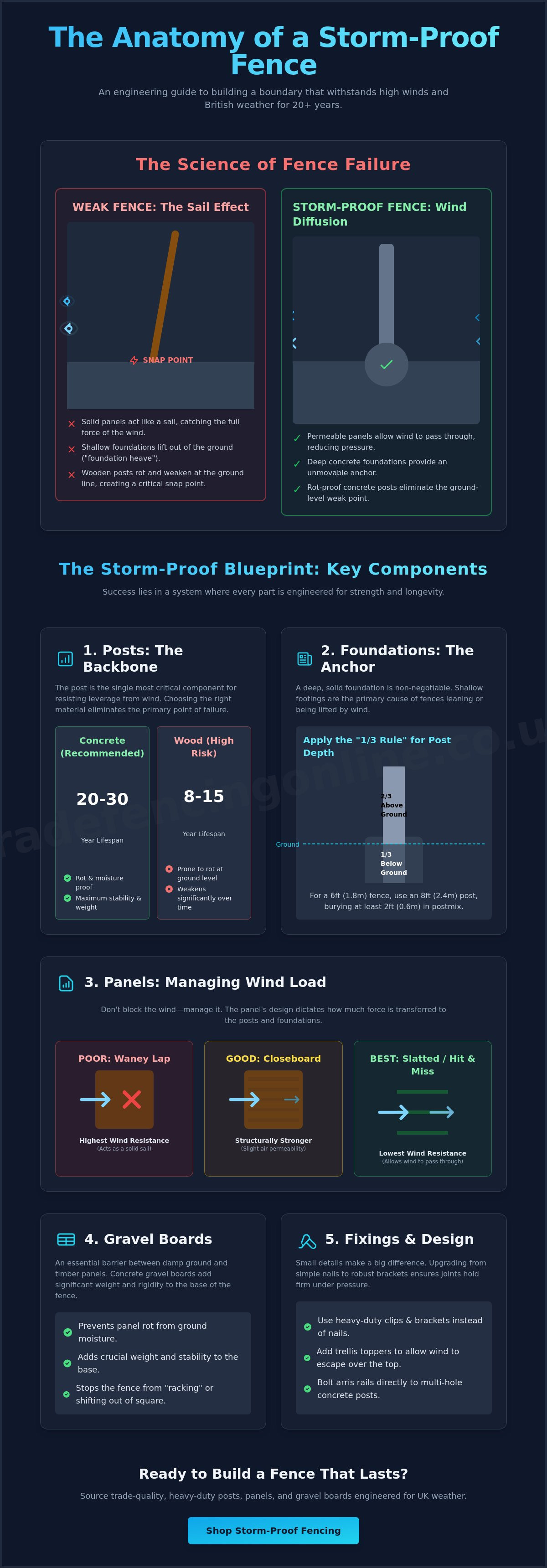
Wind load is the total force moving air exerts on a structure. When you install a solid fence, you're essentially putting a large sail in your garden. This "sail effect" is the primary cause of boundary failure during UK storms. Standard lap panels often fail because they aren't designed to distribute this pressure. The thin featheredge boards are typically held by small staples that pull out under high tension, or the timber splits where the panel meets the post-joint. If the panel doesn't give way, the force moves directly down the structure to the foundation.
Think of a 6ft fence as a giant lever. The wind pushes the top of the panel, and that force is multiplied by the time it reaches the base. This leverage puts immense stress on the post at the ground line. Identifying high-exposure zones is the first step in any storm proof fencing installation. Gardens with open aspects or those positioned in "wind tunnels" between buildings face significantly higher loads than sheltered urban plots. You must account for these forces before you dig your first hole or buy your materials.
The Science of Fence Failure
Most fence posts don't fail in the middle. They snap at the ground line. This is the "snap point" where the wood is most likely to have softened due to moisture and where the leverage force is at its peak. Foundation heave is another common issue. If you use shallow "biscuits" of concrete, the wind can literally lift the post and its base out of the ground. This failure is often caused by pressure differentials. As explained in the principles of wind engineering, wind creates a suction effect on the leeward side of the fence. This vacuum pulls on the structure just as hard as the wind pushes on the front.
Storm Proof vs. Wind Resistant
You need to manage your expectations regarding weather resistance. A "storm proof" fence is built to survive the 70-80mph gusts common in UK yellow and amber weather warnings. Total immunity to 100mph hurricane-force winds is rare and requires specialist engineering. Achieving zero damage requires a specific balance between a rigid foundation and a panel that can handle air pressure. You want a system that stands firm but doesn't act as a solid wall. Choosing trade-quality components like heavy-duty concrete posts and gravel boards provides the necessary weight and stability to resist these environmental loads without failing.
Material Selection: The Best Components for High-Wind Areas
Choosing the right materials is the difference between a fence that lasts three decades and one that collapses during its first winter. You don't need expensive metal systems to achieve a high level of wind resistance. Instead, you need a combination of heavy-duty traditional components engineered for stability. A successful storm proof fencing installation relies on weight and structural integrity at every joint. If you use flimsy panels or undersized posts, the wind will eventually find the weak point and tear the run apart.
Ironmongery is often overlooked but remains vital for base stability. Standard nails frequently pull out when timber swells and contracts in the wind. You should upgrade to heavy-duty clips and arris rail brackets to ensure a mechanical fix that won't budge. Combining these with gravel boards is essential. Gravel boards protect the bottom of your panels from ground moisture and rot, but they also provide a solid, heavy base that prevents the fence from "racking" or shifting out of square under pressure. You can source these trade-quality materials to ensure your build meets professional standards.
Posts: The Backbone of the System
In high-wind areas, concrete fence posts are the ultimate choice for longevity. Research indicates that while timber posts typically last 8 to 15 years, concrete alternatives can last 20 to 30 years without maintenance. Concrete doesn't rot at the ground line, which is where most storm failures occur. When selecting your posts, always allow for extra height to ensure deep foundations. Multi-hole concrete posts are particularly useful for bespoke bracing. They allow you to bolt arris rails directly to the structure, creating a rigid frame that resists the "lever effect" mentioned in the previous section.
Panels: Reducing the Sail Effect
Not all timber panels are created equal. While waney lap panels are cost-effective, closeboard fence panels offer much higher structural integrity. They're constructed from vertical featheredge boards that are thicker and more resilient to impact. If your garden is in a high-exposure zone, consider a "Hit and Miss" design. These panels feature alternating boards on the front and back, which allows air to pass through the fence while maintaining your privacy. This significantly reduces the wind load on your posts. For a premium finish, double slatted panels provide a modern look with the same wind-diffusing benefits.
Step-by-Step Storm Proof Fencing Installation
A fence is only as strong as its anchor. Even the highest quality closeboard panels will fail if the foundation isn't engineered to handle the leverage of a gale. Professional storm proof fencing installation relies on the 1/3 rule. This means at least one-third of your total post length must be below ground. For a standard 6ft fence, you need an 8ft post with a minimum of 600mm (2ft) buried in a solid concrete footing. Anything less creates a pivot point that the wind will eventually exploit.
Avoid the common "pencil in a bucket" mistake. This happens when the hole diameter is too wide for the post, requiring excessive concrete that actually makes the foundation brittle. Your hole should be approximately three times the width of the post. For a 100mm post, a 300mm wide hole is the trade standard. This provides enough mass to resist wind load without wasting materials or creating a foundation that's prone to cracking under lateral pressure.
Setting the Foundation
Digging the perfect hole is the hardest part of the job but the most critical for stability. If you're working in heavy Essex clay, you must account for poor drainage. Water trapped at the bottom of a hole can lead to "foundation heave" during a freeze or cause timber posts to rot prematurely. Add a 50mm layer of 20mm shingle to the base of the hole before positioning the post. This allows water to drain away from the post end. When you're ready to set the post, mixing Postcrete correctly is vital. Pour the water in first, then the powder, to ensure a rock-solid bond without dry pockets at the bottom.
Structural Bracing and Alignment
Lateral support keeps your run straight when the pressure is on. Arris rails should be securely fixed to the posts to provide a rigid framework for your featheredge boards. If you're using concrete posts, ensure your gravel boards are properly slotted or bolted into place. A gravel board shouldn't just rest on the ground; it must be part of the integrated structure to prevent the bottom of the fence from shifting. Always check your levels with every post. A leaning fence isn't just an eyesore; it's a target. Even a slight five-degree tilt significantly increases the wind load on the foundation. Use 50mm or 65mm stainless steel screws rather than nails to fix your panels. Screws offer far better vibration resistance, ensuring the boards don't rattle loose during prolonged storms.
Design Tweaks to Lower Wind Resistance
Engineering a boundary isn't just about strength. It is about aerodynamics. A solid wall takes the full impact of a storm, but a smart design allows air to pass through, reducing the total load on your posts. This approach is a core part of professional storm proof fencing installation. Small adjustments to your layout can prevent the structural failure of your perimeter without sacrificing your privacy.
Gapping is one of the most effective tactics for high-wind zones. Leaving a 10mm gap between vertical slats reduces the sail effect significantly. This is the logic behind hit and miss panels. If you are building in a particularly exposed spot, consider lowering the profile. A 5ft fence has a much shorter lever arm than a 6ft one. This reduction in height makes the structure far less likely to snap at the base or heave the foundation. You might also use strategic planting. A hedge placed in front of a fence acts as a natural baffle, slowing the air before it reaches the timber.
Using Trellis for Aerodynamics
The Trellis Trick is a proven method for protecting boundaries. A trellis topper acts as a wind diffuser. Instead of the wind hitting a solid 6ft barrier, the top foot of the fence breaks the gust into smaller, less powerful streams. Square mesh provides excellent diffusion, while diamond mesh offers a more rigid decorative finish. You must secure these toppers with heavy-duty ironmongery to prevent them from vibrating loose. You can order wind-resistant trellis and ironmongery to upgrade your existing run and improve its chances in a gale.
Alternative Fencing Styles
Some environments require a total departure from solid panels. Picket fencing is the ultimate low-drag option for front gardens. The large gaps between pales mean wind load is almost non-existent. For commercial boundaries or high-exposure perimeters, V-Mesh security fencing provides high-strength protection with minimal wind resistance. If you prefer a traditional look, post and rail with wire mesh offers a classic aesthetic that storms simply cannot move. These styles prioritize airflow, ensuring the structure remains standing when solid alternatives fail.
Source Trade-Quality Fencing in Romford and Essex
Successful storm proof fencing installation starts with trade-grade materials. Romford Fencing Ltd is the primary choice for Essex professionals who need boundaries to stay standing during severe weather. We don't supply flimsy, lightweight panels found in big-box retail stores. Our inventory is built for structural integrity and long-term durability. Buying directly from a specialist ensures your components, from reinforced concrete posts to heavy-duty arris rails, are engineered for the high-wind loads common across the UK. We focus on product integrity so you can focus on a professional build.
Trade professionals and homeowners alike benefit from our bulk pricing and established reputation. Large-scale storm-proofing projects require a high volume of heavy materials; we provide the logistical support to keep these projects moving. We offer trade accounts to streamline your procurement process and ensure you have consistent access to our premium stock. This ensures you have the right ironmongery, gravel boards, and postmix ready when the weather allows for installation. Our business-like approach values substance over style, providing a reliable solution for every boundary requirement.
Local Delivery and Support
We operate an efficient delivery service across East London and the home counties to remove logistical barriers for our customers. Our core delivery zones include Romford, Ilford, and Dagenham; we also provide comprehensive coverage for the wider Essex area. You can speak to our team for expert advice regarding your specific garden aspect and wind exposure. We maintain a deep stock of essential components in our local yard. This means you won't face the long lead times or material shortages often found at general builders' merchants. As of May 2026, our supply chains remain robust, ensuring immediate availability for urgent repairs or new installations.
Get Your Quote Today
You can order your supplies online for quick site delivery. This keeps your project on track and ensures your boundary is secured before the next yellow weather warning. If you have bespoke requirements for security fencing, timber gates, or specific ironmongery configurations, contact the Romford team directly. We provide the professional-grade solutions you need to protect your property and ensure your fence lasts for decades. We are the total solution provider for wind-resistant boundaries in the region. SHOP OUR FULL RANGE OF STORM-READY FENCING SUPPLIES BY VISITING OUR STORE AT TRADEFENCINGONLINE.CO.UK today.
Build a Boundary That Lasts
Building a fence that survives the British winter requires moving beyond standard DIY methods. You've learned that a successful storm proof fencing installation depends on the 1/3 rule for foundation depth and the use of wind-diffusing designs like trellis toppers. By selecting trade-quality concrete posts and heavy-duty closeboard panels, you remove the common failure points that lead to snapped timber and leaning boundaries. These choices ensure your perimeter remains an asset rather than a liability during high-wind events.
We are established experts in Romford, supplying high-spec components that trade professionals trust. Our yard maintains a full inventory of concrete posts, gravel boards, and arris rails ready for immediate dispatch. We offer fast delivery across Essex and East London to ensure you have the materials needed to secure your site before the weather turns. Don't wait for a yellow weather warning to find the weak spots in your perimeter. Take a proactive approach and upgrade your boundary with materials engineered for the task.
Order Storm-Proof Fencing Supplies for Local Delivery
Frequently Asked Questions
What is the best fence for a very windy garden?
Hit and Miss panels are the most effective choice for high-exposure areas. These panels feature alternating boards on the front and back that allow air to flow through the structure. This reduces the sail effect significantly compared to solid lap panels. You maintain your privacy while lowering the physical load on your posts during high-velocity gusts.
How deep should fence posts be for a 6ft fence?
You must dig your holes to a minimum depth of 600mm for a 6ft fence. This follows the industry-standard 1/3 rule, where one-third of the total post length is buried below ground level. Proper depth is the most critical factor in a successful storm proof fencing installation. It ensures the foundation can resist the leverage force applied to the top of the panel during a gale.
Are concrete fence posts better than wood for wind resistance?
Concrete posts provide superior wind resistance because they don't rot or soften at the ground line. Timber posts often fail at this specific snap point after 8 to 15 years of moisture exposure. Concrete alternatives last 20 to 30 years and provide much more mass. This extra weight helps anchor the fence against lateral pressure during severe UK storms.
Can I make my existing fence storm proof?
You can reinforce an existing run by installing arris rail brackets or concrete repair spurs. These components add mechanical strength to weak joints and rotting post bases without requiring a full replacement. Adding a trellis topper is another effective tweak. It breaks up wind gusts at the highest point of the fence, which reduces the total leverage force on the original foundations.
Is Postcrete better than hand-mixed concrete for storms?
Postcrete is the preferred trade choice for speed and reliability. It sets in approximately 5 to 10 minutes, which prevents the post from leaning or shifting while the mixture cures. Hand-mixed concrete is effective but requires careful ratio management to reach full strength. Using a pre-mixed bag ensures a consistent, rock-solid bond every time you set a post.
Do I need planning permission for a taller, stronger fence?
Planning permission is required for any fence exceeding 2 meters in height. If your boundary is adjacent to a highway used by vehicles, the height limit is 1 meter. Always check with your local council in Essex or London before increasing the height of your perimeter. Building a stronger fence within these legal limits doesn't usually require special consent.
How much wind can a standard fence panel withstand?
Standard lap panels often fail when wind speeds exceed 50mph. This happens because they're held together by small staples that pull out under tension. Heavy-duty closeboard panels are much more resilient. When combined with a professional storm proof fencing installation, these panels can withstand the 70 to 80mph gusts common in amber weather warnings.
What is a gravel board and does it help with wind?
A gravel board is a protective barrier that sits between the fence panel and the ground. It prevents the timber from absorbing moisture and rotting at the base. Structurally, it adds weight to the bottom of the fence and creates a solid, integrated run. This helps prevent the fence from "racking" or shifting out of square when the wind pushes against the top panels.