


Last August, a homeowner in Essex was ordered to tear down a £2,500 boundary fence because it exceeded height limits by just 15cm. Dealing with planning permission for fences uk is often seen as a major headache, but ignoring the rules leads to expensive enforcement notices and bitter disputes with neighbours. You want a secure, private garden without the risk of a council-ordered demolition or a legal battle over a boundary line.
It's frustrating when complex local guidelines stand in the way of your home improvements. This complete 2026 guide ensures you understand the latest regulations with total confidence. You'll learn the exact height restrictions for highways versus rear gardens, the strict rules for listed properties, and how to select quality fence panels that comply with the law. We've stripped away the legal jargon to provide a clear, actionable roadmap for your garden. Follow these steps to ensure your new fence is a legal, long-term asset for your property.
Key Takeaways
- Master the 1-metre and 2-metre height rules to avoid legal complications and ensure your garden project remains compliant.
- Identify exactly when planning permission for fences uk is mandatory, particularly for listed buildings or properties under Article 4 directions.
- Settle boundary disputes by learning how to correctly interpret "T" marks on your property deeds and title plans.
- Follow our clear, step-by-step guide to submitting a successful application through the Planning Portal with all required documentation.
- Select the right fence panels and durable concrete posts to guarantee both legal compliance and long-term structural integrity for your garden.
Understanding Fence Planning Permission: The 1-Metre and 2-Metre Rules
Installing a new boundary is a straightforward way to secure your property, but you must follow the legal height limits. In 2026, most residential projects fall under Permitted Development rights. These rights allow you to build or improve a fence without a full planning application. However, you must stick to the strict height restrictions set by your local council. For most rear and side garden boundaries, the maximum height allowed is 2 metres. If your project exceeds this, you will need to secure planning permission for fences uk before starting work.
Correct measurement is vital to stay compliant. You must measure the height from the highest point of the natural ground level immediately adjacent to the fence. Don't measure from the bottom of a ditch or a man-made mound. If your garden sits on a slope, the height is taken from the highest side of the ground. This ensures your 2-metre fence doesn't accidentally become a 2.5-metre structure in the eyes of the law. For those seeking general information on fences and their historical use, the core purpose of defining boundaries remains the same, but modern UK regulations are very specific about these dimensions.
What Counts as Permitted Development for Fencing?
Most garden fencing projects fall under Class A, Part 2 of the General Permitted Development Order 2015. This legislation allows you to maintain, improve, or alter an existing fence. You don't need new permission if the height remains the same. You can also take down a fence without permission in most cases. However, if your property is in a conservation area or involves a listed building, these rights are often restricted. Always check your title deeds for restrictive covenants that might override general planning permission for fences uk rules. Our customers often find that standard 6ft panels (1.83m) plus a gravelboard fit safely within the 2-metre limit.
The 1-Metre Rule: Highways and Footpaths Explained
The rules change when your fence is adjacent to a highway used by vehicles. In these locations, the height limit drops to 1 metre. A highway includes any public road, private road, or public footpath. Councils enforce this lower limit to maintain visibility splays for drivers and pedestrians. If a 2-metre fence blocks the view at a junction, it becomes a safety hazard.
You can sometimes bypass the 1-metre rule by using a "setback" design. If you move the fence back from the highway boundary, usually by 2 metres or more, the council may allow the standard 2-metre height. This depends on the specific layout of the road and pavement. Always confirm the exact boundary line before you order your materials. Using a trusted supplier ensures you get quality products that meet these legal standards without the fuss.
When Planning Permission is Mandatory: Listed Buildings and Article 4
The biggest mistake homeowners make is assuming the "2-metre rule" applies to every property. It doesn't. If your home sits on "designated land," your Permitted Development rights are often restricted or removed entirely. This includes National Parks, Areas of Outstanding Natural Beauty, and Conservation Areas. In these locations, the local authority prioritises the visual character of the neighbourhood over your personal preference. You must check the official government guidance before you start any work. Rules differ significantly based on your specific boundary location and how it affects the street scene.
Fencing and Listed Buildings
Listed buildings have the strictest regulations in the UK. Any structure within the curtilage of a Grade I, Grade II*, or Grade II listed property is protected. This protection includes existing boundary walls and any new fences you intend to install. Adding a small trellis to the top of an old brick wall might seem minor, but it often requires Listed Building Consent. Unauthorised work on a listed property is a criminal offence. It can lead to unlimited fines or demands to undo the work at your own expense. Always consult the Historic England database to confirm your building's status before you buy your traditional closeboard panels. If you're unsure, a quick call to your local planning officer saves thousands in potential legal costs. Professional installers always recommend getting written confirmation before starting work on historical boundaries.
Article 4 Directions: Why Your Council Might Have Said No
Local councils use Article 4 Directions to strip away specific development rights from a street or estate. This is common in parts of Essex and East London, such as Havering or Redbridge. Councils implement these directions to preserve an "open plan" feel in specific residential areas built during the 1960s and 1970s. If an Article 4 is in place, you will need planning permission for fences uk even for a standard 1-metre front garden fence. Check your local council website for "Article 4 maps" to see if your postcode is affected. These restrictions are legally binding and override standard national rules. It's better to verify this now than to receive an enforcement notice after your fence is up. Once you have the green light from the council, you can browse our range of quality fence panels to find a style that meets local requirements. We focus on providing durable, high-value products that satisfy both homeowners and local authorities.
Boundary Rules and Neighbour Disputes: Who Owns the Fence?
Don't rely on the common myth that you always own the fence on the left or right side of your property. No UK law dictates ownership based on orientation. Ownership is determined by the Title Deeds of the property. If your deeds don't specify, you might need to check the 1925 Land Registration Act principles or look for "T" marks on your property plan. A "T" mark pointing into your property indicates that the boundary and the fence are your responsibility. If you see an "H" mark, which is two "T" marks joined together at the boundary line, the fence is shared. This is known as a party fence. In these cases, you and your neighbour share the costs of maintenance and replacement. Consulting with neighbours before starting work is the best way to avoid a legal dispute. Even if you're certain of the boundary, a quick conversation prevents friction. If you're replacing a fence, refer to this complete guide to choosing fence panels for advice on "good side" orientation. While not a legal requirement, placing the "good" side toward your neighbour is a standard courtesy that often prevents complaints.Identifying Boundary Ownership
If your Title Deeds are unclear, you can obtain copies from the Land Registry for a small fee, typically around £3 for a digital title register. If the deeds are silent on ownership, the boundary is usually considered shared. Fences built entirely within your own land belong to you, but you must ensure the footings don't encroach on the neighbouring property. The Planning Portal guidance on fences confirms that while ownership is a civil matter, the height of the structure remains subject to local authority rules. If you build a fence on the boundary line without a party wall agreement, your neighbour could legally demand its removal.Trellis Toppers and Height Loopholes
Many homeowners believe that adding a trellis to the top of a 2-metre fence is a legal loophole. This is incorrect. In the eyes of the law, a trellis is a permanent structure. It counts towards the total height of the fence. If your fence is 1.8 metres tall and you add a 0.3-metre trellis, the total height is 2.1 metres. This exceeds the standard 2-metre limit for which you don't usually need planning permission for fences uk. Don't assume that because a trellis is "open" or "see-through" it's exempt from height restrictions. Local planning authorities treat any fixed addition as part of the main boundary. However, you can use a trellis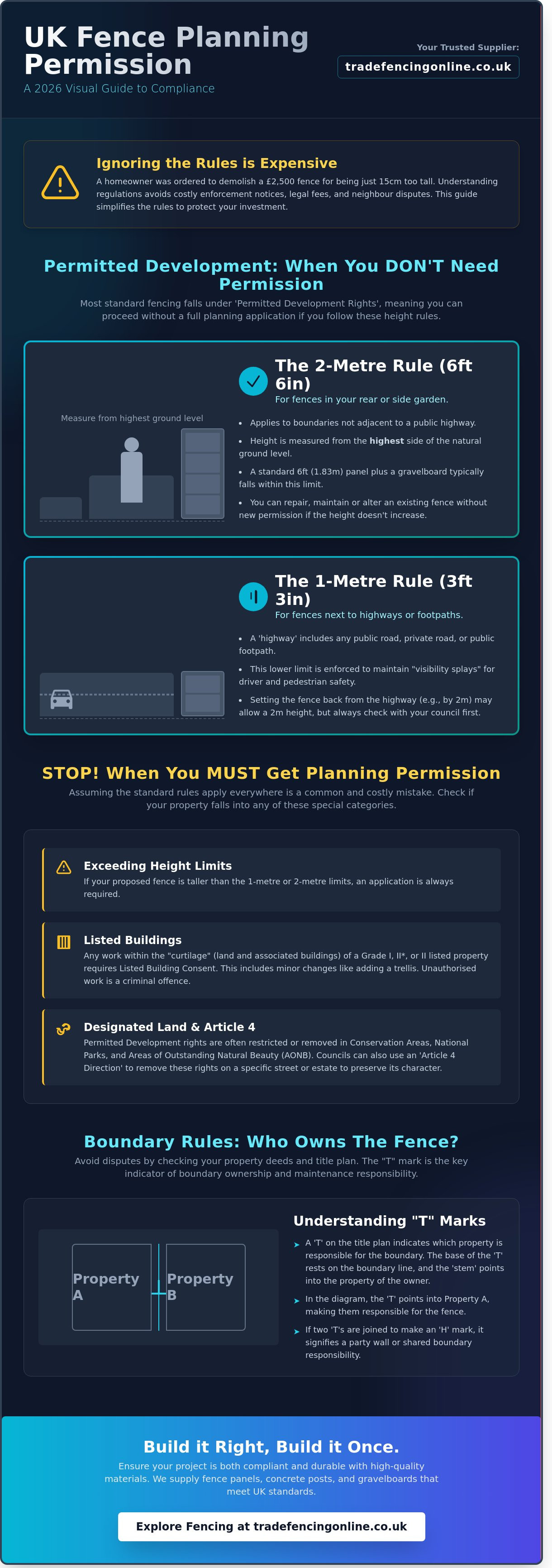
How to Apply for Fencing Planning Permission in the UK
Applying for planning permission for fences uk is a technical but logical process. You should submit your application through the Planning Portal, which serves as the national gateway for planning applications in England and Wales. The process begins by selecting your local authority and completing the "Householder Planning Consent" form. This form is specifically designed for domestic projects like new boundaries or extensions.
Your application requires a specific set of supporting documents to be considered valid. You must provide:
- A Site Location Plan: Usually at a scale of 1:1250 or 1:2500, showing the property in its wider context.
- A Block Plan: Often at 1:200 or 1:500, detailing the exact position of the proposed fence on your land.
- Elevations: Scaled drawings (1:50 or 1:100) showing the fence from the side and front, detailing its height and appearance.
- The Correct Fee: As of the 2024 statutory updates, the householder application fee in England is £258. Expect this to be the baseline for 2026, though you should check for local inflationary increases.
Once you submit the paperwork, the council starts a consultation period. The typical timeline for a decision is 8 weeks. During this time, planning officers may visit your site and neighbours can submit comments.
Preparing Your Application
Accuracy prevents delays. Your scale drawings must be professional; use 1:50 or 1:100 scales so the planning officer can verify the exact height against your boundary line. Don't just rely on drawings. Including high-quality photos of the existing site and neighbouring fences helps the council see that your proposal fits the local character. If you live in a Conservation Area or an Area of Outstanding Natural Beauty, you will likely need a Design and Access Statement. This document justifies your choice of materials and explains how the fence maintains the visual integrity of the area.
Enforcement: What Happens if You Ignore the Rules?
Building without permission is a significant risk. If a neighbour complains or an officer spots the breach, the council can issue a Planning Enforcement Notice. This legal order requires you to remove the non-compliant fencing or reduce its height at your own expense. You might hear about the "4-year rule," which suggests that if a fence stays up for four years without a complaint, it becomes immune from enforcement. Don't rely on this. Recent legislative changes in 2024 have moved many enforcement windows toward a 10-year limit. Furthermore, unauthorised fencing creates massive headaches during property surveys. If you can't produce a Lawful Development Certificate, it can delay or even ruin a house sale.
Choosing Compliant Fencing: Quality Panels and Posts for Your Project
Selecting the right materials is the final step in ensuring your project remains legal. Standard UK height regulations are strict. For front gardens adjacent to a highway, you must generally keep the height at 1 metre, which is approximately 3ft 3in. Rear garden boundaries usually allow for 2-metre heights, roughly 6ft 6in. Choosing the correct height panels from the start prevents costly mistakes and ensures you don't fall foul of planning permission for fences uk rules.
Structural integrity is just as important as height. Using concrete fence posts provides a level of durability that timber cannot match. Concrete doesn't rot at the ground level. It offers a solid, permanent foundation that withstands high winds and heavy rain. This ensures your fence remains safe and upright, satisfying both your neighbours and any potential council inspections.
Buying from a trusted fencing supplier near me ensures you receive products manufactured to standard UK sizes. Trade Fencing Online is the pragmatic choice for both trade professionals and the public in Essex. We focus on providing high-quality, dependable goods that do the job right the first time. We remove the guesswork by supplying panels and posts that fit standard dimensions perfectly.
Matching Material to Regulation
Traditional closeboard or lap panels are the most common choices for meeting the 2-metre limit. These panels are robust and provide excellent privacy. You must account for the total height of the structure. Many homeowners forget that gravel boards add to the overall height. If you install a 6ft panel on top of a 1ft gravel board, your fence hits 7ft. This exceeds the 2-metre limit and will require planning permission for fences uk. Always measure the total height from the highest ground level on either side of the boundary. Finish your project with high-quality ironmongery and gates that complement your planning-approved design.
Reliable Delivery in Essex and East London
Romford Fencing Ltd provides a fast local delivery service for all your fencing supplies. We understand that timing is critical for any construction project. Our trade-quality products are designed for longevity. They help you build a fence that stays strong for decades, not just a few seasons. We serve the Essex and East London areas with a focus on efficiency and value. Our reputation as a trusted supplier is built on providing the right products at the right price without any unnecessary fuss.
FOR QUALITY FENCING, CALL ROMFORD FENCING LTD TODAY OR EMAIL OUR TEAM.
Browse our full range of compliant panels and posts today and get your project started with confidence.
Secure Your Boundary with Confidence
Navigating planning permission for fences uk doesn't need to be a headache. Stick to the 1-metre height limit for road-facing boundaries and the 2-metre rule for rear gardens to stay within permitted development rights. Always verify if your property is subject to Article 4 directions or listed building status; these specific designations override standard rules and require formal applications. Getting the legal side right saves you from costly council enforcement notices later.
Once you've confirmed your project is compliant, choose materials that last. Trade Fencing Online is a trusted Romford-based supplier with a consistent record of 5-star reviews from local tradespeople and homeowners. We maintain a huge stock of high-quality concrete and timber products, ready for immediate use. Take advantage of our free local delivery options to get your site moving quickly without any unnecessary delays.
Order your trade-quality fence panels and posts for fast delivery across Essex and East London today. Build a boundary that's both legal and built to last.
Frequently Asked Questions
Do I need planning permission for a 6ft fence in my back garden?
You don't need planning permission for a 6ft fence in your back garden because it sits under the 2-metre height limit. Most UK residential properties have permitted development rights that allow for boundaries up to this height. If your garden doesn't border a public road, you can install our quality fence panels immediately. Always check if your property is a listed building or located within a conservation area before starting work.
Can my neighbour build a 2-metre fence without my permission?
Your neighbour can build a 2-metre fence on their own land without your consent. Planning laws allow any homeowner to erect a structure up to this height under permitted development rules. You only have a legal say if the fence crosses the boundary line or violates a specific restrictive covenant in the property title deeds. We recommend checking your deeds to confirm exact boundary locations before raising a dispute.
Does a trellis on top of a fence count towards the 2-metre height limit?
Yes, a trellis is included in the total height calculation for planning permission for fences uk. The 2-metre limit applies to the entire structure measured from the highest adjacent ground level. Adding a 30cm trellis to a 1.8-metre fence takes the total to 2.1 metres, which requires a formal application. Don't assume the trellis is exempt just because it's decorative or see-through.
What is the maximum height for a fence next to a road or pavement?
The maximum height for a fence next to a road or pavement is 1 metre. This rule applies to any boundary that borders a highway used by motor vehicles. If you want a taller fence in this specific location, you must submit a planning application to your local council. This restriction exists to ensure clear sightlines for drivers and pedestrians to maintain safety on public paths.
Is there a "loophole" to build a taller fence in the UK?
There's no legal loophole for a taller fence, but you can use natural screening like hedges. Hedges don't have the same strict height restrictions as timber fencing under current UK planning laws. Another option is the four-year rule. If a tall fence stays up for 4 years without the council taking enforcement action, it typically becomes immune from prosecution and can remain in place.
Do I need permission to replace an existing fence that is already over 2 metres?
You need permission to replace a fence that's over 2 metres unless the new replacement is lower. Even if the old fence stood for 30 years, a new installation must comply with current planning permission for fences uk regulations. You can perform minor repairs to an existing tall fence. However, replacing the entire run with new materials requires a fresh application to the local planning office.
How much does a planning application for a fence cost in 2026?
A householder planning application for a fence in England currently costs £258. This fee is set by the government and applies to most residential boundary projects. You might also face extra costs for professional drawings or site location plans required for the submission. Check the Planning Portal website for the most recent fee updates because prices often change annually in April.
What happens if I build a fence without planning permission?
The local council will issue an enforcement notice requiring you to remove or lower the fence. You'll usually have 28 days to appeal the notice or comply with the instructions. If you ignore the notice, the council can prosecute you in a magistrates' court, which results in a fine. It's much cheaper to buy the right height fence panels from a trusted supplier from the start.