


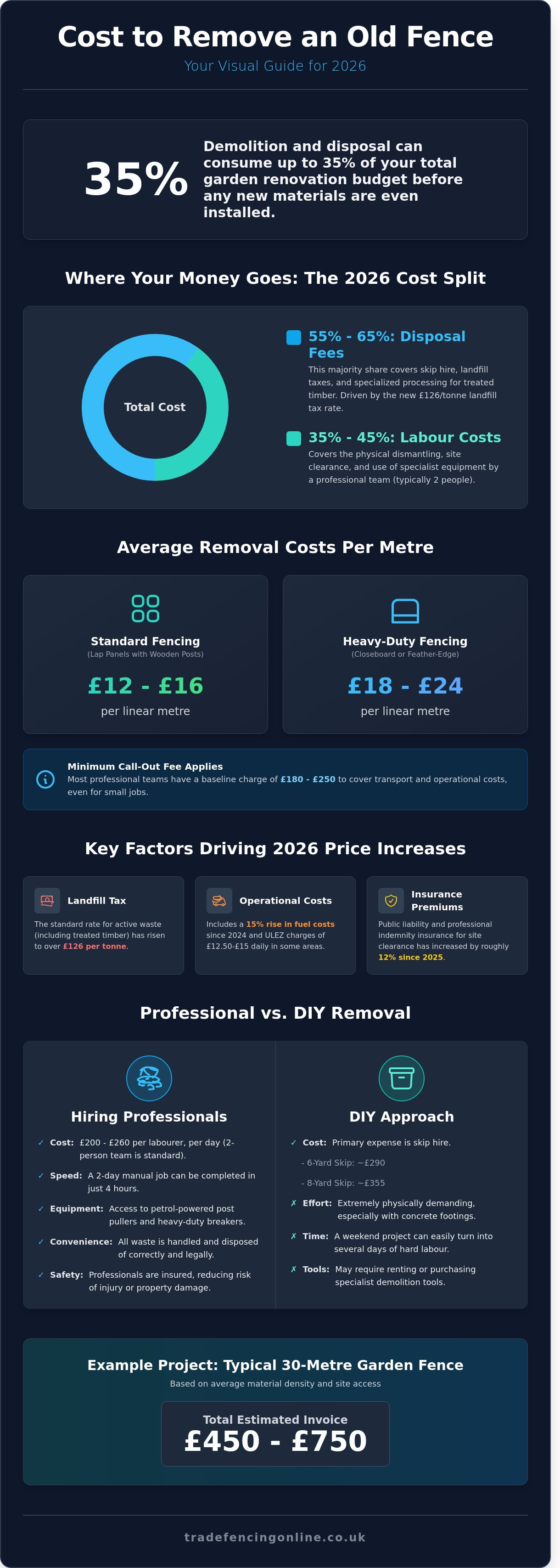
What if the most expensive part of your garden project isn't the new timber, but the rotted panels and concrete-set posts you're replacing? Many UK homeowners find that disposal fees and labour for demolition can eat up 35% of their total renovation budget before a single new nail is driven. You likely already know that clearing a site is back-breaking work, especially when dealing with heavy gravelboards and stubborn footings. It's a messy, necessary step that requires careful planning to avoid unexpected bills.
This guide provides a clear, pragmatic breakdown of the cost to remove old fence 2026 to help you budget with confidence. We'll examine how 2026 landfill tax changes and local skip permit requirements affect your final bill. You'll see the price difference between professional labour and DIY skip hire, ensuring you find the most efficient route for your project. We'll help you secure a realistic budget for demolition so you can focus on your new installation from a trusted supplier.
Key Takeaways
- Get the latest figures on the cost to remove old fence 2026, including per-metre rates for standard 3ft and 6ft panels.
- Understand the split between professional labour rates in Romford and essential waste disposal fees to avoid hidden charges.
- Identify how specific site conditions, such as concrete-set posts and restricted garden access, can significantly impact your final quote.
- Evaluate the physical demands and tool requirements of a DIY takedown to decide if the potential savings outweigh the manual effort.
- Learn how to streamline your project by coordinating professional removal with the delivery of high-quality replacement materials from Romford Fencing.
Average Cost to Remove an Old Fence in 2026
Removing a damaged or dated boundary is the essential first step for any garden renovation. The cost to remove old fence 2026 homeowners should budget for typically ranges between £12 and £25 per linear metre. This price includes the physical dismantling of the panels and the removal of posts from the ground. Total project costs are influenced by the volume of waste and the weight of the materials involved.
Labour rates have seen a steady climb leading into 2026. Contractors now face higher operational overheads, including a 15% rise in fuel costs since 2024 and increased vehicle maintenance fees. Most professional teams will not attend a site for less than a minimum call-out fee. In 2026, this baseline charge usually sits between £180 and £250. This covers the cost of getting a crew and a waste disposal vehicle to your property, even for very small runs of fencing.
Price per Metre Breakdown
Standard lap panels with wooden posts are the most affordable to strip out. You'll likely pay £12 to £16 per metre for these lighter materials. If you're dealing with premium, heavy-duty closeboard or traditional feather-edge fencing, the price increases to £18 or £24 per metre. These systems are often nailed to substantial arris rails and thick posts, requiring more time and effort to deconstruct. For a typical 30-metre garden boundary, expect a total invoice between £450 and £750 depending on the material density.
Panel height also dictates the final quote. A 3ft trek through a garden with low panels is fast work. However, 6ft panels effectively double the weight of the waste. When planning your project, check UK fencing regulations to ensure your replacement height stays within legal limits, as this also affects future disposal costs.
Why 2026 Pricing is Different
The primary driver for the cost to remove old fence 2026 is the updated landfill tax. As of April 2026, the standard rate for active waste has risen to over £126 per tonne. Garden waste, particularly pressure-treated timber, is classified as active waste and cannot be disposed of cheaply. This tax alone adds a significant margin to every contractor's quote compared to previous years.
Location is a major factor for those in the South East. Expanded congestion zones and ULEZ requirements in East London and parts of Essex now add daily charges of £12.50 to £15.00 for non-compliant plant machinery and older vans. Contractors must pass these costs on to remain profitable. Additionally, professional indemnity and public liability insurance premiums for garden demolition and site clearance have increased by roughly 12% since 2025. This ensures that your property is protected during the removal process, but it does reflect in the final price per metre.
Labour Costs vs. Disposal Fees: Where Your Money Goes
Understanding the cost to remove old fence 2026 requires a clear breakdown of where your budget is actually spent. You aren't just paying for someone to pull up timber. The total price splits into physical labour and professional waste management. In many Romford and Essex projects, disposal fees now account for 55% to 65% of the total invoice. This shift is due to rising landfill taxes and stricter processing requirements for treated timber.
Professional contractors provide a transparent split. They separate the time spent on-site from the external costs of skips or waste transfer stations. This clarity helps you see the value in hiring a specialist. A local expert handles the heavy lifting and ensures the site is ready for your new quality fence panels without leaving a mess behind.
Professional Labour Rates
Fencing labourers in the Essex area typically charge daily rates between £200 and £260 per person. Most reputable firms send two-person teams as standard. This setup is a safety requirement. Handling heavy concrete gravel boards or 2.4-metre posts alone is dangerous and inefficient. A two-man team works faster and reduces the risk of property damage.
The value of professional labour lies in their equipment. Specialists use petrol-powered post pullers and heavy-duty breakers. These tools turn a two-day manual struggle into a four-hour job. You pay for the speed and the specialist demolition kit that a standard DIY approach lacks. Efficiency on the first day means your garden is ready for installation much sooner.
For homeowners in Hampshire and the South of England, engaging a specialist firm like Helyers of Hampshire (helyers.co.uk) ensures the removal process is handled as part of a broader landscaping vision, minimizing the downtime between site clearance and the installation of new garden features.
The Logistics of Waste Disposal
Disposing of old timber and concrete is the most complex part of the job. You can't simply put old fence panels in a standard household bin. In 2026, a 6-yard skip for garden waste in Romford costs approximately £290, while an 8-yard skip averages £355. These prices reflect the high cost of processing chemically treated wood, which requires specific handling at waste centres.
"Man and van" services offer a flexible alternative to skips. These services usually cost between £160 and £270 per load. They are often faster because the team loads the vehicle immediately. However, the "hidden" cost here is legal compliance. You must verify that any contractor holds a valid waste carrier licence. Following official waste disposal regulations protects you from heavy fly-tipping fines. If your waste is dumped illegally, the homeowner is often held liable. Using a trusted supplier ensures your old garden materials are tracked and recycled properly.
Key Factors That Impact Your Fence Removal Quote
Estimating the cost to remove old fence 2026 depends on several physical variables. Contractors don't just look at the length of the fence. They assess the total weight of the materials and the time required to clear the site. Concrete-set posts are the biggest time sink. A standard 100mm timber post driven into soil might pull out in five minutes. A concrete post set in a 600mm deep footing often requires a jackhammer or hours of manual excavation. This can easily double the labour portion of your quote.
Vegetation overgrowth is another common hidden cost. Thick ivy, brambles, or established hedges must be cleared before the panels are even accessible. Clearing a 10-metre stretch of heavy ivy can add three hours of labour to the job. Ground conditions also dictate the pace. Working on a steep slope or in heavy London clay is physically demanding. It's significantly slower than working on flat, sandy soil where posts come out with less resistance.
The Concrete Post Factor
Removing concrete footings is the most labour-intensive part of any removal project. Contractors typically use two methods: manual digging or mechanical jackhammers. Full removal is the best option if you're installing a new fence in the same position. However, concrete disposal costs more than wood because of the sheer weight. A single concrete post and its footing can weigh over 90kg. If you're on a tight budget, consider asking the team to cut the posts at ground level. This avoids the high cost of excavation and heavy waste disposal.
Access and Site Complexity
Site access dictates how fast the team can work. If the waste must be carried through a narrow side gate or through a terraced house, expect higher labour fees. Every extra 10 metres the team carries heavy, waterlogged panels adds to the time on site. You must also consider your legal duty of care for waste. You're responsible for ensuring your contractor is a registered waste carrier. Working around existing structures like sheds, decking, or greenhouses adds risk. This requires slower, more precise work to avoid accidental damage. Shared boundaries also require coordination with neighbours to ensure access and prevent damage to their property.
DIY Fence Removal: Is the Saving Worth the Effort?
Removing a domestic fence is a labour-intensive task that many homeowners underestimate. If you're tackling 20 or more panels and posts, you're looking at shifting approximately 600kg of timber and concrete. This isn't just a weekend hobby; it's heavy manual labour. The cost to remove old fence 2026 might seem high when hiring a pro, but doing it yourself requires significant physical stamina and specific safety precautions.
Safety is the primary concern for any DIYer. Always check for underground utility cables before digging out posts. Striking a power line with a spade or post-hole digger is a lethal risk. Use a CAT scanner if you're unsure of the layout. You also need to manage heavy lifting. A standard 6ft fence panel weighs around 25kg when dry, but old, waterlogged timber can weigh 40kg or more. Lifting these alone often leads to avoidable back injuries.
Essential Tools for the Job
You can't do this job with a standard hammer. You need a reciprocating saw to cut through stubborn timber and a heavy-duty crowbar for prying. A 14lb sledgehammer is essential for breaking up concrete "globs" around post bases. Don't skip PPE. Heavy-duty gloves, eye protection, and steel-toe boots are mandatory to handle splintered wood and rusted nails. In 2026, hiring a hydraulic post-puller costs roughly £55 per day. This tool is vital if you want to avoid hours of manual digging.
The "Hidden" DIY Costs
The cost to remove old fence 2026 includes more than just your time. Van hire for a single day now averages £95 plus fuel. Most UK recycling centres have strict rules regarding "trade-sized" waste. While the government removed some DIY waste charges in 2024, many councils still limit free disposal to two large items or bags per week. A 20-panel fence far exceeds this limit, meaning you'll likely face commercial tipping fees or multiple trips. Professionals have the experience to drop panels without crushing your garden features or damaging existing gravelboards.
Save yourself the stress and get the right materials for the replacement early. Buy quality fencing online to ensure your new perimeter is ready to go as soon as the old one is cleared.
Planning Your Replacement with Romford Fencing
Removing an old fence is only half the job. You need a clear plan for what comes next to avoid leaving your property exposed. Timing the removal of your current structure with the arrival of new materials prevents security gaps in your garden. By 2026, logistics and fuel costs are expected to stay high, so ordering your fencing supplies in bulk is a smart financial move. It reduces multiple delivery fees and ensures you have every component on-site for a single, efficient installation phase.
We highly recommend using concrete fence posts for long-term stability. Unlike timber, concrete does not rot at the ground level. This choice significantly reduces the cost to remove old fence 2026 projects in the future. Why? Because the posts remain in place permanently. You only need to slide out the old panels and slide in the new ones, cutting down on future labour and disposal costs.
Lowering Future Removal Costs
Invest in quality from the start to save money later. Choosing pressure-treated fence panels adds years to the lifespan of your boundary. Always include gravel boards in your order. These act as a vital barrier between the damp soil and the wooden panels, preventing premature decay. Modular fencing systems are also a pragmatic choice. They allow you to replace a single damaged section without dismantling the entire run. This makes future repairs simpler and far more cost-effective.
Fast Delivery for Your Project
Efficiency is our priority at Romford Fencing Ltd. We coordinate our local delivery service across Essex and East London to match your project timeline. You can arrange for your old fence to be cleared just as our driver arrives with your new materials. This keeps your garden secure and your workspace tidy. We are your one-stop-shop for everything fencing, providing the reliability you need for a professional finish. The total cost to remove old fence 2026 becomes much more manageable when the replacement process is this streamlined.
FOR QUALITY FENCING, CALL ROMFORD FENCING LTD TODAY OR EMAIL OUR TEAM FOR A COMPLETE PROJECT QUOTE.
Plan Your 2026 Fence Replacement Today
Clearing a boundary is the essential first step to a secure garden. You now understand how labour rates and waste disposal fees dictate your total budget. Accurate planning ensures the cost to remove old fence 2026 doesn't catch you off guard during the demolition phase. Professional removal saves significant time, but a DIY approach can reduce initial spend if you have the right tools and transport for waste. Once the old timber is gone, focus on high-quality replacements that stand the test of time.
Trade Fencing Online is a trusted Romford Fencing Ltd supplier. We provide trade-quality materials at unmatched prices for every project size. You can choose from various free local delivery options to keep your project moving without delays. It's important to choose durable products that won't require frequent repairs. Don't let a broken fence compromise your home's security or kerb appeal any longer.
Order your new fence panels and posts from Trade Fencing Online today
Start your garden transformation with confidence and get the professional finish your property deserves.
Frequently Asked Questions
Do I need a permit to remove my own garden fence in the UK?
You don't usually need a permit to remove a fence on your own property in the UK. Check with your local planning office if your home is a listed building or sits within a conservation area. Article 4 Directions can restrict changes to your property's exterior. If the fence borders a highway and is over 1 metre tall, or 2 metres elsewhere, different rules apply for its replacement under the Town and Country Planning Order 2015.
How much does it cost to dispose of old wooden fence panels at a tip?
Most UK local authority Household Waste Recycling Centres allow residents to dispose of wooden fence panels for free if they arrive in a car. If you use a van or trailer, you must apply for a permit through your council website. Commercial waste rates in 2024 averaged between £150 and £200 per tonne at private transfer stations. Check your local council's specific vehicle restrictions and booking requirements before travelling.
Can I burn my old fence panels in my garden?
You shouldn't burn old fence panels in your garden. Most modern and vintage fencing is treated with chemicals like copper chrome arsenic or creosote that release toxic fumes when ignited. The Environmental Protection Act 1990 prohibits smoke that causes a nuisance to neighbours. Local councils can issue abatement notices and fines up to £5,000 for persistent domestic smoke nuisance that interferes with the use of nearby properties.
Is it cheaper to hire a skip or a man with a van for fence removal?
Hiring a man with a van is typically cheaper for smaller volumes of waste. A 6-yard skip costs between £250 and £300 on average in 2024, whereas a waste clearance service might charge £100 to £150 for a partial load. Choosing a man with a van also removes the need for a £50 to £100 skip permit if the container sits on a public road. Always ensure the trader has a valid Waste Carrier Licence.
How long does it take for a professional to remove 100ft of fencing?
A professional team of two can usually remove 100ft of standard fencing in 4 to 6 hours. This timeframe assumes the posts are set in soil rather than deep concrete. If the team needs to jack out heavy concrete footings, the job can take a full 8-hour working day. Factoring in these variables helps determine the total cost to remove old fence 2026 projects and ensures your site is ready for new gravelboards and panels.
Should I remove the concrete footings or just cut the posts?
You should remove the concrete footings if you plan to install new fence posts in the same positions. Leaving old concrete in the ground creates obstacles for new gravelboards and post holes. If you're shifting the fence line, you can cut timber posts at ground level and cover them with soil. Removing concrete adds roughly 30 minutes of labour per post but provides a clean slate for the new installation.
Will a fencing contractor include removal in their installation quote?
Most fencing contractors provide removal and disposal as an optional line item rather than a standard inclusion. Ask for a "supply, fit, and clear" quote to avoid hidden costs. Disposal fees currently make up approximately 15% to 25% of a total project invoice. Ensure the contractor holds a valid Waste Carrier Licence from the Environment Agency before they take your old panels away to avoid fly-tipping liability.
What happens if my old fence contains hazardous materials like old creosote?
Old fencing treated with coal-tar creosote before the 2003 UK ban is classified as hazardous waste. You can't dispose of these panels in standard skips or at most local tips. You must contact a specialist waste contractor or a hazardous waste transfer station. These facilities charge higher rates, often starting at £250 per tonne, to ensure the chemicals don't leach into the environment during the disposal process.