


The cheapest fence panel on the market today often becomes the most expensive investment you'll ever make for your garden. Most homeowners in Essex and London choose traditional timber because the initial price tag is lower, but the composite fencing vs wood cost gap closes much faster than you might think. It's frustrating to realise that a bargain timber install can double in price after just five years of sanding, staining, and replacing rot-damaged boards. You want a quality garden that looks professional without the hidden costs of constant upkeep.
This guide cuts through the marketing noise to deliver a clear price comparison for 2026. We provide a direct 10-year total cost of ownership breakdown to help you understand if the higher upfront price of composite actually saves you money. From weathering the damp UK winters to resisting the summer sun, you'll discover which material offers the best ROI for your property. We break down the installation figures and maintenance schedules so you can make a confident, value-driven decision for your home today.
Key Takeaways
- Compare upfront material prices for panels and posts to understand the initial "sticker shock" of different fencing options.
- Expose the hidden long-term drain on your wallet caused by the recurring costs of timber preservatives, oils, and maintenance labour.
- Use our 20-year financial outlook to find the break-even point where composite fencing vs wood cost shifts in favour of the more durable material.
- Evaluate how choosing concrete, wood, or composite posts significantly impacts your total installation quote and long-term ROI.
- Determine if your project requires the immediate savings of traditional timber or the "set and forget" peace of mind offered by high-quality composite.
Upfront Costs vs. Long-Term Value: The Fencing Price Gap
Choosing between materials requires a look beyond the initial receipt. The composite fencing vs wood cost debate usually starts with sticker shock when homeowners compare a basic timber quote to a premium composite estimate. Traditional wood is the budget-friendly choice for immediate installation. Composite is a long-term financial strategy for your property. You aren't just buying panels; you're buying decades of reclaimed weekends and zero maintenance bills.
Total Cost of Ownership (TCO) is the metric that matters most for UK garden boundaries. A cheap timber fence might need replacing twice in the time one composite fence remains standing. UK inflation has hit timber prices hard, with construction-grade wood seeing volatile price swings since 2021. In contrast, manufactured composite prices remain more stable because they rely on consistent industrial processes rather than raw forestry yields. Buying wood is a low-cost entry with high recurring expenses, while composite is a high-cost entry that settles your fencing budget for a generation.
The Initial Investment: What to Expect
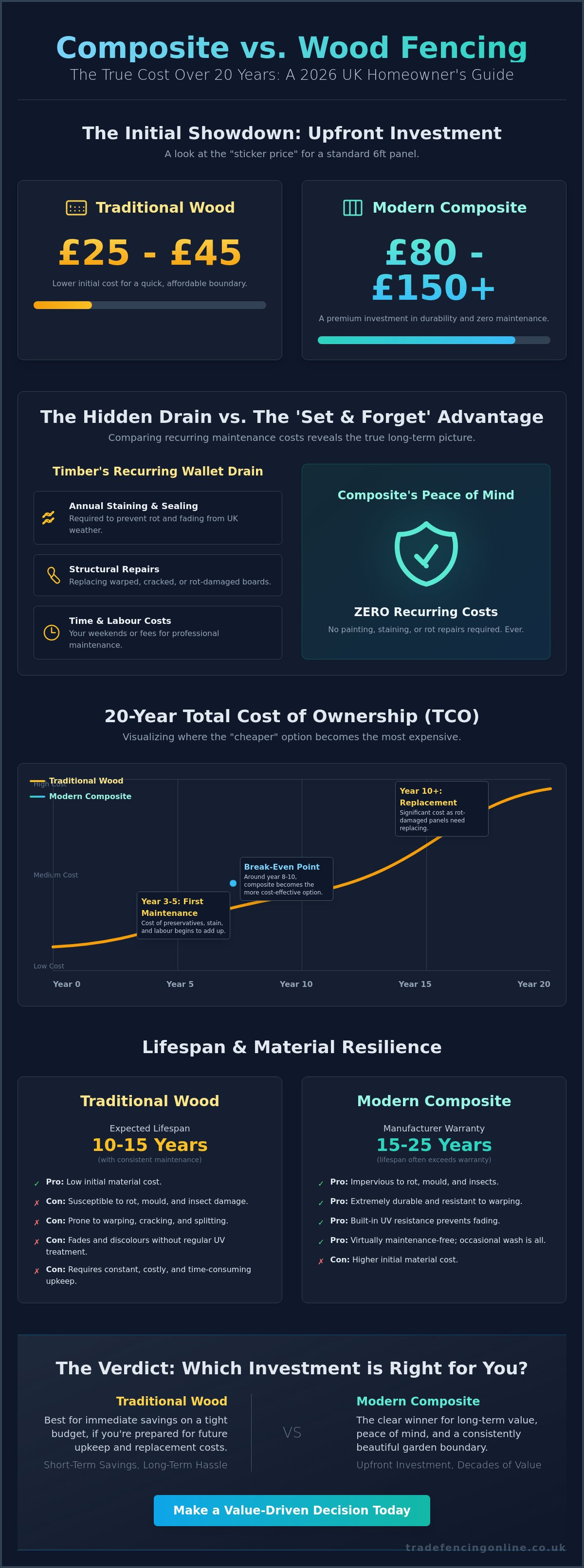
Standard UK garden projects often start with timber because the entry price is low. You can expect to pay between £25 and £45 for a standard 6ft lap or closeboard panel. These panels provide a quick, affordable boundary for those on a tight budget. Premium Wood-Plastic Composite (WPC) alternatives typically start at £80 and can exceed £150 per panel depending on the brand and finish. This price gap exists because WPC uses a blend of recycled plastic polymers and wood fibres. This material composition creates a dense, rot-resistant product that outlasts organic timber in the damp British climate.
Why Composite Commands a Premium
The higher cost of composite isn't arbitrary. Manufacturing WPC is a complex engineering process compared to simply milling raw logs. Producers must extrude materials under high pressure to ensure structural integrity. This process includes adding built-in UV resistance and colour-fast technology. These additives prevent the fading and warping common in softwood. Most composite systems come with 15 to 25 year manufacturer warranties. When you calculate the composite fencing vs wood cost over twenty years, the premium panels often prove cheaper. They eliminate the need for annual staining, painting, or structural repairs that drain your time and wallet.
Detailed Material Cost Breakdown: Panels, Posts, and Fixings
Understanding the composite fencing vs wood cost requires a look at the full bill of materials. You can't just compare the price of one panel to another. A standard quote includes the panels, structural posts, and specific ironmongery required for a secure install. While timber components are cheaper upfront, the cost of the "extras" needed to keep them standing can close the gap quickly.
Compare fence panels based on their construction and material grade. Timber prices fluctuate depending on wood species and treatment levels. Composite prices remain more stable but sit at a higher baseline. You also need to account for hidden hardware. Timber needs galvanised nails or arris rail brackets. Composite systems rely on specialised hidden clips and screws to manage thermal expansion. Using a professional fencing cost estimation method helps track these small but frequent expenses that often catch homeowners off guard.
Timber Panel Variations and Pricing
Budget overlap panels are the cheapest entry point for any garden. For a stronger, more attractive finish, choose closeboard fence panels. These use thicker vertical slats that resist warping. Pressure treatment is a non-negotiable cost for longevity. UC3 treatment is standard for panels, but anything touching the floor needs UC4 grade timber. Adding decorative elements like trellis tops typically increases the panel bill by 15% to 25% per section. Gravel boards are another essential extra. They keep the wood off the damp ground, preventing rot. Expect to pay an extra £12 to £30 per bay for these, depending on whether you choose timber or concrete.
Composite System Components
Composite isn't just a panel; it's a modular system. Most WPC (Wood Plastic Composite) setups use tongue-and-groove boards that slot together. This requires specific starter strips and finishing rails to bookend the installation. Unlike timber, which often uses wooden posts, composite systems frequently require aluminium posts for structural integrity. These aluminium components don't rot, but they cost significantly more than standard 100mm timber posts. You can choose between full-panel WPC units or individual boards. Individual boards offer more flexibility for height adjustments but take longer to assemble on-site. If you're looking for a durable solution, browse our current fencing range to see how these systems fit your budget.
Post choice dictates a large portion of your total quote. Concrete posts are heavy and difficult to install but offer a 20-year plus lifespan for timber panels. Timber posts are the cheapest but are the first part of the fence to fail. Composite or aluminium posts provide the most consistency but represent the highest initial investment in the composite fencing vs wood cost debate.
Maintenance Costs: The Hidden Drain on Timber
Wood fencing requires constant financial input. The initial purchase price is only the starting point. Over a 25-year period, the composite fencing vs wood cost gap narrows quickly due to these recurring expenses. Timber is a high-maintenance material that demands regular attention to stay structural.
The 2-Year Treatment Cycle
Timber is organic. It rots, warps, and fades without protection. For a standard 10-panel garden fence, you need approximately 20 litres of high-quality UV-resistant stain to ensure full coverage. At current UK retail prices of £30 per 5L tub, that's £120 per application. You must repeat this process every 24 months to stop the wood from becoming brittle.
Over a decade, you'll spend £600 just on chemicals and stains. This figure doesn't include the cost of brushes, rollers, or sandpaper. Composite fencing removes this requirement entirely. It's the primary reason professional installers recommend composite for long-term value. You buy it once and wash it with soapy water. That's the extent of the upkeep.
Labour and Professional Upkeep
Maintaining a fence is hard work. If you hire a professional, expect to pay day rates between £150 and £250. Sanding back old flakes and applying two coats to 10 panels typically takes two full days. That's a £400 labour bill every two years. If you don't pay this, the wood fails faster.
If you do it yourself, consider the opportunity cost. A typical DIYer spends 16 hours over a weekend on fence maintenance. If you value your free time at a modest £20 per hour, that's £320 of lost value every time you pick up a brush. Choosing composite gives you those weekends back for the next 25 years.
Beyond the scheduled painting, wood carries other hidden risks:
- Storm Damage: Aged timber becomes brittle. UK winter storms often snap weakened posts or blow out panels. Repairing a single panel can cost £80 in parts and labour.
- Ground Rot: Even pressure-treated wood often fails at the ground level within 10 to 12 years.
- Structural Failure: When wood fails prematurely, you pay for a full replacement. This includes new materials, waste disposal fees, and installation labour.
Composite panels are engineered with flexibility. They withstand higher wind loads without splintering or snapping. When calculating the total composite fencing vs wood cost, avoiding a full mid-life replacement is where the real savings are found. A quality composite system stays structural for 25 to 30 years without the need for a single drop of stain.
Lifespan and ROI: A 20-Year Financial Outlook
Choosing a garden boundary isn't just about the initial bill. It's about how many times you'll pay it. A budget timber fence typically lasts between 5 and 10 years before rot or wind damage forces a replacement. In contrast, quality composite panels are engineered to last 20 to 25 years. When you calculate the composite fencing vs wood cost over two decades, the "expensive" option usually wins. By year 11, the composite installation has typically paid for itself. This is the point where a timber owner is usually facing their first full replacement and the associated labor costs.
The financial benefit comes from the lack of maintenance. A 40-metre timber run requires roughly £400 in stains and sealants every two years to reach its maximum lifespan. Over 20 years, that's £4,000 just in liquids. Composite owners spend zero. You avoid the recurring expense of brushes, pressure washers, and weekend labor. The ROI is clear: you pay more upfront to secure 20 years of weekend freedom and price stability.
Replacement Cycles in Essex & London
Soil conditions in the South East significantly impact your fence. Heavy Essex clay and high moisture levels in London gardens accelerate timber rot at the ground level. If you prefer the look of wood, using concrete fence posts is a smart middle ground. They won't rot like timber, which saves you from a total collapse during a storm. However, you'll still face waste disposal fees when the panels fail. Skip hire for old, treated wood can cost upwards of £250 per load in 2026. Choosing WPC means you only pay for installation and disposal once in a generation.
Property Value and Kerb Appeal
Homebuyers in 2026 prioritize low-maintenance living. A grey or charcoal composite fence offers a contemporary finish that doesn't fade, peel, or warp. While traditional timber has a classic charm, it looks weathered and tired within three seasons. Professional valuations often reflect the quality of the boundary. A permanent, high-spec composite fence signals to buyers that the property is well-maintained. This can be a deciding factor in competitive London markets, where a "move-in ready" garden adds tangible value to the asking price.
Don't settle for a fence that needs replacing every decade. Order your high-quality fencing supplies today and invest in a boundary that lasts.
The Verdict: Making the Right Investment for Your Home
Choosing between materials depends on your financial timeline. Timber provides immediate budget relief. It's the best option if you want a professional finish without a high upfront cost. Composite is for homeowners who want "set and forget" peace of mind. It eliminates the need for biennial painting, staining, or structural repairs. When you weigh up the composite fencing vs wood cost over a ten-year period, composite often proves more economical. It avoids the rising price of wood treatments and the labour costs associated with maintenance.
Selecting a trusted fencing supplier in Romford ensures you get British-standard materials built for the UK's damp climate. We recommend reviewing your property plans before ordering. If you intend to stay in your home for more than five years, the durability of composite pays for itself. It doesn't rot, warp, or splinter. Check our current sale prices for both materials to see the latest deals and secure your stock today.
Best Use Cases for Timber
- Property Flipping: If you're renovating a house for immediate resale or managing short-term rentals, timber keeps your margins high. It provides the "kerb appeal" buyers expect at a fraction of the initial cost.
- Traditional Aesthetics: Natural wood texture remains non-negotiable for classic cottage gardens. It blends into the landscape in a way that synthetic materials can't always replicate.
- Longevity Hacks: You can extend a timber fence's life by 50% or more. The secret is using high-quality fencing supplies, such as concrete gravel boards and UC4 pressure-treated posts, to prevent ground contact rot.
Why Local Delivery Matters
Logistics can make or break your project budget. Romford Fencing’s delivery service saves you significant money on transport logistics. We don't hide high shipping fees in our prices. Because we maintain high stock levels in Essex and East London, you can avoid the 4-week project delays common with national retailers. We keep our yard ready so you can get your installation finished on schedule.
Our local expertise ensures you get the right advice for the specific wind speeds and soil conditions in the Romford area. We're a one-stop-shop for everything fencing. Don't risk your investment with inferior products from untrusted sources. FOR QUALITY FENCING, CALL ROMFORD FENCING LTD TODAY OR EMAIL OUR TEAM.
Invest in a Smarter Boundary for 2026
Deciding on your next garden project requires a look at the total cost of ownership rather than just the receipt at the checkout. While timber offers a lower entry point, the composite fencing vs wood cost gap narrows quickly when you factor in the £1,200 average spent on stains and preservative treatments over a 20-year period. Composite panels provide a maintenance-free alternative that holds its value and appearance long after traditional wood has started to rot. We focus on providing trade-quality materials at unmatched prices, ensuring you don't have to overpay for durability. As a 5-star trusted supplier, we've built a reputation for reliability across Romford and Essex. Our team handles the heavy lifting with free local delivery options on qualifying orders, making us your one-stop-shop for everything fencing. It's the most efficient way to secure your home and increase your property's long-term ROI without the hassle of yearly upkeep. Get your project started with the right materials today.
View Our Full Range of Quality Fence Panels & Get Free Local Delivery
Frequently Asked Questions
How much more expensive is composite fencing than wood in 2026?
Composite fencing typically costs between 100% and 150% more than standard pressure-treated timber panels. While a basic wood panel might cost £35 to £45, a high-quality composite alternative often starts at £100 per section. The composite fencing vs wood cost remains a significant factor for homeowners, though the price gap is narrowing as manufacturing efficiency improves and timber prices fluctuate.
Does composite fencing really last 25 years in the UK?
Yes, most premium composite brands offer a 20 to 25 year warranty that covers rot, decay, and insect damage. The UK averages over 150 rainy days per year, which causes standard timber to warp and rot over time. Because composite doesn't absorb moisture, it maintains its structural integrity much longer than wood, even in damp British winters.
Can I install composite fencing myself to save on costs?
You can install composite fencing yourself to save approximately £50 to £80 per linear metre in professional labour fees. Most modern systems use a simple tongue-and-groove method where boards slot into aluminium or composite posts. It's a straightforward two-person job that doesn't require advanced carpentry skills, making it a popular choice for DIY enthusiasts looking to reduce the total project cost.
Is wood fencing better for the environment than composite?
Wood is generally better for the environment if it's FSC-certified and sourced from sustainably managed forests. While composite fencing uses recycled plastics and wood fibres, it requires more energy to manufacture and isn't biodegradable. However, because you'll likely replace a timber fence three times over a 30 year period, the long-term waste impact of wood can be higher if it's not disposed of correctly.
Will a composite fence fade in the sun over time?
All composite materials experience a slight colour change, typically losing about 5% to 8% of their original pigment within the first six months of exposure. This is a natural weathering process caused by UV light. Once this initial period ends, the colour stabilises. Modern boards contain UV inhibitors that prevent the heavy bleaching or grey appearance common with old timber fences.
What is the cheapest type of wood fencing that still lasts?
Pressure-treated (Tanalised) feather edge fencing is the most affordable option that provides a reliable 10 to 15 year lifespan. Avoid cheaper overlap panels, which use thinner 5mm slats that often fail after five years of UK weather. Investing in 125mm thick pressure-treated boards ensures your fence stays upright without the high initial composite fencing vs wood cost of premium materials.
Do I need special tools to install a composite fence?
You don't need specialist equipment for installation; standard woodworking tools like a mitre saw, spirit level, and drill are perfectly adequate. Use a fine-toothed saw blade to ensure clean cuts through the recycled plastic and wood fibres. It's important to use stainless steel screws if the system isn't clip-based, as these won't rust or react with the composite material over time.
Is it cheaper to use concrete posts with wood panels?
Using concrete posts with wood panels is about 20% more expensive than using timber posts, but it's cheaper in the long run. A concrete post costs roughly £25 compared to £10 for wood, but it won't rot at the ground line. When the wood panel eventually fails after 10 years, you simply slide a new one into the existing concrete channels without digging new holes.