


How many seconds would it take a trespasser to scale your current boundary? With UK police recording over 1.6 million incidents of theft and criminal damage in the year ending September 2023, installing professional anti-climb security fencing is often the only way to ensure your property remains a hard target. You know that standard timber panels or basic chain link won't stop a determined intruder, but you also don't want your site to look like a fortress or fall foul of local planning laws.
This guide provides the clear, expert advice you need to choose, install, and maintain the most effective security solutions without overspending. We'll help you navigate the confusion between 358 prison mesh and V-mesh, explain the 2-metre height rule for UK planning permission, and show you how to achieve a secure perimeter that lasts. Whether you're protecting a commercial yard or a private estate, we've broken down the technical specifications and costs to help you make a pragmatic, value-driven decision for your property's safety.
Key Takeaways
- Learn how anti-climb security fencing uses specialised narrow apertures to eliminate handholds and stop crime before it starts.
- Compare the high-security "358" prison mesh with profiled V-mesh to find the right balance between protection, aesthetics, and budget.
- Identify the specific security requirements for your property, whether you are protecting commercial assets or securing a residential garden.
- Navigate UK planning regulations for fence heights and select the correct heavy-duty posts to ensure a legal and secure installation.
- Discover the logistical advantages of sourcing quality materials from trusted local suppliers in Essex and East London.
What is Anti-Climb Security Fencing and Why is it Essential?
Anti-climb security fencing is a specialized barrier engineered to eliminate hand and foot holds. Most standard fences have gaps large enough for a person to climb with ease. This security mesh uses narrow apertures that make scaling nearly impossible. It's a fundamental element of perimeter security concepts. The goal is to stop crime at the boundary before an intruder reaches the building.
The psychology of deterrence is powerful. When a criminal sees a professional mesh system, they recognize a hardened site. This immediate visual impact stops opportunists before they even try. In the UK, recent crime statistics indicate that 65% of commercial property breaches start at the perimeter. Anti-climb systems are essential for schools, utility sites, and data centres where protection is non-negotiable. Standard timber fencing fails as a security barrier because it's easily smashed or climbed using the horizontal rails as ladders. For residential borders, this fencing provides a sleek alternative to bulky walls while maintaining high security. Metal mesh provides a permanent, low-maintenance solution that doesn't rot or warp over time.
The Science of Anti-Climb Design
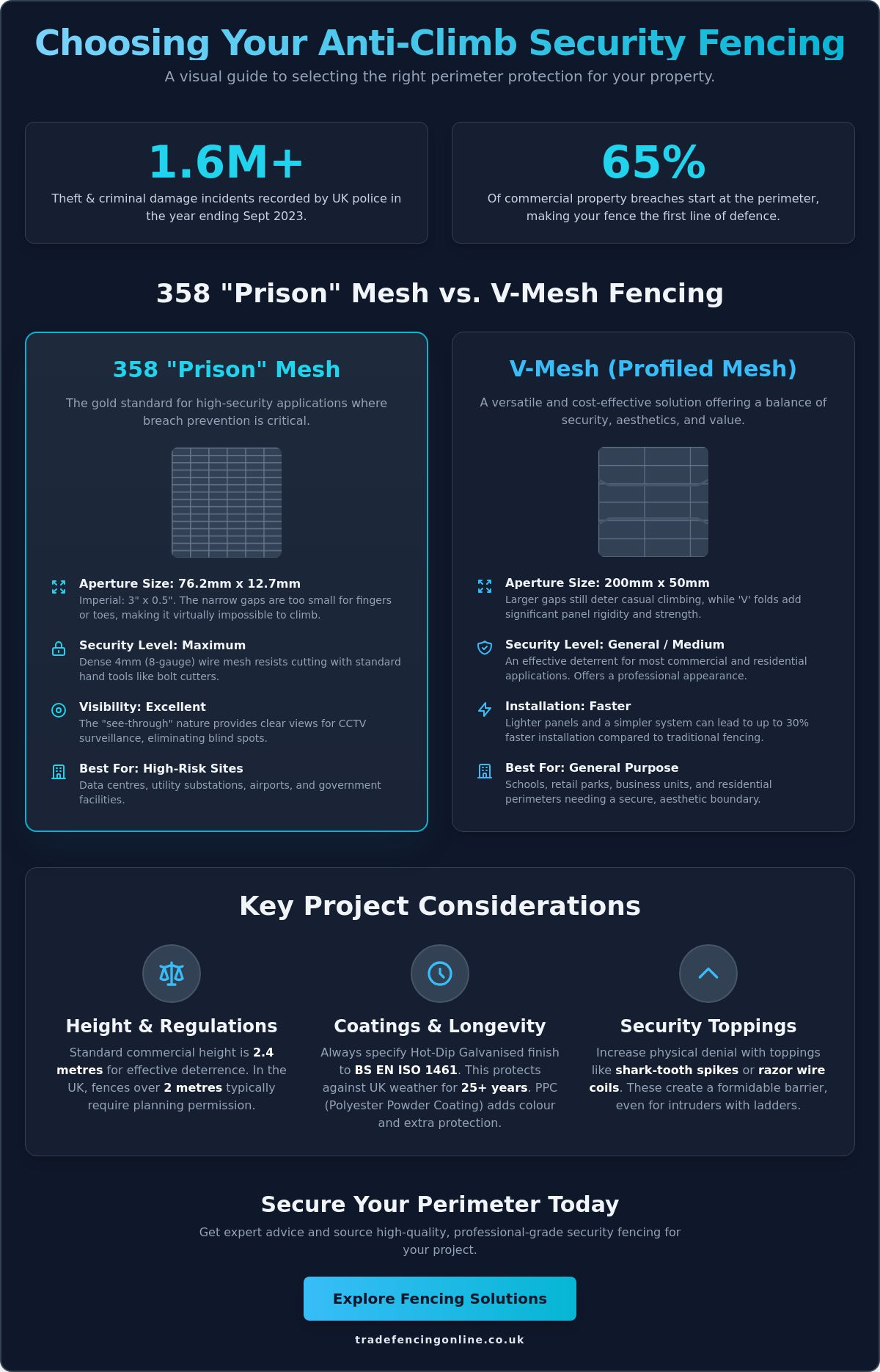
The industry standard for maximum security is the 76.2mm x 12.7mm aperture pattern. These dimensions are specifically chosen because they're too small for fingers or toes to enter. People call this 358 mesh because of its imperial measurements. Tensile strength is the next priority. Using 4mm or 8-gauge wire ensures the fence can't be easily deformed or cut with standard tools. Height plays a massive role too. Most UK commercial installations start at 2.4 metres. This height forces an intruder to use a climbing aid, making them more visible and vulnerable to detection. High-quality steel mesh is galvanized to BS EN ISO 1461 standards, ensuring the structure remains robust for over 25 years.
Deterrence vs. Physical Denial
Quality security systems offer both visual deterrence and physical denial. The dense mesh prevents the use of standard bolt cutters because the tool's head won't fit between the wires. This structural integrity is vital for high-risk zones. You can increase the denial factor by adding security toppings. Options like shark-tooth spikes or razor wire coils create a formidable finish. These additions ensure that even if an intruder brings a ladder, the top of the fence remains impassable. It's an efficient, cost-effective way to protect assets and people without needing constant human surveillance. By investing in professional-grade mesh, you create a boundary that is both a psychological warning and a physical dead-end for intruders.
358 Mesh vs V-Mesh: Choosing the Right Security Specification
Selecting the right anti-climb security fencing depends on your site's risk level and budget. 358 mesh and V-mesh represent the two most common specifications in the UK market today. While they look similar from a distance, their performance characteristics differ significantly. Choosing the wrong spec can leave your perimeter vulnerable or result in unnecessary overspending. You need a solution that balances physical resistance with site requirements like visibility and aesthetics.
Deep Dive into 358 Prison Mesh
358 mesh gets its name from its imperial measurements: 3 inches by 0.5 inches by 8 gauge. This translates to a tight 76.2mm x 12.7mm aperture. It's the gold standard for high-security sites. The gaps are too small for a finger or toe hold. This makes it virtually impossible to climb without specialized equipment. Because the wire is so dense, standard manual bolt cutters cannot gain enough purchase to snip the mesh. It provides excellent "see-through" visibility. Security teams prefer this for CCTV monitoring. The mesh doesn't create "blind spots" at sharp angles. You'll find it protecting 90% of UK high-security data centres and utility substations.
V-Mesh Fencing: The Versatile All-Rounder
V-mesh, or profiled mesh, uses a larger 50mm x 200mm aperture. It features "V" shaped folds pressed horizontally into the panel. These folds provide structural rigidity without the weight of heavy-duty 358 wire. It's a cost-effective choice for schools, retail parks, and commercial boundaries. Installation is fast. A skilled team can often install V-mesh 30% faster than traditional palisade. It offers a professional look that doesn't feel overly aggressive or "prison-like." If you need a reliable boundary for a lower-risk site, check our range of mesh options to find the right balance of price and protection.
Material Coatings: Galvanised vs PPC
The UK climate is harsh on steel. All mesh must be hot-dip galvanised to BS EN ISO 1461 standards to prevent rust. For many sites, a Polyester Powder Coating (PPC) is added over the galvanisation. This provides a double barrier against corrosion. It also improves the site's professional appearance. Moss Green (RAL 6005) and Jet Black (RAL 9005) are the standard industry choices. These colours help the fence blend into landscapes or match corporate branding. A quality PPC finish can extend the maintenance-free life of a fence by 10 to 15 years compared to basic galvanised finishes.
- 358 Mesh: Best for high-risk zones, prisons, and utility sites.
- V-Mesh: Ideal for schools, businesses, and public spaces where budget matters.
- Palisade: A traditional alternative for industrial yards where visual deterrence is the main priority.
Security Fencing for Different Sectors: Trade vs Residential
Perimeter protection isn't a one-size-fits-all solution. A warehouse storing £500,000 of plant machinery needs a different approach than a family home in a suburban street. Trade Fencing Online provides tailored solutions for every scenario. We're a trusted supplier for commercial contractors and homeowners alike. The primary goal remains the same: stop intruders. However, the visual impact and installation method vary by sector. Commercial sites prioritise raw strength and visibility. Residential projects focus on blending security with aesthetics. Public sector sites like schools must balance high security with child safety.
Commercial and Industrial Applications
Industrial sites often cover large areas. Efficient perimeter management is vital here. We recommend mesh kits for these projects. They offer a cost-effective way to secure long boundaries quickly. Every kit includes the panels, posts, and fixings required for a professional finish. Access control is the next step. You can't secure a site if the gates are a weak point. Integrate heavy-duty mesh gates with your anti-climb security fencing to maintain a continuous line of defence.
Conduct a site-specific risk assessment before ordering. Identify high-traffic areas and potential blind spots. This ensures you buy the right height and gauge for your specific threat level. According to industry reports, theft from UK construction sites costs the sector over £800 million annually. Investing in high-quality mesh prevents these losses by removing easy access points for opportunistic thieves.
Residential Security: Safety Without the Stigma
Homeowners often worry that high-security options look too industrial. You don't have to sacrifice your home's kerb appeal for safety. One effective method involves using mesh as a "backing" for traditional timber garden fence panels. This creates a dual-layer barrier that's nearly impossible to cut or climb while maintaining a classic look. Office for National Statistics data shows that 64% of domestic burglaries in England and Wales involve the intruder entering through the rear of the property. A reinforced perimeter stops them at the boundary.
Colour choice changes everything. Standard galvanised finishes look industrial. Green (RAL 6005) or Black (RAL 9005) powder coatings blend into UK garden landscapes. They disappear against hedges and trees. For added height without an aggressive look, use trellis toppers. These provide a psychological deterrent and make climbing difficult without making your garden look like a fortress.
Public sector projects require even more care. Schools must use "anti-trap" designs to prevent injuries to children. Anti-climb security fencing in these environments often uses "V-mesh" profiles. These provide excellent visibility for CCTV and staff supervision while meeting safety standards. Trade Fencing Online is your one-stop-shop for these specialised requirements, ensuring you get the right product at the right price.
UK Regulations and Installation: Planning Your Project
Installing anti-climb security fencing requires more than just buying panels. You've got to follow UK building regulations to avoid legal fines or being forced to tear the structure down. Follow this five-step process to ensure your perimeter is both legal and effective.
Planning Permission and Height Restrictions
The 2-metre rule is the standard for most UK properties. You can usually install a fence up to 2 metres high without seeking formal planning permission. However, if your property borders a public highway or a footpath used by vehicles, the height limit is restricted to 1 metre. Conservation areas and heritage sites have different rules. You must check with your local planning office if you're near a Grade I or Grade II listed building. Installing 358 mesh or V-mesh without a permit in these areas often results in enforcement notices from the council.
- Step 1: Confirm height limits with your local council planning department.
- Step 2: Select the right fence posts for your mesh type. Steel RHS (Rectangular Hollow Section) posts provide the necessary rigidity for anti-climb security fencing.
- Step 3: Dig post holes to a minimum depth of 600mm. For fences exceeding 2.4 metres in height, increase this depth to 900mm to handle wind loading and prevent leverage attacks.
- Step 4: Secure panels using high-security fixings. Use "sheared off" nuts or specialized clips that can't be removed with standard hand tools.
- Step 5: Conduct a final inspection. Check that no gaps between the ground and the panel exceed 50mm. Large gaps are a common vulnerability that intruders exploit to bypass the system.
Professional Installation vs. DIY
You might save on labour costs with a DIY approach, but security fencing isn't a standard garden project. It requires specific tools like internal tensioning bars and specialized hex bits for security fasteners. Professional installers ensure the mesh is taut and the posts are perfectly plumb. This level of precision is often a requirement for insurance compliance at commercial sites. If your business suffers a breach and the fence wasn't installed to BS 1722-14 standards, your claim might be rejected. Always source high-quality fencing supplies to ensure a trade-grade finish that lasts for decades.
Ready to secure your perimeter with professional-grade materials? Browse our full range of security fencing and supplies today.
Sourcing Anti-Climb Fencing in Essex and East London
Buying heavy security materials from national suppliers often leads to massive shipping costs and logistical delays. Sourcing your anti-climb security fencing locally in Essex or East London ensures you get materials on-site without the wait. Romford Fencing Ltd brings decades of trade expertise to every customer. We understand the specific security requirements of London businesses and Essex homeowners. As a trusted supplier with 5 star reviews, we focus on providing quality goods with minimal friction.
We offer free local delivery options across Romford, Essex, and London areas. This service removes a significant cost barrier for large-scale perimeter projects. You get trade prices and expert support from a team that knows the industry inside out. Our goal is to be your one-stop-shop for everything fencing, providing a reliable, no-nonsense service that keeps your site secure and your project on budget.
Trade Fencing Online: Your Security Partner
Our inventory includes high-quality mesh panels and robust security posts designed to withstand tampering. We're the home of quality garden fencing, but our security range is built for industrial-grade durability. Whether you're a trade professional managing a commercial site or a homeowner protecting a private boundary, our team provides expert advice. We ensure you get the right specification for your project. Fast delivery across East London and the Essex region means your project stays on schedule.
- High-visibility mesh panels for clear CCTV monitoring.
- Reinforced security posts and heavy-duty ironmongery.
- Vandal-resistant fixings and specialized coatings.
- Expert support for both trade accounts and retail customers.
Next Steps for Your Security Project
Start by measuring your perimeter accurately. Note any changes in ground level or corners that require specific post types. If you have bespoke security requirements, consult with our team. We'll help you find the most cost-effective solution for your anti-climb security fencing needs. Our process is simple and designed for speed: order online, we schedule the delivery, and your goods arrive as planned.
Don't settle for inferior materials that compromise your site's safety. Trust a local expert that values substance over style. We provide the strength and reliability required for professional perimeter protection. Our structured approach removes barriers and makes the path to ordering feel simple and straightforward.
FOR QUALITY FENCING, CALL ROMFORD FENCING LTD TODAY OR EMAIL OUR TEAM.
Secure Your Property With Professional Perimeter Protection
Choosing the right anti-climb security fencing involves more than just picking a height. You must decide between the high-visibility deterrence of 358 mesh or the cost-effective strength of V-mesh based on your specific site risks. It's essential to follow UK planning regulations to ensure your installation is both legal and effective. Our kits serve both commercial trade and residential sectors, providing versatile solutions for schools, warehouses, and private estates. We focus on providing trade-quality materials that meet these rigorous standards without the unnecessary markup.
Trade Fencing Online is a trusted Essex supplier with a consistent track record of 5-star reviews from local contractors and homeowners. We maintain a large stock of professional-grade kits ready for immediate dispatch. We provide fast local delivery across Romford and East London, ensuring your security project stays on track and within budget. Don't settle for inferior barriers when you can access industry-standard protection today. Our team is ready to supply the heavy-duty materials your project demands.
Shop our high-quality Anti-Climb Security Fencing kits today
Get the security your site needs with a supplier you can trust.
Frequently Asked Questions
Does anti-climb fencing require planning permission in the UK?
Planning permission is required if the fence exceeds 2 metres in height, or 1 metre if it borders a public highway. These specific limits are set by the Town and Country Planning Order 2015. You'll need to submit an application to your local planning authority if your project exceeds these dimensions. Always check with your local council before starting work to avoid enforcement notices.
What is the difference between 358 mesh and standard weldmesh?
The main difference lies in the aperture size and security rating. 358 mesh features tight gaps measuring 76.2mm by 12.7mm, which prevents anyone from getting a finger or toe hold. Standard weldmesh usually has much larger 50mm by 50mm openings. This makes 358 the superior choice for anti-climb security fencing because it's virtually impossible to scale without specialized equipment.
Can I install anti-climb fencing on top of an existing wall?
You can install this fencing on top of an existing wall using base-plated posts. These posts are secured into the masonry using M12 or M16 resin-anchored bolts to ensure the structure remains stable. The wall must be structurally sound to handle the additional wind load created by the panels. This setup provides an effective height increase while utilizing your current boundary foundation.
Is anti-climb fencing safe for use in schools?
Anti-climb fencing is safe for schools when you select panels without sharp spikes or jagged edges. The Department for Education often recommends 358 mesh because the small apertures prevent children from climbing or getting their limbs trapped. It provides a high level of security without creating the injury risks associated with traditional palisade or barbed wire. It's a pragmatic choice for educational perimeters.
How much does anti-climb security fencing cost per metre?
Prices for anti-climb security fencing typically range from £45 to £110 per linear metre for supply and installation. This figure varies based on the height of the panels and the specific gauge of the wire used. Ground conditions and the total length of the run also impact the final cost. You should request a site survey to get a firm commercial quote for your specific project requirements.
What is the best colour for a security fence to blend in?
Green (RAL 6005) and Black (RAL 9005) are the most effective colours for blending a fence into its surroundings. Green is the standard choice for parks and rural areas where it matches the natural foliage. Black is often better for urban environments as it's less noticeable to the human eye against buildings. These powder-coated finishes also provide an extra layer of protection against the elements.
How long does a galvanised security fence last in the UK climate?
A galvanised security fence usually lasts between 25 and 70 years in the UK. This lifespan is achieved through hot-dip galvanising to BS EN ISO 1461 standards, which protects the steel from rust and corrosion. In coastal regions with high salt levels, the lifespan might be closer to 25 years. In typical inland conditions, you can expect the structure to remain functional for over 50 years.
Are there specific laws regarding fence spikes or anti-climb toppings?
The Occupiers' Liability Act 1984 dictates that property owners have a duty of care to anyone on their land, including trespassers. You must install spikes or sharp toppings at a minimum height of 2 metres to prevent accidental injury. It's also a legal requirement to display clear warning signs at regular intervals along the boundary. These signs must be visible and legible to anyone approaching the fence line.