


A fallen fence panel isn't just a mess; it's an immediate security risk for your pets and a total loss of privacy. You're likely staring at the wreckage and wondering what to do if neighbour's fence falls down, especially if you're worried about the cost or an awkward conversation. It's frustrating to deal with a broken boundary that you didn't cause, and even more stressful when you aren't sure who is legally responsible for the repair.
You don't need a law degree to resolve this, but you do need a pragmatic plan. We'll show you how to check HM Land Registry records for that vital "T" mark for just £7 and how to handle the situation professionally without ruining your relationship with the person next door. You'll learn the fastest ways to secure your garden, from replacing a £30 waney edge panel to installing durable gravel boards that prevent future rot. This guide provides a clear roadmap to getting your privacy back while keeping your costs as low as possible. Whether you need a simple repair or a full professional installation, you can find a cost-effective solution that secures your home for the long term.
Key Takeaways
- Verify ownership through property deeds and "T" marks instead of following the unreliable "left-hand rule" myth.
- Understand exactly what to do if neighbour's fence falls down when there's no legal obligation for them to repair it.
- Prioritise a 50/50 cost-sharing agreement to restore your garden security and privacy as fast as possible.
- Assess if your fence posts are salvageable or if a full replacement with gravel boards is needed for long-term durability.
- Use professional local delivery services to get the right panels and postmix to your door before the next weather event hits.
Immediate Steps: Safety and Establishing Fence Ownership
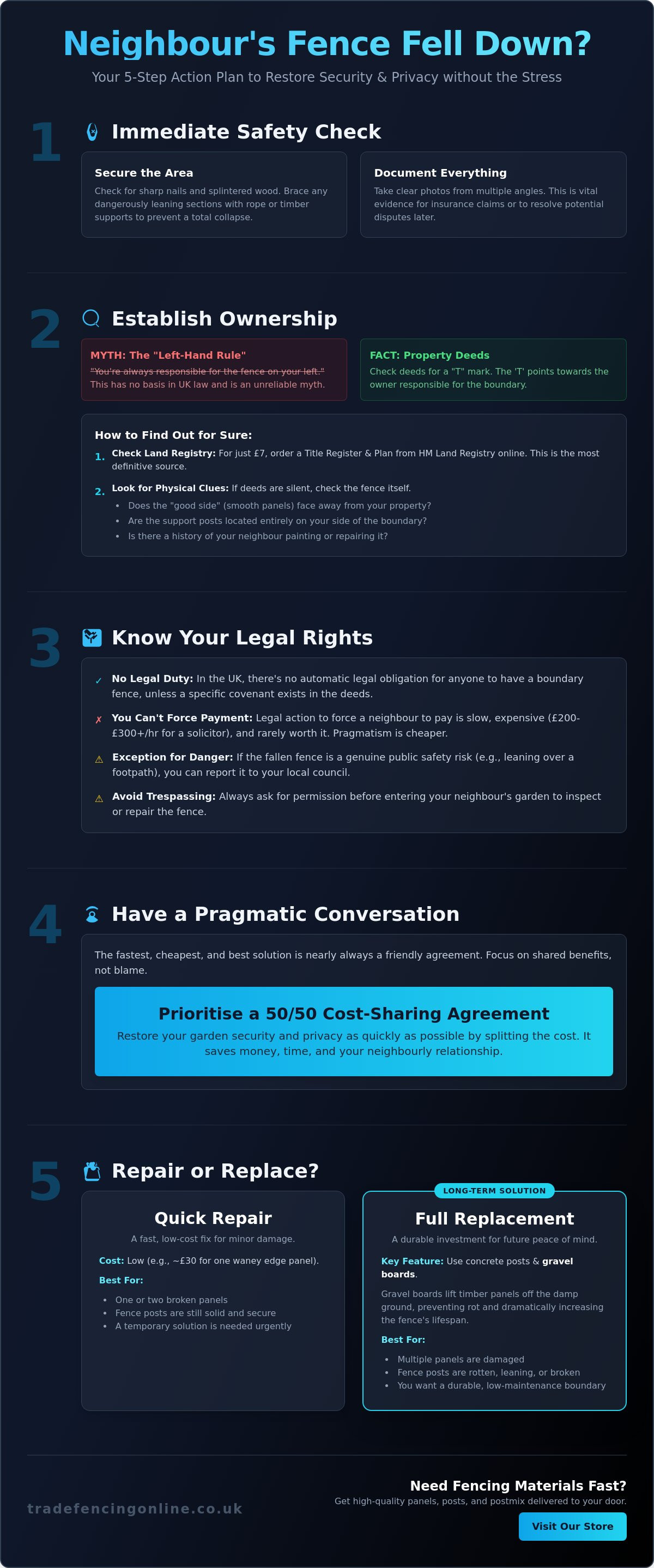
Your first task is a quick risk assessment. Check for sharp, exposed nails and splintered timber that could injure pets or children. If the fence is still standing but leaning dangerously, use heavy rope or temporary timber supports to brace it. You need to know what to do if neighbour's fence falls down before the next gust of wind turns a lean into a total collapse. Document everything immediately. Take clear photos from multiple angles to show the extent of the damage and the direction of the fall. These images are vital evidence if you need to make an insurance claim or resolve a dispute later.
The 'T-Mark' Myth vs. Deed Reality
Many people believe the "left-hand rule" determines who owns which boundary, but this has no basis in UK law. Ownership is found in your property deeds. You might see "T" marks on a boundary plan; these usually point toward the owner responsible for maintenance. However, these marks are only legally binding if the text in the deed explicitly confirms them. You can order a Title Register and Title Plan from the HM Land Registry online portal for £7 per document. If the deeds are "silent" and offer no information, the boundary is often considered shared. In some cases, the Party Wall etc. Act 1996 provides the legal framework for dealing with shared structures, though it more commonly applies to walls than simple timber fences.
Identifying Physical Clues of Ownership
If the paperwork is unclear, look at the fence itself for physical evidence. Traditionally, the "good" or finished side of the fence faces the neighbour, while the owner sees the posts and rails. This isn't a law, but it's a standard practice among professional installers to ensure the owner has the structural side on their land. Check the position of the fence posts. If the posts are set entirely on your side of the boundary line, you likely own the fence. Look for evidence of historical repairs too. If your neighbour has consistently painted or patched the panels over the last decade, they've effectively claimed responsibility for that boundary. Knowing what to do if neighbour's fence falls down starts with these simple observations before you spend a penny on new materials like closeboard panels or concrete posts.
Once you've established ownership and secured the area, you can move on to the next step: understanding your legal rights and whether your neighbour is actually required to fix the damage.
Understanding Your Legal Rights (and the Lack of Them)
Most homeowners are shocked to learn there is no automatic legal duty to have a fence in the UK. Unless your property deeds contain a specific covenant, your neighbour can technically leave the gap open indefinitely. This legal reality is why knowing what to do if neighbour's fence falls down is often a matter of diplomacy rather than law. You cannot legally force a neighbour to repair a fence just because it looks untidy or has fallen over. However, if the fallen structure is a "dangerous structure," such as a heavy panel leaning over a public footpath or a precarious concrete post, you can contact local council building control. They have the power to force a repair if public safety is at risk.
Stay on your side of the boundary line during any assessment. Entering a neighbour's garden without permission to fix a fence is technically trespass. It is always better to ask for access first. You should also distinguish between a timber fence and a party wall. A fence is usually a standalone structure, but a wall built on the boundary line might fall under different rules. If you are planning a replacement, check the official planning permission guidelines to ensure your new boundary doesn't exceed height limits. Rear garden fences are usually capped at 2 metres, while front garden fences are limited to 1 metre near a highway.
Can You Force a Neighbour to Pay?
Forcing a payment is rarely successful through legal channels. Most fencing disputes are civil matters. You might find a "positive covenant" in the deeds that requires a fence to be maintained, but enforcing this through the courts is slow and expensive. A solicitor might charge £200 to £300 per hour, which is far more than the cost of high-quality fence panels. Pragmatism usually wins here. It is often cheaper and faster to buy the materials yourself and restore your own privacy rather than engaging in a legal battle that costs thousands.
Handling Rented Properties and Landlords
If the house next door is rented, the tenant isn't responsible for the boundary. You must contact the landlord directly. Tenants often don't have the landlord's direct phone number, but you can find the owner's name and service address via the Land Registry. Professional landlords usually want to protect their property value and will be more inclined to fix a fallen fence quickly to keep their tenants happy. If you need a fast quote to send to a landlord, browse our quality fencing supplies to get an accurate price for the necessary materials.
How to Handle the 'Neighbour Conversation' Pragmatically
Establishing who is legally responsible for a boundary is one thing; getting the work done is another. If you're wondering what to do if neighbour's fence falls down, the answer is usually a calm conversation. Avoid starting with legal threats or deed interpretations. Instead, focus on the shared benefits of a secure garden. A gap in the fence affects both properties. It compromises privacy and allows pets or children to wander. Proposing a 50/50 cost split is often the most effective way to resolve the issue quickly. It bypasses long-winded arguments about historic responsibility and gets a new, secure boundary in place before the next storm hits.
If the property next door is empty or the owner is absent, the situation is more difficult. You can't legally force a repair, and you shouldn't enter their land without permission. In these cases, document that you've tried to make contact. Send a polite letter to the owner's address found on the Land Registry. If you get no response, you may need to take matters into your own hands. Installing a secondary fence on your own land is a common way to restore your security without needing their consent.
Negotiating a Shared Cost Solution
Come to the table with a solution, not just a problem. Prepare a clear list of fencing supplies and a total price for the materials. This transparency builds trust immediately. Suggest upgrading to concrete posts and gravel boards. While the initial cost is slightly higher than timber, it prevents rot and ensures the fence won't fall down again in five years. Set a firm timeline for the work. If the neighbour agrees to the split, order the materials immediately to lock in the project before they change their mind.
Building Your Own Fence on Your Land
If your neighbour refuses to contribute or disputes ownership, stop arguing. You can install your own fence just inside your boundary line. This is the "side-by-side" solution. It gives you total control over the materials, the height, and the maintenance schedule. You'll never have to ask for permission to paint or repair it again. Ensure your new installation follows fence height loopholes and standard planning rules. By keeping the structure entirely on your land, you end the ownership debate forever. It's a clean, professional way to handle what to do if neighbour's fence falls down when a neighbour won't lift a finger to help.
Repairing vs. Replacing: A Practical Cost and Effort Analysis
Deciding whether to repair or replace is your next major hurdle. If you're weighing up what to do if neighbour's fence falls down, start by inspecting the posts. A timber post rotten at the base is a structural failure. Replacing a single timber post typically costs between £50 and £70, while a concrete version is £50 to £80. If multiple posts are leaning, a full replacement is usually more cost-effective than constant patching. The average cost to repair a fence is roughly £150, but if the damage is widespread, this figure can climb quickly. Don't waste money on panels if the foundations are gone.
Gravel boards are your best defence against future rot. These boards sit at the base of the fence, keeping the timber panel off the damp ground. A 1.8-metre gravel board costs only £8 to £10. It's a small investment that adds years to the life of your boundary. For a standard 36ft run in Romford, professional installation ranges from £1,450 to £1,850. If you have the skills, doing it yourself saves on the £200 to £300 daily labour rates typical for East London and the South East. However, professional installation is often better for longevity in areas with London Clay, which causes posts to shift if they aren't set deep enough.
The Quick Fix: Patching Up Panels
You don't always need to tear everything down. If the posts are solid, you can use arris rail brackets to secure loose rails or repair spurs to reinforce a weak post. Replacing individual fence panels is a fast way to restore privacy. A basic waney edge panel costs around £30, while premium closeboard panels are £40 to £50. This is a "sticking plaster" solution. It works for a season, but it won't fix a fundamentally weak foundation. Use this approach only if the rest of the run is in good condition and you need a temporary fix.
The Total Upgrade: Investing in Longevity
For a permanent solution, upgrade to concrete fence posts. They don't rot, and they withstand the heavy clay soil common in Romford and Essex. Pair these with heavy-duty Closeboard panels for maximum wind resistance. Use at least two bags of Postcrete per post to ensure a rock-solid foundation. This setup is more expensive initially, but it ends the cycle of storm damage and avoids the potential £5,000 fines associated with non-compliant, dangerous structures. Buy your professional-grade fencing supplies today to secure your garden for good.
Fast Fencing Solutions for Romford, Essex, and East London
When you're deciding what to do if neighbour's fence falls down, speed is your priority. An open boundary in a busy area like Romford or East London is a security risk that needs immediate attention. National retailers often have long lead times and high delivery fees. Choosing a local supplier means you get the materials on-site before the next weather event causes more damage. Trade Fencing Online operates as a one-stop-shop for everything fencing, providing the same high-quality materials to the public that local tradesmen have used for decades.
We specialise in the RM, E, and IG postcode areas. This local focus allows us to offer efficient delivery options that national chains can't match. Whether you need a single replacement panel or enough materials for a 36ft run, our logistics team ensures your order arrives as scheduled. We understand the specific challenges of the local terrain. The London Clay soil predominant in Essex requires deeper foundations and stronger posts to prevent shifting. We provide the right postmix and heavy-duty gravel boards to make sure your new fence stays upright for the long term.
Our Fencing Range: Built for the Essex Climate
Our products are selected for durability in the damp UK climate. We stock heavy-duty pressure-treated panels that resist rot without needing immediate treatment. Our range includes everything from traditional closeboard and lap panels to decorative trellis and secure gates. We also supply the essential ironmongery needed for a professional finish. These fencing supplies are the same ones used by Romford Fencing Ltd for professional installations across the region. Using trade-quality materials ensures your repair isn't just a temporary fix but a permanent upgrade to your property's value.
Order Today, Secure Your Garden Tomorrow
Ordering online is the fastest way to resolve your boundary issues. Our website is designed for quick scanning and easy checkout. You can select your panels, posts, and gravel boards and have the entire kit scheduled for delivery in just a few clicks. If you're unsure about the quantity of postmix or the type of brackets you need, our team is available to provide expert advice. We pride ourselves on being a trusted supplier with a track record of 5-star reviews. Don't leave your property exposed to security risks or the prying eyes of passers-by. Browse our full range of fence panels and posts now. FOR QUALITY FENCING, CALL ROMFORD FENCING LTD TODAY OR EMAIL OUR TEAM.
Secure Your Garden Boundary Today
Dealing with a broken fence doesn't have to be a source of long-term stress. Establish ownership through your property deeds first. Then, prioritise a professional conversation with your neighbour to find a shared solution. Knowing exactly what to do if neighbour's fence falls down allows you to act fast and avoid expensive legal disputes. Whether you decide on a 50/50 cost split or choose to install a new boundary entirely on your own land, focus on using durable materials that withstand the local Essex climate. Upgrading to concrete posts and gravel boards is the most effective way to ensure your privacy remains intact for years to come.
Romford Fencing Ltd is The Home of Quality Garden Fencing in Essex. We are a Trusted Supplier with 5-Star Reviews, offering Free Local Delivery Options across the region. Don't leave your property exposed to security risks or the next big storm. Take control of your garden security by ordering trade-quality supplies from a reliable local expert. Shop Quality Fence Panels and Posts at Romford Fencing Ltd and get your garden back to its best today.
Frequently Asked Questions
Can I take down my neighbour's fence if it falls into my garden?
No, you cannot legally dispose of your neighbour's property even if it falls on your land. You should carefully move the panels back onto their property line. Removing or destroying the panels without permission is technically criminal damage. If you're stuck on what to do if neighbour's fence falls down and they won't clear it, ask for their written consent before taking any action.
What happens if a storm blows my neighbour's fence down?
Responsibility remains with the legal owner identified in the property deeds. A storm does not automatically transfer the repair duty to you. However, most neighbours choose a pragmatic 50/50 cost split to speed up the process. If the storm has caused widespread damage, local supply chains might be busy. Order your replacement materials as soon as possible to secure your boundary.
Is there a law that says which side of the fence I own?
There is no UK law that dictates boundary ownership based on which way the fence faces. The "left-hand rule" is a common myth with no legal standing. You must check the Title Register and Title Plan from the HM Land Registry. These documents will show "T" marks that indicate which party is responsible for maintaining the boundary. If the deeds are silent, the boundary is usually shared.
Can I paint my side of the neighbour's fence?
You cannot paint, stain, or even attach hanging baskets to your neighbour's fence without their express permission. Doing so is technically criminal damage because the structure is their property. If you dislike the look of their fence, the best solution is to install your own separate fence entirely on your side of the boundary line. This gives you total control over the appearance and maintenance.
How much does it cost to replace a standard 6ft fence panel?
A standard 1.8m x 1.8m waney edge panel typically costs around £30 for the materials. Premium closeboard panels cost between £40 and £50. If you require professional installation, expect to pay between £100 and £150 per panel including labour. Prices vary based on whether you use timber or concrete posts and if you include gravel boards to prevent rot at the base.
What should I do if my neighbour refuses to fix a dangerous fence?
Report the structure to your local council's building control department if it poses a genuine safety risk. They have the authority to inspect dangerous structures and can issue a notice to the owner to make it safe. This is the most effective route when a neighbour ignores a fence that is leaning precariously over a public footpath or into your garden area.
Does insurance cover a fallen garden fence?
Most standard UK home insurance policies do not cover storm damage to fences, gates, or hedges. You should check your specific policy wording, but it is rare to find a provider that pays out for wind-blown timber boundaries. It's usually faster and cheaper to buy replacement panels and posts directly than to attempt a claim that will likely be rejected after a storm.
Can I put a new fence in front of my neighbour's old one?
Yes, you can install a new fence entirely on your own land even if the old one is still there. This is a common solution when you want to know what to do if neighbour's fence falls down but the owner refuses to act. Ensure your new fence stays within height regulations, usually 2 metres for rear gardens, to avoid potential planning disputes or fines from the council.