


A cheap fence is a recurring expense you can't afford. Most standard panels fail during high winds or leave frustrating gaps that compromise your home's privacy. If you're tired of looking at dated, flimsy boundaries, tongue and groove fence panels offer the structural upgrade your garden deserves. These panels are engineered for maximum wind resistance and provide a solid, interlocking barrier that standard closeboard simply cannot match.
We understand that you want a secure, private boundary that looks professional and stands the test of time. This guide explains why tongue and groove is the premium choice for modern garden aesthetics in 2026. You'll learn how these panels significantly reduce road noise and create a clean, minimalist backdrop for your landscaping. We'll also break down the technical benefits of interlocking timber and provide the essential facts you need to ensure your new boundary lasts 15 years or more.
Key Takeaways
- Understand how interlocking timber boards create a solid, warp-resistant wall that outperforms standard closeboard panels.
- Eliminate sight-lines and gaps for total garden privacy that remains consistent even as the wood seasons over time.
- Compare vertical and horizontal tongue and groove fence panels to choose between a traditional premium finish or a modern, expansive aesthetic.
- Identify the essential support systems, including heavy-duty posts and gravel boards, required to secure these high-density panels.
- Discover the logistical benefits of sourcing trade-quality fencing locally in Essex and East London to minimize project delays.
What Are Tongue and Groove Fence Panels?
Standard fencing often fails because it's built for low cost rather than longevity. Tongue and groove fence panels are different. They are engineered as a premium boundary solution for homeowners who value privacy and structural integrity. The design uses interlocking timber boards that create a solid, gap-free wall. This construction method makes them the strongest timber panel option available on the market today.
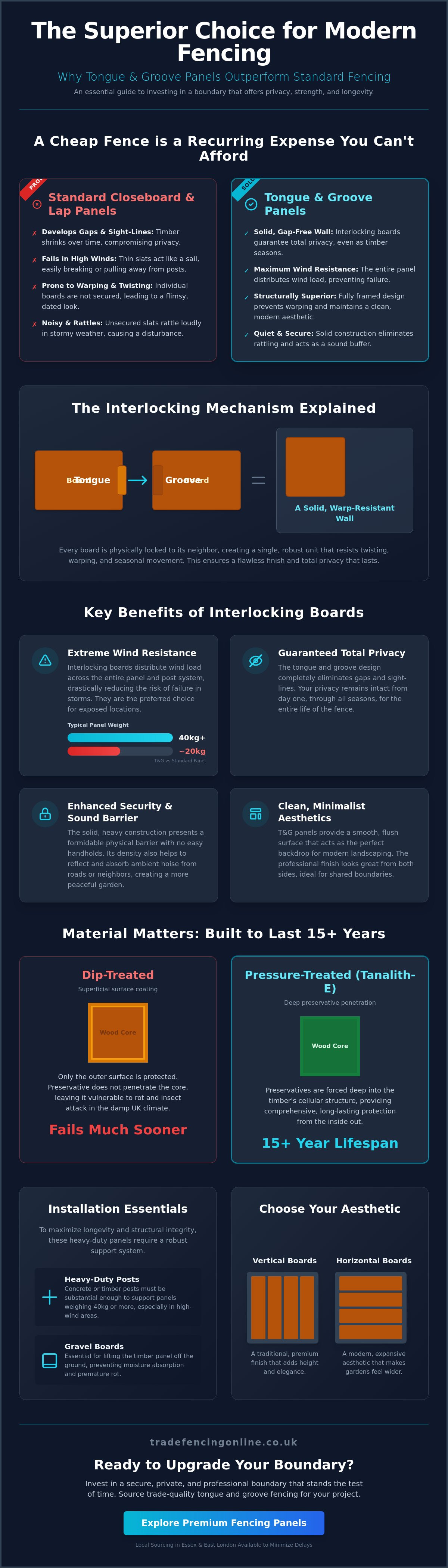
The term Tongue and groove describes the specific joint that connects every board. One edge features a protruding 'tongue' while the opposite edge has a recessed 'groove'. When these pieces slot together, they form a tight, physical bond. This is a significant upgrade over overlap fencing, where thin slats are simply nailed over each other. It also surpasses closeboard fencing, which can develop sight-lines as the vertical pales dry out and shrink over time.
Modern garden aesthetics in the UK have shifted toward minimalist, clean lines. A flush finish is now the preferred standard for high-end landscaping. Tongue and groove fence panels provide this smooth surface, making them ideal for contemporary garden designs. They look professional from both sides, which is a major advantage for shared boundaries. Regarding dimensions, the industry standard for UK post spacing is 6ft, or approximately 1829mm, in width. This ensures compatibility with existing concrete gravel boards and fence posts during a replacement project.
The Interlocking Mechanism Explained
Every board in a T&G panel is physically locked to its neighbor. This construction eliminates the annoying 'rattling' sound common in standard fences during stormy weather. Because the boards are constrained by the groove, they cannot twist or pull away from the frame. A high-quality panel is always fully framed. This perimeter frame acts as a skeleton, supporting the weight of the interlocking boards and ensuring the panel remains square and stable for years.
Common Materials: Pressure-Treated Timber
Durability starts with the right treatment. Pressure-treated timber, typically using Tanalith-E, is the gold standard for T&G longevity. Unlike dip-treatment, which only coats the surface, pressure treatment forces preservatives into the heart of the wood. This protects against rot, fungal decay, and insect attack. You can expect a lifespan of 15 years or more from a pressure-treated panel. Dip-treated alternatives may look similar on the shelf, but they will fail much sooner in the damp UK climate.
Key Benefits: Why Choose Interlocking Boards?
Choosing tongue and groove fence panels isn't just about appearance. It's a strategic investment in your property's boundary. The interlocking design creates a solid wall effect. This structure resists the warping and twisting that often ruins standard lap or closeboard fencing. Because every board is physically joined to the next, the panel moves as a single unit. This prevents individual pales from pulling away from the frame during seasonal changes or periods of high humidity.
Privacy is a major driver for this choice. Overlap panels often develop gaps as the timber seasons and shrinks. Standard closeboard can also reveal sight-lines between pales over time. Tongue and groove boards eliminate this issue entirely. Even as the wood naturally contracts, the tongue remains seated within the groove. You get total privacy from day one through the entire lifespan of the fence. There are no gaps for neighbors or passers-by to see through.
Security is another practical benefit. These panels present a flat, solid surface with no easy handholds or footholds. They are significantly harder to scale or break through than thin, 5mm lap slats. Additionally, the increased mass of the timber provides a natural sound barrier. While no fence is completely soundproof, the density of these boards helps reflect road noise and chatter from neighboring gardens. High-quality tongue and groove fence panels act as a functional acoustic buffer for your outdoor space.
Wind Resistance and Structural Integrity
Standard fences often act like sails in high winds. If the wind cannot pass through, the pressure focuses on the weakest point, usually the nails or the thin slats. Interlocking boards distribute the wind load across the entire surface and the supporting post structure. This makes them the preferred choice for exposed gardens in Essex or coastal areas where storms are frequent. A heavy-duty tongue and groove panel can weigh 40kg or more, which is double the weight of standard alternatives. To maintain this durability, proper wood preservation is vital to prevent moisture from compromising the joints.
Aesthetic Versatility for Modern Landscaping
These panels provide a clean, uncluttered backdrop for your garden. The smooth surface allows your garden features to stand out. Vibrant green foliage and modern garden furniture pop against the uniform texture of the timber. You can use these panels as a primary boundary or as internal screens to divide your space into different zones. They suit traditional cottage gardens just as well as minimalist urban plots. The boards create a seamless look that adds immediate value to your home's exterior.
Choosing the Right Style: Vertical vs Horizontal Panels
The orientation of your tongue and groove fence panels defines the visual flow of your outdoor space. While the interlocking mechanism remains the same, the choice between vertical and horizontal boards impacts drainage, maintenance, and the perceived size of your garden. You should select a style that complements your existing landscaping and the specific layout of your site. Both options provide the same premium privacy, but they serve different architectural purposes.
Vertical boards are the traditional choice. They provide a classic look that mirrors standard closeboard fencing but with a significantly more refined finish. This orientation is naturally better for water runoff. Gravity pulls moisture down the length of the board and away from the joints. If your garden has varying levels, vertical panels are the practical solution. They are much easier to install on sloping ground because you can 'step' the panels without disrupting the visual lines of the timber.
Horizontal panels are a growing trend in modern UK garden design. They draw the eye along the boundary, which makes smaller or narrower gardens feel wider and more expansive. This style is heavily influenced by the contemporary 'Venetian' look seen in high-end urban renovations. While vertical lines emphasize height and enclosure, horizontal lines create a sense of space and modern structure. Professional designers often use horizontal boards to create a seamless backdrop for outdoor kitchens or seating areas.
Vertical Boards for Height and Tradition
Vertical orientation makes a garden feel more enclosed and private. It’s an effective way to draw the eye upward, which is useful if you have impressive trees or structures to highlight. These panels are highly compatible with standard fence posts, allowing for a straightforward installation process. Because the weight is distributed vertically, there's less pressure on the individual tongues and grooves over long spans. This traditional setup remains a reliable choice for most suburban boundaries.
Horizontal Boards for Modern Width
Horizontal boards require precise installation to ensure proper drainage. You must ensure the 'tongue' side of the board faces upward within the groove to prevent water from pooling inside the joint. When installed correctly, they provide a sleek, architectural finish that suits minimalist gardens. These panels often act as a decorative screen rather than just a boundary. They work exceptionally well in urban spaces where you want to break up the monotony of brick walls with warm, textured timber.
Regardless of the orientation, you must install a capping rail. This is a protective strip of timber that sits across the top of the panel. It's the most important component for long-term timber health. Without a cap, the exposed end-grain of the boards acts like a sponge, soaking up rainwater and leading to premature rot. A sturdy capping rail sheds water away from the panel and keeps the entire structure rigid.
Installation Essentials: Posts, Gravel Boards, and Fixings
Installing premium fencing requires more than just standard DIY skills. Because tongue and groove fence panels are constructed from solid, interlocking timber, they are significantly heavier than overlap or thin lap alternatives. A single 6ft panel can weigh over 40kg. This mass places substantial stress on your support structure, especially during high winds. You must use robust materials and professional-grade fixings to ensure your boundary remains upright and secure for its intended 15-year lifespan.
Ironmongery is often overlooked, but it's the foundation of a stable fence. Standard U-clips used for lightweight panels are frequently insufficient for heavy-duty T&G. You should use heavy-duty stainless steel brackets or screw directly through the frame into the posts using exterior-grade timber screws. This prevents the panels from sagging or pulling away from the posts as the wood settles. Using the right fixings ensures the physical bond between the panel and the post is as strong as the interlocking boards themselves.
Post Selection for Heavy Panels
Stability starts with the right post. While 3x3 timber posts might suffice for lightweight trellis, they're inadequate for heavy tongue and groove panels. We recommend using 4x4 (100mm x 100mm) pressure-treated timber posts or heavy-duty concrete posts. These provide the necessary surface area and strength to hold the weight of the timber. For a standard 6ft high fence, your posts must be at least 8ft long. This allows for a minimum of 2ft to be set into the ground with high-quality postmix. You can compare the benefits of different materials in our fence posts guide.
Protecting Your Investment: Gravel Boards and Capping
Timber longevity depends on moisture management. The most common cause of fence failure is ground-level rot, where the bottom of the panel sits in damp soil or grass. Installing essential fencing supplies like gravel boards can extend the life of your panels by 5 to 10 years. These boards act as a sacrificial barrier between the premium panel and the ground. A gravel board is mandatory for tongue and groove panels because it prevents the bottom of the interlocking boards from absorbing ground moisture and voiding your warranty.
Capping rails provide the final layer of protection. While the interlocking joints are strong, the top edge of the panel features exposed end-grain that is vulnerable to rainwater. A sturdy capping rail sheds water away from these joints, preventing moisture from seeping into the grooves where it could cause internal rot. For trade-quality materials that stand up to the UK climate, you can order your complete fencing kit online for direct delivery.
Sourcing Tongue and Groove Fencing in Essex and East London
Purchasing tongue and groove fence panels from a local Romford-based supplier provides distinct logistical advantages. National retailers often struggle with long lead times and high delivery fees for heavy timber products. By sourcing locally from Romford Fencing Ltd, you reduce the time between ordering and installation. We maintain a consistent stock of trade-quality materials to ensure your project stays on schedule. Our delivery fleet serves Romford, Essex, and East London with specialized vehicles capable of handling heavy-duty loads safely.
Before you commit to a purchase, you must inspect the physical quality of the panels. A premium T&G panel should feel rigid and heavy. Look for tight joints where the tongue meets the groove. There should be no significant daylight visible between the boards. Check the frame for thickness. A flimsy frame will cause a 6ft panel to bow under its own weight within a single season. Buying from a specialist supplier ensures you receive professional-grade timber rather than the mass-produced, thin-slat alternatives found in generic DIY stores.
Trade vs Retail Quality
Big-box retailers often cut costs by using thinner timber. You'll frequently find retail panels using 12mm thick boards, which are prone to splitting and warping under pressure. Professional trade-quality panels typically utilize 16mm boards for superior strength. A thicker board provides a deeper groove. This keeps the interlocking joint secure even during extreme temperature shifts. The frame is equally critical. A robust frame is necessary to support the weight of 6ft high panels. You can find more details on material specifications in our complete guide to choosing fence panels.
Ordering and Logistics
Accurate measurement is the key to a smooth delivery. Calculate your total boundary length in meters and divide by 1.83m to determine how many panels you need. Always account for the width of your posts in your final calculation. When preparing for delivery in urban East London, ensure there's clear access for a large vehicle. These panels are heavy and require two people for safe handling. Romford Fencing Ltd provides efficient, reliable transport across the region to get your materials exactly where they need to be. Shop our full range of Tongue and Groove Fence Panels for local delivery and secure your garden boundary today.
Secure Your Garden Boundary Today
Upgrading your garden boundary is a calculated decision that prioritizes long-term value over short-term savings. You've seen how the interlocking design of tongue and groove fence panels provides a structural wall that resists wind damage and guarantees total privacy. By combining these premium panels with the correct 4x4 posts and mandatory gravel boards, you create a boundary that withstands the UK climate without the warping seen in cheaper alternatives.
We've established our reputation as a trusted local expert by delivering trade-thickness timber directly to homeowners and contractors alike. Our logistics team ensures fast delivery across Essex and East London, removing the friction from your landscaping project. You're not just buying a fence; you're installing a professional-grade system designed for longevity. Choose a boundary that looks as good as it performs.
Browse our heavy-duty Tongue and Groove Fence Panels at Romford Fencing Ltd and invest in a boundary that lasts.
Frequently Asked Questions
Are tongue and groove fence panels more wind-resistant than overlap?
Yes, these panels are significantly more wind-resistant than overlap or lap fencing. The interlocking boards create a solid, continuous wall that distributes wind pressure across the entire structure rather than focusing it on individual slats. Because every board is physically bonded to the next, there are no loose parts to rattle or snap during high winds. This makes them the most stable timber option for exposed gardens in Essex and coastal areas.
Can you replace a single board in a tongue and groove panel?
Replacing a single board in the middle of a panel is difficult because of the interlocking design. Since every tongue is seated inside the neighboring groove, you cannot simply pull one board out without affecting the others. Repairs usually require you to dismantle the panel from the top down. We recommend buying fully framed, high-quality panels from the start to avoid the need for board-level repairs later.
Do tongue and groove fence panels need a gravel board?
Yes, a gravel board is essential for protecting your investment. While the timber is pressure-treated, the bottom edge of the interlocking boards shouldn't sit directly on damp soil or grass. A gravel board creates a sacrificial barrier that prevents ground moisture from being absorbed into the panel's end-grain. This simple addition can prevent premature rot and ensure your tongue and groove fence panels last their full 15-year lifespan.
What is the standard thickness for a quality tongue and groove board?
Trade-quality boards should be at least 16mm thick to ensure long-term stability. Many cheap retail panels use 12mm boards, which are prone to splitting and warping as they season. A 16mm thickness provides enough depth for a secure, deep groove that won't fail under pressure. Always check the board thickness before buying, as thinner wood significantly reduces the structural integrity of the entire boundary.
How much noise do tongue and groove panels actually block?
These panels act as an effective acoustic barrier due to their density and lack of gaps. Standard fencing has small air gaps that allow sound waves to pass through easily. The solid, interlocking surface of a T&G panel reflects noise back toward the source. While it won't make a garden silent, it's the best timber option for reducing road noise and chatter from neighboring properties.
Can I install tongue and groove panels with concrete posts?
Yes, you can install these panels with standard slotted concrete posts. Most quality panels are manufactured to the UK standard width of 1.83m (6ft) to ensure they fit perfectly into existing concrete slots. You should ensure the panel frame is thick enough to sit snugly in the slot. If the panel is too thin, you may need to use small timber spacers to prevent it from rattling during windy weather.
How often should I treat my tongue and groove fencing?
You should apply a UV-resistant treatment every 2 to 3 years to maintain the timber's appearance. Even if the wood is pressure-treated against rot, sunlight will eventually turn the boards silver and cause the surface to dry out. Applying a high-quality oil or stain prevents the wood from cracking and keeps the interlocking joints moving naturally during seasonal shifts. Regular maintenance ensures the panels look professional for years.
Are these panels suitable for front garden boundaries?
Yes, they provide a premium look that significantly improves curb appeal. However, you must follow UK planning regulations, which generally limit front garden fences to 1 meter in height if they are adjacent to a highway. Using a shorter tongue and groove panel provides a clean, modern aesthetic that is much more durable than standard picket fencing. Always check with your local authority if you are in a conservation area before installation.