


A gate that sits just two inches too low or uses a different timber shade can instantly devalue a professional fencing installation. You've likely seen it before: a beautiful perimeter let down by a sagging, mismatched entrance that looks like an afterthought. Finding a picket fence gate to match your existing panels is the difference between a polished finish and a DIY disaster.
We know how frustrating it is when standard sizes don't quite fit or when poor-quality timber begins to rot after one wet Essex winter. You want a uniform, traditional aesthetic that stands up to the British elements without the hassle of constant repairs. This guide shows you exactly how to achieve that seamless look. We'll cover precise measurement techniques to prevent sagging, material choices that resist rot, and how to select styles that complement your home perfectly. You'll soon have the knowledge to secure a durable, professional-grade gate that arrives quickly and fits right the first time.
Key Takeaways
- Boost your property’s kerb appeal and value by creating a seamless, traditional palisade entrance that maintains boundary visibility.
- Learn how to choose a picket fence gate to match your existing boundary by correctly identifying pale profiles and measuring gap ratios.
- Ensure long-lasting durability in UK gardens by selecting pressure-treated Scandinavian Redwood over standard softwoods.
- Avoid unsightly rust streaks on your timber pales by installing heavy-duty galvanized ironmongery and professional-grade hardware.
- Discover the benefits of sourcing high-quality gates and panels at trade prices from an established, local Essex fencing expert.
Why a Picket Fence Gate to Match is Essential for Kerb Appeal
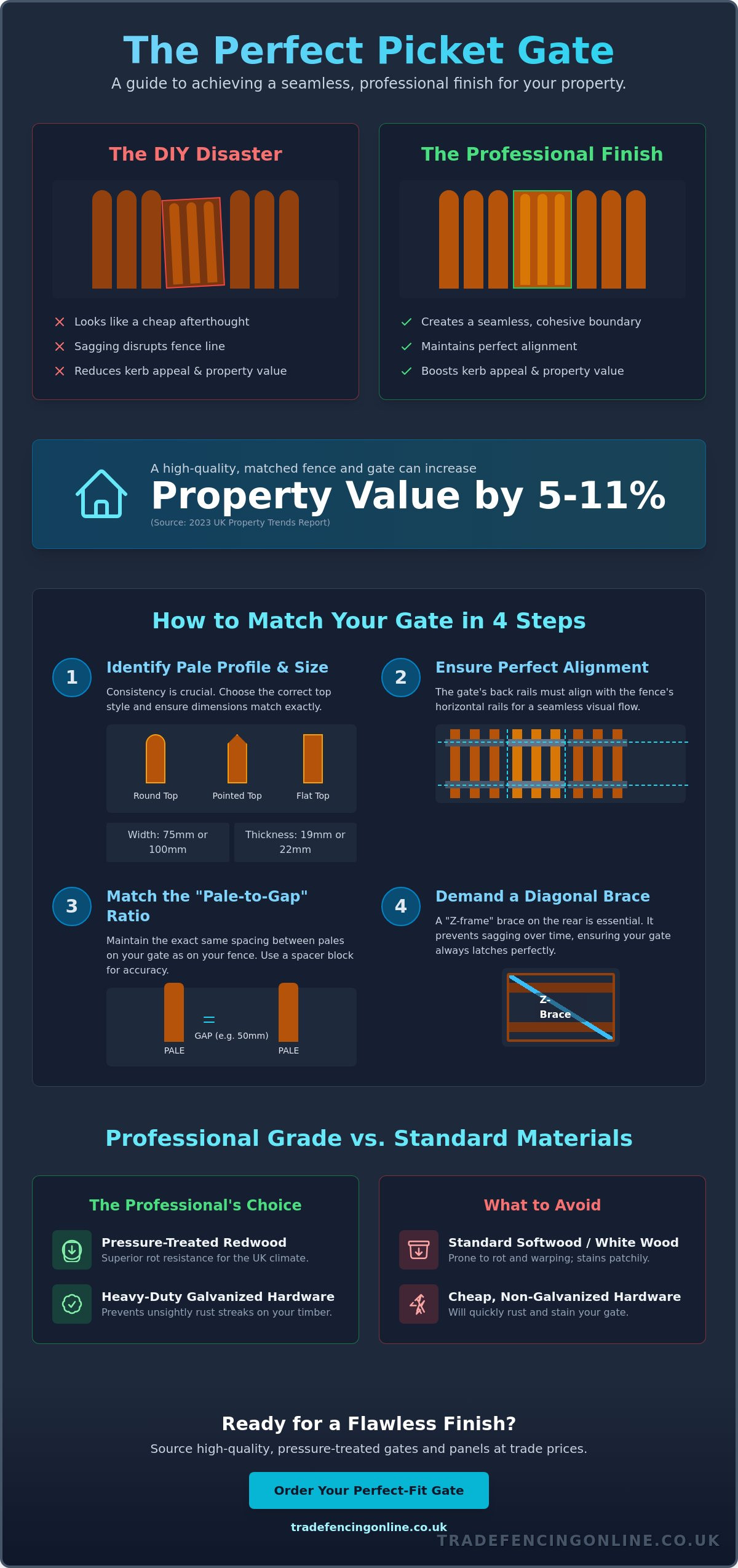
A picket gate serves as a traditional palisade entrance. It provides a clear boundary while maintaining full visibility of your garden. Choosing a picket fence gate to match your existing panels is the most effective way to ensure a professional finish. A matched boundary has a direct psychological impact on visitors and buyers. It suggests the property is well-maintained and secure. According to a 2023 report on UK property trends, high-quality garden fencing can increase property value by an estimated 5% to 11%.
Homeowners use these gates for several practical reasons. They're ideal for front gardens where you want to show off landscaping. They work well as pet enclosures because the gaps allow animals to see out, which often reduces barking and anxiety. You can also use them to mark transitions between garden paths and vegetable patches. The primary issue with generic gates is alignment. Off-the-shelf options often fail to match the specific pale width or height of your fence panels. This creates a staggered, messy look that ruins the symmetry of your home's exterior. Buying a picket fence gate to match your specific panel height prevents this visual disruption.
The Traditional Palisade Aesthetic
Picket fencing is a staple of UK residential architecture. The history of the picket fence dates back centuries, originally used for its simple construction and effectiveness. The "open" design is a functional choice for the British climate. It allows light to flow through to flower beds and offers minimal wind resistance during autumn storms. Maintaining symmetry is a core principle of traditional garden design. A gate that sits flush with the fence line preserves these clean, horizontal rows and keeps the boundary looking intentional.
Matching vs. Contrasting Gates
A 100% match is usually the best choice for a seamless, professional appearance. It makes the gate blend into the boundary, making the garden feel larger and more cohesive. In some designs, a contrasting gate style works well. An arched top gate can act as a decorative focal point in a flat-top fence. A palisade is a fencing style consisting of vertical pales with gaps. Whether you choose a match or a contrast, the quality of the timber and the spacing of the pales must remain consistent to avoid a DIY look. Stick to trusted suppliers to ensure the timber grade matches your existing installation.
How to Choose a Picket Fence Gate to Match Your Existing Boundary
Finding a picket fence gate to match an existing boundary requires attention to detail. You don't want a gate that sits out of sync with the rest of your garden. Consistency in height, spacing, and timber quality defines a professional installation. Start by examining the specific components of your current fence to ensure the new gate looks like part of the original build rather than an afterthought.
Identifying Your Pale Profile
Identify the pale profile first. Round top pales are the standard for most UK suburban gardens. Pointed tops provide a traditional aesthetic often seen in rural properties or heritage homes. Flat tops work best for modern, minimalist designs. Measure the width of your current pales. They're usually 75mm or 100mm wide. Matching this width is non-negotiable for a professional finish. Always choose Redwood timber. It offers better resistance to rot and ensures the stain colour matches your existing panels perfectly. Cheaper white woods often take on a different hue when treated, creating a patchy appearance across your boundary.
The Technicals of Alignment
Check the horizontal rails on your fence. Measure from the ground to the top of the first horizontal rail. The gate's back-rails must align with these for structural harmony. A gate that sits higher or lower than the fence line looks amateur and disrupts the visual flow. Every gate requires a Z-frame or diagonal brace on the rear. This prevents the timber from sagging under its own weight over time. Without this brace, your gate will eventually scrape the ground and fail to latch.
Calculate the "Pale to Gap" ratio carefully. Consistency is vital for a seamless look. If your fence has 50mm gaps, keep that measurement exact on the gate. When you install the pales, use a spacer block to ensure the distance remains uniform. If the pales are too cramped, the gate looks heavy. If they're too sparse, you lose privacy and the boundary feels weak. Standard pedestrian gates are 900mm wide. If your gap is 1100mm, you'll need a bespoke build to avoid large, unsightly gaps at the hinge posts.
Confirm the timber thickness is 19mm or 22mm. Thinner pales often warp within 12 months of exposure to the British weather. Professional suppliers provide 22mm timber for maximum durability. This extra thickness ensures the gate matches the heavy-duty feel of a well-built fence. If you're unsure about measurements, always measure the gap between the posts, not the old gate itself. This ensures your new picket fence gate to match fits the space perfectly even if the posts have shifted slightly. For a durable, professional-grade solution, view our range of quality gate options today.
Material Quality: Pressure-Treated Timber for Long-Lasting Gates
Pressure treatment, often called Tantalising, is the industry standard for any timber gate in the UK. This process involves placing the wood in a vacuum tank and forcing chemical preservatives deep into the grain. It isn't a surface spray; it's a deep-level protection against rot, wood-boring insects, and fungal decay. For a picket fence gate to match a high-quality boundary, this treatment is non-negotiable. Without it, the constant exposure to ground moisture and rain will cause standard timber to fail in less than 3 years.
Expect a service life of 10 to 15 years when you choose pressure-treated timber. You'll notice a distinct green tint on new gates. This is a natural result of the copper-based preservatives reacting with the wood. It isn't a defect. Over 6 to 12 months, this green hue weathers down to a natural honey brown before eventually turning into a classic silver-grey. If you prefer a specific colour, you can paint or stain the gate once the timber has fully dried after installation.
Why Scandinavian Redwood is the Trade Choice
We supply Scandinavian Redwood because it outperforms standard UK softwoods in every category. These trees grow slowly in cold northern climates, resulting in tighter growth rings and a much higher density. This structural integrity is vital for gates. Standard softwoods often warp, twist, or "cup" when the Essex weather shifts from heavy rain to direct sunlight. Redwood remains stable and features smaller, more consistent knots. It provides a superior surface for those looking for a picket fence gate to match a premium garden aesthetic, as it absorbs stains and paints more evenly than cheaper alternatives.
Maintenance Tips for Picket Gates
Even the best timber needs basic care to stay functional. Conduct a hardware check every spring. Tighten any loose screws on hinges or latches, as timber naturally expands and contracts with moisture changes. While the pressure treatment prevents rot, it doesn't stop UV bleaching. Applying a UV-resistant oil or clear wood preserver every 2 years maintains the wood's supple texture and prevents surface cracking. For a full list of the tools you'll need for these tasks, see our guide on essential fencing supplies. Keeping the bottom of the gate clear of leaf litter and debris will also prevent unnecessary moisture build-up.
Completing the Project: Hardware and Installation Basics
Selecting the right ironmongery is the difference between a gate that lasts 15 years and one that sags within six months. When you install a picket fence gate to match your existing run, the hardware must be heavy-duty and fully galvanized. Cheap, non-galvanized steel reacts with timber and rain, leading to ugly black rust streaks down your pales. High-quality zinc coatings prevent this corrosion and keep the boundary looking professional.
Essential Ironmongery for Picket Gates
Tee hinges are the standard choice for picket gates. You must choose the correct size to support the weight of the timber; the hinge should cover between 1/3 and 1/2 of the gate's total width. If your gate is 900mm wide, use a 300mm or 450mm hinge to distribute the load properly. For the latch, ring latches offer a traditional look and operate from both sides, while Suffolk latches provide a more rustic feel. Always install a gate stop on the closing post. This small block of wood prevents the gate from swinging through the frame, which protects the hinges from bending under wind pressure.
Setting Your Gate Posts Correctly
Standard intermediate posts aren't strong enough to support a swinging gate over time. You need 100mm x 100mm (4x4) fence posts as a minimum standard. These provide the structural mass required to resist the constant pull of the gate. Dig your holes at least 600mm deep for a standard 1.2m picket fence. Use two bags of Postcrete per hole for a rapid, rock-solid foundation. Use a spirit level on two adjacent faces of the post to ensure it's perfectly plumb. Even a 2-degree lean will cause your gate to swing open or shut on its own.
Timber is a natural material that absorbs moisture. In the wet UK winter, a gate can expand by several millimetres. Always leave a 5-10mm expansion gap between the gate frame and the posts during installation. Without this tolerance, the gate will stick and bind against the post as soon as the weather turns. This simple adjustment ensures smooth operation year-round without the need for constant planing or trimming.
Order your heavy-duty ironmongery and timber today at Trade Fencing Online.
Order Your Picket Fence Gate to Match from Trade Fencing Online
Finding a picket fence gate to match your existing boundary doesn't have to be a struggle. Romford Fencing Ltd provides a comprehensive selection of timber gates designed specifically to complement our picket panels. We focus on durability and aesthetic consistency, ensuring your garden entrance looks like it was built as part of the original installation. Whether you're a DIY homeowner or a professional landscaper, our trade-level pricing ensures you get the best value without compromising on timber quality. Our gates are manufactured to withstand the British weather, using pressure-treated wood that resists rot and decay for years to come.
Standard sizes often fail to meet the needs of older properties or unique garden layouts. If you have a non-standard gap, our team provides bespoke quotes for custom gate sizes. Simply provide your dimensions and we will manufacture a picket fence gate to match your specific requirements. This service eliminates the need for awkward on-site modifications that can weaken the timber structure or ruin the visual symmetry of your fencing.
The Romford Fencing Advantage
We've built our reputation as a trusted supplier through consistent 5-star local reviews and a commitment to stock availability. We understand the specific needs of Essex gardens and the importance of structural integrity. We stock high-quality fence panels that align perfectly with our gate styles. This ensures the wood grain, pale spacing, and height remain uniform across your entire perimeter. For local fencing contractors, we offer trade accounts to streamline bulk ordering and project management. You get direct access to our expert knowledge and the most competitive rates in the region.
- Quality Assurance: Every gate is inspected for timber quality and joinery precision.
- Trade Prices: We pass our bulk-buying savings directly to you.
- Expert Support: Our staff can advise on the best ironmongery and post sizes for your specific gate.
Fast Local Delivery in Essex and London
We operate a "One-Stop-Shop" delivery model that simplifies the entire procurement process. This means we bring everything to your door, from the pales and gates to the postmix and ironmongery. There's no need to visit multiple suppliers to finish a single job. Our delivery fleet covers Romford, Basildon, Chelmsford, and Barking on a regular schedule, ensuring your materials arrive when you need them. We focus on efficiency so your project stays on track without unnecessary delays.
Our logistics team coordinates closely with customers to provide accurate delivery windows. We pride ourselves on being a reliable partner for both large-scale commercial installs and small residential repairs. If you're ready to complete your garden boundary with a professional finish, Browse our Gate and Ironmongery range today. You can order online or contact our team directly for a bespoke quote on custom sizes.
Secure Your Garden with a Professional Finish
Investing in a picket fence gate to match your existing boundary is the most effective way to boost your property's kerb appeal. It's not just about looks; it's about structural integrity. We build our gates from high-quality pressure-treated Scandinavian Redwood. This specific timber resists rot and stands up to the unpredictable British weather. You'll get a durable, professional product that maintains its shape and strength for years to come.
Trade Fencing Online is a 5-star rated local supplier. We focus on providing trade-quality materials at competitive prices for every customer. If you're based in Essex, take advantage of our free local delivery options to save on your project costs. We've simplified the ordering process so you can get the ironmongery and timber you need without any fuss. We're the home of quality garden fencing, and we're ready to help you complete your garden boundary today.
Order Your Matching Picket Gate and Hardware Online Now
Your garden transformation is just a few clicks away.
Frequently Asked Questions
Can I buy a picket gate that matches my existing 3ft or 4ft fence?
You can easily buy a picket fence gate to match standard 3ft or 4ft fence heights. Most UK suppliers stock gates in 0.9m and 1.2m heights to ensure a level top line across your boundary. Check the pale spacing on your current panels. Standard spacing is often 50mm or 75mm, so choose a gate that mirrors these dimensions for a seamless look.
What is the best width for a matching picket gate?
The most common width for a matching picket gate is 0.9m. This provides enough clearance for wheelie bins and lawnmowers, which typically measure around 0.5m to 0.7m wide. If you need vehicle access, you'll require a double gate setup. Most pedestrian gates shouldn't exceed 1.2m in width to prevent excessive strain on the hinges and posts.
How do I stop my picket gate from sagging over time?
Install a diagonal brace, often called a Z-frame, to prevent your picket gate from sagging. The brace must run from the bottom hinge corner up to the top latch corner. This transfer of weight keeps the gate square. Use 75mm x 75mm timber posts set 600mm deep in concrete to provide a rigid foundation that won't shift under the gate's weight.
Should a picket gate open inwards or outwards?
A picket gate should typically open inwards towards your garden. This prevents the gate from obstructing public pavements or highways, which is a requirement under the Highways Act 1980. Opening inwards also protects the gate from wind damage. If your driveway slopes steeply upwards, you might need a rising hinge to allow the gate to clear the ground.
Does my matching picket gate need a special type of hinge?
Use heavy-duty tee hinges or strap hinges for a picket fence gate to match your existing setup. For a 0.9m wide gate, use 300mm or 350mm hinges to distribute the weight across the horizontal rails. Galvanised steel finishes are essential for UK weather to prevent rust. Avoid small butt hinges as they lack the structural support needed for external timber gates.
How much gap should I leave between the gate and the posts?
Leave a 10mm gap on the hinge side and a 10mm to 15mm gap on the latch side. Timber expands when wet, and UK humidity levels can cause wood to swell by 2% or 3% during winter months. These tolerances ensure the gate doesn't bind against the posts. Use a spirit level to check both posts are perfectly vertical before hanging the gate.
Can I paint my pressure-treated picket gate immediately?
Don't paint a pressure-treated picket gate immediately after installation. The treatment process leaves moisture in the wood that prevents paint or stain from adhering correctly. Wait for the timber to dry for at least 60 to 120 days. You can test this by dropping water on the surface; if it beads up, the wood is still too wet for treatment.
Do I need a permit for a picket fence and gate in my front garden?
You don't need planning permission if your front garden fence and gate are under 1 metre high. This rule applies to boundaries adjacent to a highway used by vehicles. If you live in a Conservation Area or your property is a Listed Building, different rules apply. Always check with your local council's planning department if your proposed height exceeds the 1000mm limit.