


Why are you replacing your garden fence every five years when a professional boundary should last twenty? It's a common cycle of frustration for many homeowners. You spend money on new panels only to see the post bases rot or the timber blow out during a typical UK winter storm. You need a boundary that offers real value and stops the constant drain on your maintenance budget.
Selecting the right long lasting garden fencing materials is the only way to ensure your boundary lasts for decades; not just a few seasons. This guide shows you how to achieve a 15 to 25 year lifespan using the right combination of pressure-treated timber, concrete posts, and gravel boards. We will preview the specific benefits of different materials and the installation methods that guarantee stability. This information provides a clear path to a durable, low-maintenance fence that looks professional and stays standing regardless of the weather.
Key Takeaways
- Identify the critical differences between UC3 and UC4 pressure-treated timber to prevent premature rot at the ground line.
- Learn why concrete posts and gravel boards are the most long lasting garden fencing materials for boundaries exposed to high winds and damp soil.
- Master the "one-third" installation rule to ensure your fence posts remain stable during severe UK winter storms.
- Discover how to create a proper weathering slope at the post base to divert moisture away from vulnerable timber components.
- Understand the logistical and quality advantages of sourcing trade-standard materials from specialist suppliers in Essex and London.
What Makes Garden Fencing Long Lasting? Understanding Material Lifespans
Long-lasting is a specific performance standard, not a vague marketing term. In the UK, a fence is only considered durable if it remains structurally sound for 15 to 25 years. Many standard retail products fail this test because they cannot withstand the three primary enemies of longevity: ground moisture, UV radiation, and wind loading. Ground moisture is the most aggressive threat. It attacks the base of the posts where the timber meets the soil, leading to rapid fungal decay and structural collapse.
Choosing the right long lasting garden fencing materials prevents the "false economy" of repeated replacements. Budget-grade lap panels often feature thin slats that are only a few millimetres thick. These materials warp under intense UV rays and easily shatter during high-wind events. You might save money on the initial purchase, but these panels typically fail within 5 to 7 years. Investing in professional-grade materials ensures your boundary remains a structural asset rather than a recurring maintenance liability.
The durability of your fence depends heavily on how the raw materials are handled before they reach your garden. Understanding The Science of Timber Preservation is essential for any property owner. High-quality timber undergoes a vacuum-pressure process that forces chemical preservatives deep into the wood grain. This creates a permanent barrier against the damp conditions and insect wood-borers common in Essex and London gardens. Without this deep treatment, timber is simply a ticking clock.
Average Lifespan of Common Fencing Materials
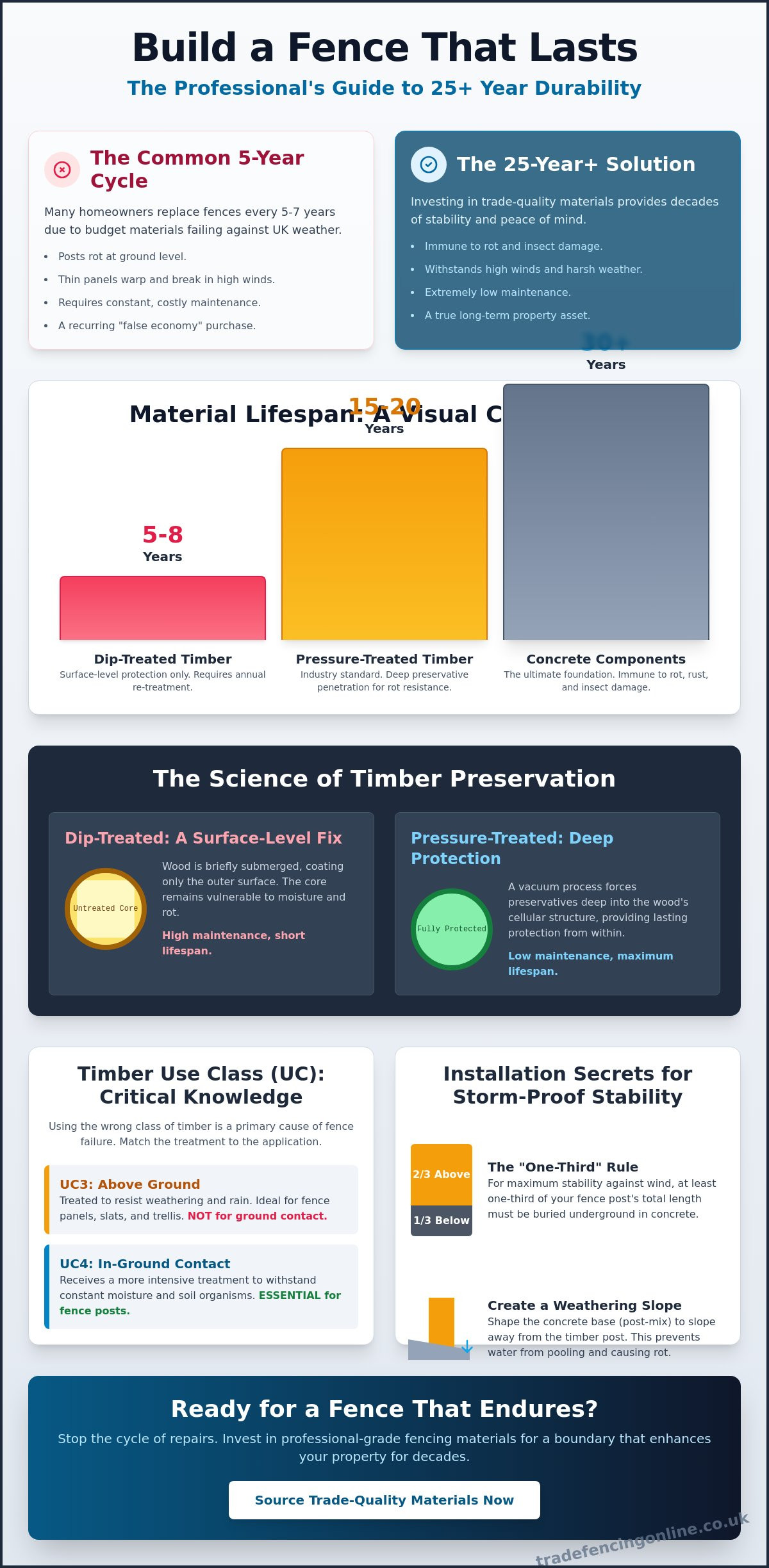
- Dip-treated timber: 5-8 years. These products only have a surface coating of preservative. They require annual staining or painting to maintain their integrity.
- Pressure-treated (Tanalised) timber: 15-20 years. This is the industry standard for professional installations. It offers excellent resistance to rot without constant maintenance.
- Concrete posts and gravel boards: 30+ years. Concrete is immune to rot, rust, and insect damage. It provides the most stable foundation for any fencing system.
Why Material Choice Matters for Your Property Value
A sturdy fence does more than mark a boundary. It provides immediate kerb appeal and signals to potential buyers that the property is well-maintained. Secure, high-quality fencing also improves garden privacy and acts as a significant deterrent to intruders. If you choose cheap materials, you'll likely pay for the labour and materials twice in a single decade. Buying trade-quality materials once is the most cost-effective strategy for any homeowner who values their time and budget.
The Science of Timber Preservation: Pressure Treated vs. Dip Treated
Timber preservation is a technical process, not a cosmetic one. To secure long lasting garden fencing materials, you must understand how wood is protected from the elements. Pressure treatment involves placing timber in a vacuum chamber to remove air from the wood cells. High pressure then forces chemical preservatives deep into the timber's cellular structure. Dip-treated wood, by contrast, is simply submerged in a tank for a few minutes. This leaves the core of the wood vulnerable. Dip-treated products require annual staining to prevent rot, making them a high-maintenance and ultimately shorter-lived choice.
Industry standards categorize timber by Use Class (UC) to define its durability. UC3 timber is rated for components that don't touch the ground, such as fence slats or trellis. UC4 timber is specifically treated for direct soil contact and is used for high-quality fence posts. UC4 treatment involves a longer vacuum cycle to ensure the preservative reaches the heartwood. Using UC3 wood for a post is a common mistake that leads to a fence collapsing within a few years. Professional suppliers prioritize trade-quality fencing materials that meet these rigorous British Standards for preservation.
What is Tanalised Timber?
Tanalised timber is wood treated with Tanalith E, a modern copper-based preservative. It's designed to provide long-term protection against fungal decay and insect attack. You can identify it by a faint green or bronze tint, which eventually weathers to a natural silver-grey. If you cut pressure-treated timber during installation, you must manually reseal the cut ends with a preservative. Failing to do this exposes the untreated core to moisture, negating the benefits of the vacuum process. Don't ignore this step if you want your boundary to last.
Choosing Between Closeboard and Lap Panels
Closeboard fence panels are the superior choice for durability and wind resistance. They feature vertical, overlapping feather edge slats that are significantly thicker than those found in budget lap panels. While a standard lap panel might use 8mm slats, premium closeboard panels often use 12mm or 15mm timber. This heavy-duty construction provides a rigid structure that won't rattle or shatter during UK winter storms. The overlapping design also ensures better privacy and a more professional aesthetic for your garden boundary.
If you want a boundary that remains sound for decades, browse our range of pressure-treated fence panels designed specifically for the UK climate.
Concrete vs. Wooden Posts: Which Support Lasts Longest?
Most fences fail at the ground line. This is the "kill zone" where moisture and oxygen create the perfect environment for rot. If you're looking for long lasting garden fencing materials, the post choice is your most important decision. A snapped post usually requires a full boundary rebuild. This is an expensive and avoidable headache. You need a support system that handles the weight of the panels and the pressure of UK winter winds without buckling. This need for structural resilience is mirrored in industrial storage, where GSE Racking engineers heavy-duty racking systems to safely support massive loads in demanding warehouse environments.
Concrete posts are the definitive solution for long-term stability. They offer total immunity to the rot and insect damage that eventually claims every wooden post. While some homeowners prefer the look of timber, concrete provides a 30-year foundation that won't snap during a storm. Academic research on Understanding Material Lifespans confirms that inorganic supports consistently outperform treated timber in wet soil conditions. Relying on concrete removes the need for chemical retreats or structural repairs at the base of your fence.
A durable system requires more than just posts. You must also use concrete gravel boards to protect your panels. These boards sit at the base of the fence and prevent the timber panels from touching the damp earth. This simple addition can double the life of your panels by keeping them dry and clear of debris. It's the most effective way to prevent rising damp from rotting the bottom of your feather edge slats.
The Case for Concrete Support Systems
Concrete systems are built for efficiency. Slotted concrete posts allow you to slide panels in and out without using nails or brackets. This makes future maintenance simple. If a panel is damaged by an impact, you can replace it in minutes. The weight of the concrete also provides superior wind resistance. It keeps your boundary upright when timber alternatives might flex or fail. It's a "fit and forget" solution for those who value durability over initial cost.
Wooden Posts: Maximising Life with Proper Installation
If you choose wooden posts for their traditional appearance, don't settle for budget 3x3 options. Always use 4x4 posts. These have a higher heartwood content, which is naturally more resistant to decay than the outer sapwood. You must set these posts in a stable, well-drained base using postcrete. This ensures the post doesn't shift and helps moisture drain away from the timber. Never bury a wooden post directly in soil without a gravel board to act as a barrier. Proper installation is the only way to get a decade of service out of a timber post.
Installation Secrets for a Fence That Defies the Elements
Even the highest quality long lasting garden fencing materials will fail if the installation is rushed. A durable boundary is a complete system where every component supports the next. Wind loading is the primary cause of structural failure in the UK. If your posts aren't deep enough, the entire line will lean or collapse during the first major storm. You must build for the worst-case weather scenario to ensure your investment stays upright for decades.
Follow the "one-third" rule for maximum stability. At least one-third of the total post length must be below ground level. When pouring your postmix, create a "weathering slope" at the base. This involves tapering the concrete away from the post so water runs off into the surrounding soil rather than pooling against the timber or concrete base. This small detail prevents the standing water that accelerates decay at the most vulnerable point of the structure.
Don't ruin your panels with cheap fixings. Use stainless steel or galvanised fencing ironmongery to prevent ugly rust streaks from running down the wood. These streaks aren't just an eyesore; they indicate that the metal is corroding and losing its structural grip. Ensure there is adequate air flow between slats to prevent moisture traps. Trapped dampness is a fast track to fungal decay, even in treated wood.
Step-by-Step: The Durable Installation Framework
Digging to 600mm minimum is non-negotiable for standard 6ft panels. Ensure your gravel board is perfectly level before mounting the panels. This component keeps the timber off the damp earth and provides a solid horizontal reference for the rest of the run. Secure your panels to the posts using metal clips instead of direct-nailing. This reduces wood splitting and makes it far easier to slide panels out if you ever need to replace one after an impact.
Maintenance Tips to Double Your Fence’s Life
Maintenance shouldn't be a chore. Apply a UV-protective oil to your pressure-treated wood every two to three years to prevent the timber from drying out and cracking. For the best finish, preparing the surface with high-quality abrasives from Fosseway Tapes & Fixings Limited before oiling will ensure a smooth, professional result. Keep the base of the fence clear of vegetation and leaf debris. Wet leaves held against the timber create a permanent moisture trap that bypasses the gravel board's protection. Check your brackets and tighten any loose screws after major storms to maintain the structural rigidity of the entire boundary.
Shop our full range of professional fencing supplies to start your project with the right gear.
Sourcing Trade-Quality Fencing Materials in Essex and London
Sourcing the right long lasting garden fencing materials requires moving beyond general DIY retailers. Most big-box stores stock light-duty products designed for ease of transport rather than ultimate durability. A specialist fencing supplier provides access to trade-standard timber that is physically heavier and structurally superior. This is the difference between a fence that rattles in the wind and one that remains silent and secure. Professional-grade materials are built to a higher specification to meet the demands of trade contractors who cannot afford callbacks for failed boundaries.
Local environmental factors are often ignored by national chains. In Essex and parts of East London, heavy clay soil presents a unique challenge for any boundary. Clay soil expands significantly when wet and contracts during dry spells. This constant ground movement can easily loosen shallow posts or crack low-quality, air-entrained concrete. Romford Fencing Ltd understands these local ground conditions. We provide high-density concrete and timber specified to withstand the shifting pressure of local soil. Our materials are selected to perform in the specific climate and geological conditions of the South East.
Romford Fencing Ltd maintains a strict commitment to trade-standard timber and concrete. We don't stock the thin, dip-treated panels found in budget outlets. Every component in our yard is selected for its ability to contribute to a 20-year boundary. We provide fast delivery services across Romford, Essex, and East London, ensuring your materials arrive on-site in peak condition. This logistical support is essential when handling heavy concrete posts and gravel boards that require specialized transport.
Why Trade-Grade Materials Last Longer
Trade-grade materials feature thicker slats and higher-quality timber cuts. While retail panels often use 100mm wide slats, our feather edge panels typically use 125mm slats with a larger overlap. This prevents the "see-through" effect that occurs when timber naturally shrinks over time. You also get access to professional-grade fence posts and gravel boards that meet UC4 standards for ground contact. This ensures your long lasting garden fencing materials don't fail prematurely due to inferior treatment or thin dimensions. Trade timber is also less likely to have large, structural knots that can fall out and weaken the panel.
Ordering for Your Project
To build a 20-year fence, calculate your materials based on 1.83m (6ft) centres. Always include one extra post for the end of the run and account for any corner posts required. Concrete components are heavy and difficult to transport in a domestic vehicle. We offer reliable local delivery to solve this logistical problem. This service ensures your materials arrive on-site without the risk of damage or personal injury. Buying from a local expert means you get the right advice and the right materials the first time.
SHOP DURABLE FENCE PANELS AT ROMFORD FENCING
Secure Your Property with a 25-Year Boundary
Building a durable fence is an investment in your property's security and value. You now understand that longevity depends on the combination of UC4 pressure-treated timber and a robust concrete foundation. Avoiding the "false economy" of cheap dip-treated panels saves you from the cycle of repeated replacements. By using concrete gravel boards and setting your posts to the correct depth, you ensure your boundary stands firm against the worst UK winter storms. These small technical choices make the difference between a five-year fix and a twenty-five-year solution.
Romford Fencing Ltd has been a specialist supplier in Romford since 2026. We provide trade-grade materials specifically designed to handle the variable weather and heavy clay soils of the South East. Don't settle for retail-grade products that warp or rot within a few seasons. We offer fast delivery across Essex and East London to get your project moving without delay. Our inventory includes everything from heavy-duty feather edge panels to reinforced concrete posts.
Browse Our Range of Trade-Quality, Long-Lasting Fencing Supplies and select the long lasting garden fencing materials your garden deserves. Start building a boundary that lasts for decades today.
Frequently Asked Questions
What is the longest lasting wood for garden fencing?
Pressure-treated softwood rated to UC4 standards is the most cost-effective and durable choice for UK gardens. While hardwoods like cedar offer natural resistance, they are significantly more expensive and often unnecessary for standard boundaries. UC4 timber is specifically treated for ground contact, providing a reliable 15 to 20 year lifespan when installed correctly with proper drainage.
Are concrete fence posts worth the extra money?
Concrete posts are definitely worth the investment because they are immune to rot and insect damage. Timber posts are the most common point of failure in any fence line. By spending more upfront on concrete, you eliminate the need for post replacements every decade. Concrete provides a 30-year structural foundation that stays upright regardless of soil moisture levels.
How long do pressure treated fence panels actually last?
High-quality pressure-treated panels typically last between 15 and 20 years. This durability depends on the panels being kept clear of the ground using gravel boards. Investing in long lasting garden fencing materials like Tanalised timber ensures your boundary survives the damp UK climate far longer than budget dip-treated alternatives, which often fail within five years.
Do I need to treat my fence if it is already pressure treated?
You don't need to apply immediate rot-protection, but annual maintenance helps maintain the timber's condition. Applying a UV-protective oil or water repellent every two years prevents the wood from drying out and cracking. While the pressure treatment protects the core of the timber from decay, external treatments preserve the surface appearance and reduce natural weathering.
Which fence style is best for high-wind areas in the UK?
Closeboard or feather edge fencing is the superior choice for wind-prone locations. The overlapping vertical slats and heavy-duty back rails provide a rigid structure that resists gale-force winds better than thin overlap panels. For the best results, use these panels with slotted concrete posts to ensure the entire boundary remains stable during winter storms.
Can I install a new fence over old concrete posts?
You can reuse existing concrete posts if they are still structurally sound and vertically level. Check the slots for cracks or blockages before ordering new panels. This is one of the main advantages of concrete systems; you can simply slide out old, damaged timber and slide in new panels without the labour and expense of digging new post holes.
What is the best way to prevent the bottom of a fence from rotting?
Installing a concrete gravel board is the only guaranteed way to stop ground-level rot. It acts as a protective barrier that keeps the timber panels away from damp soil and wet grass. Without a gravel board, moisture wicks directly into the bottom of the feather edge slats, causing the wood to soften and decay prematurely.
Is composite fencing more durable than pressure-treated timber?
Composite fencing is technically more durable because it doesn't rot or suffer from fungal attacks. It requires almost zero maintenance and stays the same colour for years. However, the initial cost is significantly higher than timber. For most property owners, high-grade pressure-treated timber remains the best value solution for achieving a 20-year boundary without the premium composite price tag.