


Last Saturday, a homeowner in Romford spent three hours dismantling a garden boundary only to find their 6ft panels would not fit in a standard hatchback. It's a common frustration for many. You want a clear garden, but local recycling centers often have 2 meter height barriers that block transit vans, and hiring a skip for just five panels feels like a poor investment. Knowing how to dispose of old fence panels uk homeowners can manage without stress is essential for any renovation project.
We provide a straightforward plan to help you clear your site legally and efficiently. You will discover the most cost-effective ways to remove or recycle your old timber while staying on the right side of Environment Agency waste regulations. We explain how to prep your wood for the tip, why you shouldn't burn treated timber, and how to navigate the 2023 regulatory updates regarding hazardous wood waste. This guide ensures your old fencing is gone quickly so you can focus on your new installation.
Key Takeaways
- Use heavy-duty gear and a systematic approach to dismantle panels safely and efficiently without damaging your posts.
- Navigate local council regulations and waste classifications to master how to dispose of old fence panels uk via household recycling centres.
- Compare skip hire against manual tip runs to choose the most cost-effective removal method for your specific project scale.
- Distinguish between pressure-treated and clean timber to unlock sustainable upcycling opportunities and reduce environmental impact.
- Plan your replacement project with high-quality materials to ensure long-term durability and lower your future disposal requirements.
Preparing Your Old Fence Panels for Disposal
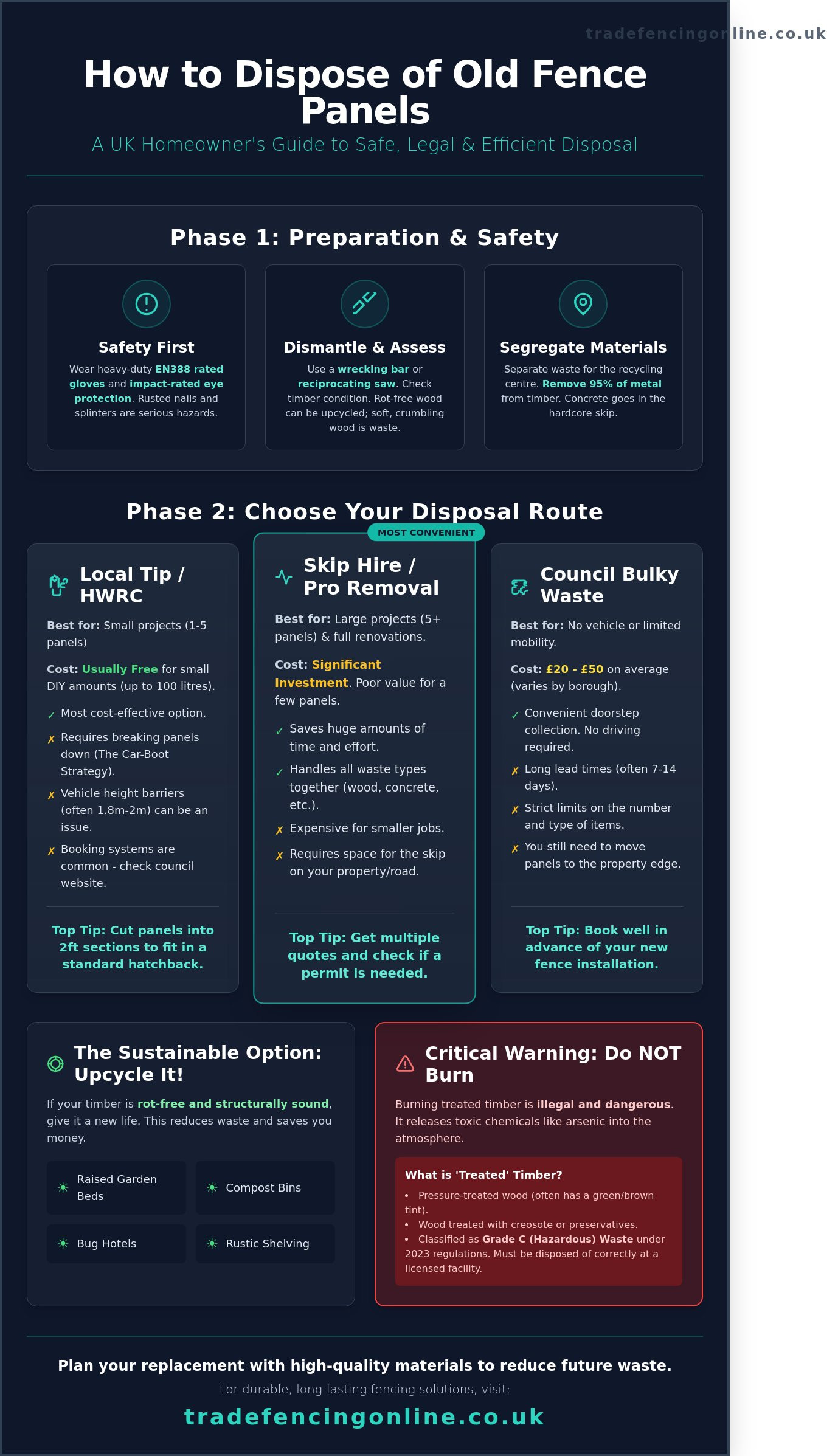
Success starts with preparation. Before you learn how to dispose of old fence panels uk, you must dismantle the structure safely. Rusted nails and splintered timber are immediate hazards. Always wear EN388 rated heavy-duty leather gloves and impact-rated eye protection. Rusted fixings often snap under pressure, sending sharp metal fragments flying. A systematic approach prevents injury and ensures the materials are ready for the local tip or reuse.
Assess the condition of every panel before you start tearing them down. If the timber is rot-free and structurally sound, it's reclaimable. You can often sell these on local marketplaces or donate them to community projects. If the wood is soft, grey, or crumbling, it's destined for the waste pile. Dismantle panels by sliding them vertically out of concrete slotted posts. For timber posts, use a pry bar to pull the panels away without shattering the rails. This keeps the waste manageable and much easier to transport in a standard vehicle.
Essential Tools for Fence Removal
The right kit makes the job 50% faster. Use a 24-inch wrecking bar for maximum leverage against stubborn ring-shank nails. These nails are designed to stay put, so brute force alone won't work. A reciprocating saw with a wood-and-metal blade is your best friend for cutting through seized bolts or breaking down oversized sections. Keep a small plastic tub nearby. Drop every screw, hinge, and bracket into it. This keeps your garden safe for pets and children while organising your metal recycling in one go.
Separating Wood, Metal, and Concrete
UK recycling centres operate on strict segregation rules. You can't throw a panel with heavy metal hinges still attached into the wood skip. Most facilities categorise fencing as Grade C waste. This includes treated timber like pressure-treated larch or cedar. Remove all ironmongery before you arrive to avoid being turned away or charged commercial rates. Many UK tips expect you to remove 95% of metal fixings before they'll accept timber as standard wood waste.
- Timber: Remove all metal. Most tips accept 'nails-in' timber if the nails are flush, but check local council guidelines first.
- Metal: Brackets, screws, and bolts go into the scrap metal skip. These are 100% recyclable.
- Concrete: Gravel boards and post-mix remnants are heavy. These must go into the hardcore or rubble container.
Planning your trip to the recycling centre saves hours of frustration. Knowing how to dispose of old fence panels uk involves understanding that concrete and wood have different disposal routes. Concrete gravel boards are fully recyclable but must be free of soil and timber debris. Following these steps ensures a smooth transition from your old, broken fence to a clean, ready-to-build site.
Using Local Authority Recycling Centres (The Tip)
Visiting a Household Waste Recycling Centre (HWRC) is a standard method for how to dispose of old fence panels uk. It's a pragmatic choice for small garden projects. You must distinguish between 'Household Waste' and 'DIY Waste' to avoid unexpected fees. Following UK government policy changes in January 2024, many local authorities stopped charging residents for small amounts of DIY timber. You can typically dispose of up to two units or 100 litres of waste for free, as long as you don't exceed four visits within a four-week period.
Always check your local council’s specific rules for timber before loading your vehicle. Some sites require you to remove all metal fixings, such as rusted screws or heavy-duty brackets, before they accept the wood. Height barriers are a frequent obstacle for DIYers. Most UK centres set these at 1.8 or 2 metres. If you drive a 4x4 with a roof rack or a small van, you might need to apply for a vehicle permit or book a specific commercial-style slot. Booking systems are now standard in many counties. Sites in Kent, Essex, and Hampshire require you to book a 30-minute window online. Don't turn up without a confirmed slot, or you'll be turned away at the gate.
The Car-Boot Strategy: Breaking Panels Down
A standard 6ft fence panel won't fit in a car. You must break it down into manageable pieces. Use a hand saw or a circular saw to cut the panel into 2ft sections. This size fits easily into a standard hatchback with the rear seats folded down. Lay a heavy-duty tarpaulin or old blankets first. This protects your car's interior from sharp splinters, dirt, and old creosote. A medium-sized car like a VW Golf can realistically carry 1 or 2 panels per trip without obstructing your mirrors or damaging the headlining.
Council Bulky Waste Collection Services
Council doorstep collections are a reliable alternative if you don't have a large vehicle. You book a slot, leave the panels at the edge of your property, and the waste team collects them. Costs usually range from £20 to £50 depending on your borough. Lead times are often 7 to 14 days. Most councils limit these collections to 5 or 6 items per visit. If you're replacing a long boundary, this isn't the most efficient route. Once your old boundary is cleared, you can order quality replacement panels to secure your garden again.
Hiring Professional Waste Removal and Skips
Deciding how to dispose of old fence panels uk homeowners often find that professional services save significant time. If your project involves replacing more than 10 standard 6ft panels, multiple trips to the local household waste recycling centre become inefficient. Large scale fencing projects generate bulk that quickly exceeds the capacity of a standard family car. Hiring a skip or a waste team keeps your property clear and prevents damage to your vehicle interior from splinters and nails.
Select a skip size based on your specific waste volume. Common options include:
- 2-Yard Mini Skip: Holds roughly 25 to 30 bin bags. Best for small repairs.
- 4-Yard Midi Skip: Suitable for approximately 45 to 50 bin bags. Fits a small garden fence replacement.
- 8-Yard Builders Skip: The most popular choice for full garden renovations. It handles heavy waste like concrete gravel boards and fence posts effectively.
You must use a Licensed Waste Carrier. The Environmental Protection Act 1990 dictates that householders are responsible for their waste until it is properly disposed of. If a rogue trader fly-tips your old panels, you face fixed penalty notices or fines up to £50,000. Ask for a waste transfer note and verify the company on the Environment Agency's public register before they depart with your old fencing.
Skip Hire vs. Man and Van Services
Static skips stay on your driveway for several days, letting you work at your own pace. However, man and van clearance teams offer a faster turnaround. These services often include labour, which is a major benefit if you are moving heavy concrete posts or wet timber panels. A single concrete post can weigh over 40kg. Having a team load the vehicle reduces the risk of personal injury. Always check the carrier's licence number on the Environment Agency website to ensure they are legitimate operators.
Navigating Skip Permits and Road Restrictions
You need a skip permit from your local council if the skip sits on a public road. If you place the skip on private land or a driveway, no permit is required. In urban areas like East London, narrow streets make skip placement difficult. A wait-and-load service is a practical alternative here. The driver stays with the vehicle for 30 minutes while you load it, removing the need for a permit.
Permit costs vary by borough. For instance, a permit in Havering costs £43 for a 14-day period as of 2024. Most councils require 3 to 5 working days to process these applications. Factor these timeframes into your project schedule to avoid delivery delays.
Eco-Friendly Alternatives: Repurposing and Upcycling
Sending treated timber to a landfill site is a waste of usable material. Most fence panels in the UK are pressure-treated to prevent rot and insect attacks. This process means the wood won't break down naturally in a landfill for 20 to 30 years. Instead, it takes up space and can eventually leach preservatives into the surrounding environment. Before you finalize how to dispose of old fence panels uk, identify what type of wood you have. Clean, untreated wood is rare in fencing but appears pale and smells only of timber. Pressure-treated wood usually has a green or brown hue. Creosote-soaked panels, common in installations from the 1990s, are dark, oily, and have a pungent, chemical odour. Knowing how to dispose of old fence panels uk properly protects both your wallet and the local environment.
Upcycling Ideas for Old Garden Timber
If the wood is still structurally sound, reuse it. You can strip sturdy slats to create durable garden edging or simple compost bins. Stacked offcuts make perfect bug hotels that support local biodiversity by housing solitary bees and beetles. Reclaimed closeboard sections are also ideal for building rustic planters. These small projects extend the life of the timber and save you money on new garden accessories. If you don't want to build something yourself, offer the panels for free on local community groups like Freecycle or Facebook Marketplace. Allotment owners often need scrap timber for their plots and will usually collect it for free, saving you the hassle of transport.
The Dangers of Burning Treated Wood
You must never burn old fence panels in a domestic fireplace, wood burner, or garden incinerator. Most panels installed before the EU-wide ban in 2004 were treated with Chromated Copper Arsenate (CCA). Burning this timber releases arsenic and other toxins into the air. Inhaling this smoke poses severe health risks to you and your neighbours. Modern treatments are also chemical-heavy and unsafe for combustion. Beyond the health risks, legal restrictions apply. The Clean Air Act 1993 allows local councils to issue Abatement Notices if your bonfire causes a nuisance. Fines for residential smoke nuisance can reach £5,000. Keep your garden safe and legal by avoiding the matches entirely.
Transitioning to Your New Garden Fence
Once you have cleared the site, you have the perfect opportunity to assess your boundary. A clear ground allows you to inspect the condition of existing footings and check for drainage issues that might have rotted your previous panels. Understanding how to dispose of old fence panels uk is the first step toward a total garden refresh. You should coordinate the removal of waste with the arrival of your new materials to ensure the security of your property isn't compromised for more than 24 hours.
Choosing high-quality materials during this transition significantly reduces the frequency of future disposal tasks. Standard untreated timber often requires replacement every 5 to 7 years. In contrast, selecting premium, pressure-treated wood can extend the lifespan of your boundary to 15 years or more. This durability means fewer trips to the recycling centre and better long-term value for your investment. Consider these planning steps while the ground is clear:
- Check Post Stability: Ensure existing posts are still plumb and haven't suffered from "ground rot" at the soil line.
- Install Concrete Gravel Boards: These act as a moisture barrier between the soil and the timber. Using concrete instead of wood for the base can increase the lifespan of your panels by 50%.
- Measure Twice: UK gardens often have slight variations in ground level. Clear access makes it easier to calculate if you need stepped panels or custom heights.
- Verify Disposal Timing: Arrange your skip hire or man-and-van service to coincide with your delivery to keep your driveway clear of obstructions.
Selecting Durable Replacements
For maximum longevity, closeboard fence panels are a superior choice over basic lap panels. They use thicker featheredge boards that withstand the high winds common in the UK. Ensure your timber is pressure-treated to resist the 800mm to 1,400mm of annual rainfall typical for our climate. It is also vital to match your new panels to the correct fence posts, whether you prefer the traditional look of wood or the maintenance-free nature of concrete.
Romford Fencing Ltd: Your Local Supply Partner
We provide trade-quality fencing supplies for DIY enthusiasts and professional contractors alike. Our team offers free local delivery options across Essex and East London, making it easier to manage your project timeline. If you're unsure about quantities, we can help you calculate the exact materials needed for your specific garden layout. We are the home of quality garden fencing and your one-stop-shop for everything fencing. Now that you know how to dispose of old fence panels uk, let us help you build a replacement that lasts for decades.
Upgrade Your Garden with Professional Fencing Solutions
Clearing out broken timber is the vital first step toward a secure garden. You've learned that preparation involves removing all metal fixings and checking your local council's specific rules. Since January 2024, UK government policy allows householders to dispose of small amounts of DIY waste at recycling centres for free, usually limited to two 50L bags or one large item per visit. Understanding how to dispose of old fence panels uk ensures you stay compliant while clearing space for a superior boundary. Hiring a skip remains the most efficient route for larger projects involving multiple panels.
Once the waste is gone, you need a replacement that stands the test of time. Trade Fencing Online is a trusted Romford supplier with a consistent record of 5-star reviews. We stock trade-quality materials specifically built to handle the wet and windy UK climate. We offer free local delivery options to ensure your materials arrive exactly when you need them. It's the simplest way to get your garden back in top shape without any unnecessary fuss.
Browse our range of quality replacement fence panels for fast Essex delivery. Your new garden project starts here.
Frequently Asked Questions
Can I put old fence panels in my household wheelie bin?
No, you can't put old fence panels in your household wheelie bin. Most UK local authorities classify fencing as DIY or construction waste rather than standard domestic refuse. These large timber sections can damage the compaction mechanisms in standard bin lorries and won't be collected by the roadside crews.
Instead of using your bin, you should take the panels to a local recycling centre. Over 90 percent of UK councils provide dedicated skips for wood waste at these facilities. This ensures the timber is processed correctly and doesn't end up in a landfill site meant for household scraps.
Is it illegal to burn old fence panels in my garden?
It's illegal to burn fence panels if they produce "dark smoke" or create a nuisance for your neighbours. Under the Environmental Protection Act 1990, councils can issue abatement notices and fines of up to £5,000 for persistent smoke issues. Most modern panels are pressure-treated with chemicals that release toxic fumes when ignited, making them unsafe for garden fires.
You should only burn wood that's completely untreated and dry. Since almost all commercial fencing sold in the UK is treated with preservatives to prevent rot, burning is rarely a legal or safe option. Stick to recycling centres to avoid potential legal trouble and environmental harm.
Do I need to remove all the nails before taking panels to the tip?
You don't usually need to remove every single nail, but it helps the recycling process. Most Household Waste Recycling Centres accept timber with small fixings like nails and screws still attached. These are often removed later using industrial magnets during the shredding process at the processing plant.
However, you must remove heavy ironmongery before disposal. This includes large gate hinges, heavy-duty bolts, and padlocks. Taking these off ensures your waste is accepted as "Grade B" wood, which is often recycled into chipboard or used for biomass fuel production.
How much does it typically cost to get 10 fence panels removed?
Removal costs depend on whether you use a private waste carrier or a council service. According to 2024 data from Checkatrade, a professional waste removal company typically charges between £150 and £300 for a medium load of garden waste. This price usually covers the labour for loading the vehicle and the commercial disposal fees.
If you choose a council bulky waste collection, the price is often lower but varies significantly by region. For example, some London boroughs charge a flat fee for up to five items, while others charge per item. Always verify that your chosen collector holds a valid Environment Agency Waste Carrier Licence before they take your materials away.
Can I take fence panels to the recycling centre in a van?
Yes, but you'll likely need a specific permit to enter the site. Many UK councils require van drivers to register for a "Household Waste Permit" to ensure the waste isn't coming from a commercial business. These permits are usually free for residents but limit you to a specific number of visits, such as 12 trips per year.
Check your local authority website for vehicle restrictions before you set off. Some sites have height barriers set at 2 metres or weight limits that prevent large transit vans from entering. Bringing a copy of a recent utility bill is also a smart move to prove you're a local resident.
What should I do with old concrete fence posts and gravel boards?
Concrete posts and gravel boards must be disposed of in the "Hardcore and Rubble" skip at your local tip. Don't mix these with your wooden panels as they're processed differently. Concrete is considered inert waste and is typically crushed to be reused as sub-base material for new roads or building foundations.
If you're hiring a skip, ensure you tell the provider you have heavy concrete items. Concrete is much heavier than timber, and filling a large skip with posts could exceed the legal weight limit for the delivery vehicle. Keeping your wood and concrete separate from the start makes the whole job much faster.
Are old fence panels considered hazardous waste?
Most modern panels aren't hazardous, but timber treated before 2003 might be. Fencing treated with creosote before the UK ban in 2003 is classified as hazardous waste because it contains chemicals that are harmful to health and the environment. These older panels require specialist disposal and can't be put in standard wood recycling skips.
If your fence has been standing for over 21 years, it's important to know how to dispose of old fence panels uk safely. Check for a strong chemical smell or an oily, dark brown appearance. If you suspect creosote, contact your local council for advice on hazardous waste drop-off days or specialist collection services.
Can I leave my old fence panels for the bin men to collect?
No, you can't leave old fence panels on the pavement for your regular bin collection. Standard refuse teams are only contracted to collect what's inside your bins. Leaving large items on the street is technically fly-tipping, which can result in a fixed penalty notice starting at £400 depending on your local council's policy.
If you can't get to the tip, you must book a specific bulky waste collection. This is a separate service where you pay a fee for a dedicated team to pick up large items. Understanding how to dispose of old fence panels uk through the correct channels saves you from fines and keeps your street clear for your neighbours.