


Most garden fences fail within five years because homeowners treat the ground like an afterthought rather than a threat. It's frustrating to watch a significant investment rot away at the base while the rest of the panel looks brand new. You've likely spent hard-earned money on timber only to see moss and decay take over far too soon. Implementing proper gravel board rot protection is the only way to stop this cycle and protect your property boundary from constant moisture contact.
Extend the life of your boundary to 15 years or more by using the right materials and installation techniques. Gravel boards act as a sacrificial layer. They take the brunt of the wet soil so your expensive panels don't have to. Choose the correct material for your specific soil type to prevent total fence failure and keep your garden secure.
Understand the critical differences between timber and concrete protection. This guide covers UC4 treatment standards for ground contact and the professional installation methods used to keep moisture at bay. Discover how to shield your garden fence from ground-level decay and achieve a clean, professional finish that stands the test of time.
Key Takeaways
- Identify why fences rot at the base and how to block moisture before it destroys your panels.
- Select the most effective gravel board rot protection by comparing the long-term benefits of concrete and timber materials.
- Don't waste money on the wrong wood; learn why UC4 treatment is mandatory for any timber touching the soil.
- Master professional installation steps to clear soil channels and provide a level foundation for your boundary.
- Get better results by sourcing specialized supplies from local Romford merchants who understand the regional climate.
The Science of Ground-Level Rot: Why Fences Fail at the Base
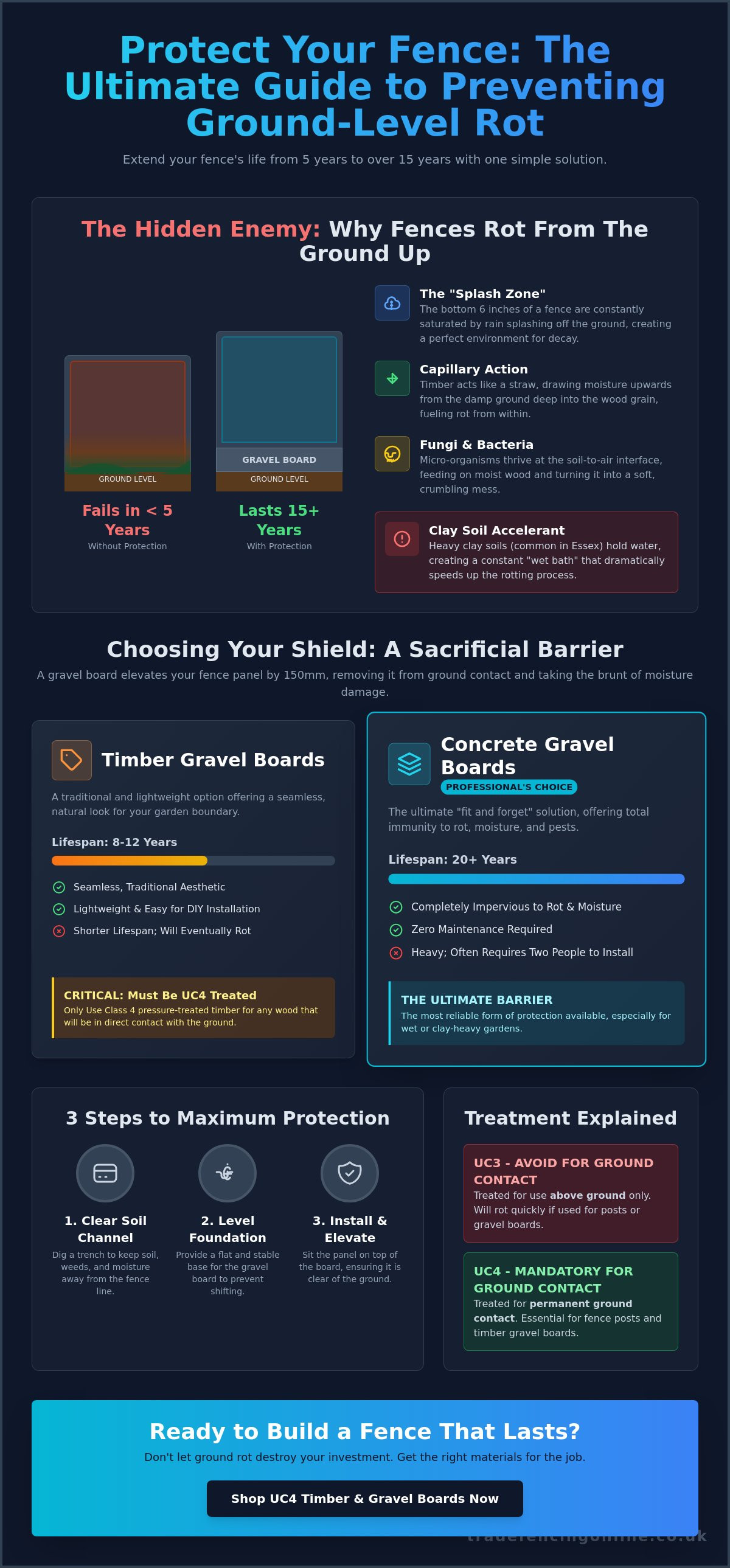
The bottom six inches of your fence determine the lifespan of the entire structure. This area is the primary failure point because it sits in a constant state of dampness. When rain hits the ground, it creates a "splash zone." Water bounces off the soil and saturates the lower timber panels. Once the wood is wet, capillary action takes over. Timber acts like a series of vertical straws, drawing moisture upwards through its cellular grain. This internal saturation creates the perfect environment for wood-decaying fungi and bacteria. These organisms thrive specifically at the soil-to-air interface. They need both moisture from the earth and oxygen from the air to survive. Without active gravel board rot protection, the structural integrity of your fence panels will degrade from the bottom up.
Understanding The Science of Wood Preservation is vital for anyone looking to stop this biological attack. Fungi secrete enzymes that break down the lignin and cellulose in the wood. This process turns solid timber into a soft, pulpy mess that eventually crumbles. It's not just an aesthetic issue; it's a structural failure that leaves your boundary vulnerable to wind damage. Once the base of a panel loses its density, it can no longer hold the weight of the structure above it.
The Impact of Essex and East London Clay Soils
Local gardens in Romford and Essex face a specific challenge: heavy clay soil. Unlike sandy soils that drain quickly, clay holds onto water for days after a downpour. This leads to a "ponding" effect around the base of your fence posts and panels. In these conditions, standard timber panels without a barrier sit in a cold, wet bath. This constant exposure accelerates rot significantly faster than in other regions of the UK. If you're building a fence in these areas, you're fighting a battle against stagnant moisture. Standard panels simply aren't built for direct ground contact in heavy clay environments where drainage is poor.
Sacrificial Protection: The Role of the Gravel Board
A gravel board is a sacrificial barrier. It's a simple, high-value component designed to sit between the earth and your fence panel. By elevating the main panel by just 150mm, you remove it from the splash zone and direct soil contact. This single installation step can double the lifespan of your boundary. Replacing a single gravel board is a minor expense compared to the cost of a full set of premium fence panels. Investing in gravel board rot protection ensures you only replace the affordable, accessible parts of your fence rather than the entire line. This is a pragmatic choice for any homeowner who values their time and budget. We supply various gravel boards specifically designed to withstand these harsh conditions, ensuring your main panels stay dry and secure for years.
Timber vs. Concrete Gravel Boards: Choosing Your Rot Protection
Selecting the right material for your gravel board rot protection depends on your priorities for maintenance and aesthetics. Concrete offers total immunity to decay. Timber provides a traditional, unified look. Both serve as the vital barrier discussed in the previous section, but they require different installation approaches and offer varying lifespans in typical UK weather. Concrete boards often last 20 years or more, while timber boards usually require replacement every 8 to 12 years, even with high-quality treatment. You must weigh the initial labor of installation against the long-term maintenance requirements of your garden boundary.
Weight is a significant factor in your decision. A standard concrete board is heavy and typically requires two people to lift and slide into position safely. This makes it a favorite for trade professionals who prioritize structural permanence. Conversely, timber boards are lightweight and manageable for a solo DIY project. If you're working in a garden with limited access or steep inclines, the portability of wood can be a major advantage. However, you must accept that timber remains a biological material. Even the best wooden gravel board rot protection will eventually succumb to the elements, whereas concrete is a "one and done" investment.
Concrete Gravel Boards: The Ultimate Rot-Proof Barrier
Concrete is the "fit and forget" solution for wet or clay-heavy gardens. It's completely impervious to moisture, fungi, and insect attack. This makes it the most reliable form of protection available for ground-level fencing. It works best with concrete slotted posts, where the boards simply slide into the grooves. Maintenance is nonexistent. You don't need to paint, seal, or treat it. It won't warp in the summer or swell in the winter. For homeowners who want a secure, permanent boundary with zero ongoing effort, concrete is the pragmatic choice. It provides a solid, industrial-strength base that anchors the entire fence line against high winds.
Wooden Gravel Boards: Aesthetics and Easy Fitting
Wooden boards offer a seamless finish when paired with matching fence panels. They're the preferred choice for those who want a natural wood aesthetic across the entire boundary. To ensure durability, always use heavy-duty 22mm thick boards. Thinner boards warp quickly when they absorb moisture from damp soil. When using timber, the chemical treatment is the most important factor. You can find more technical details in this EPA Overview of Wood Preservatives regarding how these barriers resist decay. Always treat any cut ends with a dedicated end-grain preservative to prevent internal rot from starting at the edges. If you prefer the look of natural timber, you can browse our full range of fencing supplies to find the right match for your garden.
Understanding Pressure Treatment: UC3 vs. UC4 Timber
Don't judge timber by its color. Whether a board looks green or brown, the hue is merely a cosmetic dye added during the treatment process. The technical specification is what determines the effectiveness of your gravel board rot protection. In the UK, timber is graded by Use Classes (UC). If you use the wrong grade for ground-level work, the wood will fail within a few years regardless of how "treated" it looks on the shelf. You need to know exactly what you're buying to avoid wasting money on materials that aren't fit for purpose.
UC3 timber is designed for outdoor use where the wood never touches the ground. This includes fence panels, rails, and pickets. UC4 timber is the only standard suitable for direct ground contact or constant wetting. To achieve a UC4 rating, timber undergoes a rigorous vacuum pressure process. Manufacturers place the wood in a sealed chamber and create a vacuum to remove air from the timber's cells. Preservatives are then forced deep into the wood grain under high pressure. This creates a deep-seated barrier that resists the fungi and bacteria found in wet soil. This process is far more intensive than the methods used for standard above-ground timber.
Why UC4 Matters for Your Gravel Board
Using UC3 timber for a gravel board is a mistake that leads to premature failure. When touching wet soil, UC3 wood often rots in less than five years. UC4 timber is treated to a higher chemical concentration and is often "incised" before the pressure cycle begins. Incising involves making thousands of tiny slits in the wood surface. These slits allow the preservative to penetrate much deeper into the core of the board. When looking for a fencing supplier near me, always verify that their gravel boards and posts are specifically rated for UC4 ground contact. It's the only way to ensure your foundation lasts as long as your panels.
Dip-Treated vs. Pressure-Treated: The Critical Difference
Cheap dip-treated timber is common in many DIY stores, but it's unsuitable for gravel board rot protection. Dip-treatment only coats the surface of the wood. If you cut the board or if the surface gets scratched during installation, the untreated interior is exposed to immediate decay. Pressure-treatment provides deep grain saturation that doesn't wash away or peel. Romford Fencing Ltd prioritizes pressure-treated stock for all local deliveries because we know the Essex clay requires the toughest possible defense. Don't settle for surface-level coatings when your garden boundary depends on long-term structural integrity. Buying professional-grade pressure-treated timber is the only way to build a fence that lasts.
How to Install Gravel Boards for Maximum Protection
Proper installation is just as critical as selecting the right materials. Even the highest grade of gravel board rot protection will fail if it's fitted incorrectly. You must follow a structured process to ensure the board functions as a true barrier. Start by clearing a shallow channel in the soil where the board will sit. In heavy Essex clay, this channel allows you to position the board partially below the surface, which prevents gaps that let wind and pests through. Ensure the base of this trench is firm and compacted to prevent the fence from sinking over time.
Leveling is your next priority. Use a spirit level to check the board's position before fixing it. A perfectly level gravel board provides a flat foundation that supports the full weight of the panel above it. If the board is slanted, it puts uneven pressure on your fence posts and can lead to a leaning boundary. You'll need the right fencing supplies to complete this stage, including galvanised nails or screws that won't rust when exposed to damp earth. Finally, leave a 5mm gap between the top of the gravel board and the bottom of the fence panel. This prevents "moisture bridging," where water trapped between the two surfaces rots the panel's bottom rail.
Fixing Boards to Wooden Posts
When working with timber posts, you must use gravel board cleats. These are small blocks of treated wood screwed into the side of the post to provide a ledge for the board. Don't rely on end-nailing through the board into the post; it's a weak connection that will pull apart as the wood moves. Use stainless steel or galvanised screws to avoid unsightly rust streaks down your new timber. For extra durability, apply a bead of external sealant along the top edge of the board. This encourages water runoff and adds another layer of gravel board rot protection to the most vulnerable part of the joint.
Fitting Boards into Slotted Concrete Posts
Concrete systems use a "drop-in" method that is much faster but requires precision. Simply slide the concrete gravel board down the slots of the posts until it rests firmly on the ground. If your garden is on a slope, don't try to tilt the boards. Instead, "step" the fence by using different heights of boards or digging one end deeper into the soil. This keeps the panels horizontal and maintains the structural integrity of the line. Ensure the board is snug within the post channel. If there's a gap, use small plastic or wooden shims to stop the boards from rattling during high winds. Ready to start your project? Buy professional-grade gravel boards today for a fence that lasts.
Sourcing Durable Fencing and Gravel Boards in Romford
Selecting a reliable supplier is the final step in ensuring your boundary stands the test of time. While general DIY retailers often stock generic timber, these products frequently lack the specific grading required for the heavy clay conditions found across Essex and East London. Romford Fencing Ltd stocks materials specifically chosen to handle the moisture retention issues previously discussed. By sourcing from a specialist merchant, you ensure that every component of your gravel board rot protection system meets professional standards rather than just retail price points. We focus on structural performance and long-term value for our local customers.
Specialist knowledge is what separates a successful project from a premature failure. We understand the technical distinctions between Use Classes and ensure our customers receive the correct specification for their specific soil type. Romford Fencing Ltd maintains a comprehensive inventory of UC4 pressure-treated timber and high-density concrete boards. Our logistics team provides fast, reliable delivery throughout Romford, Essex, and East London, ensuring your materials arrive on-site without delay. This localized service means you get trade-grade products backed by experts who know the regional environment.
Trade Quality for Every Customer at Romford Fencing Ltd
We provide the same high-specification fence posts and gravel boards to homeowners that we supply to professional fencing contractors. This ensures your DIY project benefits from the same structural integrity as a commercial installation. We invite customers to visit our Romford depot to inspect the quality of our pressure treatment and the thickness of our timber boards before purchasing. For those managing larger landscaping projects in the East London area, we offer competitive bulk pricing structures. This pragmatic approach ensures you get premium gravel board rot protection while maintaining a sensible budget for your entire garden renovation.
Complete Your Project with Romford Fencing Ltd
A successful fence installation requires more than just boards and panels. We supply a full range of essential components, including professional-grade postmix, galvanised ironmongery, and specialized fencing tools. Our team is available to provide direct, practical advice on the best materials for your specific garden layout. We don't just sell products; we provide the total solution for a secure and rot-free boundary. By consolidating your order with an established local expert, you reduce delivery costs and ensure all components are compatible. View our range of Gravel Boards and start your project today with the confidence that your new fence is built to last.
Protect Your Garden Investment Today
Building a durable garden boundary requires more than just standard timber. You've learned that the "splash zone" and capillary action are the primary causes of premature failure. By choosing high-quality gravel board rot protection, you stop decay before it reaches your expensive fence panels. Remember to prioritize UC4 pressure-treated timber or concrete for any component in direct contact with the soil. Proper installation, including leveling and moisture gaps, ensures your fence stays upright for 15 years or more.
Don't settle for inferior materials from general DIY stores. As established Romford experts, we provide trade-grade UC4 timber and robust concrete solutions designed for the local climate. We offer fast local delivery across Essex and East London to keep your project moving. Our stock is selected for performance and durability, giving you a professional finish with minimal fuss.
Take the first step toward a maintenance-free garden boundary. Order high-quality gravel boards for local Essex delivery and secure your fence against the elements. You'll save money on future replacements and enjoy a secure, reliable garden for years to come.
Frequently Asked Questions
Do I really need a gravel board for my new fence?
Yes, a gravel board is essential if you want your fence to last. It creates a physical barrier between the soil and the timber panels. Without this protection, your panels will absorb ground moisture and fail within 3 to 5 years. Using a gravel board is a cost-effective way to double the lifespan of your investment.
Which is better: concrete or wooden gravel boards?
Concrete is the superior choice for long-term durability and zero maintenance. It's completely rot-proof and ideal for wet Essex gardens. Wooden boards are better if you want a seamless, natural look. However, timber requires high-quality UC4 pressure treatment to survive ground contact. Your choice depends on whether you value structural permanence or visual consistency.
Can I add a gravel board to an existing fence?
You can add gravel boards to an existing fence if the posts have enough height and the panels can be raised. You'll need to lift the panels higher on the posts or trim the bottom of the timber to make room. This is a common way to retrofit gravel board rot protection to a fence that was originally installed incorrectly.
How long do pressure-treated wooden gravel boards last?
High-quality UC4 pressure-treated timber boards typically last between 8 and 12 years. Their lifespan depends heavily on soil drainage and local weather conditions. Boards sitting in heavy clay soil may fail sooner than those in well-drained areas. Always check the treatment grade before buying, as standard UC3 timber will rot much faster when touching the earth.
Do concrete gravel boards ever need replacing?
Concrete gravel boards are designed to last 20 years or more and rarely need replacing. They don't rot, warp, or decay like timber. You only need to replace them if they suffer significant impact damage or if they crack due to extreme ground movement. For most homeowners, they are a permanent solution for ground-level protection.
What height should a standard gravel board be?
The standard height for a gravel board is 150mm, which is approximately 6 inches. This height is sufficient to lift your fence panels out of the splash zone where rain bounces off the soil. Some specialist projects use 300mm boards for extra height or to level out significantly uneven ground. We stock standard 150mm boards in both timber and concrete.
Should a gravel board touch the ground?
Yes, your gravel board should sit firmly on the ground or be slightly buried to prevent gaps. This ensures a secure boundary and stops pests from passing under the fence. While the board touches the soil, the fence panel itself must sit slightly above the board. This specific layout is the key to effective gravel board rot protection for your main panels.
Can I paint or stain my gravel boards to match my fence?
You can easily paint or stain wooden gravel boards to match your fence panels. Use a high-quality exterior wood preservative or fence paint for the best results. Concrete boards can also be painted using masonry paint, though many customers prefer their natural grey or recessed finish. Treating timber boards with additional stain provides a secondary layer of moisture resistance.