


Your choice of fence posts is significantly more important than the decorative panels they hold up. While most homeowners spend hours picking a panel style, a fence is only as reliable as its foundation. If you select the wrong material or size, you risk your entire investment leaning or collapsing during the next heavy Essex storm. We understand the frustration of seeing a brand new fence rot at the base after just a few years of wet weather. You want a boundary that stays upright and looks professional without constant maintenance.
It's common to feel confused by the technical differences between 3x3 and 4x4 dimensions, or whether concrete is worth the extra upfront cost for your specific garden. This guide helps you choose the perfect support to ensure a professional finish that stands for 15 years or more. We will compare pressure-treated timber versus concrete, break down the total project costs, and explain how to get reliable local delivery in Romford and across the county. You'll get the facts you need to build a fence that lasts, delivered straight to your door by a trusted local supplier.
Key Takeaways
- Understand why selecting the correct structural backbone prevents premature rot and protects your garden boundary against high wind loads.
- Compare the unmatched durability of concrete against the traditional aesthetic of timber to find the most cost-effective solution for your project.
- Master industry-standard sizing for fence posts, including the essential 2ft burial rule for ensuring long-term stability.
- Learn how to use Postcrete and gravel boards to create a professional foundation and protect your installation from ground moisture.
- Identify the specific lengths and specifications required to accommodate varying terrain and privacy needs across Essex and East London.
The Foundation of Your Garden: Why Choosing the Right Fence Posts Matters
Fence posts are the single most critical component of any boundary. They act as the structural backbone for your garden, absorbing the constant pressure of wind loads and the weight of the panels. If you choose the wrong material or an incorrect size, you are guaranteed to face premature rot and a total fence failure. Romford Fencing Ltd provides trade-quality posts specifically designed to withstand the heavy clay soils found across Essex and East London. Selecting a high-specification post can extend the lifespan of your fence panels by more than 12 years, saving you the cost and hassle of a full replacement.
The Role of the Fence Post in Structural Integrity
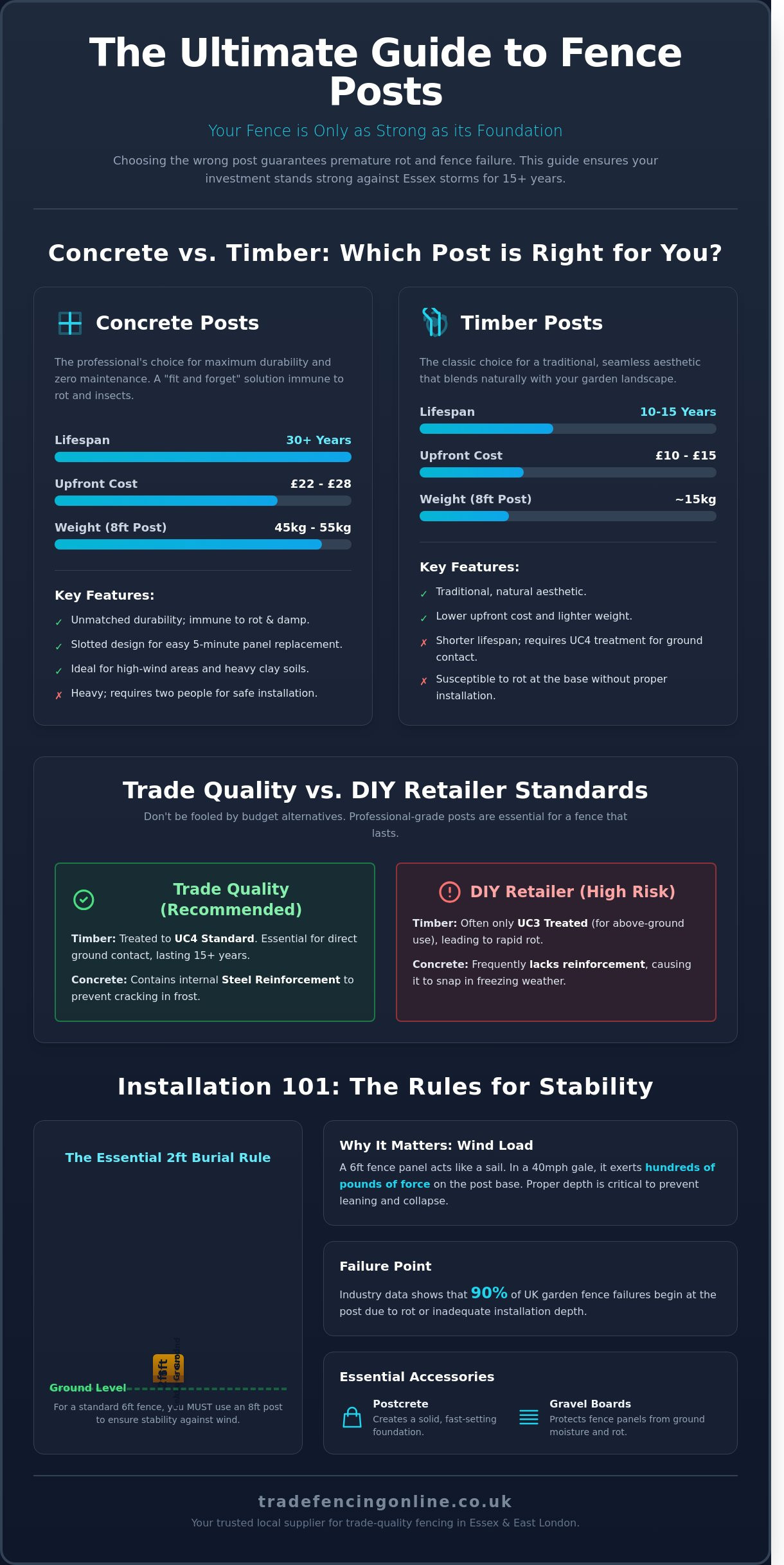
Posts distribute wind pressure across the entire fence line. Without this support, panels would buckle under standard UK gusts. You must follow the "one-third rule" for installation: at least 33% of the total post length needs to be buried below ground level. For a standard 6ft fence, this means using an 8ft post to ensure stability. Industry data shows that 90% of UK garden fence failures begin at the post, usually due to poor installation or inadequate depth. Understanding different types of fencing and their specific weight requirements is essential, but the post always remains the primary point of failure. A 6ft panel acts like a sail in high winds; in a 40mph gale, it exerts hundreds of pounds of force on the post base.
Understanding Trade Quality vs. DIY Retailer Standards
Don't confuse professional grade materials with mass-market alternatives found in big-box DIY stores. Most budget retailers sell timber treated only to UC3 standards, which is meant for above-ground use. Trade-quality wooden fence posts must be treated to UC4 standards. This process involves high-pressure chemical penetration that allows the wood to survive direct soil contact for 15 years or more. Mass-market concrete posts often lack the internal steel reinforcement found in professional stock, causing them to crack during the first -5°C frost. Romford Fencing sources materials that meet strict professional trade specifications, ensuring your garden stays secure. Our posts are built to handle the unique expansion and contraction cycles of local clay soils, which can snap inferior products within 24 months of installation.
- UC4 Treated Timber: Essential for any wood in direct contact with the ground.
- Steel Reinforced Concrete: Prevents snapping during freeze-thaw cycles.
- Clay Soil Compatibility: Heavy-duty specifications to resist soil movement in Essex and East London.
Investing in the right fence posts from the start prevents the "lean" that affects so many British gardens. It's the difference between a fence that lasts 5 years and one that stands for 20.
Concrete vs. Wooden Fence Posts: Comparing Durability, Cost, and Style
Choosing between concrete and timber fence posts dictates your garden's maintenance schedule for the next 20 years. Concrete provides a "fit and forget" solution. It is immune to ground rot, damp, and insect attacks. Timber offers a traditional, seamless aesthetic. It blends into the landscape of smaller gardens where harsh lines might feel intrusive.
Cost is a primary factor for most UK homeowners. A standard 2.4m timber post typically costs between £10 and £15. A concrete equivalent costs between £22 and £28. While wood is cheaper upfront, concrete offers a lower cost per year. A pressure-treated timber post lasts roughly 10 to 15 years. A concrete post often exceeds 30 years of service. Before you buy, check the UK planning permission for fences to ensure your post height stays within the standard 2-metre limit for rear gardens.
Pros and Cons of Concrete Fence Posts
Concrete is the professional choice for high-wind areas. The slotted design allows you to slide panels in and out without nails or screws. This makes future panel replacement a five-minute job. The main drawback is the weight. A standard 8ft concrete post weighs approximately 45kg to 55kg. You will need two people for a safe installation.
To achieve a clean finish, pair these posts with concrete gravel boards. This prevents the wooden panel from touching the damp soil. It stops moisture transfer and extends the life of your timber by up to 40%. It creates a uniform, grey border that looks industrial and secure.
Pros and Cons of Timber Fence Posts
Timber posts offer unmatched flexibility on-site. You can cut, notch, or screw into them with standard tools. This is vital for gardens with awkward corners or steep gradients. You can easily match the post colour to your closeboard or lap panels using consistent stains. This creates a continuous wooden wall that makes small gardens feel larger.
The biggest risk is ground-line rot. Data suggests 80% of timber post failures occur at the point where the wood meets the soil and air. To mitigate this, ensure your post holes have 150mm of hardcore at the base for drainage. Always use UC4 kiln-dried timber for any component going into the ground. If you prefer the natural look of wood, you can browse our range of quality fence posts to find the right match for your project.
- Concrete: Zero maintenance, high initial cost, 30-year lifespan.
- Timber: High maintenance, low initial cost, 15-year lifespan.
Sizing and Specifications: Finding the Correct Dimensions for Your Project
Getting the dimensions right is the difference between a fence that lasts 15 years and one that leans after the first winter storm. UK industry standards focus on two main widths: 75mm (3x3) and 100mm (4x4). These sizes align with British Standards for fencing, ensuring the timber provides enough surface area for secure fixing and structural integrity. Choosing the wrong size often leads to premature failure or unnecessary costs.
The most frequent mistake DIYers make is buying a 6ft post for a 6ft fence. This leaves zero length for the foundation. You must always allow 600mm (2ft) for burial in the ground to create a stable lever against wind force. For a standard 1.8m (6ft) high boundary, you require an 8ft post. This 2ft depth ensures the fence posts can resist wind loading and the weight of the heavy timber panels. Without this foundation, the leverage from the wind will eventually pull the post out of its concrete footing.
Choosing Between 3x3 and 4x4 Posts
75mm (3x3) posts suit low-level projects like 3ft or 4ft picket fencing. They work well in sheltered urban spots where wind isn't a major factor. If you're installing 6ft panels or heavy closeboard, 100mm (4x4) is the only professional choice. The extra 25mm increases the cross-sectional area significantly, providing the stability needed for tall boundaries. While 4x4 posts typically cost 35% more than 3x3 options, they prevent the expensive job of replacing snapped posts after a gale. For high-wind areas, don't compromise on the 100mm thickness.
Height Guide: Matching Posts to Panels
Precision in height calculation prevents project delays. Use this simple guide for standard UK installations:
- 3ft Fence: Use 5ft posts.
- 4ft Fence: Use 6ft posts.
- 5ft Fence: Use 7ft posts.
- 6ft Fence: Use 8ft posts.
If you're using concrete gravel boards, remember they add 150mm (6 inches) to the base height. You still need that 600mm burial depth. If your total height (panel plus gravel board) exceeds 6ft, you must source a 9ft post to maintain the 2ft underground ratio. This setup keeps the timber panels away from the damp soil, which is vital for the longevity of your fence posts. Always measure twice before ordering to ensure your heights account for both the panel and the burial depth.
Standout Products from the Trade Fencing Online Collection
Trade Fencing Online provides a comprehensive selection of fence posts designed for durability and ease of installation. Our inventory caters to every project scale, from small residential garden repairs to full-scale commercial perimeter installations. We stock everything from lightweight timber options for quick DIY fixes to heavy-duty multi-hole concrete posts for maximum security. As a trusted supplier, we ensure our products meet the rigorous demands of British contractors and homeowners alike.
To ensure we meet specific site requirements, our range includes precise lengths from 5ft to 10ft. A 5ft post is the standard choice for 3ft low-level decorative fencing. In contrast, our 10ft options provide the necessary 3ft burial depth required for 7ft high-security barriers on uneven or sloping terrain. Having the correct length is vital for structural integrity; a post that's too short won't withstand high wind loads during autumn storms.
Every timber post in our collection undergoes high-pressure treatment to UC4 standards. This process forces preservative chemicals deep into the wood grain, creating a robust barrier against rot and fungal decay. This level of protection is essential for the British climate, where ground moisture remains high for over 200 days of the year. Our treated timber is built for long-term ground contact, giving you peace of mind that your boundary will remain stable for years to come.
Top Picks: Concrete Slotted Posts
Concrete slotted posts are the "fit and forget" solution for modern gardens. These posts feature a pre-formed channel that allows standard 6ft lap panels or heavy-duty closeboard sections to slide directly into place. You don't need brackets, screws, or complicated fixings, which often reduces total installation time by 30% compared to traditional timber methods. We offer these in various lengths to accommodate bespoke garden heights and different gravel board configurations.
Top Picks: Pressure-Treated Timber Posts
For a modern, clean look in residential settings, our square-cut timber posts are the primary choice. We source all our wood from sustainable, FSC-certified forests, ensuring your garden project supports responsible forestry. These posts are specifically treated for long-term ground contact and are significantly lighter than concrete alternatives. This makes them the preferred option for solo DIYers who need an easy-to-handle product that can be cut to size on-site with standard tools.
Browse the full range of fence posts for current prices and availability.
Essential Accessories and Local Delivery in Essex and East London
A fence post is only as good as its foundation. If you don't secure your fence posts correctly, the first British gale will likely bring your garden boundary down. Stability starts with Postcrete. This ready-to-use concrete mix sets in under 10 minutes and provides the rigid support needed for long-term durability. We also insist on using gravel boards for every installation. These boards act as a vital barrier between the damp ground and your fence panels. They protect both wooden and concrete posts from rising moisture and soil contact, significantly extending the lifespan of your materials.
Postcrete and Fixings: The "Hidden" Essentials
Calculations are simple but vital. You will typically require 1 to 1.5 bags of Postcrete per post for a standard 600mm deep hole. For a professional timber finish, always use galvanised arris rail brackets and clips. These ironmongery essentials ensure your rails stay level and secure without the wood splitting over time. When you pour the concrete, remember to create a "weathering" slope at the top of the footing. Use a trowel to angle the wet mix away from the post. This prevents rainwater from pooling at the base, which is the primary cause of premature rot in timber systems.
The Romford Fencing Delivery Advantage
Romford Fencing Ltd provides fast, reliable delivery across Romford, Ilford, Dagenham, and the wider Essex area. We offer free local delivery options for bulk orders, making us your one-stop-shop for everything fencing. Concrete items are exceptionally heavy and difficult to transport in a standard domestic vehicle. Our team ensures your materials arrive safely and are placed in a convenient location on your property. This removes the logistical headache of moving 20kg bags and heavy concrete posts yourself. Before your delivery arrives, go through this preparation checklist:
- Spirit level for checking vertical accuracy.
- Spade or specialized post-hole digger.
- Tape measure and string line for alignment.
- Heavy-duty gloves for handling rough concrete.
- Access to a water supply for the Postcrete mix.
We are the home of quality garden fencing and pride ourselves on being a trusted supplier with 5-star reviews. Our process is designed for speed and efficiency so you can get the job done right the first time. Secure your fence posts today for fast local delivery. FOR QUALITY FENCING, CALL ROMFORD FENCING LTD TODAY OR EMAIL OUR TEAM.
Build a Lasting Perimeter with Quality Materials
Choosing the right foundation determines whether your garden project lasts for 2 years or 15 years. Selecting between the natural look of pressure-treated timber and the structural resilience of concrete is your first major decision. Matching dimensions to your specific wind loading requirements prevents costly replacements later. As a trusted Essex supplier with a consistent record of 5-star reviews, we provide trade-standard materials at unmatched prices. We simplify the logistics by offering free local delivery options across Essex and East London on qualifying orders. It's time to stop planning and start building with our professional-grade fence posts. Our inventory is stocked with durable options designed to withstand the British weather. You don't have to settle for DIY-grade materials when trade-quality solutions are this accessible. We're your one-stop-shop for everything fencing, ensuring you get the reliability of a local expert who understands the specific needs of UK gardens.
Browse our full range of trade-quality fence posts and order online today
Your garden transformation is just a few clicks away; we're ready to help you get the job done right.
Frequently Asked Questions
How deep should a fence post be in the ground UK?
You must bury a fence post at least 600mm (2 feet) into the ground for a standard 1.8m (6ft) garden fence. A reliable rule of thumb is to ensure one-third of the total post length is below ground level. This depth provides the stability needed to withstand UK wind speeds, which often exceed 50mph during winter storms. If your soil is particularly soft or sandy, increase this depth to 750mm to prevent the structure from leaning over time.
Is concrete or wood better for fence posts?
Concrete is better for long-term durability while wood offers a better aesthetic at a lower initial price point. Concrete posts often last over 20 years because they don't rot or suffer from insect damage in damp UK soil. Wooden posts are roughly 30% cheaper and look more natural in traditional gardens, but they require regular maintenance to reach a 10 to 15-year lifespan. Your choice depends on whether you value low upfront costs or zero maintenance.
Do I need a gravel board with concrete fence posts?
You should always use a gravel board with concrete posts to protect the bottom of your wooden panels. A 150mm or 300mm gravel board keeps the timber off the damp ground, which prevents premature rot and water damage. This simple addition can extend the life of your panels by up to 5 years. Concrete gravel boards are the most durable option and slide easily into the grooves of slotted concrete posts for a secure fit.
How long do pressure-treated wooden fence posts last?
High-quality pressure-treated wooden fence posts typically last between 10 and 15 years in standard UK conditions. The UC4 kiln-dried treatment process ensures chemical preservatives penetrate deep into the timber, offering much better protection than cheaper dip-treated alternatives. Without this industrial treatment, a standard timber post might fail in under 5 years. Always check for a 15-year anti-rot guarantee when buying your materials to ensure you're getting a professional-grade product.
Can I put wooden fence panels into concrete posts?
You can easily fit standard 1.83m (6ft) wooden fence panels into slotted concrete posts. These posts feature a 50mm wide groove designed specifically to hold timber panels securely without the need for additional clips or brackets. Simply slide the panel down the grooves until it sits firmly on the gravel board. This combination is a popular choice for UK homeowners because it provides a sturdy, wind-resistant structure with the traditional appearance of timber.
What is the standard spacing between fence posts?
The standard spacing for fence posts in the UK is 1.83 metres (6 feet) between the inner faces of the posts. Most mass-produced fence panels are manufactured to this exact width. If you're using 100mm posts, your centre-to-centre measurement will be approximately 1.93 metres. Don't dig all your holes at once; measure your specific panels as you go, as a 10mm error can make installation impossible without trimming the timber.
How many bags of Postcrete do I need per fence post?
You generally need 1 to 2 bags of Postcrete for every standard fence post. For a 75mm square post in a 200mm wide hole, 1 bag is usually sufficient to secure the base. If you're using larger 100mm posts or digging wider holes in loose soil, use 2 bags to ensure a solid foundation. Postcrete sets in just 5 to 10 minutes, so only pour the water and mix when the post is perfectly level and positioned.
What is the best way to stop wooden fence posts from rotting?
The most effective way to stop rot is using UC4 pressure-treated timber combined with a concrete gravel board. You can also apply a bitumen-based post protector to the section of the timber that sits at ground level, where moisture and oxygen levels cause the most decay. Ensure the concrete haunching at the base slopes away from the post to shed rainwater. These steps can increase the service life of your timber by 50% or more.