


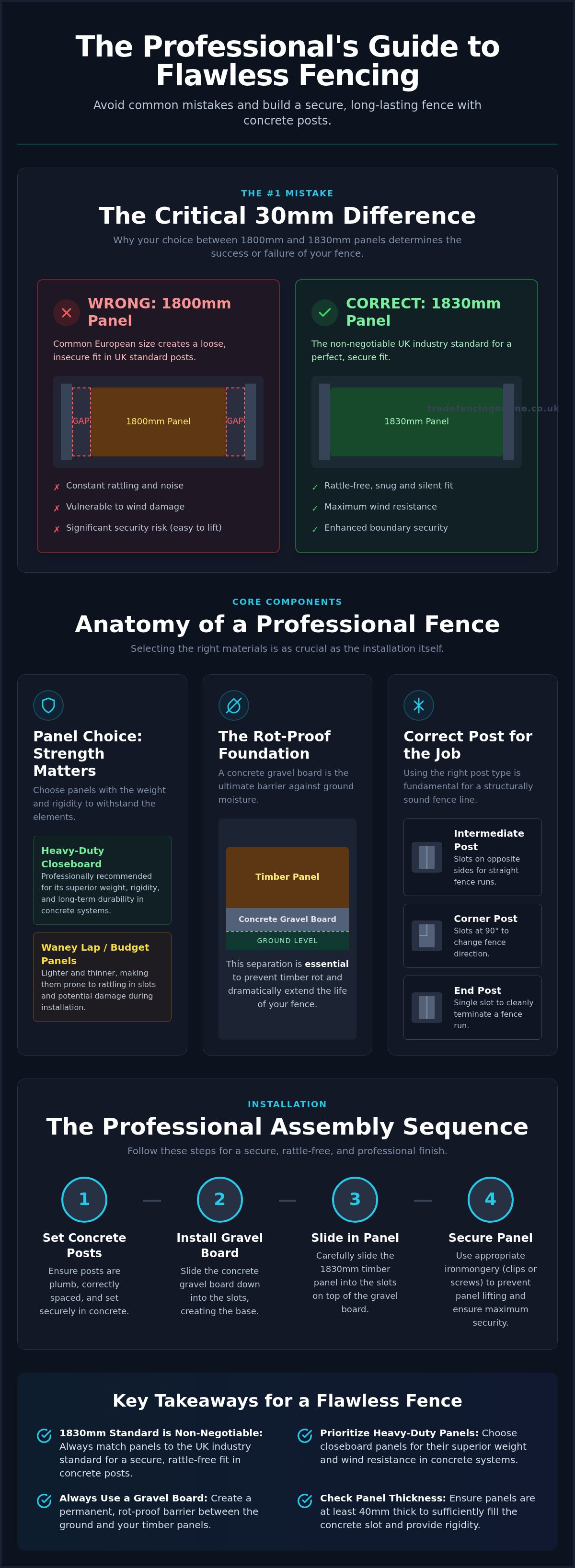
Did you know that buying a standard 1800mm fence panel is often the first mistake homeowners make when upgrading their garden? If you want to know how to fit fence panels to concrete posts correctly, you have to start with the right technical measurements. Most UK slotted concrete posts are designed specifically for 1830mm (6ft) panels. Choosing the common 1800mm European size leaves a gap that causes annoying rattling and makes your fence vulnerable to wind damage.
We understand the frustration of seeing timber panels rot at the base or slide out of alignment. It's a waste of time and money when your boundary doesn't last. This guide provides the professional steps needed to create a secure, zero-maintenance boundary that stands up to British weather. You'll learn why the 1830mm standard is non-negotiable and how to use concrete gravel boards to stop ground moisture from destroying your timber. We will also cover the essential ironmongery needed to stop the panel lifting security risk for a truly professional finish.
Key Takeaways
- Match your timber panels to the 1830mm UK industry standard to ensure a secure fit within slotted concrete posts.
- Prioritize heavy-duty closeboard panels for concrete systems to benefit from superior weight and long-term wind resistance.
- Always install a concrete gravel board at the base to create a permanent rot-proof barrier between the ground and your timber.
- Discover the professional sequence of how to fit fence panels to concrete posts for a rattle-free and secure garden boundary.
Understanding Compatibility: Which Fence Panels Fit Concrete Posts?
Success depends on technical precision. Standard UK slotted concrete posts are engineered for panels exactly 1830mm (6ft) wide. This measurement is the industry standard for trade-grade fencing. If you buy panels from a supplier using European dimensions, you'll likely receive 1800mm wide units. While 30mm sounds negligible, it creates a loose fit that compromises the entire structure. This section explains how to avoid the common pitfalls when learning how to fit fence panels to concrete posts.
The 1830mm vs 1800mm Width Trap
Many homeowners assume all 6ft panels are identical. They aren't. European-style panels are often 1800mm wide to suit different regional standards. In a UK concrete post system, these undersized panels will rattle constantly. High winds will eventually cause the timber to vibrate against the concrete, leading to premature wear or the panel blowing out of the slots entirely. It's a significant security risk too. Loose panels are far easier for intruders to lift and remove. Always verify the exact metric width before you commit to a purchase. For a broader UK fencing overview, standard dimensions are the foundation of any secure boundary.
Types of Slotted Concrete Posts
You must select the right post for each position in your fence run. Using the wrong post type makes it impossible to secure your panels correctly. There are three main categories to consider:
- Intermediate Posts: These have slots on opposite sides and are used for straight sections of the fence.
- Corner Posts: These feature slots at a 90-degree angle, allowing you to change the direction of the boundary.
- End Posts: These have a single slot to finish a run cleanly against a building or gate post.
Check the dimensions and weight ratings of our slotted concrete posts to ensure they match your chosen panel height. Panel thickness is also critical for a rattle-free finish. Ensure your timber is at least 40mm thick. This thickness fills the concrete slot sufficiently, providing the rigidity needed for a professional, wind-resistant installation. Understanding these components is the first step in mastering how to fit fence panels to concrete posts.
Choosing the Best Panel Styles for Concrete Systems
The Essential Role of Concrete Gravel Boards
A professional "trade system" relies on a zero-contact barrier between timber and soil. Timber panels should never touch the ground directly. Ground moisture is the primary cause of vertical rot, even in pressure-treated wood. By using concrete gravel boards, you create a permanent moisture barrier that keeps the timber dry and elevated. When calculating your total height, remember that Official UK planning permission rules usually limit garden fences to 2 metres. This total includes the height of your gravel board and the panel combined. For more details on panel types, see our Complete Guide to Choosing Fence Panels.
Decorative Options for Modern Boundaries
Concrete posts don't have to look industrial. You can easily integrate decorative fence panels to create a premium garden finish. These often feature lattice or slatted designs that allow light to pass through while maintaining privacy. If you need extra height without creating a solid wall, consider adding trellis toppers. These slide into the concrete slots just like a standard panel. This approach is a key part of learning how to fit fence panels to concrete posts while maintaining an attractive aesthetic. If you're planning a full garden overhaul, you can find everything you need at Trade Fencing Online.
Step-by-Step: How to Fit Fence Panels into Concrete Slotted Posts
Precision is the difference between a fence that lasts and one that rattles in the first autumn breeze. Start by measuring the distance between your post slots. For standard UK systems, this must be exactly 1830mm. If the gap is wider, your panels will be unstable; if it's narrower, they simply won't fit. Once your posts are set and the concrete has cured, slide your concrete gravel board into the slots first. Use a spirit level to ensure the board is perfectly flat. This level base is vital. It supports the entire weight of the timber panel and prevents it from leaning or bowing over time.
Next, lift the fence panel and align it with the top of the concrete slots. This task usually requires two people to keep the panel vertical as it descends. Carefully slide the panel down the slots until it rests firmly on the gravel board. For more technical context on site preparation, consult a Step-by-step installation guide. Ensuring a smooth slide prevents the timber edges from splintering against the rough concrete surface. This method is the most efficient way to understand how to fit fence panels to concrete posts for a professional finish.
Pro Tips for a Secure, Rattle-Free Fit
Wind noise is a major complaint with slotted posts. You can eliminate this by driving small timber wedges into the gap between the panel and the concrete slot at the top and bottom. Specialized galvanized fence clips are also a trade-grade solution to lock the panel in place. Always check for "plumb" during every stage of the lift. If a panel is even slightly tilted, it will jam halfway down the slot. Before you begin the heavy lifting, check your tool list with our Essential Fencing Supplies Checklist.
Maintenance and Longevity
Concrete posts are permanent, but timber panels need regular care. Apply a high-quality wood treatment annually to protect against UV damage and moisture. This ensures the timber matches the long lifespan of the concrete. One of the best features of this system is the ease of repair. You can replace a single damaged panel by sliding it out and dropping a new one in without disturbing the post footings or the gravel board. Learn more about post durability in our Wood vs Concrete Post Guide.
Build a Secure and Durable Garden Boundary
Mastering how to fit fence panels to concrete posts is the most effective way to create a wind-resistant, professional boundary. Precision matters. You've learned that technical success starts with matching 1830mm panels to your slotted posts. Don't skip the concrete gravel boards; they're the only way to create a permanent moisture barrier that prevents timber rot. Following the correct lifting and leveling sequence ensures your fence remains rattle-free and stable even in harsh conditions. Using wedges or clips will provide that final layer of security and peace of mind.
Our Romford Fencing Ltd team is ready to support your project with expert advice and trade-quality materials at competitive prices. We provide fast local delivery across Essex and East London to keep your build on schedule and your property secure.
Get started on your garden transformation today and enjoy a high-quality finish that stands the test of time.
Frequently Asked Questions
Do all 6ft fence panels fit concrete posts?
No, not all panels labeled as 6ft will fit standard UK slotted concrete posts. You must verify that the panels are exactly 1830mm wide. Many retailers sell European-style panels that are 1800mm wide. These smaller panels leave a 30mm gap that causes constant rattling and makes the fence vulnerable to wind damage. Always check the metric measurements before you order.
Can I put wooden fence panels into existing concrete posts?
You can fit new timber panels into existing posts as long as the concrete is structurally sound and the posts are still plumb. This is a practical way to refresh your garden without the cost of new foundations. Measure the internal distance between the post slots to ensure they match the 1830mm standard. Understanding how to fit fence panels to concrete posts correctly allows you to replace damaged sections individually.
How do I stop my fence panels from rattling in concrete posts?
Stop panels from rattling by driving small timber wedges or specialized galvanized fence clips into the gap between the panel and the concrete slot. Position these at the top and bottom of each post to create a firm friction fit. This eliminates noise during high winds and prevents the timber from vibrating against the concrete, which can cause premature wear and damage to the panel edges.
Should I use a gravel board with concrete posts?
Yes, you should always use a concrete gravel board to prevent your timber panels from touching the damp ground. Concrete gravel boards act as a permanent moisture barrier that stops vertical rot at the base of the wood. This simple addition significantly extends the lifespan of your timber. It also provides a level, solid base that simplifies the process of how to fit fence panels to concrete posts during installation.