


That constant clatter from your garden isn't just a noise nuisance; it's the sound of your fence panels slowly destroying themselves. Every vibration against the post-groove causes premature wear that weakens your entire boundary. If you want to protect your property, using fence panel wedges to stop rattling is a structural necessity, not just a way to get a better night's sleep. It's time to stop the damage before a storm does it for you.
It's exhausting to lie awake during a gale, waiting for the next loud bang or fearing a panel will finally blow out. You've probably tried temporary fixes like folded cardboard, but these unsightly DIY solutions fail as soon as they get wet. We'll show you how to secure your garden properly using professional-grade products like the £7.99 Fix-a-Fence™ pack. As a trusted supplier, we've seen how the right ironmongery saves homeowners from expensive repairs. This guide provides the expert installation steps you need for a silent garden and a secure fence structure that stays quiet for years.
Key Takeaways
- Identify why concrete posts and timber expansion gaps cause noise in your garden.
- Compare plastic and timber fence panel wedges to stop rattling to find the best grip for your fence.
- Evaluate the benefits of non-invasive wedges versus permanent ironmongery like fence clips.
- Master the professional installation technique using simple tools for a secure, silent finish.
- Learn to recognize when thin panels need replacing with quality fencing to ensure a long-lasting, quiet boundary.
Why Do Fence Panels Rattle? Understanding the Gap Problem
A rattling fence is more than an annoyance; it’s a sign of a structural mismatch. Timber is a natural material that reacts to the environment. It requires an expansion gap to breathe as it absorbs and releases moisture throughout the seasons. Without this small tolerance, panels would warp or bow within their frames. However, this necessary space often becomes too large, leading to the constant clatter you hear during high winds.
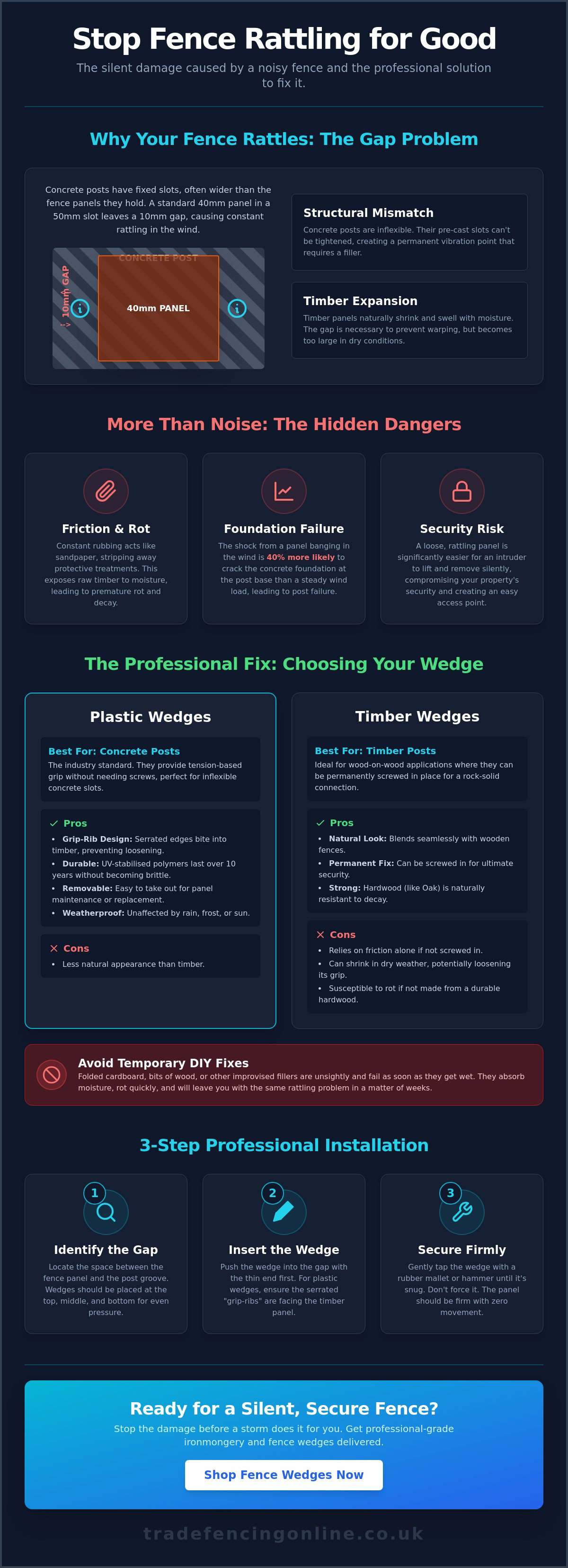
Concrete fence posts are the primary cause of this noise. Most standard concrete posts feature a fixed H-slot channel designed to accommodate various panel styles. These channels are typically cast wider than the panels themselves to ensure easy installation. When a 40mm thick panel sits in a 50mm channel, the resulting 10mm of "slop" allows the wind to move the timber back and forth. Homeowners often turn to fence panel wedges to stop rattling because these simple tools provide the necessary tension to bridge the gap between the timber and the post. A fence wedge is a tapered spacer designed to eliminate lateral movement by filling that specific void.
The Difference Between Concrete and Timber Post Rattles
Concrete posts offer no flexibility once they're in the ground. Because the slot width is fixed, you can't tighten the grip on the panel. This creates a permanent vibration point. Timber posts are different. Rattles in wooden systems usually stem from loose nails, failing ironmongery, or warped arris rails. If your panel is moving against a wooden post, it's often because the fasteners have pulled through the grain over time. You should also check the connection at the gravel board. If the panel isn't seated firmly against the gravel board, the base will vibrate independently of the top, creating a double-clacking sound that's difficult to ignore.
Why a Rattling Fence is a Structural Risk
Constant movement creates friction wear. As the panel slides against the post, it acts like coarse sandpaper, stripping away protective stains and treatments. This exposes raw timber to rot and decay. Even worse is the effect of shock loading. When a panel catches a gust of wind and bangs against the post, it sends a sudden jolt through the entire structure. This repetitive impact is 40% more likely to crack the post-mix seal at the base than a steady wind load. Once that seal breaks, water enters the foundation, leading to post-failure. There's also a security element to consider. Loose panels that haven't been secured with fence panel wedges to stop rattling are significantly easier for intruders to lift and remove silently, compromising your property's perimeter. For a comprehensive overview of fences and their components, understanding these mechanical stresses is vital for long-term maintenance.
Choosing the Right Fence Panel Wedges: Plastic vs. Timber
Selecting the correct material is the first step toward a quiet garden. While both options solve the noise problem, they serve different post types and environmental conditions. You need to match the wedge to your specific fence structure to ensure a long-term fix. Using the wrong material often leads to the wedge falling out or rotting within a single season, leaving you back at square one.
Grip strength is the most critical factor. Serrated plastic wedges feature a "grip-rib" design that bites into the timber panel. This mechanical lock prevents the wedge from vibrating loose during high winds. In contrast, smooth timber wedges rely purely on friction. While timber looks more natural, it can shrink during dry spells, which reduces its holding power. For most homeowners, fence panel wedges to stop rattling need to be a "set and forget" solution, making material choice a priority over initial cost.
When to Use Plastic Fence Wedges
Plastic wedges are the industry standard for concrete posts. Since you can't screw into concrete without specialist drills and anchors, you need a wedge that stays in place through tension alone. Products like the Fix-a-Fence™ 20-pack, which retails for £7.99 as of May 2026, are engineered from UV-stabilised polymers. This is vital because standard plastics become brittle and snap after 12 months of sun exposure. High-quality plastic wedges are designed to last for a decade. They're also easy to remove if you need to lift your panels for seasonal treatment or replacement. If you want a quick, effective fix, you can find professional-grade ironmongery and fencing supplies that match these specifications.
The Case for Hardwood Oak Wedges
Oak wedges are the premium choice for timber-to-timber applications. If you have wooden posts, you can secure these wedges permanently with a single stainless steel screw. This creates a rock-solid connection that won't move even in a gale. Oak is naturally resistant to decay, outperforming standard pressure-treated softwood which often rots if water gets trapped in the gap. You must always pre-drill oak. If you don't, the dense grain will likely split the wedge when you drive the screw home. While hardwood is more expensive than plastic, the aesthetic benefit of matching the wood grain is often worth the investment for front-facing garden boundaries.
Buying in bulk is the most efficient way to secure a perimeter. A standard garden with 10 panels requires at least 20 wedges to be effective. For larger estates, Tape Tech 10-packs were priced at £9.80 in May 2026, but larger 30-packs from brands like Woodside often provide better value per unit. Investing in a full set ensures every panel is tight, preventing the "domino effect" where one rattling panel eventually loosens its neighbours.
Wedges vs. Brackets: Which Fix is Right for Your Garden?
Choosing between wedges and brackets depends on your post material and the severity of the wind load. For concrete systems, fence panel wedges to stop rattling are often the only viable solution. They provide a non-invasive tension fix that doesn't require drilling into brittle concrete. Brackets and clips offer a more permanent mechanical lock but require invasive fixing, meaning you'll need to screw directly into the timber or post. If you're a tenant or want a solution that allows for easy panel removal during maintenance, wedges are the superior choice.
Brackets are the heavy-duty alternative. While a wedge fills the gap, a bracket clamps the panel to the post. This is essential in coastal areas or exposed hillsides where wind speeds frequently exceed 40 mph. However, screwing into your fence has downsides. It creates entry points for moisture, which can lead to localized rot if the screws aren't stainless steel or galvanised. Wedges avoid this risk entirely by using compression instead of penetration.
Using Fence Clips for High-Wind Areas
Galvanised steel clips provide a robust mechanical lock that prevents any lateral movement. These are particularly effective for closeboard fence panels that carry significant weight. You should also consider arris rail brackets if your fence is showing signs of structural sagging. These brackets reinforce the horizontal supports, ensuring the panel stays square within the posts. When the frame is rigid, the effectiveness of your anti-rattle measures increases significantly. Clips and brackets are best suited for timber posts where you can achieve a flush, secure fit with standard wood screws.
The Problem with Temporary DIY Fixes
Many homeowners reach for whatever is at hand to stop the noise. Using folded cardboard, stones, or untreated wood offcuts is a mistake that leads to expensive repairs. Cardboard acts like a sponge, holding water against the panel and accelerating rot. Stones can crack the H-slot of a concrete post under the pressure of a storm. Even untreated wood shims will develop fungal growth within months, spreading decay to your expensive panels. The cost of professional fence panel wedges to stop rattling is negligible compared to the price of a full panel replacement. For example, a 20-pack of Fix-a-Fence™ wedges was priced at £7.99 in May 2026, whereas a single high-quality 6ft panel can cost five times that amount. Don't risk your boundary's integrity for a zero-cost "hack" that fails at the first sign of rain.
Sometimes, a wedge simply won't work. If your panel has warped more than 15mm from its original plane, the gap will be too inconsistent for a standard wedge to grip. In these cases, the timber has lost its structural memory. You'll need to replace the panel entirely to restore the security and silence of your garden boundary.
How to Install Fence Panel Wedges for a Silent Finish
Installing fence panel wedges to stop rattling is a straightforward task that yields immediate results. You don't need professional training, but you do need the right approach to ensure the fix lasts through a British winter. Preparation is key to avoiding wasted time and broken components. If you follow a logical process, you can silence an entire garden perimeter in less than an hour.
You will need a rubber mallet, a sturdy step ladder, and optional stainless steel wood screws if you are using timber wedges on wooden posts. Before reaching into any gaps, inspect the post channels for wasp nests or accumulated debris that can build up over time. Always wear heavy-duty gloves to protect against splintered wood, particularly if your panels are several years old and have already suffered friction damage.
For maximum stability, we recommend the "Triangle Method" of placement. This involves positioning one wedge at the top-rear of the left post and another at the top-rear of the right post. To eliminate all movement, place a third wedge at the bottom-center of the panel where it meets the gravel board. This three-point tension distribution prevents the panel from pivoting or vibrating in any direction during a gale. Use a rubber mallet to deliver light, consistent taps to the head of the wedge until the lateral movement of the panel stops completely.
Step-by-Step Installation Guide
- Step 1: Clean the channel. Use a flathead screwdriver or a stiff brush to remove moss, grit, and old DIY "hacks" like folded cardboard. A clean surface ensures the serrated ribs of the wedge can bite into the timber properly.
- Step 2: Position the first wedge. Place it at the top-rear of the panel. This keeps the fix out of your primary line of sight while providing the most leverage against wind force.
- Step 3: Test the movement. Firmly shake the panel frame. If you still detect "slop" or noise at the base, add lower wedges as required to create a total mechanical lock.
Pro-Tips for Long-Term Results
If you are using plastic wedges in concrete posts, apply a small dab of exterior-grade adhesive to the flat side of the wedge before insertion. This prevents the wedge from "walking" out of the channel during extreme temperature fluctuations that cause the timber to shrink. Make it a habit to check your wedges annually every October. Heavy winter gales can shift even the tightest fixings, so a quick five-minute inspection can prevent a panel blowout in December. To achieve a seamless finish, you can paint timber wedges to match your current fence stain or position plastic versions so they sit slightly recessed within the post-shadow. For professional advice or fencing installation services in Romford, our team is ready to help.
Quality Fencing Supplies: Beyond the Quick Fix in Romford
Hardware can't always save a failing structure. While fence panel wedges to stop rattling provide an immediate fix for loose timber, they aren't a cure for panels that have reached the end of their lifespan. You'll know it's time to admit defeat when the timber is too thin for the post channel or has warped beyond 15mm. In these cases, the timber lacks the mass required to stay silent regardless of how many spacers you use. Investing in quality fence panels with a consistent thickness is the only way to guarantee a quiet garden. Romford Fencing Ltd provides trade-grade timber that resists the bowing common in cheaper DIY-store alternatives.
Upgrading Your Fencing System
A permanent solution often involves more than just a wedge. Switching to concrete fence posts creates a rock-solid foundation that won't rot or shift over time. These posts provide a consistent H-slot that makes securing your panels much easier. You should also ensure you're using gravel boards to support the bottom of each section. Gravel boards act as a physical barrier against ground moisture, preventing the base of your panel from softening and vibrating. High-quality timber panels use thicker slats and heavy-duty framing, providing the weight needed to withstand high wind loads without the constant clatter of inferior products. This added mass is what separates trade-grade timber from the thin, flimsy alternatives found in national retail chains.
Fast Delivery for Essex and East London
We've built our reputation as a trusted supplier for both trade professionals and DIY enthusiasts across the region. Romford Fencing Ltd is the home of quality garden fencing, offering everything from ironmongery to full installation services. We provide free local delivery options for customers in Essex and East London, making it simple to get the supplies you need without delay. You don't have to wait weeks for a silent garden. You can order your fence panel wedges to stop rattling, brackets, and new panels in one go for a complete perimeter upgrade. If you aren't sure which fix is right for your specific wind load, contact our team for expert advice. We let our five-star reviews speak for our service and product quality. FOR QUALITY FENCING, CALL ROMFORD FENCING LTD TODAY OR EMAIL OUR TEAM to discuss your requirements.
Secure Your Garden Perimeter Today
You now have the technical knowledge to silence your garden for good. Identifying the "slop" in concrete posts is the vital first step toward a quiet boundary. Choosing UV-stabilised plastic or pre-drilled oak ensures a durable fix that won't rot or snap after one season. By using the Triangle Method for fence panel wedges to stop rattling, you protect your posts from shock loading and prevent friction wear on your timber. These simple adjustments extend the life of your fencing by years and save you from expensive structural repairs.
We're a trusted Essex supplier with 5-star reviews from both trade professionals and DIY customers. We provide trade-quality materials at public prices, ensuring you get professional results without the retail markup. If you're ready to upgrade your boundary or replace warped sections, we offer free local delivery on qualifying orders throughout Essex and East London. Browse our range of quality fence panels and ironmongery today to find the right components for your specific project. Don't wait for the next gale to test your boundary's integrity; take action now and enjoy a silent garden for years to come.
Frequently Asked Questions
Do fence panel wedges work with concrete posts?
Yes, fence panel wedges to stop rattling are specifically designed for concrete posts. Since you can't drill into concrete without risking cracks, these wedges use compression to lock the panel in place. They bridge the 10mm gap typically found in standard H-slot channels. This tension prevents the timber from moving even during 40mph wind gusts, keeping your garden boundary silent and secure.
How many wedges do I need per fence panel?
You should use a minimum of two wedges per panel for effective results. We recommend the Triangle Method, which requires three wedges for the best stability. Place one at the top-rear of each post and a third at the bottom center against the gravel board. For 6ft high panels, adding a fourth wedge halfway down the post provides 30% more stability against lateral movement.
Will wedges stop my fence from falling down in a storm?
Wedges reduce the risk of failure but won't fix a rotted foundation. They prevent shock loading, which is the repetitive banging that can crack a post-mix seal. By eliminating this vibration, you protect the structural integrity of the posts. However, if your posts are already leaning or have snapped at the base, you need a full replacement rather than a temporary tension fix.
Can I use wedges on both lap panels and closeboard fencing?
Yes, these wedges are compatible with both lap panels and traditional closeboard fencing. The fix depends on the gap between the panel frame and the post channel rather than the panel style itself. Most standard UK panels are 40mm thick, leaving a 10mm void in concrete posts. As long as there is a gap for the wedge to bite into, it will successfully stop the noise.
Are plastic or wooden fence wedges better?
Plastic wedges are generally superior for concrete posts due to their serrated grip-rib design. UV-stabilised polymers won't rot and can last over 10 years in damp conditions. Wooden wedges, particularly oak, are better for timber-to-timber setups where you want to screw the fix into place permanently. Softwood wedges should be avoided as they often shrink and fall out within 12 months of installation.
Do I need to screw the wedges into the fence?
Screwing is only necessary if you're using timber wedges on wooden posts for a permanent bond. For concrete posts, the wedges are held in place by friction and tension alone. If you use high-quality serrated plastic wedges, the ribs lock against the timber grain, making screws redundant. Never attempt to screw into concrete posts as this will cause the material to shatter and fail structurally.
What is the best way to stop a fence panel from banging?
The most effective method is using professional fence panel wedges to stop rattling instead of temporary DIY hacks. You must avoid using folded cardboard or stones, as these fail during the first heavy rain or wind shift. A purpose-built wedge provides consistent pressure across the panel frame. This eliminates the clacking sound and stops the friction that wears down your timber treatment over time.
Where can I buy fence panel wedges near me in Romford?
You can buy professional-grade wedges and ironmongery at Romford Fencing Ltd. We are located in the Romford area and serve customers across Essex and East London. We stock everything from individual packs to bulk quantities for large perimeter projects. We also offer free local delivery options for qualifying orders, ensuring you get trade-quality supplies delivered directly to your door without the retail markup.