


An estimated 20% of planning applications for fences are retrospective. This means one in five homeowners builds their boundary first and only realizes they've breached the law when a council enforcement notice arrives. Understanding the specific fence height regulations front garden owners must follow is the only way to avoid legal action and wasted costs. You likely want to improve your home's kerb appeal or security, but the definition of a "highway" often causes expensive confusion for those living near roads or public footpaths.
We know you want a clear answer so you can get on with your project. This guide shows you exactly how high your front garden fence can be under UK law and how to stay compliant without needing planning permission. We'll break down the strict 1-metre rule, explain when you actually need to apply for permission, and help you find professional 3ft or 4ft panels that fit the criteria. You don't have to sacrifice privacy for legality if you choose the right materials and installation approach.
Key Takeaways
- Understand the 1-metre legal limit for any boundary adjacent to a highway or public footpath.
- Identify the specific triggers that make planning permission mandatory for front garden projects.
- Learn the "set back" strategy to install taller fencing legally without council approval.
- Ensure compliance with fence height regulations front garden rules by selecting professional 3ft panels or picket fencing.
Understanding the 1-Metre Rule for Front Garden Fencing
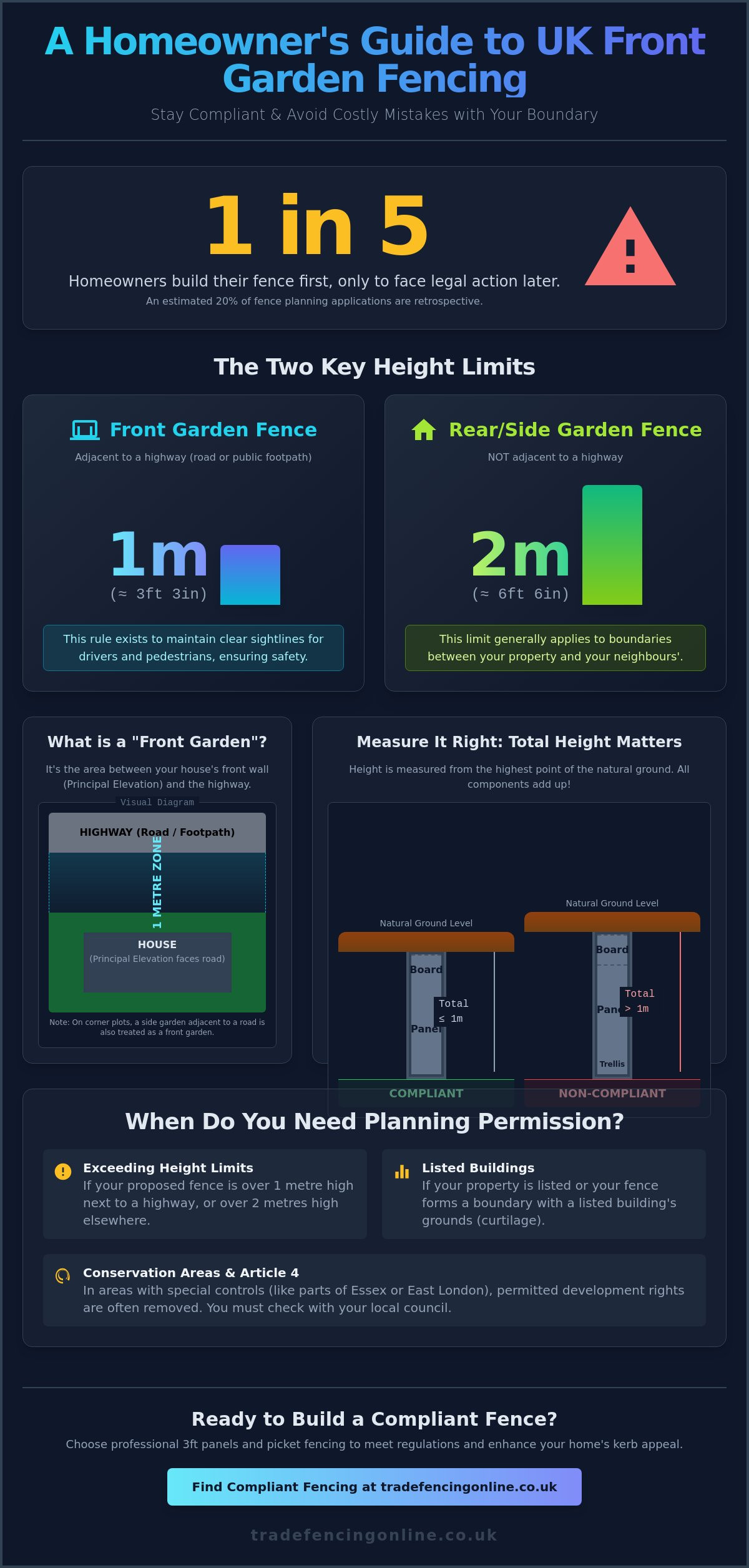
The 1-metre rule is the most critical factor in UK boundary law. If you're planning a new installation, you must stick to a maximum height of 1 metre (approximately 3ft 3in) for any structure adjacent to a highway. This restriction is primarily about safety. Local councils enforce these height limits to ensure drivers have clear sightlines at junctions and pedestrians remain visible. If your fence exceeds this, you're likely breaching the Town and Country Planning Act 1990, which provides the legal framework for these restrictions. Safety is the priority here; an over-height fence can create dangerous blind spots on residential streets.
Measurement must be taken from the highest point of the natural ground level. This prevents homeowners from artificially raising the ground with a plinth to bypass the limit. If your fence is not adjacent to a highway or footpath, the limit usually increases to 2 metres. However, for the vast majority of UK frontages, the 1-metre rule remains the standard. Adhering to these fence height regulations front garden standards ensures you won't face an enforcement notice or a demand to tear down your new panels.
What Counts as a Front Garden?
Planners usually define a front garden as any area between the "principal elevation" and the road. The principal elevation is the wall of the house that contains the main entrance. It's not always that simple. If you have a corner plot, your side garden might also be subject to fence height regulations front garden rules if it runs alongside a public footpath or road. In areas like Essex, the "building line" is often used to determine where front garden rules end and back garden rules begin. If your fence sits forward of the house's front wall, expect the 1-metre limit to apply regardless of how you use the space.
Measuring Your Fence Height Correctly
Height is measured from the ground up, not just the timber panel itself. You must calculate the total height from the bottom of the gravel board to the very top of the structure. Total height is the combined measurement of every component, including the gravel board, the main panel, and any decorative trellis added to the top. If you use 1-foot gravel boards with a 3-foot panel, you've already reached 4 feet and breached the limit.
Sloping ground requires careful planning. If the ground level varies, the council usually measures from the highest point of the natural ground adjacent to the fence. Don't assume you can "step" the panels to gain extra height on a slope. If the highest point of the fence is more than 1 metre above the highest point of the ground, it's non-compliant. Measure twice to ensure your posts and panels sit within the legal boundary.
When Do You Need Planning Permission for a Front Fence?
Planning permission is mandatory if your proposed structure exceeds specific legal limits. The most common trigger for UK homeowners is the 1-metre height limit on any boundary adjacent to a highway or public footpath. If you want a taller barrier for privacy or security, you must submit a formal application. For boundaries that don't border a road, such as side or rear fences between neighbours, the limit is 2 metres. Ignoring these fence height regulations front garden standards can lead to legal complications with your local council.
Listed buildings involve much stricter requirements. If your property is listed, or sits within the curtilage of a listed structure, your permitted development rights are usually restricted. This means you might need permission for even a small 1-metre fence that would otherwise be allowed. The same rule applies if your fence forms a boundary with the grounds of a nearby listed building. Curtilage refers to the land immediately surrounding the house, so don't assume a fence at the edge of your property is exempt. You can find official guidance on fence height to help determine your specific legal standing.
Conservation Areas in Essex and East London
Local conservation zones in areas like Romford or Havering often have bespoke restrictions. Councils use Article 4 Directions to remove standard permitted development rights to maintain the historical character of the neighbourhood. In these heritage sites, any change to the principal elevation boundary requires council approval. This includes replacing an old wall with a new timber fence. Always verify local rules with your planning department before starting work.
The Application Process and Costs
Submitting an application is done through the Planning Portal. You must provide accurate site plans and elevations of the proposed fence. Most local authorities aim to provide a decision within 8 weeks. If you build without permission, you risk an enforcement notice. This is a legal order to dismantle the fence and restore the boundary to its original state. It's a waste of time and money. If you're sticking to the 1-metre rule, you can find compliant and cost-effective fence panels in our current inventory to get your project finished quickly.
Fence Height 'Loopholes' and the Highway Boundary Rule
Many homeowners look for ways to gain privacy while following fence height regulations front garden limits. One effective method is the 'Set Back' strategy. If you move your fence away from the highway boundary, the 1-metre rule may no longer apply. Usually, a gap of 2 metres from the road allows you to build up to 2 metres high under permitted development. Check the UK Planning Portal guidance on fence height for specific distance requirements. Don't assume a small gap of a few inches is enough to bypass the law. The fence must be far enough back that it's no longer considered "adjacent" to the highway.
A common question is whether you can add a trellis to a 1-metre fence. The answer is no. Planning law considers the total height of the structure. If your timber panel is 1 metre and you add a 30cm trellis, the total height is 1.3 metres. This requires planning permission. There's no "decorative" exemption for trellis tops. Similarly, the 'De Minimis' principle is often misunderstood. While a council is unlikely to take enforcement action over a 1.1m fence, they still have the legal right to do so. It's better to stay strictly within the limit to avoid any risk of a forced removal.
Defining the Highway Boundary
A highway isn't just a main road. It includes public footpaths, bridleways, and even some unpaved tracks. If the public has a right of way, it's likely a highway. Private roads are different. If a road isn't "adopted" by the council, the 1-metre rule might not apply. However, most residential streets in the UK are adopted. Use your Land Registry deeds to identify your exact boundary line. Don't build on council-owned verges or footpaths.
Hedges vs. Fences: The Legal Difference
Hedges are the ultimate loophole for privacy. Unlike fences, there's no fixed legal height limit for a hedge in UK planning law. You can grow a 3-metre hedge in your front garden without permission. Be aware of the High Hedges Act. If your hedge is evergreen and blocks light to a neighbour's window, the council can intervene. A smart strategy is to install a compliant 1-metre fence for security and plant a hedge behind it for privacy. This combination keeps you fully compliant with fence height regulations front garden rules while blocking the view from the street.
How to Measure and Install a Compliant Front Garden Fence
Successful installation begins with material selection that respects the 1-metre legal limit. For most front gardens, 3ft (900mm) panels are the safest choice. This allows for a small gravel board at the base while staying strictly within fence height regulations front garden limits. If your boundary is uneven, custom-cut closeboard fencing offers more flexibility than fixed panels. Closeboard allows you to overlap the vertical pales to accommodate slight curves or rises in the pavement. This ensures there are no unsightly gaps at the bottom of the fence that might compromise security. Ensure your fencing supplies include the correct gravel boards to protect the timber from ground moisture and prevent premature rot.
Choosing the right support is equally important. You must factor in the height of concrete fence posts when calculating your final dimensions. While the post itself can be taller than the panel, the panel and any attachments must not exceed the 1-metre mark. Concrete posts provide superior durability and don't rot, making them a reliable choice for exposed frontages. Use high-quality postmix and cement to secure your posts firmly. Front garden fences are often exposed to more wind and traffic vibration than rear gardens, so a solid foundation is non-negotiable. Always measure from the highest point of the ground to the top of the post cap to ensure you don't accidentally breach local planning rules.
Step 1: Mark Your Boundary and Check Sightlines
Precision prevents legal disputes. Use string lines to mark your exact boundary and ensure the fence stays entirely on your property. This is especially important for front gardens where boundaries meet public footpaths. Always check for underground services like water pipes or electric cables before you start digging post holes. It's important to understand that post depth does not count toward height limits. You can dig as deep as necessary to ensure a stable foundation without affecting your compliance with fence height regulations front garden standards. Checking your sightlines ensures that your fence doesn't block the view for drivers exiting your driveway or using the main road.
Step 2: Installing Posts and Panels
Start by setting your posts at the correct intervals. Standard UK fence panels are 6ft (1.83m) wide, so your post centres must match this exactly. Use a spirit level to ensure the first panel is perfectly level, even if the ground is uneven. If you're working on a slope, you may need to step the panels, but keep the highest point of each section within the 1-metre limit. Secure your panels using heavy-duty clips or nails to prevent rattling and wind damage. Proper ironmongery ensures the structure remains safe and professional for years. Shop our range of 3ft panels and installation kits to start your project with the right materials.
Choosing the Best Front Garden Fence Panels for Your Property
Selecting the right timber style ensures you stay compliant with fence height regulations front garden limits while improving your property's value. Picket fencing remains the classic choice for UK frontages. It typically stands at 3ft (900mm), which sits comfortably under the 1-metre legal threshold. The spaced pales allow for excellent visibility, satisfying council safety requirements for highways and footpaths. If you prefer a solid barrier, closeboard panels offer maximum privacy at a low level. These are built using overlapping vertical pales, creating a strong and secure boundary that doesn't breach permitted development rules.
Decorative trellis is another functional option for low-level boundaries. It works as a stylish alternative to standard panels, provided the total height remains under 1 metre. This approach is perfect for homeowners who want to define their space without creating a solid wall. For more detailed advice on timber styles and durability, read our fence panels guide. This resource explains the differences between lap, closeboard, and decorative options to help you make an informed decision for your project.
Top Styles for 1-Metre Boundaries
Palisade or picket fencing is the go-to for a traditional, open feel. It's easy to install and maintains a friendly, welcoming aesthetic. For those seeking a modern touch, horizontal slatted panels provide a contemporary look that suits newer builds or renovated East London terraces. These panels offer privacy from certain angles while still letting light pass through. Consistency is key for a professional result. Always match your front gate to your fence height. A mismatched gate looks unprofessional and may draw unwanted attention from local planning officers if it exceeds the surrounding boundary height.
Why Buy from Romford Fencing Ltd?
Romford Fencing is the established local expert for Essex and East London. We specialize in providing the high-quality materials required to meet strict fence height regulations front garden standards. Our reputation is built on reliability and value. We offer fast local delivery to Romford, Havering, and surrounding areas, ensuring your project stays on schedule. We provide trade-quality materials directly to the public. This means you get professional-grade fence panels, posts, and gravel boards at competitive prices. Our products are designed specifically for the UK climate, utilizing pressure-treated timber for long-term durability. We are a no-nonsense supplier focused on getting you the right gear without unnecessary fuss. Our inventory is always stocked with the 3ft and 4ft components needed for compliant front garden installations.
Secure Your Front Boundary with Confidence
Building a front boundary doesn't have to be a legal headache. You now understand that the 1-metre rule is the standard for any fence adjacent to a highway. By following these fence height regulations front garden guidelines, you avoid the risk of enforcement notices and wasted materials. You can achieve privacy through the set-back strategy or by combining a compliant timber structure with natural hedging. These methods provide security without the need for a planning application.
Choose a supplier that understands local requirements. Romford Fencing Ltd has been the expert supplier to Romford and Essex for over 10 years. We provide trade-standard durability on all panels and posts to ensure your installation lasts. Our team offers fast local delivery on all fencing materials so you can start work immediately. Don't leave your project to chance. Use professional-grade timber that meets UK standards from day one. Our 3ft picket and closeboard panels are designed specifically to meet these legal height restrictions.
BROWSE OUR RANGE OF COMPLIANT FENCE PANELS
Get your front garden project finished correctly and enjoy the improved kerb appeal of a legal, high-quality boundary.
Frequently Asked Questions
Can I put a 6ft fence in my front garden in the UK?
You generally cannot install a 6ft fence in a front garden without planning permission if it borders a road or footpath. The legal limit for any boundary adjacent to a highway is 1 metre. To install a 1.8-metre (6ft) structure, you must submit a formal application to your local council. Building a high fence without approval risks an enforcement notice and the cost of removal.
Does a trellis count towards the 2-metre fence height limit?
Yes, any trellis added to the top of a fence counts towards the total height calculation. Planning laws measure the structure from the natural ground level to the highest point. If you have a 1.8-metre panel and add a 0.3-metre trellis, the total height is 2.1 metres. This exceeds the 2-metre limit for side and rear gardens and would require planning permission to remain compliant.
How high can a fence be between two houses in a front garden?
The height limit depends on whether the boundary is adjacent to a highway. If the fence between the houses is forward of the building line and near a public road, it must stay under 1 metre. If the boundary is set back and doesn't border a public right of way, you can usually build up to 2 metres. Always check your Land Registry deeds to identify the exact boundary line before starting.
What is the penalty for having a fence that is too high?
The local council can issue an enforcement notice requiring you to lower or remove the fence. You might be allowed to apply for retrospective planning permission, but approval is never guaranteed. If you fail to comply with an enforcement notice, you could face prosecution and fines. The financial burden of dismantling and replacing a non-compliant fence often far outweighs the cost of doing it right the first time.
Can my neighbour have a higher fence than me in their front garden?
A neighbour can only have a higher fence if they have obtained planning permission or if the structure has stood for over four years without challenge. Sometimes older fences gain immunity from enforcement. Don't assume their high fence makes yours legal. You must still follow the specific fence height regulations front garden rules for your own property boundary to avoid potential legal disputes with the local authority.
Do I need planning permission to replace an existing 6ft front fence?
Yes, you usually need permission if the replacement is over 1 metre and adjacent to a highway. Even if the old fence was 6ft, replacing it counts as a new development. If the original fence didn't have planning permission, you don't automatically inherit the right to maintain that height. Always verify the status of your boundary with the planning department to ensure your new timber panels are fully legal.
Is there a loophole for fence height regulations?
The most effective legal strategy is the "set back" method. If you move the fence 2 metres away from the highway boundary, you can often build up to 2 metres high under permitted development. Another option is using hedges, as they aren't governed by the same height restrictions as timber fences. These methods allow for increased privacy while staying within the legal framework of fence height regulations front garden standards.
Does the 1-metre rule apply to hedges in the front garden?
No, the 1-metre rule does not apply to hedges, shrubs, or trees. There's no fixed legal height for a hedge in UK planning law, provided it doesn't cause a nuisance or block light under the High Hedges Act. This makes hedging a popular choice for homeowners who want privacy but cannot build a high fence. You can maintain a tall hedge behind a compliant 1-metre timber fence for maximum security.