


A standard lap panel fence is often just one heavy storm away from becoming firewood. Most UK homeowners know the frustration of waking up to a leaning boundary or snapped posts after a typical British gale. It's a cycle of repair that wastes time and money. You need a boundary that stays standing; this is why professional-grade feather edge fencing is the essential choice for your property.
Discover why this style is the gold standard for British gardens. This guide explains how to choose the right components for a fence that lasts up to 30 years. We'll break down the materials you need for total privacy and maximum wind resistance. From pressure-treated timber to efficient local delivery in Romford, Essex, and East London, you'll learn how to build a secure boundary that doesn't let you down.
Key Takeaways
- Understand why the tapered design of feather edge fencing offers superior wind resistance and structural strength over standard lap panels.
- Compare the benefits of pre-made panels for fast installation against component kits for bespoke, on-site construction.
- Identify the essential components, including gravel boards and specific post types, required to prevent timber rot and maximize fence lifespan.
- Access trade-quality materials with the convenience of specialist local delivery across Romford, Essex, and East London.
What is Feather Edge Fencing and Why Does It Outlast Lap Panels?
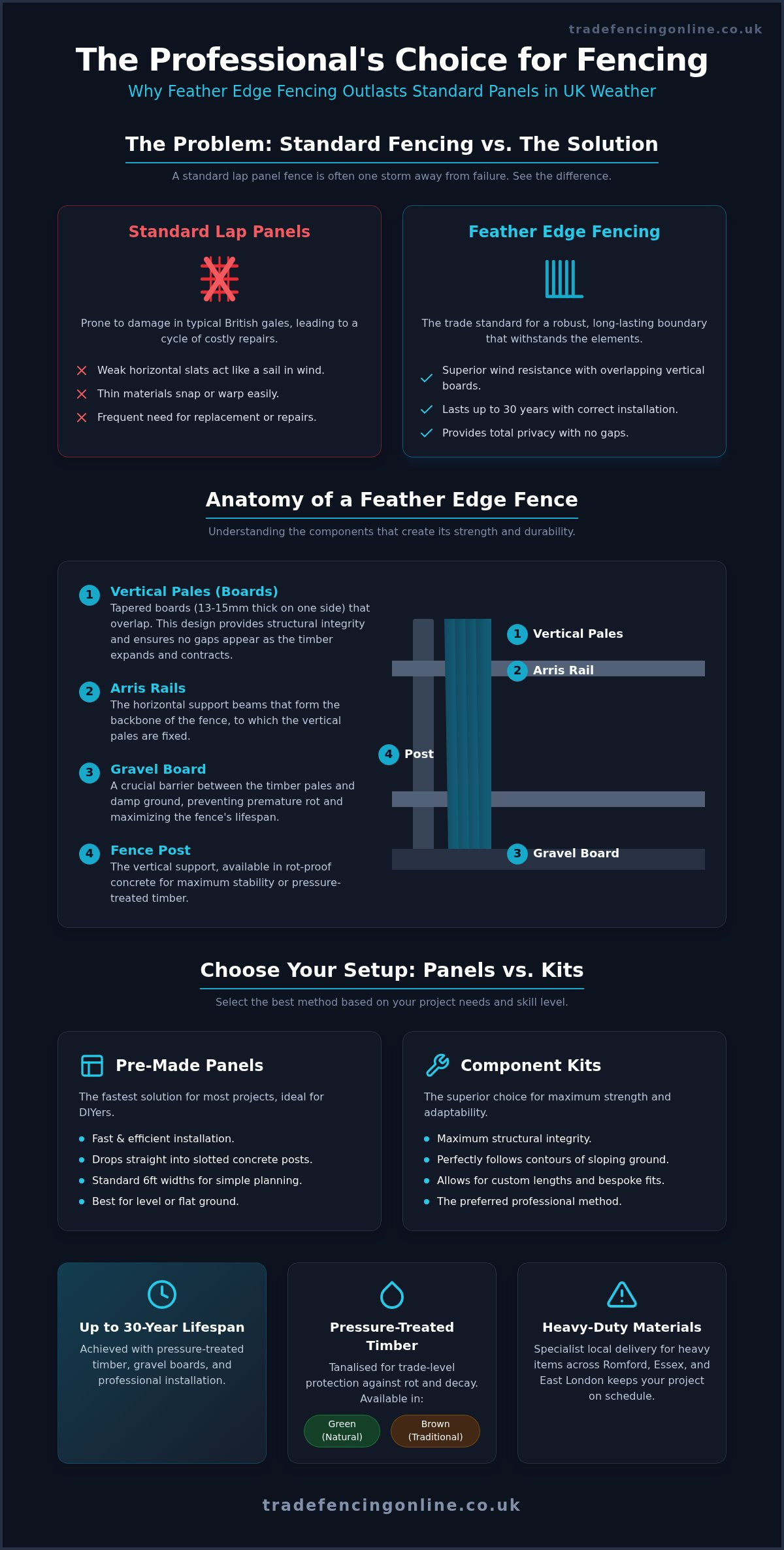
Feather edge fencing is the trade standard for a reason. It consists of vertical boards, known as pales, fixed to horizontal rails. Each board features a tapered profile; one side is approximately 13-15mm thick, while the other tapers to a thin edge. This specific shape allows the boards to overlap seamlessly. Unlike waney lap panels that use thin horizontal slats; this vertical construction provides superior structural integrity and total privacy.
Wind resistance is a major advantage. While solid panels act like sails and catch the wind, the overlapping design of feather edge fencing allows for slight pressure relief while remaining completely opaque. It's a robust solution built for the unpredictable British weather. We supply trade-quality timber designed to withstand high winds without snapping or warping.
Feather Edge vs. Closeboard: Understanding the Terminology
In the UK trade, you'll often hear "closeboard" used as a synonym for feather edge. The terms describe the same overlapping vertical board style. Professional installers prefer this method for its versatility. Because the boards are individual components, you can easily adjust them to follow the contours of sloping or uneven ground. This eliminates the awkward gaps often seen under rigid, pre-made panels.
- Arris Rails: These are horizontal support beams that provide the backbone of the fence.
- Vertical Pales: These are the tapered boards that create the secure boundary.
- Expansion Room: The overlap ensures that as timber naturally expands and contracts with the seasons, no gaps appear in your fence line.
Choosing Your Setup: Pre-Made Panels vs. Component Kits
Deciding how to purchase your feather edge fencing depends on your skill level and the layout of your garden. Pre-made panels are the fastest solution for most projects. These units drop straight into slotted concrete posts, which is ideal for DIYers looking for a professional finish with minimal assembly. We supply these in standard 6ft widths to ensure your planning process remains simple and efficient.
For maximum structural integrity, building from scratch using component kits is the superior choice. This method allows you to create custom lengths and ensures the fence remains perfectly plumb on sloping ground. You can choose either green or brown pressure-treated (tanalised) timber for your build. Both options offer trade-level protection against rot; the choice is purely aesthetic. Green treatment leaves a natural wood finish, while brown provides a deeper, traditional look that many Essex homeowners prefer.
Selecting the Right Height and Board Specification
UK gardens typically utilise 3ft to 6ft options. Front gardens often require lower heights to comply with permitted development rights for fences, while 6ft is the standard for rear garden privacy. Board thickness directly impacts the long-term durability of your boundary. A thicker board resists warping better than thinner alternatives and provides superior sound insulation from neighbours. Check our Complete Guide to Choosing Fence Panels for detailed height regulations and local installation advice.
You can view our full range of heavy-duty feather edge fence panels to find the right fit for your Romford or East London property. We specialise in fast local delivery for these heavy items, ensuring your project stays on schedule.
Installation Essentials: Gravel Boards, Posts, and Fixings
The longevity of your feather edge fencing depends on the supporting infrastructure. Gravel boards are non-negotiable components. They create a physical barrier between the timber and the damp ground. Without them, even pressure-treated wood absorbs ground moisture, leading to premature rot at the base of the pales. Following best practices from the Wood Protection Association ensures your installation meets professional standards for timber protection. You can order professional-grade gravel boards for your project to secure this protection.
Choosing between fence posts made of timber or concrete is your next decision. Concrete posts offer unmatched stability for heavy feather edge runs and won't rot underground. Timber posts provide a more traditional aesthetic but require proper setting in postmix to remain secure. Regardless of the post type, always use galvanised ironmongery. Standard nails react with the tannins in the wood, causing unsightly black rust streaks that ruin the finish of your new boundary.
Why Local Delivery in Romford and Essex Matters
Fencing materials are exceptionally heavy. A standard project with 10 or more panels often exceeds a tonne in weight. This makes specialist delivery essential for safety and convenience. Romford Fencing Ltd provides reliable local service across East London and Essex using vehicles designed for heavy lifting. We ensure your items arrive safely and are placed close to your installation site. Check our Essential Fencing Supplies Checklist before you order to ensure your project goes smoothly.
Secure Your Garden Boundary Today
High-quality feather edge fencing is the definitive choice for a wind-resistant and private garden boundary. Selecting heavy-duty components and matching them with essential gravel boards ensures a robust structure designed for long-term security. These professional-grade materials prevent common issues like base rot and leaning panels, providing a boundary that stays upright through typical British storms.
SHOP NOW
We provide trade-quality timber directly to the public at competitive prices with fast local delivery across Romford, Essex, and East London. Our specialist fleet handles heavy loads with ease, ensuring your materials arrive safely at your property. Trust our established expertise to supply the durable components your next project requires. Start your build today to create a secure, professional finish.
Frequently Asked Questions
How many feather edge boards do I need per metre?
You need 10 boards per linear metre when using standard 125mm wide pales. This allows for the essential 25mm overlap required for a secure, gap-free finish. If you opt for 100mm boards, you'll need 13 per metre. It's best practice to order a few spares to handle any onsite adjustments. We supply all components for trade and public customers across East London.
Should I use 100mm or 125mm wide feather edge boards?
Industry professionals usually specify 125mm wide boards for feather edge fencing. This width provides a stronger structural profile and reduces the total number of fixings needed for the job. While 100mm boards offer a traditional look, the 125mm option is more efficient for large garden boundaries. Both types are available in our Romford warehouse for fast delivery to your property.
Is feather edge fencing better than lap fencing for wind resistance?
This vertical style is far superior to standard lap fencing in high winds. The individual boards and heavy-duty frame don't catch the wind like a solid horizontal panel. This design allows for better pressure distribution across the posts, which prevents the fence from leaning or snapping. It's the most reliable choice for exposed gardens in Essex and East London.
How do I stop my feather edge fence from rotting at the bottom?
Installing gravel boards is the only effective way to stop timber rotting at the base. These boards act as a sacrificial barrier between the damp ground and your main fence pales. Concrete gravel boards are the most durable choice and can double the lifespan of the structure. Keeping your timber off the soil ensures your boundary remains solid for decades.