


For wire fencing, professionals use fencing pliers to cut and tighten wire, crimp connectors, and drive in or remove staples. In sports fencing, the essential kit includes a mask, jacket, underarm protector, glove and weapon. To understand what tools do professional fencers use, distinguish wire-installation tools from the protective equipment and weapons used in training.
One tool kit does not cover every job: fencing a boundary and practising the sport call for different equipment. This guide explains how fencing pliers and tensioning tools help secure wire, then covers the protective kit and weapons used at different stages of practice. You’ll see what each item does and which tools suit the task.
Key Takeaways
- Fencing pliers handle several wire tasks, from cutting and tightening to crimping connectors and removing staples.
- Pair the right hand tools with the job: wire tensioning tools support a secure fence line, while digging tools suit different ground conditions.
- For a first fencing class, focus on the essential mask, jacket, glove and weapon; regular practice brings additional kit needs.
- Electric practice adds scoring cords and, for foil or sabre, an electric jacket, so equipment changes with the training stage.
Cutting, tightening and securing wire with fencing pliers
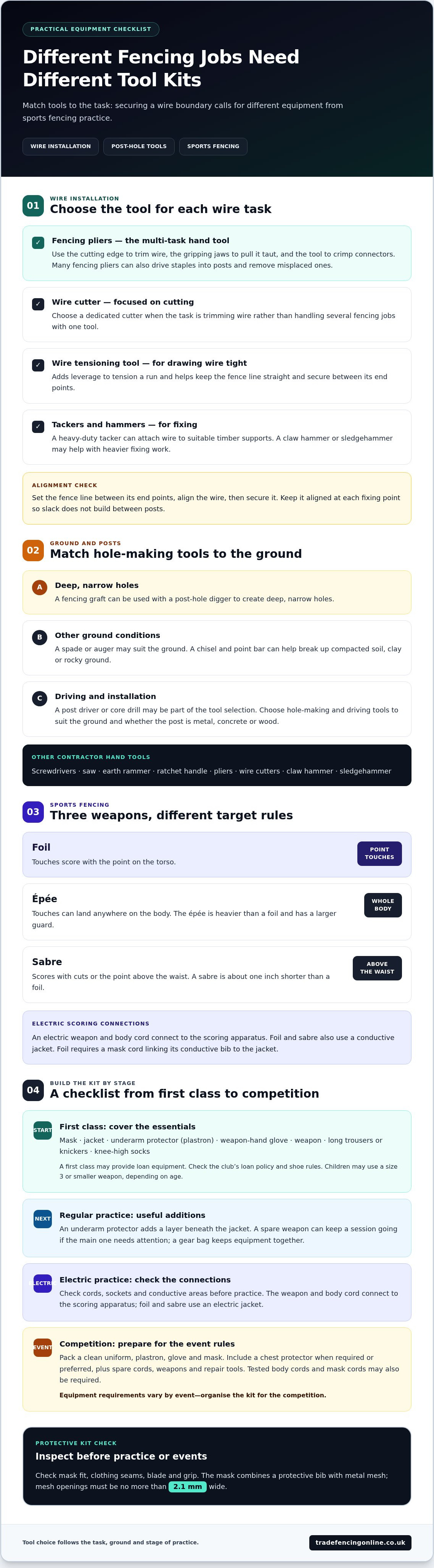
The answer to what tools do professional fencers use depends on whether the task is wire fencing or sports practice. For wire work, fencing pliers combine several functions: the cutting edge trims wire, the gripping jaws help pull it taut, and the tool can crimp connectors. Many fencing pliers can also drive staples into posts and remove misplaced ones. A wire tensioning tool helps keep a run straight and secure. Set the fencing line between its end points, then align and secure the wire. Heavy-duty tackers can attach wire to suitable timber supports.
Match each tool to the work. Fencing pliers handle several tasks, while a dedicated wire cutter focuses on cutting. A tensioning tool adds leverage when drawing wire tight. A claw hammer or sledgehammer may help with heavier fixing work. Keep the wire aligned as you secure each point, so slack doesn’t build between posts. That distinction also helps explain what tools do professional fencers use: the right selection depends on the material, fixing method and task.
Tools for digging post holes depend on the ground and post material. A fencing graft can be used with a post-hole digger to create deep, narrow holes. A spade or auger may suit other ground conditions. A chisel and point bar can break up compacted soil, clay or rocky ground. Installation methods vary for metal, concrete and wooden posts, so choose hole-making and driving tools to suit the post.
Sports fencing uses three weapons: foil, épée and sabre. An épée is heavier than a foil and has a larger guard; a sabre is about one inch shorter than a foil. Foil touches score with the point on the torso. Épée touches can land anywhere on the body, while sabre scores with cuts or the point above the waist. Electric scoring requires an electric weapon and body cord. Foil and sabre also use a conductive jacket, while foil requires a mask cord connecting its conductive bib to the jacket.
A beginner’s checklist includes a mask, jacket, underarm protector or plastron, weapon-hand glove, weapon, long trousers or knickers, and knee-high socks. The mask combines a protective bib with metal mesh; its mesh openings must be no more than 2.1 millimetres wide. Before practice or events, check the mask fit, clothing seams, blade and grip. A first class may provide loan equipment, while regular practice can call for a spare weapon and gear bag.
Useful wire-fencing tools include fencing pliers, a wire tensioning tool and heavy-duty tackers. A fencing contractor’s hand tools may include a claw hammer, sledgehammer, screwdrivers, saw, tensioning fence tool, pliers, wire cutters, earth rammer and ratchet handle. Tools for making fence-post holes can include a post-hole digger, spade, post driver, auger and core drill.
Equipment for different stages of practice
A first class is an introduction, not a reason to assemble a full competition kit. Beginners can bring or borrow equipment, so check the club’s loan policy and shoe rules before attending. Wear clothes that allow free movement. Children may use a size 3 or smaller weapon, depending on age. Choosing an appropriate weapon helps match the equipment to the fencer and their stage of learning.
Regular practice brings different needs. An underarm protector adds a layer beneath the jacket, while a spare weapon lets a session continue if the main one needs attention. A gear bag keeps equipment together between classes. These additions become useful as a fencer moves from introductory sessions to more frequent training.
Electric practice depends on reliable scoring connections. The weapon and body cord connect the fencer to the scoring apparatus. Foil and sabre also use an electric jacket. Before a session, check cords, sockets and conductive areas. This can help identify a connection problem before it interrupts practice or affects whether a touch registers.
Competition preparation calls for equipment suited to the event. A clean uniform, plastron, glove and mask form part of the kit, with a chest protector when required or preferred. Pack spare cords, weapons and repair tools in case equipment needs attention. Tested body cords and mask cords may also be required. Event rules determine what the fencer needs, so organise the kit for the competition rather than assuming every event uses identical equipment.
Build the kit as training progresses. Start with what the first class requires, then add equipment for regular or electric practice and prepare separately for competitions. This staged approach keeps the focus on the upcoming session and makes the next equipment decision clear.
Choose equipment to suit the session rather than following a fixed shopping list. For a first fencing class, beginners should check the club’s loaner policy and shoe rules. This clarifies what they need to bring and which shoes are acceptable, keeping the first decision focused on getting ready for class rather than assembling equipment for every later stage.
For regular fencing practice, useful additions include an underarm protector, a spare weapon and a gear bag. Treat these as stage-specific choices, so you can add what suits your current practice without assuming everything is needed at once. Review what you already have, identify which addition fits your routine, and build from there.
For electric fencing practice, check cords, sockets and conductive areas. Keep this equipment check separate from decisions about what to acquire: first consider whether practice is introductory, regular or electric, then focus on the corresponding equipment. Matching each decision to the session helps the kit develop in step with practice.
Romford Fencing: Fence Panels
Romford Fencing Ltd supplies practical materials for a garden boundary project. Choose panels for the boundary, then consider how posts support the layout and whether gravel boards suit the base. Ironmongery provides fittings to secure fencing components. Planning these materials together helps you prepare for installation.
If you’re replacing a damaged section, identify which parts need renewing. For a new boundary, plan the panels, posts and fittings together. Romford Fencing Ltd also offers fencing installation, alongside the materials you need for the project.
Explore fence panel options, or visit tradefencingonline.co.uk to contact Romford Fencing Ltd.
Put your next fencing project in motion
Knowing what tools professional fencers use helps distinguish sports practice from a garden fencing project. For a boundary, consider how the finished fence should fit your space and which materials the job needs. Romford Fencing Ltd supplies fence panels, fence posts and gravel boards to help you plan those essentials together.
Choose the next step that suits your project. Review the available fencing materials, then decide whether to install them yourself or use Romford Fencing Ltd’s fencing installation service. A clear plan makes it easier to move from research to action.
Start with the needs of your space, then build your fencing plan from there.