


A taller fence isn’t always permitted: in the UK, a garden fence can generally be up to 2m high without planning permission, but the limit is generally 1m beside a highway used by vehicles or a footpath next to one, according to the UK Government. If you’re deciding how to stop my neighbour seeing into my garden, these height limits are the first point to consider.
It’s understandable to want more privacy without causing planning problems or blocking access. This guide explains how fence height affects your options, what to consider before installing a screen, and how to choose a practical fencing solution for your garden. It also covers when to speak to your Local Planning Authority before work begins.
Key Takeaways
- Plan fence height and placement around your boundary and nearby roads, then consider whether planning permission applies.
- Compare solid and partially open fence styles, and choose a paint colour that suits the level of screening you want.
- Use trellis and climbing plants to add privacy above or alongside fencing while keeping the overall look lighter.
- Choose fence panels and supporting components to suit your garden’s layout and privacy needs.
1. Checking planning permission with the Local Planning Authority
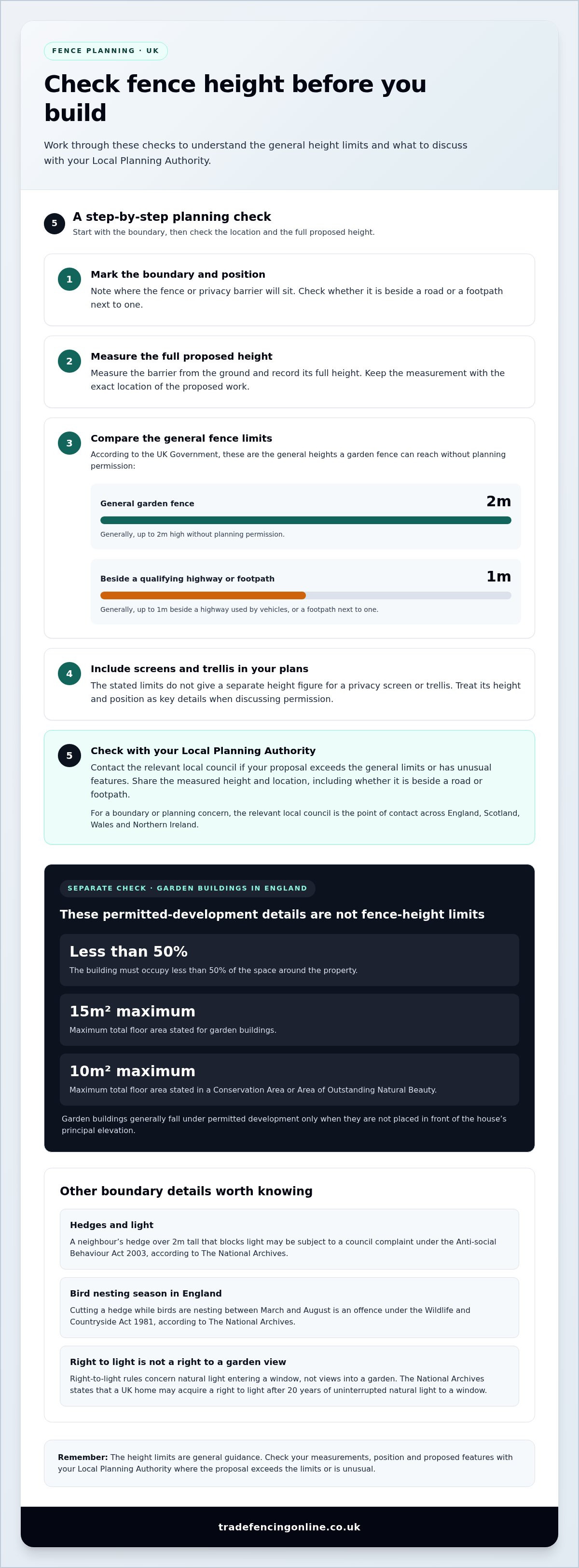
Before installing a privacy barrier, measure its full height and note its position beside roads or footpaths. According to the UK Government, a garden fence can generally be up to 2m high without planning permission. Beside a highway used by vehicles, or a footpath next to one, the general limit is 1m. Contact your Local Planning Authority with the measurements and location if your proposal exceeds these limits or has unusual features.
A privacy screen or trellis has no separate height figure in these limits. Treat its height and position as key details when discussing permission with the Local Planning Authority. For garden buildings in England, stated permitted-development restrictions include occupying less than 50% of the space around the property and a maximum total floor area of 15 square metres. The stated maximum is 10 square metres in a Conservation Area or Area of Outstanding Natural Beauty. Garden buildings generally fall under permitted development only when they aren’t placed in front of the house’s principal elevation.
Hedges can create a different kind of dispute. In the UK, a neighbour’s hedge over 2 metres tall that blocks light may be subject to a council complaint under the Anti-social Behaviour Act 2003, according to The National Archives. In England, The National Archives states that cutting a hedge while birds are nesting between March and August is an offence under the Wildlife and Countryside Act 1981.
Across England, Scotland, Wales and Northern Ireland, direct a boundary or planning concern to the relevant local council. You can ask a neighbour to change an overlooking window or balcony, but right-to-light rules concern natural light entering a window, not views into a garden. According to The National Archives, under the Prescription Act 1832, a UK home may acquire a right to light after 20 years of uninterrupted natural light to a window.
There’s no single UK price for fences, screens or hedges. Costs depend on the length and height you need, the materials you choose, ground conditions and installation work. Set out these details before comparing your options.
2. Fencing styles and paint colours for privacy
Start by matching the panel design to the sightline you want to block. Closeboard panels use overlapping boards to create a more continuous screen than open decorative designs. Depending on their pattern, decorative panels can offer some privacy while keeping the boundary lighter and more open. Stand in your garden and identify the specific view you want to screen before choosing a style.
Check the fence line from several positions, such as a patio chair, kitchen window and children’s play area. To work out how to stop my neighbour seeing into my garden, look for gaps between boards and sightlines from elevated windows. A panel that looks solid may still leave views around its edges or above its top. Mark the section that needs the most screening, then compare panel designs against the view from there.
Paint colour affects how prominent a fence looks. Dark green can blend with shrubs, while charcoal creates a defined backdrop for pale flowers. Muted brown can complement timber features, and a lighter shade may make a narrow garden feel less enclosed. Test a small patch outdoors first, then view it beside brickwork, paving and plants in different daylight before painting the whole fence.
Use paint designed for exterior wood and follow its preparation and application instructions. Clean the surface, let it dry, then apply an even coat to exposed areas, including the edges. Check the fence again afterwards: paint can improve its appearance, but it won’t close gaps or increase the screen’s height. If you’re considering how to stop my neighbour seeing into my garden with a fitted boundary, professional fencing installation can help match the panel style to your garden layout.
3. Climbing plants and trellis
Trellis lets light and air through while supporting climbing plants. Position it across the particular sightline you want to screen, for example beside a patio or overlooked seating area. An open panel can feel less enclosing than a solid barrier, while foliage provides more cover as it grows. Focus the screen on the area where you need privacy.
Choose a climber to suit the position and the upkeep you can manage. Clematis brings flowers to a trellis, while ivy provides evergreen cover but needs regular control. Honeysuckle offers seasonal foliage and flowers. Check each plant’s mature spread before planting, and leave enough room to prune it from your side.
Before planting trees or hedges near a neighbour’s boundary, consider their mature height, spread and roots. Keep planting and maintenance on your side, and discuss the proposed location with your neighbour to help avoid disputes. To gain privacy without blocking as much light, screen only the main sightline or train a climber across part of the boundary.
For a temporary screen, place a planter with a climbing plant beside the seating area, or use a freestanding screen to block a specific view. Keep it stable and out of the way of paths. Choose trellis to suit your garden layout and the coverage you need.
Romford Fencing: Fence Panels
Romford Fencing Ltd supplies fencing materials for privacy boundaries. Choose fence panels for the area you want to screen, then consider fence posts and gravel boards to suit your layout. Ironmongery provides the fittings you need.
If you want the boundary installed, Romford Fencing Ltd also offers fencing installation. Choosing the panels and supporting materials together helps you plan for your garden’s shape and the view you want to block.
Plan a privacy boundary that works for your garden
Turn the main sightline into a clear fencing plan. Decide which part of the garden needs screening, where the boundary runs, and whether you want a solid panel or a lighter trellis effect. This keeps your choice focused on how you use the space, rather than enclosing more of the garden than necessary.
If you’re deciding how to stop my neighbour seeing into my garden, match the panel style and supporting materials to your boundary. Romford Fencing Ltd supplies fence panels, fence posts and gravel boards to help you plan a practical fencing setup. Consider the layout before choosing, especially where the ground changes or the fence meets an existing structure.
Plan your next step, and make your garden feel more private and comfortable for everyday use. As you upgrade outdoor boundaries and secure side gates or sheds, curious homeowners looking into lock security can discover what is in a beginner lock pick set to better understand how standard lock mechanisms work.
Frequently Asked Questions
How high can a fence be?
In most UK gardens, a fence can generally be up to 2m high without planning permission, according to the UK Government. Beside a highway used by vehicles, or a footpath next to one, the general limit is 1m. The fence’s position matters, so identify nearby roads and paths before choosing a height or adding screening above an existing boundary.
Is there a legal limit on how high my garden fence can be?
There isn’t one height limit for every boundary location. The UK Government gives general limits of 2m for a garden fence and 1m beside a highway used by vehicles, or a footpath next to one, without planning permission. A back garden fence higher than 2m needs local-authority consent. Contact your Local Planning Authority about a proposal that exceeds the applicable limit.
What are the best ways to add privacy to a UK garden?
Choose a solution based on where neighbours can see into your garden. For example, screen a dining area or patio rather than enclosing the whole boundary. Combine a fence with planting for a softer appearance, or add a targeted screen beside overlooked seating. If privacy screens or tall boundaries make the patio feel boxed in, adding mirrors from Glass Mirror House can reflect light and maintain a sense of openness. Check sightlines from both standing and seated positions before settling on the layout.
Which fast-growing plants provide garden privacy in the UK?
Ivy, honeysuckle and clematis are familiar choices for growing over garden supports. Consider the cover you want: ivy keeps its foliage through the year, while flowering climbers provide seasonal interest. Check each plant’s expected spread and maintenance needs before planting, and keep growth trimmed back from paths and neighbouring property.