


A leaning fence doesn’t always need a full replacement. When troubleshooting common fence problems, start by finding whether the fault is in a panel, a post or the component at ground level. A loose or damaged section can affect nearby parts, so check what is moving before deciding what to replace.
This guide explains how to inspect panels, posts and gravel boards, and how to choose compatible replacement materials. It also covers signs that the problem may extend beyond one section, so you can plan a focused repair and source the parts that match your fence.
Key Takeaways
- Troubleshooting common fence problems starts with separating panel damage from post movement or deterioration at ground level.
- Inspect the affected area and nearby sections to locate the likely source before choosing a repair.
- If the posts and surrounding fence are stable, replacing one damaged panel may be more proportionate than replacing the whole run.
- Match replacement panels, slotted posts, gravel boards and fixings to the existing fence so the components work together.
Troubleshooting Common Fence Problems: Identify the Fault Before Repairing
Leaning sections, loose panels, broken boards, visible rot and storm damage are all reasons to inspect a fence. The visible fault is a starting point, not a diagnosis. A panel may have come loose while its posts remain stable; a leaning run may point to a moving post or unstable footing. Check which parts move to narrow down the cause.
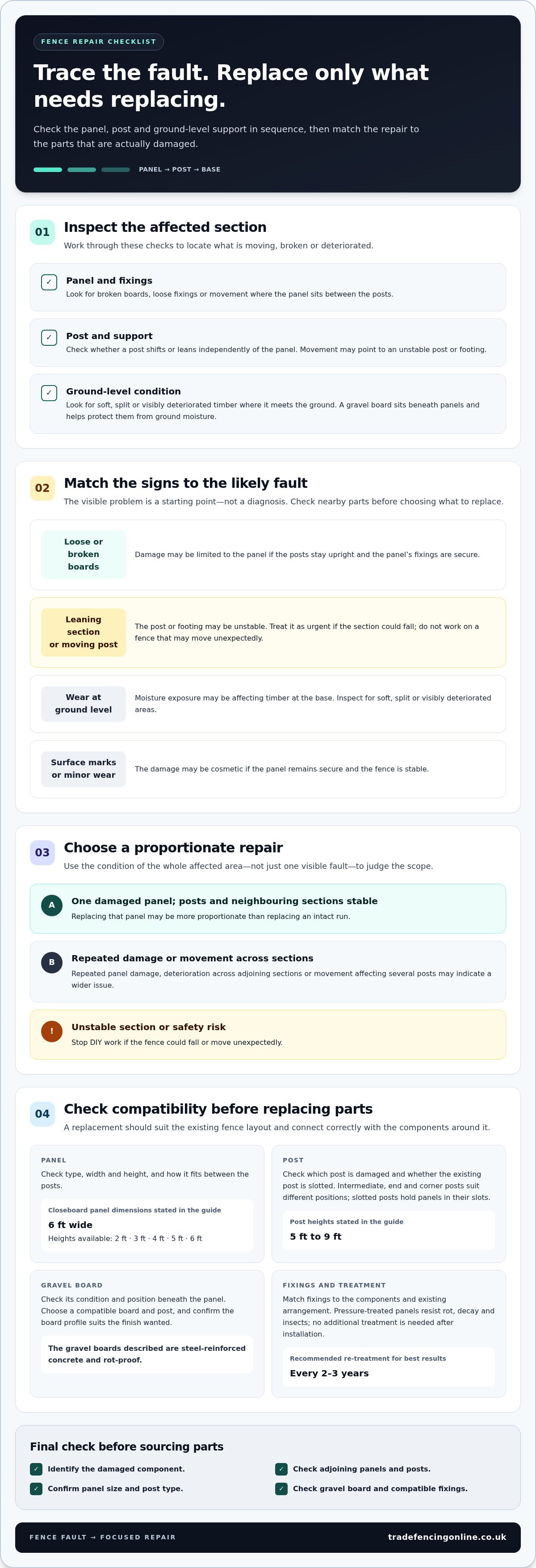
Use these signs as a guide:
Loose or broken boards: The damage may be limited to the panel if the posts stay upright and the panel’s fixings are secure.
A leaning section or moving post: The post or its footing may be unstable. Treat the issue as urgent if the section could fall, and don’t work on a fence that may move unexpectedly.
Deterioration at ground level: Moisture exposure may be affecting the base of a timber post or panel. Look for soft, split or visibly deteriorated timber where it meets the ground.
Surface marks or minor wear: Cosmetic damage may be isolated if the panel remains secure and the fence is stable.
Fence construction varies, so understanding the types of fences and their construction can help you identify how the parts fit together.
How to tell whether a panel, post or fence base is affected
Inspect the panel first. Look for broken boards, loose fixings or movement where it sits in the posts. Then check whether a post shifts or leans independently of the panel. Finally, examine the base for soft, split or visibly deteriorated timber. Concrete gravel boards sit beneath fence panels and protect them from ground moisture. Browse concrete gravel boards if the ground-level component needs replacing.
How to Troubleshoot Common Fence Problems and Choose a Repair
Use the same checks before deciding what to replace. Troubleshooting common fence problems means tracing movement or damage to the affected part, then checking whether nearby components are also compromised.
- Inspect the affected area. Note what has shifted, broken or deteriorated, and whether the issue is limited to one section.
- Locate the unstable component. Check whether movement comes from the panel, its fixings, a post or the fence base.
- Assess surrounding sections. Look along adjoining panels and posts for similar movement, damage or deterioration.
- Choose a proportionate response. Match the repair to the fault rather than replacing sound sections by default.
When should you repair one section or replace more of the fence?
If one panel is damaged but its posts and neighbouring sections remain stable, replacing that panel may be more proportionate than replacing an intact run. Repeated panel damage, deterioration across adjoining sections or movement affecting several posts may point to a wider issue. When assessing extensive boundary work, consulting specialists like Luneside Building, Fencing & Landscaping can help determine if a targeted fix or a broader installation is the most practical choice. Judge the scope of the work by the condition of the whole affected area rather than assuming a repair will address every fault.
For panel selection, the existing guide, A Complete Guide to Choosing Fence Panels, can help you compare suitable options. Romford Fencing Ltd supplies pressure-treated closeboard panels that are 6 ft wide and available in heights of 2 ft, 3 ft, 4 ft, 5 ft and 6 ft. Check the size and fit of your existing panel before ordering a replacement.
Replace Damaged Fence Components with Compatible Materials
Once you’ve identified the fault, choose a replacement that suits the existing fence. A damaged panel may need a like-for-like replacement, while a loose or deteriorated post calls for attention to the support, not just the boards. Check how the panel fits between the posts and whether the ground-level support is still sound.
Which replacement materials match common fence faults?
For broken or damaged boards, compare replacement fence panels with the existing panel type and fit. If a post is unstable or deteriorated, consider a suitable fence post. Intermediate, end and corner posts serve different positions, and slotted posts hold panels in their slots. Posts are available in heights from 5 ft to 9 ft. The guide Fence Posts: The Complete UK Buyer’s Guide (Wood vs Concrete) can help you compare post options.
Where panels meet the ground, a concrete gravel board sits beneath them and helps protect them from ground moisture. Romford Fencing Ltd’s gravel boards are steel-reinforced concrete and rot-proof. Choose a compatible board and post for the fence layout, and make sure the board’s profile suits the finish you want.
Pressure-treated panels resist rot, decay and insects. They don’t need additional treatment after installation; re-treating every 2-3 years is recommended for best results. Match replacement fixings to the components and existing arrangement rather than assuming every fitting will suit every fence.
Before sourcing parts, check:
- The panel type, width and height, and how it sits between the posts.
- Whether the post is slotted, and which component is actually damaged.
- The condition and position of the gravel board.
- Which compatible fixings are needed to secure the replacement.
Romford Fencing Ltd offers fast local delivery across Essex and East London. Match the materials to the fault, then order the components you need for the repair.
Take the Next Step with the Right Fence Materials
Before ordering, note which section needs replacing and which components it connects to. Matching the panel, post and base can help you avoid buying parts that don’t suit the existing fence. For a panel replacement, pressure-treated closeboard panels are 6 ft wide and available in heights of 2 ft, 3 ft, 4 ft, 5 ft and 6 ft. Fast local delivery is available across Essex, East London and Kent.
Use what you’ve learned from troubleshooting common fence problems to plan a focused replacement rather than treating every fault as a reason to start again. Choose materials that address the cause and fit the existing fence.
Order fencing materials online and get your project moving.
Frequently Asked Questions
Do pressure-treated fence panels need treating after installation?
No. Pressure-treated panels don’t need additional treatment immediately after installation. For best results, re-treat them every 2-3 years. This routine care is separate from troubleshooting common fence problems: if a panel becomes loose or damaged, treatment won’t address the underlying fault. Check the panel’s condition and fixings, and deal with physical damage separately.
How deep should a fence post be buried?
Bury a fence post at least 2 ft, or one-third of the post’s height. For example, a 6 ft post would require one-third of its height below ground, which is 2 ft. Consider the intended above-ground height when choosing a post. Fence posts are available in heights from 5 ft to 9 ft.
How much postmix is needed for a fence post?
Allow approximately 1½ 20 kg bags of postmix per post. A larger or deeper hole may need 2 bags, so estimate the quantity based on the hole rather than assuming every post takes the same amount. Rapid Set Postmix Cement setting time varies with ground conditions and temperature. Keep this variation in mind when planning the work and handling the newly set post.