


Why invest hours into your garden only for the timber to rot away within three seasons? You likely want a garden that looks professional without the constant worry of maintenance. Many UK homeowners assume any thick piece of wood will do, but choosing the wrong railway sleepers for raised beds often leads to structural failure or soil contamination. We understand the importance of using reliable, high-quality materials that offer genuine value and long-term durability for your landscaping projects.
This guide provides a straightforward blueprint to help you choose, build, and maintain your garden structures. You'll learn the critical differences between new treated softwood and reclaimed oak. We'll also address safety concerns regarding creosote and provide a clear construction plan to simplify the assembly process. Follow these steps to ensure a durable, professional-grade garden feature that enhances your outdoor space for years to come.
Key Takeaways
- Compare the durability of different materials to choose between the 8-12 year lifespan of treated softwood and the 20-plus years offered by solid oak.
- Learn the professional methods for installing railway sleepers for raised beds, including essential ground preparation and the use of staggered joints for structural stability.
- Identify which timber treatments are safe for domestic garden use to protect your soil and plants from harmful chemicals found in reclaimed wood.
- Save time and logistics costs by sourcing professional-grade sleepers and fencing materials from a specialist supplier with fast delivery across Essex and East London.
Choosing the Right Railway Sleepers for Garden Raised Beds
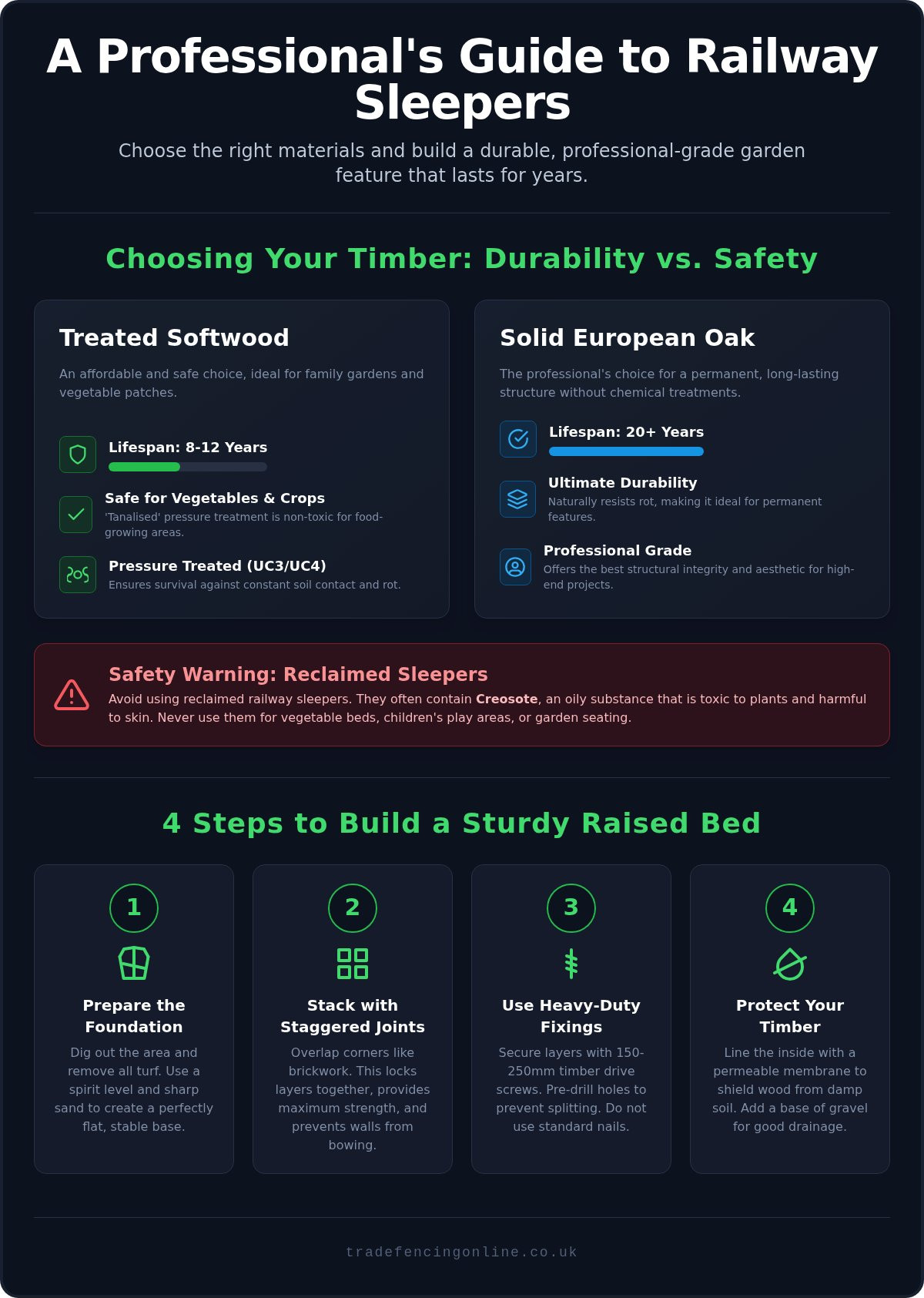
The success of your garden project depends entirely on the timber grade you select. A standard Railway sleeper is a structural necessity for modern landscaping. When selecting railway sleepers for raised beds, prioritize durability and safety. Softwood options provide an affordable entry point. These typically offer a lifespan of 8 to 12 years when pressure-treated. If you want a permanent fixture, European Oak is the professional choice. It often lasts over 20 years without needing additional chemical treatment.
Treated Softwood vs. Reclaimed Oak Sleepers
New softwood sleepers undergo 'Tanalised' green pressure treatment. This process forces preservatives deep into the wood fibres to stop rot. It's safe for growing vegetables and edible crops. It's the best choice for family allotments. In contrast, reclaimed sleepers often contain creosote. This oily substance is toxic to plants and harmful to skin. Don't use reclaimed timber for food-growing areas or garden seating. It's a risk that isn't worth taking for a domestic garden.
Stick to standard 2.4m lengths to minimize waste. These dimensions are the trade standard. They're easy to handle and fit most garden layouts. Pressure treatment to UC3 or UC4 standards ensures the railway sleepers for raised beds survive constant soil contact. This is vital for structural longevity. Buying 2.4m lengths allows for efficient cutting patterns. You'll spend less on materials by reducing offcuts. Our sleepers are sourced for their straight edges and structural consistency. This makes stacking and levelling much faster for any installer.
If you're planning a full garden overhaul, match your sleepers with high-quality fence panels. This creates a unified, professional finish that increases property value. Consolidating your order also simplifies delivery logistics.
To complete the look of your garden overhaul, you can also find high-quality, trendy furniture options from Rengard that perfectly complement newly installed sleepers and fencing.
How to Build a Raised Bed with Railway Sleepers
Building with railway sleepers for raised beds requires a solid foundation. Don't just place timber on grass. Dig out the area and remove all turf. Use a spirit level to ensure the base is flat. A stable foundation prevents the structure from leaning as the soil settles over time. If your ground is uneven, use a thin layer of sharp sand to create a level starting point.
When installing railway sleepers for raised beds, use 'staggered joints' at every corner. This technique mimics traditional brickwork and locks the layers together. It provides maximum structural strength against the weight of wet soil during winter months. Avoid lining up vertical seams. If you're building a bed more than two sleepers high, this structural overlap is essential to prevent the walls from bowing outwards.
Forget standard nails. They'll pull out over time as the wood expands and contracts. Use heavy-duty timber drive screws instead. These should be 150mm to 250mm long depending on your timber thickness. They provide a secure, long-lasting grip that withstands seasonal wood movement and pressure. Pre-drill your holes to prevent the timber from splitting near the ends.
Essential Fixings and Liners for Longevity
Moisture is the main enemy of timber. Line the inside of your bed with a permeable membrane to create a barrier between damp soil and wood. This reduces rot risk. Use gravel boards or clean stone at the base for drainage. We recommend 150mm to 250mm timber screws for securing multiple layers. This approach follows the Royal Horticultural Society (RHS) guide. You can order your landscaping supplies from our Romford depot for fast local delivery.
Sourcing Quality Sleepers and Landscaping Materials in Essex
Sourcing railway sleepers for raised beds shouldn't be a logistical headache. Heavy timber is difficult to transport without a dedicated vehicle. National merchants often charge high delivery fees or offer slow lead times for bulky items. By choosing a specialist supplier in Romford, you benefit from fast regional delivery across Essex and East London. Our local expertise ensures you get trade-quality materials at competitive prices. We understand the specific landscaping requirements in the South East and provide a more efficient service than national chains.
Safety is a priority when selecting timber for your garden. According to UK safety regulations, creosote-treated wood is restricted for use in gardens where frequent skin contact occurs. This makes our new, pressure-treated sleepers the ideal choice for domestic projects. To achieve a professional finish, consolidate your order. Purchasing your sleepers alongside fence panels ensures a unified garden design. It also reduces your total delivery costs by bringing all heavy materials in one drop.
Fast Delivery and Trade Value in Romford
Domestic projects in East London deserve trade-grade durability. We supply the same high-tier materials to homeowners that we provide to professional contractors. Check our Essential Fencing Supplies checklist to ensure you have all the fixings, postmix, and ironmongery required for a complete install. Visit our Romford site for expert advice or order online for immediate project turnaround. Our goal is to provide quality goods with minimal friction.
Start Your Garden Project Today
Success with railway sleepers for raised beds comes down to material quality and structural integrity. You now understand the importance of choosing pressure-treated softwood or durable oak to avoid premature rot. Correct stacking with staggered joints ensures your structure withstands the pressure of wet soil year after year. Don't let the logistics of heavy timber hold you back. We provide trade-quality timber and fixings with expert local delivery across Essex and East London. As established Romford Fencing Ltd, we supply the professional-grade materials you need for a high-end finish. Our team is ready to help you transform your outdoor space with reliable, value-driven solutions.
SHOP NOW
Take the first step toward a more productive and professional garden layout today, and once your space is ready for entertaining, visit The BBQ Experts to find the perfect outdoor cooking equipment.
Frequently Asked Questions
Do railway sleepers need to be treated for raised beds?
Softwood sleepers must be pressure-treated to prevent rot and fungal decay when in contact with damp soil. While hardwood like oak is naturally durable, softwood requires chemical protection to reach its full lifespan. Using treated railway sleepers for raised beds ensures your garden structure remains stable for many years. Always verify that the timber is treated to UC4 standards for direct ground contact.
How long do railway sleepers last in the ground?
Lifespan depends on the wood species and the quality of the treatment process. Pressure-treated softwood typically lasts between 8 and 12 years before rot becomes a structural issue. In contrast, solid European oak sleepers often last over 20 years without any chemical intervention. Using a liner and ensuring proper drainage will help maximize the longevity of any timber used in your garden.
Can I use reclaimed sleepers for growing vegetables?
For a standard single-height bed of these dimensions, you'll need three 2.4m sleepers. Two sleepers form the long sides, while the third is cut into two 1.2m lengths for the ends. If you're building a double-height bed, order six units to allow for staggered joints at the corners. This calculation is based on the trade-standard 2.4m lengths we stock at our Romford depot.