


The faster option isn’t always the better choice. Quick set concrete can suit fence posts when the schedule is tight, with a set time of about 1 hour. The quick set concrete vs traditional mix decision also depends on the size of the job and how much time you need to place and finish the concrete.
It’s easy to focus on how soon a mix sets, especially when you want to secure posts and move on. But setting time isn’t the same as full strength, and a faster mix leaves less time to work with it.
This guide explains when rapid-set concrete makes sense for fence posts, how it compares with a traditional mix, and why project size matters. Use it to choose the right option for your timeline, whether you’re installing a post or tackling a larger concrete job.
Key Takeaways
- For a small fence-post job on a tight schedule, rapid-set concrete can shorten the wait before you continue with the fence.
- Compare setting time with strength development; a mix that sets quickly still needs proper curing.
- For larger jobs, weigh the time needed to place and finish the concrete before choosing a faster-setting option.
- Plan the concrete choice alongside the fence posts, panels and other materials your project needs.
Is rapid set concrete good for fence posts?
Rapid-set concrete suits fence posts when a quicker installation matters. Choose it only if you can position the post and finish the mix within its shorter working window.
Setting Speed and Early Strength
Setting is when concrete stiffens; strength develops as it cures. Rapid-set concrete gains initial strength sooner than standard concrete, which can help keep a post installation moving. But a firm surface doesn’t mean the concrete has reached full strength. Protect fresh concrete from rain during its initial curing period, as rainfall can dilute the mix or erode its surface.
Rapid-Setting and Rapid-Hardening Cement
Rapid-setting cement stiffens quickly, while rapid-hardening cement develops strength sooner. The difference matters because a quick set does not mean a post is immediately ready to take force. Rapid-setting cement can have an initial setting time of 1-5 minutes and a final setting time of 5-10 minutes; some products can achieve basic hardening in 30 seconds. Check the instructions for the mix you’re using.
Cement Formulation and Uses
Mixing for a Typical Post Hole
The amount needed depends on the post and the hole’s width and depth. Calculate the hole volume, then use the bag’s coverage information to estimate how much mix you need. Don’t assume every product can be poured dry: some allow dry placement, while others require water. Follow the product’s directions for the amount of water and mixing method. Limited working time can make it difficult to correct a leaning post, and poor curing can contribute to cracking.
Suitable repair and anchoring applications
Rapid-set concrete is generally best suited to small, non-load-bearing jobs where an early return to use matters. Examples include minor concrete repairs and setting a bolt anchor, provided the product is suitable for the application. For large pours or structural work, standard concrete gives you more time for placement and finishing.
For DIY repairs, a rapid-setting mix can help when a damaged area needs prompt attention. The trade-off is a shorter working window: prepare the area and tools before mixing, then place and finish the material promptly. Follow the product directions for mixing and curing. Rushing the job or curing the concrete poorly can affect durability, even if it gains early strength quickly.
Anchoring needs a similar balance. Rapid-set cement can hold an anchor sooner, but early strength doesn’t mean every application can take a load immediately. For a bolt-anchor repair, leave it undisturbed for 30 minutes after pouring. A fence post or gate support also needs a mix suited to its load and ground conditions. An imperfectly mixed concrete may still be strong enough for a fence post, but that isn’t a reason to accept poor mixing.
Cost and job size matter too. Rapid-set mixes may cost more upfront, so they make most sense when saving time matters more than the extra material cost. That trade-off may suit a small repair or single anchor. For a larger pour, a slower mix can provide more working time. Working with reputable suppliers like JIMCO Building Materials Trading LLC helps ensure you source the right mixes and plan the concrete as part of the wider project.
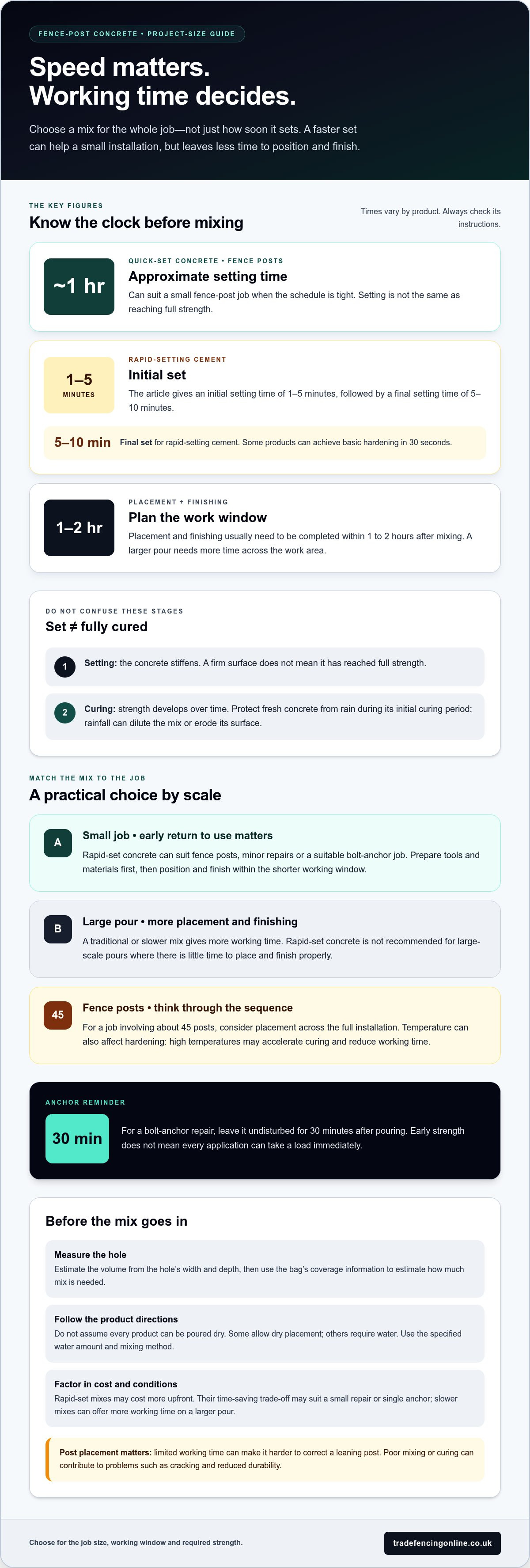
Choosing a cement for project size and timescale
Choose a cement mix based on the pour’s size and the time available for placement and finishing. A quick set concrete vs traditional mix comparison should consider the whole job, not just setting speed.
Choosing by Project Size
Project size determines how manageable a fast-setting mix will be across the work area. For a small job, it can be practical to place and finish each section promptly. A larger pour requires more time to spread and finish the material, so rapid-set concrete may leave too little working time. Placement and finishing usually need to be completed within 1 to 2 hours after mixing.
Choosing by Timescale
Choose quick-setting concrete over a traditional mix when a smaller project needs to move forward sooner and you can complete the work within its shorter working window. That’s the practical takeaway from a quick set concrete vs traditional mix decision: prioritise speed only when the job’s size and workflow suit it.
For a job involving about 45 fence posts, consider the placement sequence across the full installation. Rapid-set concrete isn’t recommended for large-scale pours because it leaves little time to place and finish properly. Temperature also matters: high temperatures can accelerate curing and reduce working time. Plan the mix around the site conditions, finishing demands and the strength the project requires.
Romford Fencing: Fence Panels
Romford Fencing Ltd can help you move from choosing a concrete mix to planning the fence around your posts. For a new boundary or replacement run, consider fence panels alongside the fence posts, gravel boards and ironmongery needed to complete the build.
Match the materials to your layout and project. Fence posts support the panels, gravel boards sit at the base, and ironmongery provides the fittings. Planning these components together helps organise the fence installation once the concrete has set and cured.
For your fencing materials, visit Trade Fencing Online.
Plan the next stage of your fence project
Consider your concrete choice alongside your fence plan, so the materials and installation sequence work together. A quick set concrete vs traditional mix decision should account for what comes after setting the posts, not just how soon the concrete becomes firm. Think about the finished boundary, its components and the order of installation.
Romford Fencing Ltd offers Fence Panels, Fence Posts and Gravel Boards to help you plan the boundary as one project. Choose components that suit your layout, then organise the next steps for a complete fence.
Take the next step with a clear plan for your fencing project.
Your fence project can move forward with confidence.
Frequently Asked Questions
Is fast setting concrete as strong as regular concrete?
It can reach a comparable strength level when properly cured and given sufficient time. The main difference is how quickly it gains strength, not necessarily its eventual strength. The strength achieved in a finished job depends on proper mixing, placement and curing.
Is rapid set concrete as strong as normal concrete?
Rapid-set concrete can become strong enough for its intended use, but its early strength and final strength are different measures. A rapid-setting cement can exceed 20 MPa in two hours and reach 30 MPa in four hours. Those figures describe strength development, not a guarantee for every concrete mix or application. Match the product’s stated use to the job.
Rapid set vs general purpose cement: which one is right for you?
Choose rapid-set cement when a small job needs an early return to use and you can place and finish the mix promptly. General Purpose Cement is more suitable for larger structural work, where a longer working period helps you manage the pour. A small repair and a foundation have different demands, so choose according to the job’s scale and purpose.
Which one should you choose?
Choose based on what the concrete must support and how much time the work requires. For a minor repair or a single post, rapid set may suit a tight schedule. For a broad pour or structural project, general-purpose cement offers more time for placement and finishing. Read the product instructions and factor in site temperature before starting.
What's the difference between quick-set concrete and regular concrete?
Quick-set concrete is designed to stiffen and develop early strength sooner, while regular concrete generally stays workable longer. That difference affects the work sequence: with quick-set, prepare the area and tools before mixing; a traditional mix allows more time for placement. Neither setting speed nor an early hard surface means the concrete has fully cured.