


A new fence can spark a boundary dispute before the first post goes in. Knowing how to approach a neighbour about a new fence starts with checking the property documents and agreeing where the boundary lies. You can’t alter a fence your neighbour owns without their permission.
Settle ownership and discuss the plans before choosing materials or arranging work. A clear, friendly conversation helps both neighbours understand what may change and avoid surprises.
This guide explains how to check fence responsibility, when you need your neighbour’s permission and what to discuss before work begins. It also covers putting shared plans in writing, so everyone understands the work, costs and future maintenance.
Key Takeaways
- Use property documents to investigate who is responsible for the fence and where the boundary runs.
- Before changing a fence, establish who owns it and get permission if it belongs to your neighbour.
- If you propose sharing replacement costs, agree the work and each person’s contribution before it begins.
- Discuss the fence’s position, appearance and timing in advance, then put any agreement in writing.
1. Checking fence ownership and boundary responsibility
Start with the property documents for both homes. Compare the plans and deed wording for boundary details or repair covenants. A title plan can help indicate a boundary, but it may not show its exact position on the ground.
Look for T-marks, but read the wording alongside them. A T-mark can indicate who must maintain a fence when the deed confirms that responsibility. On its own, it does not prove who owns the land beneath the fence. There is also no general rule that you are responsible for the fence on the left-hand side. In England and Wales, neighbours do not generally have to maintain or replace a garden boundary fence unless the deeds require it.
Check what type of structure you’re dealing with before relying on party-wall rules. According to The National Archives (legislation.gov.uk), the Party Wall etc. Act 1996 applies to party walls or masonry party fence walls, rather than normal timber or concrete-post garden fences. For covered party-structure repairs, a notice must give at least two months before work begins.
If the deeds and plans conflict, pause work and seek help from a surveyor experienced in boundaries. They can compare documents with the fence’s position and physical features, helping clarify the issue before damage or disputes arise. The Royal Institution of Chartered Surveyors has a boundary dispute helpline on 02476 868 555. Keep copies of relevant plans and correspondence about maintaining the boundary.
2. Can I replace my fence without my neighbour's permission?
You can replace a fence you own, but don’t alter or remove your neighbour’s fence without permission. If ownership or the boundary is unclear, pause before work starts and review the property documents.
According to the UK Government, a garden fence generally cannot exceed two metres in height without planning permission. Check the proposed height before agreeing the design, especially if it would be taller than the existing fence.
For a shared repair or replacement, suggest a clear plan rather than simply asking your neighbour to pay. Explain which sections are damaged, what work is needed and how you propose dividing the costs and responsibilities. If ownership is unclear, neighbours may agree to share replacement costs equally, but this is an agreement, not an automatic requirement. If your neighbour declines to contribute, check whether the property deeds require payment; otherwise, don’t assume they must share the bill.
Give your neighbour time to respond and keep the discussion focused on a practical compromise. You might suggest repairing the damaged section first or choosing a simpler design that suits both gardens. If talks stall, your council may be able to help you find a mediator. Before arranging work, put the agreed tasks, contributions and future maintenance responsibilities in writing.
For a shared project, compare at least three quotes before settling the proposed contribution. Once you’ve agreed the specification, browse fence panels to help match the plan to the boundary.
3. Discussing fence plans before work begins
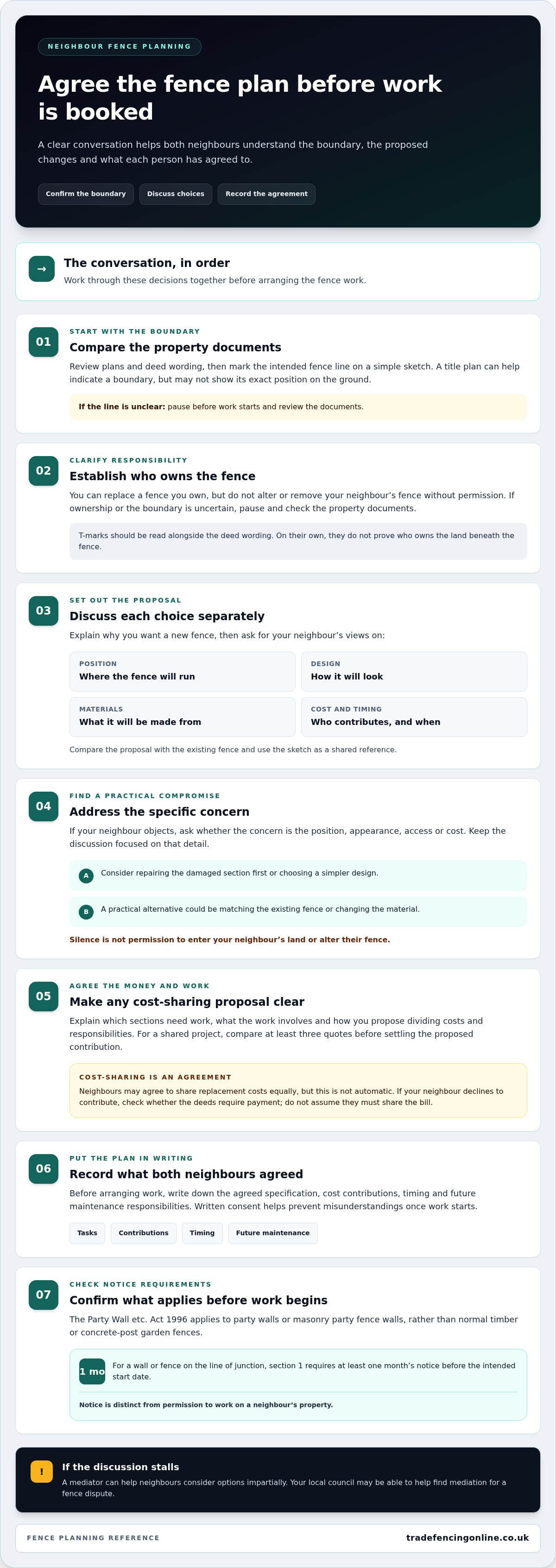
Start the conversation before booking work. Explain why you want a new fence, then discuss the proposed boundary position together. Bring the property documents and mark the intended line on a simple sketch. This gives you both a clear reference before discussing design or materials. Knowing how to approach a neighbour about a new fence means presenting a specific plan, not demanding agreement.
Discuss the fence position, design, materials and costs as separate choices, and ask for your neighbour’s views. Compare the proposed structure with the existing fence, then record the agreed specification, cost contributions, timing and future maintenance responsibilities. Written consent helps prevent misunderstandings once work starts.
Check the notice requirements if you plan to build on the line of junction. According to The National Archives (legislation.gov.uk), section 1 of the Party Wall etc. Act 1996 requires at least one month’s notice before the intended start date for a wall or fence on that line. This is distinct from permission to work on a neighbour’s property.
If your neighbour objects, ask which detail concerns them: the position, appearance, access or cost. Offer a practical alternative, such as matching the existing fence or changing the material. When working out how to approach a neighbour about a new fence, keep the discussion focused on specific choices. Don’t treat silence as permission to enter their land or alter their fence.
If you can’t resolve the disagreement through direct discussion, a mediator can help you consider options impartially. Your local council may be able to help find mediation for a fence dispute. Keep the discussion focused on the specific change and agree who will do what before arranging work.
Romford Fencing: Fence Panels
Once you and your neighbour have agreed on the fence position, design and responsibilities, Romford Fencing can supply the materials for the project. Choose fence panels for the agreed boundary and consider whether fence posts, gravel boards or ironmongery are also needed. A clear list of agreed materials makes it easier to organise what you need before work begins.
If you’re replacing only part of a boundary, compare the planned panels with the existing fence so you can discuss how the completed run will look. For a full replacement, include the posts and fittings alongside the panels on your materials list. Keep your neighbour informed about choices that affect the shared boundary.
Visit Trade Fencing Online to browse fencing products for your agreed project.
Move forward with a clear plan
A fence project is easier to manage when you know the next step. Turn the agreed boundary plan into a materials list, then arrange work once responsibilities are clear. This keeps the conversation practical and gives both neighbours a shared reference as the project moves forward. Keep your neighbour updated to help maintain the agreement you reached.
Knowing how to approach a neighbour about a new fence means focusing on shared decisions and following through on what you agree. Romford Fencing supplies fence panels, fence posts and gravel boards for your materials list.
Take the next step by confirming the plan and responsibilities with your neighbour, then prepare a materials list for the agreed work. For tools, outdoor essentials, and hardware from independent UK sellers, platforms like Anglia Market can help you source what you need while supporting small businesses.
Frequently Asked Questions
Can I replace my fence without my neighbour's permission?
You can replace a fence you own, provided the work stays on your land and doesn’t affect your neighbour’s property. If you rent in England, ask your landlord to address fence problems and get permission before changing a fence. For a fence on or near the boundary, establish ownership and agree on access before work starts.
Does a Land Registry plan show who owns a fence?
No. A Land Registry title plan helps show the general boundary, but it doesn’t identify fence ownership or establish the precise boundary on the ground. Use it alongside the title register and property deeds. For example, deed wording may assign repair duties, while a T-mark needs supporting wording to show maintenance responsibility.
What legal framework governs boundary fences?
The relevant rules depend on the boundary structure and the property deeds. The Party Wall etc. Act 1996 applies to party walls and masonry party fence walls, not ordinary timber or concrete-post garden fences. Deed covenants may set maintenance duties. Planning rules can also matter if a proposed fence exceeds permitted height limits.
Why are fence laws useful to know about?
Understanding the rules helps you distinguish ownership, maintenance duties and planning requirements before spending money or starting work. It can prevent assumptions that a neighbour must repair a fence or that a boundary-side structure is shared. If a fence is unsafe, the situation may call for a different response from an ordinary disagreement about appearance.
How should I start a conversation with my neighbour about a new fence?
Choose a suitable moment and open with a clear, neutral reason: “I’d like to discuss the fence and possible options before making plans.” Ask what matters most to your neighbour, such as privacy, appearance or access. Listen before suggesting a solution, then agree how you’ll follow up on anything that needs checking.