


Your gate is only as strong as the steel holding it up. Most homeowners focus on the timber but ignore the ironmongery until the gate starts dragging across the driveway. You likely know the frustration of a sagging gate that won't latch properly, especially after a wet British winter has rusted inferior hardware. Choosing the right heavy duty gate hinges and latches is the only way to prevent these structural failures and keep your entrance secure.
This 2026 buyer's guide shows you how to select and install the most durable ironmongery to stop sagging for good. We'll examine rust-resistant galvanised finishes, high-security locking mechanisms, and the trade-quality hardware required for heavy timber gates. You'll learn why investing in professional-grade components ensures your gate swings smoothly for years. Follow these steps to upgrade your property's security and functionality without the need for constant maintenance.
Key Takeaways
- Understand how heavy duty gate hinges and latches distribute weight effectively to prevent gate sagging and structural failure.
- Identify the specific load-bearing differences between strap hinges and hook-and-band hinges to match your gate's weight requirements.
- Learn why hot-dipped galvanised finishes are critical for protecting your ironmongery from rust in the British climate.
- Master a professional five-step installation process using coach bolts to ensure your gate remains secure and aligned for years.
Why Heavy Duty Gate Hinges and Latches are Essential for Large Gates
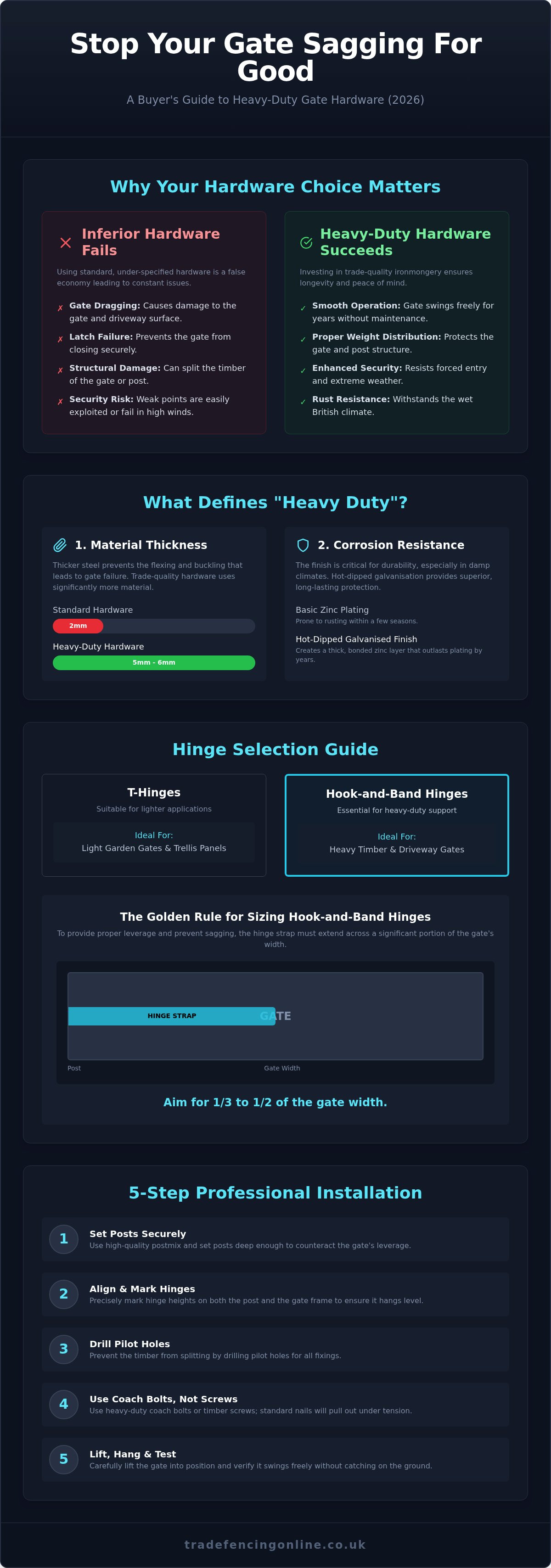
A large timber gate acts like a lever. It exerts constant downward force on the post and the hardware. Standard hinges often buckle under this tension. Understanding the mechanical principles of a hinge helps explain why weight distribution is critical. Heavy duty gate hinges and latches use thicker steel gauges and longer straps to spread the load across a larger surface area. This prevents the wood from splitting and keeps the gate leaf level. Heavy-duty hinges are essential structural components for any gate over 3ft wide.
When we define "heavy duty" in the context of ironmongery, we're talking about material thickness and industrial-grade galvanisation. Trade-quality hardware uses 5mm or 6mm steel rather than the flimsy 2mm versions found in budget kits. This strength is a security requirement. Weak latches are easy to bypass with a crowbar, but reinforced ironmongery resists forced entry and remains functional even in high-traffic areas. You need hardware that won't flex or snap under the weight of solid oak or pressure-treated softwood.
The Consequences of Using Under-Specified Hardware
Choosing cheap hardware is a false economy. Weak hinges cause the gate to drop, leading to ground-drag that ruins both your timber and your driveway surface. In the UK, high winds put immense pressure on gate leaves. If your latch isn't rated for the weight, it can snap or bend during a storm. This leaves your property exposed and your gate swinging uncontrollably. For homeowners in Essex and London, where weather can be unpredictable, trade-quality steel is a necessity to prevent long-term damage.
Selecting the Best Ironmongery for Your Fencing Project
Choosing the right heavy duty gate hinges and latches requires matching hardware to specific gate weights. In the coastal and urban environments of Essex and East London, rust is your primary enemy. Always specify hot-dipped galvanised finishes. This chemical process creates a thick zinc layer that outlasts standard zinc plating by years. For security, pair these hinges with a heavy-duty ring latch for pedestrian access or a pad-lockable Brenton bolt for driveway security. These bolts allow for a heavy padlock, creating a physical barrier that discourages intruders. Refer to our Essential Fencing Supplies Checklist to ensure you have all fixings before starting.
Choosing Between T-Hinges and Hook-and-Band Hinges
T-hinges are suitable for lighter garden gates or decorative trellis panels. However, heavy closeboard or driveway gates require hook-and-band hinges. These consist of a large metal strap and a separate pin bolted to the post. A reliable rule of thumb is that your heavy duty gate hinges and latches should reach at least one-third, and ideally half, of the way across the gate width. This provides the necessary leverage to prevent the timber from bowing. You can find these trade-quality components in our Driveway and Pedestrian Gates collection. Selecting the correct size ensures the weight is supported by the post rather than the gate frame.
If you aren't sure which hardware fits your timber, you can browse our full ironmongery range for detailed specifications.
Professional Installation and Sourcing Quality Hardware in Essex
Hanging a heavy gate requires precision to ensure long-term functionality. Follow this 5-step process for a professional finish. First, ensure your posts are set deep in the ground with high-quality postmix to counter the leverage of the gate leaf. Second, align your heavy duty gate hinges and latches by marking the heights on both the post and the gate frame. Third, always drill pilot holes. This prevents the timber from splitting when you drive in large fixings. Fourth, use coach bolts or heavy-duty timber screws. Standard nails will pull out under the constant tension and weight of a driveway gate. Finally, lift the gate into position and verify it swings freely without catching.
Sourcing your hardware from a local Romford supplier offers distinct advantages. You gain access to trade-level stock designed for the professional market, ensuring your project meets high standards. We provide fast local delivery across Essex and East London, allowing you to complete your installation without the delays often found with national retailers. This local expertise ensures you get the right heavy duty gate hinges and latches for your specific timber type and gate weight.
Maintenance Tips for Long-Lasting Gate Operation
Maintaining your ironmongery is straightforward but essential. Lubricate pivot points annually using heavy-duty grease to ensure a smooth, silent operation. Inspect all mounting bolts for signs of loosening caused by vibration or timber shrinkage. After severe winter storms, check your gate posts for any signs of movement or leaning. Romford Fencing Ltd offers a wide range of Fence Panels that pair perfectly with our professional-grade hardware for a complete, secure property solution.
Upgrade Your Property with Trade-Quality Ironmongery
Securing your property entrance starts with the right hardware. You now understand how trade-grade weight distribution prevents sagging and why hot-dipped galvanised finishes are essential for the Essex climate. Using professional fixings like coach bolts ensures your installation remains rigid for years. As a specialist supplier based in Romford, we provide the trade-quality materials required for maximum durability. We offer fast local delivery across East London and Essex to keep your project on schedule.
Build a gate that stands the test of time and operates smoothly in every season.
Frequently Asked Questions
What is the best hinge for a heavy 6ft timber gate?
Hook-and-band hinges are the superior choice for a heavy 6ft timber gate. These heavy duty gate hinges and latches provide maximum weight support by using a separate pin and strap mechanism. Ensure the strap covers at least half the gate's width to prevent the wood from warping. For 6ft heights, we recommend using three hinges to distribute the vertical load more effectively across the gate post.
How do I prevent my wooden gate from sagging over time?
Prevent sagging by installing adjustable hook-and-band hinges that allow you to realign the gate as the timber settles. Your gate must also have a diagonal brace running from the bottom hinge corner up to the top latch corner. This transfer of weight keeps the frame square. Always use heavy-duty coach bolts instead of standard screws to ensure hardware doesn't pull away from the post.
Are galvanised gate hinges better than powder-coated ones for UK weather?
Hot-dipped galvanised finishes are significantly better for the UK climate. While powder-coated hinges look attractive initially, the coating can chip and lead to rapid rusting. Galvanisation involves a chemical bond between zinc and steel that protects the metal even if it gets scratched. This is essential for properties in Essex and East London, where high moisture levels can quickly degrade inferior, non-trade metals.
Can I install heavy-duty latches on a standard garden gate?
You can install heavy-duty latches on standard gates if the timber frame is thick enough to accept the larger fixings. Using heavy duty gate hinges and latches on a lighter gate adds security and prevents the latch from snapping during high winds. Ensure the gate's weight remains balanced so the heavier ironmongery doesn't cause a thin garden gate frame to warp or tilt.