


Most garden fences fail because they weren't built for the British weather. A standard lap panel might save money today, but it won't survive a Romford winter or provide the total privacy your family expects. You need a boundary that stays upright when the wind picks up and remains rot-resistant for decades. We understand that choosing the right closeboard fence panels is about more than just aesthetics; it's about securing your property with trade-grade materials that last.
This guide explains why professionals prefer closeboard for its structural strength and how you can get these heavy-duty panels delivered across Essex and East London. You'll learn how to spot quality timber treatments, avoid common installation mistakes, and find competitive prices that don't compromise on durability. We'll show you how to achieve a professional finish without the usual project delays.
Key Takeaways
- Learn why the overlapping vertical construction of closeboard fence panels provides the structural integrity needed to survive harsh weather and high winds.
- Find the right panel sizes and specifications to fit your existing garden posts perfectly.
- Understand why trade-grade timber treatments and horizontal rails are essential so you don't face sagging or rot later.
- Discover how local Romford-based delivery ensures you receive heavy-duty materials quickly across Essex and East London.
Understanding Closeboard Fence Panels: Strength, Construction & Benefits
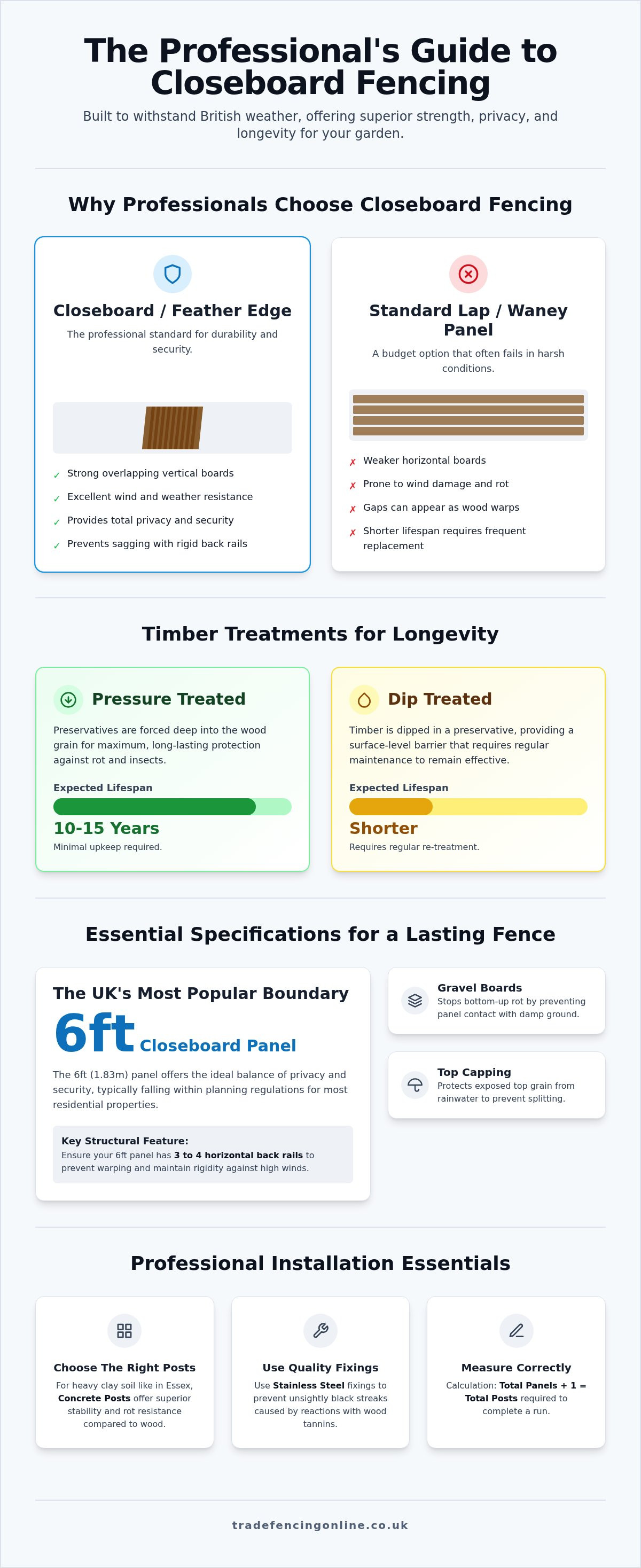
Closeboard fence panels, often called feather edge, are the professional standard for garden boundaries. These panels consist of vertical timber boards that overlap to create a solid, continuous wall. The design is purely functional. Vertical boards allow rainwater to run off quickly, while horizontal back rails create a rigid skeleton that prevents the structure from sagging. Because there aren't any gaps between the overlapping boards, these panels provide total privacy and enhanced security. Heavy-duty closeboard is built to last, offering a significantly longer lifespan than standard waney lap alternatives.
Feather Edge vs. Overlap: Why Professionals Choose Closeboard
Professionals prefer the "weatherboarding" effect of vertical slats. Water sheds efficiently down the boards rather than pooling in the horizontal grooves found on cheaper panels. The increased timber volume in closeboard fence panels provides much better wind resistance during storms. For gardens in exposed Essex locations, fully framed panels are essential to provide a complete perimeter of support that prevents boards from twisting. This structural integrity makes them the gold standard for long-term boundary security.
Timber Treatments: Dip vs. Pressure Treated
You must choose between two main treatment types for your timber. Golden-brown dip treatment offers an immediate barrier against rot but needs regular maintenance to stay effective. Green pressure treatment forces preservatives deep into the wood grain for maximum protection. Pressure-treated timber typically achieves a 10-15 year lifespan with very little upkeep. Always check your treatment type to ensure your investment survives the damp UK climate.
Choosing the Right Specifications for Your Garden Project
Standard closeboard fence panels usually come in 6ft (1.83m) widths to fit traditional UK post spacing. Heights range from 3ft for low-level boundaries up to 6ft for total rear garden privacy. If you're replacing existing sections, ensure your new panels are compatible with your current setup. Our panels fit standard slotted concrete or wooden posts perfectly. You can choose between natural timber finishes or traditional brown treatments to match your garden's aesthetic. These are heavy, trade-grade products. Always use two people for a safe installation to avoid injury or damage to the timber.
The 6ft Closeboard Panel: The UK's Most Popular Boundary
The 6ft height is the most common specification for residential boundaries. It offers the best balance of security and privacy while staying within standard planning regulations. Most UK properties don't require permission for a 2-meter fence, making a 6ft panel with a gravel board the ideal solution. Check our 6ft fence panels guide for more detail on height regulations. A sturdy 6ft panel must have three or four horizontal back rails to maintain its shape against the wind.
Essential Components: Gravel Boards and Capping
Adding the right accessories will double the life of your timber. Gravel boards are essential because they prevent the panel from touching the damp ground. This simple addition stops bottom-up rot before it starts. Don't overlook top capping either. It protects the exposed end grain at the top of each board from soaking up rainwater. Without it, the boards will split and warp much faster. You can order panels and matching accessories online to ensure everything arrives in one delivery.
Installation Essentials: Posts, Local Delivery & Trade Tips
Successful installation starts with accurate site preparation. Measure your perimeter in meters and divide by 1.83 to find the number of closeboard fence panels required. Always add one extra post to the total number of panels to complete the run. Professionals use stainless steel fixings for all timber-to-timber connections. Standard galvanised nails often react with the tannins in the wood, causing unsightly black streaks down your new fence over time. Stainless steel prevents this chemical reaction and maintains a clean finish on your closeboard fence panels.
Concrete vs. Wood: Which is Best for Essex Soil?
Essex is known for heavy clay soil that holds moisture and shifts during seasonal changes. While wooden posts offer a traditional look, concrete posts provide superior stability in these damp conditions. Concrete won't rot below the ground line, ensuring your boundary stays upright for decades. For a professional finish on complex garden layouts, always use dedicated corner and end posts. These specialized components ensure the panels are secured properly at every change of direction.
Fast Delivery in Romford, Essex, and East London
Getting heavy timber products to your site shouldn't cause project delays. We operate a physical yard in Romford (RM7), offering "yard-to-door" delivery that national DIY chains can't match. This local focus means we understand the logistical needs of Essex and East London customers. We provide trade-quality materials with fast turnaround times to keep your fencing project on schedule.
Secure Your Garden with Professional Grade Fencing
SHOP NOW: Heavy Duty Closeboard Fence Panels at TradeFencingOnline.co.uk
Your garden transformation starts with a secure perimeter. Order now to get your project moving and enjoy a fence built for the long term.
Frequently Asked Questions
How many years do closeboard fence panels last?
Closeboard fence panels usually last 15 years or more if you choose pressure-treated timber. This treatment protects the wood from rot and insect damage. Using gravel boards is essential to keep the timber away from wet soil. This prevents the bottom of the panel from soaking up moisture, which is the primary cause of premature rot in Essex gardens.
Can I fit closeboard panels into concrete H-posts?
You can easily fit our panels into standard concrete H-posts. Each panel is built to the standard 6ft (1.83m) width, so they slide directly into the post slots without modification. Always pair them with a concrete gravel board. This creates a solid foundation and keeps the timber dry, ensuring your installation remains stable and rot-free for years to come.
Do closeboard panels need painting?
Pressure-treated timber doesn't need painting to stay rot-resistant. The treatment provides all the protection the wood needs against the weather. You might still choose to use a UV-resistant stain if you want to stop the boards from turning silver over time. This maintenance is purely for aesthetics rather than structural integrity, but it does help the wood stay supple and look new.
Is a closeboard fence more wind-resistant than a lap fence?
Closeboard is much more wind-resistant than traditional lap fencing. The vertical orientation of the boards combined with heavy-duty horizontal back rails creates a rigid structure. This design doesn't catch the wind like a sail, making it less likely to blow down during a storm. It's the professional choice for exposed perimeters and high-wind areas across the Essex and London region.