


A solid garden fence should protect your boundary, not twist open and compromise your privacy after a few wet British months. If you are standing outside wondering why my wooden fence is warping, the problem usually stems from uneven moisture absorption and direct sun exposure. Watching panels cup, pull away from fixings, or pop right out of slotted posts is frustrating, especially when you expect outdoor timber to stay straight and secure.
The good news is that you can often correct the problem without replacing your entire boundary run. You will discover the exact reasons garden timber bows or twists, how to straighten panels using practical DIY bracing, and preventative installation methods that stop future distortion. Here is how to diagnose timber movement, salvage your boards, and secure long-term boundary stability.
Key Takeaways
- Understand why my wooden fence is warping by diagnosing how differential moisture absorption and direct sun exposure force timber to twist.
- Determine whether bowed boards can be straightened using timber bracing and coach screws or if structural damage demands panel replacement.
- Protect your boundary from ground damp by isolating timber panels with concrete or pressure-treated gravel boards.
- Ensure long-term stability by pairing heavy-duty closeboard panels with slotted concrete fence posts that accommodate natural seasonal movement.
Why Wooden Fence Panels Warp: Moisture Imbalance and Thermal Stress
Timber is a porous material that constantly absorbs and expels water to match surrounding humidity. If you find yourself asking why my wooden fence is warping, the core issue is uneven cellular movement. Wood shrinks and swells across its growth rings at different rates. When intense sun hits one side of a fence panel, moisture rapidly evaporates from that exposed face. The shaded reverse side stays damp and swollen. This differential drying creates severe internal tension, pulling the board toward the drier face. Rigid installation makes it worse; overtight fixings leave zero tolerance for thermal expansion, forcing boards to buckle outward.
The Four Main Types of Timber Distortion in Fences
Timber movement usually presents as one of four distinct physical shapes:
- Cupping: Board edges curl inward across the face, forming a hollow trough down the centre.
- Bowing: The board bends along its length from end to end, lifting off the support rails.
- Crooking: The timber curves sideways along its narrow edge, disrupting alignment with adjacent slats.
- Twisting: The board spirals along its length, lifting opposite corners out of alignment.
Low-grade, unseasoned timber installed wet will distort rapidly as it dries down to the UK outdoor equilibrium of 14% to 20% moisture content. Additionally, raw, unsealed bottom end-grains act like sponges, wicking standing ground water upward into the slats. Installing pressure-treated closeboard fence panels built from heavy-gauge timber significantly reduces these structural failures compared to standard waney-lap panels.
Need durable, warp-resistant fencing built for British weather?
SHOP NOWHow to Fix a Warped Fence: Straightening vs Replacement Decision Guide
Before picking up tools, evaluate the severity of the distortion. If you are asking why my wooden fence is warping only to find decayed posts or snapped arris rails, straightening individual boards won't solve the issue. Framework problems require structural repairs. However, if your posts stand true and the timber remains sound without extensive splits, you can mechanically correct surface movement. When timber fibres shear apart or thin slats crack completely, installing new pressure-treated fence panels is the most practical path forward.
Step-by-Step Method to Straighten Bowed Fence Boards
Salvage moderately warped timber using this direct bracing process:
- Relieve fastener tension: Back out overtightened screws or pull smooth nails that lock tension into the curved board.
- Moisten the timber: Lightly dampen the concave face of the board with water to relax dry wood grain.
- Clamp into position: Use clamps to pull the board tight against a straight timber batten or arris rail.
- Anchor permanently: Drive exterior-grade coach screws or ring-shank nails through the board into the supporting framework.
- Add vertical bracing: Screw an extra vertical timber batten across the panel rear to lock the run rigid.
For boundaries where multiple slats have warped past recovery, upgrade to robust trade fencing supplies built to resist British weather.
Upgrade your boundary with heavy-duty replacement panels and hardware
SHOP NOW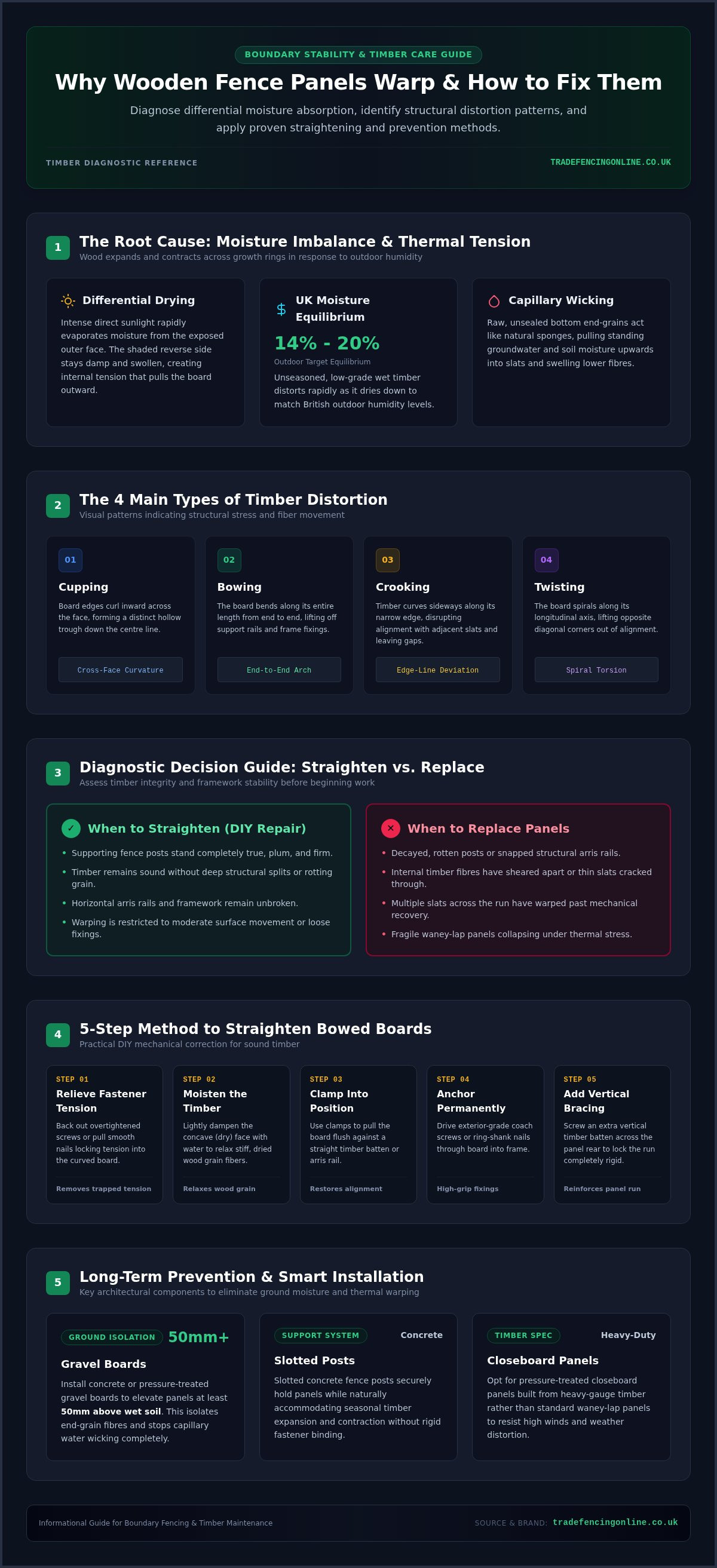
Preventing Warped Fencing: Smart Installation, Ground Clearance, and Timber Selection
Ground contact ruins timber faster than surface rain. Preventative installation is the definitive answer if you never want to ask why my wooden fence is warping again. Fitting concrete or pressure-treated gravel boards establishes a vital physical barrier, elevating timber panels at least 50mm above wet soil and pooling grass water. This isolates end-grain fibres and stops capillary wicking completely.
Pairing these boards with slotted concrete fence posts ensures long-term stability. Panels slide directly into the channels, allowing the wood to expand and contract freely across changing seasons without binding against rigid fixings. To maintain moisture balance, treat both faces of your timber simultaneously with a penetrating preservative so atmospheric water evaporates evenly from front to back.
Choosing Robust Timber Styles: Closeboard vs Standard Lap Panels
Panel specification directly dictates structural longevity. Thin waney-lap panels distort easily under hot summer sun because their thin slats lack substantial bracing. Heavy-duty closeboard fence panels use thick, overlapping vertical feather edge boards secured across robust horizontal backing rails. This design resists lateral bending and prevents wind pressure from curling the timber.
Foundation integrity is equally vital. Always anchor fence posts firmly with quality post mix to maintain a plumb, upright boundary. Leaning or shifting posts impart continuous rotational torque onto attached panels, twisting otherwise straight timber over time.
Get trade-grade panels, concrete posts, and gravel boards delivered fast
SHOP NOWSecure Your Boundary with Warp-Resistant Fencing
Stopping timber distortion comes down to proper ground isolation and choosing heavy-duty materials built for the job. Once you understand why my wooden fence is warping, the permanent fix is straightforward. Upgrade from fragile lap slats to pressure-treated closeboard panels, mount them into slotted concrete posts, and install gravel boards to block rising soil damp. Romford Fencing Ltd stocks complete runs of weather-resilient timber and concrete components, supported by fast local delivery across Essex and East London directly from our Romford depot.
With trade-grade materials installed correctly, your garden boundary will remain straight, private, and secure through every wet winter and baking summer.
Frequently Asked Questions
Can you straighten a warped wooden fence panel without removing it?
Yes, you can straighten moderately bowed fence boards without taking the whole panel down if the framing remains sound. Loosen bound fasteners, use clamps to pull the timber flush against an arris rail or added vertical batten, and drive exterior-grade coach screws through the face. If internal framing has cracked or individual slats have split along the grain, replacing the panel is the only lasting fix.
Why do new fence panels start warping shortly after installation?
New panels warp quickly when unseasoned, high-moisture timber dries out unevenly in the open air. If you wonder why my wooden fence is warping within weeks of going up, rapid evaporation is usually responsible. Freshly treated timber contains high internal moisture. Direct sun bakes the exterior face while the back stays damp, shrinking outer wood fibres and twisting the boards before they reach equilibrium.
Does pressure-treated timber warp in hot UK summer weather?
Yes, pressure-treated timber can still warp during intense heatwaves. Preservative treatments protect wood against rot and insect attack, but they don't make timber waterproof. High summer temperatures draw moisture out of the sun-facing side two to three times faster than shaded backs. This intense differential drying shrinks the front face rapidly, forcing the panel to cup or bow despite the chemical treatment.
How much gap should be left between wooden fence panels and the ground?
Keep wooden fence panels at least 50mm (2 inches) above finished ground level. Leaving timber slats in direct contact with wet soil or turf accelerates why my wooden fence is warping by drawing ground moisture up into the lower end-grain. Fit a 150mm concrete or UC4 pressure-treated gravel board underneath the panel to bridge the gap, block soil contact, and protect boundary stability.