


When planning a new garden fence, the choice of post is just as crucial as the panels themselves. While timber is a common choice, it comes with the inevitable hassle of rot, warping, and regular maintenance. You might be wondering if the higher initial cost and extra weight of concrete fence posts are truly worth it, or if they'll simply look too industrial for your garden. The truth is, these initial concerns are often outweighed by decades of reliability and zero upkeep.
Steel-reinforced concrete posts are the ultimate long-term investment for a strong, secure boundary. They offer a 'fit and forget' solution that stands firm against the worst of the British weather, providing unmatched durability that timber simply cannot match. This guide will show you exactly why they are the most cost-effective choice over time. We'll break down the key benefits, explain the difference between intermediate, corner, and end posts, and help you choose the correct size for your fence panels. Get ready to feel confident in building a fence that is made to last.
Key Takeaways
- Learn why concrete posts are a 'fit and forget' solution, outlasting timber and saving you money on future replacements.
- Recognise the key components of a concrete fencing system to ensure you order the correct posts for a professional finish.
- Discover how to spot the difference between high-quality concrete fence posts and inferior products to guarantee maximum strength.
- Avoid common installation mistakes by using a simple rule to calculate the correct post length for your specific fence height.
Unmatched Durability: Why Concrete Posts Outlast Timber
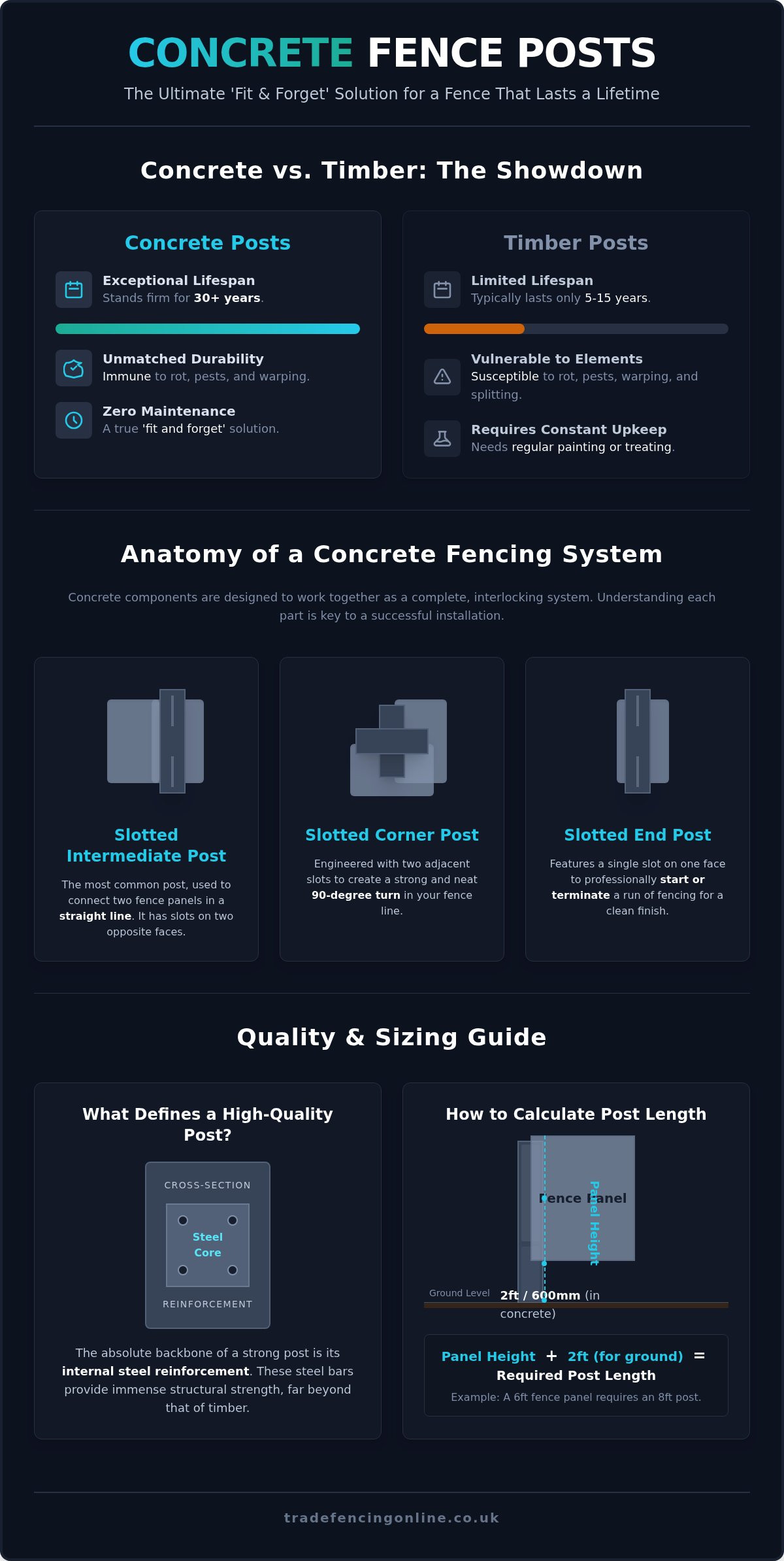
When installing a new fence, you want a solution that lasts. Concrete fence posts are the definitive 'fit and forget' option, engineered to provide decades of reliable service. While a standard timber post may last 5-15 years before succumbing to the elements, a concrete post can stand firm for 30 years or more. This exceptional longevity is down to its fundamental material and construction, making it a superior long-term investment that eliminates the cost and hassle of future replacements.
Immunity to Rot and Pests
The primary weakness of any timber post is its vulnerability to moisture and insects at ground level. Concrete is completely impervious to these threats. It will not absorb water, preventing the ground-line rot that inevitably causes wooden posts to fail. Furthermore, pests like termites and woodworm simply cannot damage it. This inherent resilience means concrete posts require no chemical treatments or preservatives to maintain their integrity, offering a robust and maintenance-free foundation for your fence panels.
Superior Strength and Weather Resistance
Our concrete fence posts are manufactured with steel reinforcing bars running through their core. This is achieved through a manufacturing process known as Precast concrete, which provides immense structural strength far beyond that of timber. This reinforcement allows them to withstand high winds and the harshest UK weather conditions without failing. Unlike wood, concrete will not warp in the sun, split during a frost, or weaken after years of exposure to rain, ensuring your fence line remains straight and secure for its entire lifespan.
A Truly Low-Maintenance Fencing Solution
The ongoing upkeep of wooden posts is a hidden cost. They require regular painting, staining, or sealing every few years to protect them from the weather and prolong their life. Concrete requires zero maintenance. Once installed, there is no need to spend time or money on treatments. If treating a fence costs £40 in materials and a full day of work every three years, you could save over £250 and an entire week of your time over a 20-year period. Choosing concrete is a practical decision that pays for itself in saved time and money.
The Anatomy of a Concrete Fencing System
Unlike standalone wooden posts, concrete fencing components are designed to work together as a complete system. This interlocking design ensures a strong, uniform, and professional finish that lasts for decades. Understanding the role of each component is essential for planning your project and ordering the correct materials. The strength of your new fence relies on using the correct concrete fence posts for each part of the boundary line.
For most domestic fencing projects, you will need a combination of three main types of slotted posts.
Slotted Intermediate Posts
This is the most common post and will form the bulk of your order. An Intermediate Post has two slots running down its opposite faces. Its purpose is to connect two fence panels in a straight line, with one panel sliding into each slot. You will need one intermediate post for every straight section between two panels, providing continuous strength and support along the entire length of your fence.
Slotted Corner Posts
As the name suggests, a Corner Post is specifically engineered to create a clean 90-degree turn in your fence line. Instead of being on opposite sides, the two slots are adjacent to each other, forming an 'L' shape. This allows two fence panels to meet securely at a right angle. Using a dedicated corner post is critical for maintaining the structural integrity and achieving a neat, professional look at every turn.
Slotted End Posts
A Slotted End Post is used to start or terminate a run of fencing. It features a single slot on one face, providing a secure and tidy finish. These posts are essential when your fence meets a solid structure like a house wall, a garage, or when it finishes next to a garden gate. It ensures the final panel is held firmly in place without leaving an empty, exposed slot.
By planning your layout and counting the required number of intermediate, corner, and end posts, you can ensure a smooth installation. When combined with concrete gravel boards, these concrete fence posts create a complete, rot-proof foundation for your garden boundary.
What Defines a High-Quality Concrete Post?
When choosing components for your new fence, it is crucial to understand that not all concrete posts are created equal. A lower price often indicates a compromise on materials or manufacturing, which can lead to premature failure and costly future repairs. To ensure your fence stands strong for decades, you must look beyond the initial cost. Knowing what defines a high-quality product empowers you to invest wisely in a durable, long-lasting boundary.
As a trusted supplier of fencing materials, we believe an informed customer is a satisfied one. Here are the key features to look for:
Steel Reinforcement: The Backbone of Strength
The absolute backbone of a strong post is its internal steel reinforcement. Quality concrete fence posts have steel bars (rebar) cast inside during manufacturing. Concrete is exceptionally strong under compression but can be brittle when subjected to bending forces, such as high winds or accidental impact. The embedded steel provides the necessary tensile strength, allowing the post to flex and resist snapping. For a secure and lasting fence, never compromise on this feature; always choose steel-reinforced posts.
Wet-Cast Manufacturing for a Superior Finish
The production method directly impacts strength and finish. We supply superior wet-cast concrete posts, which are made using a more fluid concrete mix. This technique produces a denser, stronger, and less porous product that is highly resistant to water ingress and frost damage. The result is not only a more durable post but also one with a smoother, more attractive finish. This stands in sharp contrast to inferior dry-cast methods, which often yield a rougher, more brittle post.
Consistent Sizing and a Smooth Slot
Precision is a hallmark of quality. A well-made post will have consistent, uniform dimensions, ensuring a perfect fit for your fence panels and gravel boards. This makes the installation process significantly faster and more straightforward. Equally important is the finish of the slot itself. A smooth, clean slot allows panels to slide in without being scraped or damaged, protecting their treatment and appearance. Investing in quality posts ensures a professional result. At Romford Fencing Ltd, we are committed to supplying high-quality, steel-reinforced concrete posts that meet these exacting standards.
Sizing and Installation Planning
Correct planning is the foundation of a successful fencing project. Before you order materials, it is essential to calculate the correct post lengths and understand how the components work together. This ensures a strong, level, and long-lasting installation without costly mistakes or delays.
How to Calculate the Correct Post Length
To ensure your fence is secure, a portion of the post must be set underground in concrete. The standard rule is to allow an extra 2ft (600mm) on the total height of your fence. Use this simple formula:
Fence Panel Height + Gravel Board Height + 2ft (600mm) = Required Post Length
This 2ft allowance provides the necessary depth for a solid foundation using post mix, anchoring your fence firmly against wind and ground movement. Below are two common examples:
| Component | Example 1: 5ft Fence | Example 2: 6ft Fence |
|---|---|---|
| Fence Panel Height | 5ft (1.5m) | 6ft (1.8m) |
| Gravel Board Height | 1ft (300mm) | 1ft (300mm) |
| Depth in Ground | 2ft (600mm) | 2ft (600mm) |
| Total Post Length | 8ft (2.4m) | 9ft (2.7m) |
Compatibility with Panels and Gravel Boards
Our slotted concrete fence posts are manufactured to industry standards. They are designed to work seamlessly with standard 6ft (1.83m) wide fence panels. The system is simple: a concrete or timber gravel board slides into the bottom of the slot, and the fence panel fits directly on top. This modular design not only provides a clean finish but also makes future maintenance straightforward. If a single panel gets damaged, it can be lifted out and replaced without disturbing the rest of the fence.
Securing Your Posts: The Role of Post Mix
A fence is only as strong as its foundation. Every post, whether concrete or timber, must be set in a solid concrete base. For fast and efficient installation, we recommend using a rapid-setting product like Postcrete. Simply dig the hole to the correct depth, position the post, and add the mix and water as instructed. This step is critical for creating a rigid, durable fence that will stand for years to come. Do not cut corners on the foundation.
For a complete range of quality fencing supplies, including posts, panels, and post mix, visit tradefencingonline.co.uk today.
The Final Verdict: Invest in a Fence That Lasts
When building a boundary designed to stand the test of time, the evidence is clear. Concrete posts decisively outperform timber, offering unmatched durability against rot, moisture, and pests. This means a low-maintenance, long-term solution that saves you money and effort over its extended lifespan. Choosing a quality, steel-reinforced post is the most critical step in creating a robust fencing system, providing the structural integrity needed to support your panels through any weather conditions the UK seasons can throw at it.
Ready to make a smart investment in your property? Trade Fencing Online is your trusted supplier for professional-grade fencing materials. All our concrete fence posts are steel-reinforced for maximum strength, guaranteeing a secure and stable foundation for your project. We make getting the job done easy with fast local delivery across Essex and East London. Shop our full range of quality concrete fence posts and secure your perimeter with confidence.
Frequently Asked Questions About Concrete Fence Posts
Are concrete fence posts more expensive than wooden ones?
Yes, the initial purchase price for concrete posts is higher than for standard timber posts. However, they represent better long-term value. Wooden posts require regular treatment and will eventually rot, needing replacement. Concrete posts are a fit-and-forget solution with an exceptional lifespan, saving you money on maintenance and replacement costs over the years. They are a durable, cost-effective investment for any quality fencing project.
Will concrete posts crack in frost or extreme weather?
Quality concrete posts are manufactured to be extremely resilient and can withstand typical UK weather, including frost. They are steel-reinforced for superior strength. Cracking is very rare and is usually caused by improper installation allowing water to pool and freeze, or from a pre-existing manufacturing defect. When installed correctly with proper drainage, they provide a reliable, weather-proof foundation for your fence for decades.
Can you paint concrete fence posts to match your garden design?
Yes, you can paint concrete posts to suit your garden's aesthetic. For the best and most durable finish, use a quality exterior masonry paint. Ensure the post surface is clean, dry, and free from any dirt or algae before you begin painting. This simple preparation will help the paint adhere properly and provide a long-lasting, professional look that complements your fence panels and garden design.
How heavy are concrete fence posts and can I install them myself?
Concrete posts are significantly heavier than wood. For example, a standard 8ft (2.4m) slotted concrete post can weigh over 45kg. Due to this weight, installation should always be considered a two-person job to ensure safety and correct handling. While a competent DIYer can undertake the installation, it is physically demanding. Always use correct lifting techniques to avoid injury when handling these heavy items.
How do you attach fence panels to concrete posts?
Attaching panels is a simple and efficient process. Our slotted concrete fence posts are designed with a groove running down the length of the post. You simply slide your gravel board and fence panel down into this slot. No brackets, nails, or screws are required. This design not only makes for a fast and secure installation but also allows for easy replacement of individual panels if one becomes damaged in the future.
What is a concrete repair spur and when would I need one?
A concrete repair spur is a cost-effective solution for fixing wooden fence posts that have rotted or broken at ground level. Instead of digging out the entire post and concrete footing, you bolt the spur to the sound section of the existing wooden post. The spur is then set in fresh concrete, creating a new, solid foundation. This is a quick and strong repair that saves you the time and expense of a full post replacement.