


Choosing the right fence post is a critical decision. Select a post that’s too small, and you risk your new fence failing at the first sign of a strong wind. Choose one that’s too large, and you could be overspending on materials you simply don't need. This is the central debate when comparing a standard 3x3 post against the more robust 4x4 fence post. Is the extra size and cost of a 4x4 really necessary for your project, or is it overkill?
This straightforward guide removes the guesswork. We provide a direct comparison of 3x3 (75mm x 75mm) and 4x4 (100mm x 100mm) posts, covering the crucial differences in strength, stability, and overall cost. You will learn exactly which post is suitable for different fence heights and panel types, especially in typical UK weather conditions. By the end, you will have the confidence to select the correct components for your project, ensuring you build a quality fence that is secure, long-lasting, and cost-effective.
Understanding the Basics: What is a 4x4 Fence Post?
The 4x4 fence post is the undisputed industry standard for domestic garden fencing projects across the UK. It provides the essential strength and stability required to build a durable, long-lasting boundary. While referred to as a "4x4," this is its nominal size in inches. The actual finished size is typically closer to 100mm x 100mm, a standard metric measurement used in the timber trade.
Manufactured from rough-sawn timber, these posts offer an excellent combination of structural integrity and value. The rough finish also helps the wood preservative penetrate deeper, enhancing its lifespan. As the essential vertical support for many different types of fences, its treatment is paramount. For any section intended for ground contact, a UC4 pressure treatment is vital. This industrial process forces preservatives deep into the timber, providing robust protection against rot and insect attack, which is critical for the part of the post buried in the ground.
Key Features of a 4x4 Post
A quality 4x4 timber post is the foundation of a reliable fence, offering several key advantages for homeowners and trade professionals:
- Excellent Strength: Provides more than enough rigidity and support for standard domestic fence heights, typically up to 1.8m (6ft).
- Versatile Application: Suitable for use with almost all types of fence panels, from heavy-duty closeboard and tongue & groove to lighter decorative and picket panels.
- Robust Aesthetic: The substantial 100mm profile gives the entire fence line a solid, secure, and professional appearance.
- Proven Durability: A correctly installed, UC4-treated 4x4 fence post is the benchmark for a domestic fence designed to withstand the elements for years.
When is a 4x4 Post the Right Choice?
This post is the go-to choice for most standard fencing jobs. We recommend specifying a 4x4 post in the following common scenarios:
- For erecting standard 1.8m (6ft) high garden fence panels.
- When installing heavy-duty panels, such as closeboard or featheredge, that carry significant weight.
- In gardens or locations that are exposed to high winds, where extra stability is required.
- For hanging standard-sized garden gates, providing a solid anchor point for hinges and latches.
The Alternative: When to Use a 3x3 Fence Post
While the 4x4 fence post is the industry standard for most boundary fencing, there are situations where a 3x3 post is a practical and cost-effective alternative. A 3x3 post (with an actual size of approximately 75mm x 75mm) is a lighter-duty option designed for lower-stress applications where the robust strength of a larger post is not required. Understanding its specific strengths and limitations is key to a successful project.
Choosing a 3x3 post for the right job can offer significant savings and easier installation. However, it is not a direct substitute for a 4x4 post in high-stress or tall fencing projects.
Key Features of a 3x3 Post
The main advantages of using a 75mm x 75mm post are related to cost, handling, and aesthetics for specific applications:
- Lower Cost: A lower price per post can significantly reduce the overall budget for your fencing project, especially over longer runs.
- Easier Handling: Being lighter and more manageable, these posts are easier to transport and install, potentially saving time and labour.
- Subtle Appearance: The slimmer profile is less imposing, making it an excellent choice for decorative fencing or low-level garden boundaries where you want the panels to be the main feature.
- Sufficient Strength: For the correct application, a 3x3 post provides all the structural support needed for a durable and effective fence.
Best Use Cases for a 3x3 Post
To ensure long-term performance, 3x3 posts should only be used in appropriate scenarios. They are the ideal choice for:
- Low-Level Fencing: Perfect for front gardens or boundary fences up to a maximum height of 1.2m (4ft).
- Lightweight Panels: Supporting lighter panels like picket fencing, chain-link, or open-design trellis that do not catch the wind.
- Garden Partitions: Creating decorative borders, zoning off vegetable patches, or building internal garden screens.
- Sheltered Locations: Fencing in areas protected from strong winds, where the lateral load on the fence will be minimal.
For any fence taller than 1.2m, or for those using heavy panels like closeboard, a 4x4 fence post is essential for stability and longevity. This is supported by official guidance in many areas; for example, the City of Beaverton fence requirements specify 4x4 posts as the minimum for fences over 6 feet tall, underlining their critical role in structural integrity. Always select the post that matches the demands of your project.
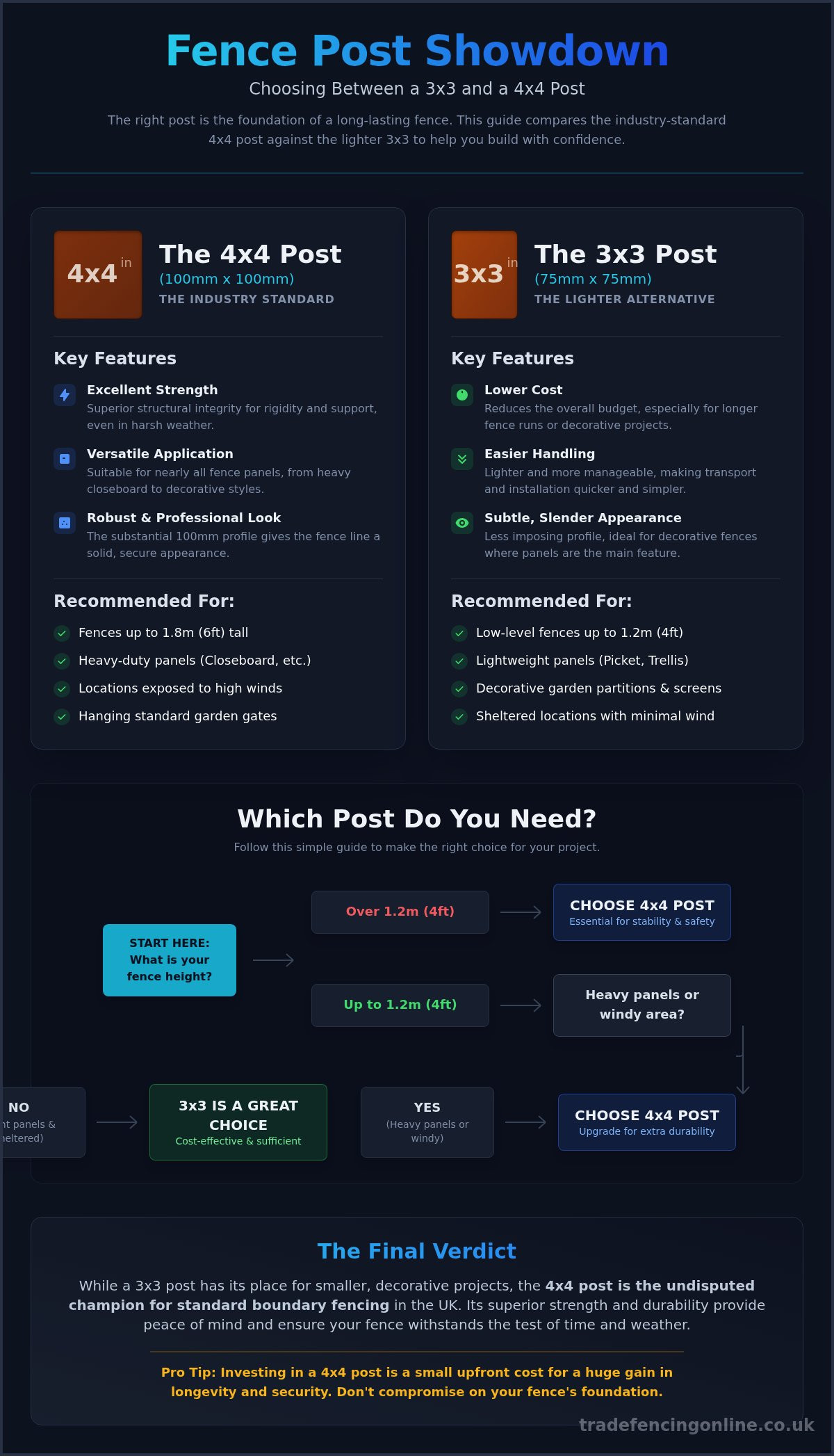
Head-to-Head: 4x4 vs 3x3 Fence Post Comparison
Choosing between a 3x3 (75mm) and a 4x4 (100mm) fence post is a critical decision. While the initial cost saving of a 3x3 post can be tempting, it is vital to understand the trade-offs in strength, longevity, and overall project security. For most standard UK boundary fences, the choice is clear.
Strength and Durability
A 4x4 post contains significantly more timber than a 3x3 post, giving it superior structural integrity. This added mass is crucial for resisting the primary forces a fence endures: bending from wind load and the weight of the panels themselves. A standard 6ft fence panel acts like a sail in high winds, and a 3x3 post is simply not robust enough to handle that pressure over time, often leading to warping or snapping. While UK regulations differ, even international standards like the NYC Building Code fence requirements emphasize using sturdy posts for fence height and safety, underscoring the universal need for correct material selection.
Cost vs. Long-Term Value
There is no question that 3x3 posts have a lower initial purchase price. However, this is a short-term saving that can lead to significant long-term costs. The extra few pounds for a 4x4 fence post should be viewed as an investment in the stability and lifespan of your entire fence. Upgrading from 3x3 to 4x4 posts often adds less than 10% to the total project cost but can double the life of your fence, saving you the much larger expense of replacing snapped posts and damaged panels after the first major storm.
Recommended Panel Pairings
The weight and height of your chosen fence panel are the most critical factors when selecting a post. Matching the post to the panel is essential for a secure and lasting installation.
- 4x4 Posts: The professional standard for heavy panels. Ideal for 5ft and 6ft Closeboard, Lap Panels, and substantial Slatted Panels. Their strength is necessary to support the weight and withstand the wind load on these larger surfaces.
- 3x3 Posts: Best reserved for lightweight, decorative applications. Use them for 3ft to 4ft Picket Panels, garden Trellis, or low-level decorative screens where panel weight and wind exposure are minimal.
For a durable boundary fence that provides security and privacy, the 4x4 post is the correct choice, offering unmatched value and peace of mind. Explore our full range of quality treated timber posts to find the right solution for your project.
Installation and Practical Considerations
Correct installation is the key to a durable and professional-looking fence. While a quality 4x4 fence post provides the strength, securing it properly ensures it will stand firm for years. This section covers the essential calculations and materials you will need to get the job done right.
Calculating Post Length
A common mistake is buying a post that matches the height of your fence panel. For a stable fence, a significant portion of the post must be buried underground. The industry standard is to bury at least 600mm (2ft) of the post.
- For a 6ft (1.8m) high fence, you will need an 8ft (2.4m) post.
- For a 4ft (1.2m) high fence, you will need a 6ft (1.8m) post.
Always add a minimum of 600mm to your desired finished fence height to determine the correct post length to purchase.
Digging and Securing Your Posts
The size of your post dictates the size of the hole and the amount of concrete required. A larger post demands a wider and deeper foundation for maximum stability.
A standard 4x4 fence post (100mm x 100mm) requires a hole that is approximately 300mm x 300mm (12" x 12"). This larger footing typically requires between 1.5 and 2 bags of postmix per post to secure it properly.
In comparison, a smaller 3x3 post (75mm x 75mm) can be set in a slightly smaller hole of around 225mm x 225mm (9" x 9"), usually requiring just one bag of postmix.
Hardware and Fixings
Ensure your chosen hardware is compatible with your posts. Most standard fence panel clips, U-brackets, and bolt-down supports are designed to fit the dimensions of a 4x4 post, making it a versatile and widely supported option.
However, always check the specifications of your fixings before purchase to guarantee a perfect fit and a secure installation. Using the wrong size bracket can compromise the strength of your fence line. For a complete solution, shop our full range of quality fence posts and fixings.
Choosing Your Fence Posts: The Final Verdict
Selecting the correct post size is crucial for a secure and durable fence. The key takeaway is simple: for most standard garden fences, especially those over 5ft tall, the superior strength of a 4x4 fence post makes it the professional's choice. While 3x3 posts offer a practical solution for shorter fences or lightweight panels, investing in the right foundation ensures your project stands strong for years to come.
At Trade Fencing Online, we provide the quality materials you need to get the job done right. All our timber posts are Pressure Treated (UC4) to guarantee longevity and resistance against rot. As a trusted supplier with 5-star reviews, we are committed to providing exceptional value and service, including fast local delivery across Essex and London. Ready to start your project? Browse our quality 4x4 and 3x3 timber fence posts now.
Build with confidence, knowing you have the best materials for the job.
Frequently Asked Questions About 4x4 Fence Posts
Can I use 3x3 fence posts for a 6ft fence?
We do not recommend using 3x3 inch posts for a 6ft (1.8m) fence. Posts of this size lack the strength to support the height and weight of the panels, especially in high winds. They are prone to warping and snapping under pressure. For a durable and secure 6ft fence, the industry standard is a 4x4 inch (100mm) post. This provides the necessary structural integrity for a long-lasting boundary that you can depend on.
How far apart should I space my 4x4 fence posts?
Standard UK fence panels are 6ft (1.83m) wide, so your posts should be set at 1.83m centres to ensure the panel fits correctly. If you are constructing a traditional closeboard fence with rails, a post spacing of up to 2.4m is acceptable. However, for maximum strength and to prevent sagging over time, we advise keeping the distance between posts to a minimum, particularly in areas exposed to strong winds.
Are 4x4 posts strong enough for a garden gate?
Yes, a 4x4 post is strong enough for most standard garden gates up to 3ft (0.9m) wide. It is essential that the hanging post, which bears the gate's weight, is set deeper in concrete than a standard line post for extra stability. For heavier or wider gates, we recommend upgrading to a 5x5 or 6x6 inch post to prevent sagging and ensure smooth, reliable operation for years to come.
What is the difference between a rough sawn and a planed fence post?
A rough sawn post has a coarse, textured finish directly from the mill and is the most common, cost-effective choice for garden fencing. A planed post (or PSE - Planed Square Edge) is machined to create a smooth, uniform surface on all sides. Planed posts provide a more contemporary and decorative finish, making them ideal for premium fencing projects where appearance is a key factor. They are typically sold at a higher price point.
Should I use wooden or concrete posts for my fence?
The choice depends on your budget, desired look, and installation preference. Concrete posts offer maximum longevity and are immune to rot and insect damage. However, they are heavy and more difficult to install. A quality pressure-treated 4x4 fence post provides a classic, natural aesthetic and is easier to handle and fit. Modern treatments ensure excellent durability, offering a reliable and traditional alternative to concrete.
How many bags of postcrete do I need for a 4x4 fence post?
For a standard 4x4 fence post, one 20kg bag of postcrete is usually sufficient. This is based on digging a hole that is three times the width of the post and to the correct depth (typically 2ft or 600mm for a 6ft fence). For terminal posts, corner posts, or gate posts that require greater stability, using one and a half to two bags is recommended to create a stronger, more robust foundation.