


A new fence is a significant investment in your property. The last thing you want is for your quality panels to rot prematurely from contact with damp ground. This is the single biggest cause of fence failure, but it is easily preventable. The solution is a simple, effective component that professionals always use: gravel boards. They act as a protective barrier, lifting your fence panels away from the moisture and decay that lurks in the soil, saving you money on future repairs.
But are they just an unnecessary upsell from your fencer? How do you choose between wood and concrete? And what size is right for your project? This straightforward guide provides the answers. We will explain exactly what gravel boards are, why they are essential for prolonging the life of your fence, and how to select the correct type and size. Get the information you need to protect your investment and ensure your fence stands strong for years to come.
Key Takeaways
- A gravel board is the most effective way to protect your fence panels from premature rot and moisture damage caused by ground contact.
- Learn the key differences between concrete and wooden options to decide which offers the best long-term value and durability for your project.
- Understand how gravel boards are sized to match standard fence panels, making your selection process straightforward and error-free.
- Discover the basic principles of installation and see how this essential component fits into a complete, professional fencing system.
What is a Gravel Board? The Ultimate Fence Protector
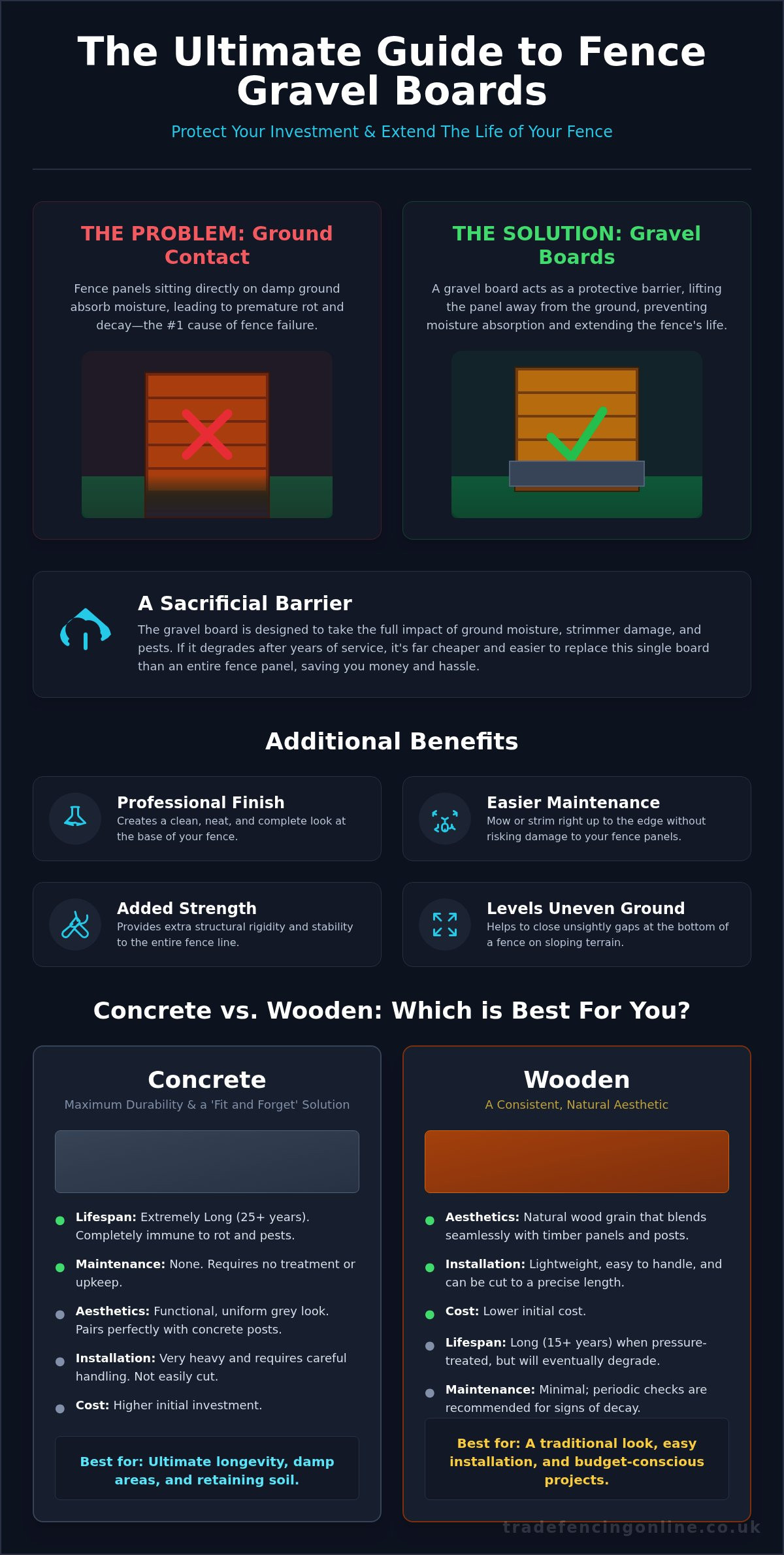
In simple terms, a gravel board is a protective barrier fitted between the bottom of your fence panel and the ground. Its primary job is to solve the biggest problem facing any timber fence: rot caused by ground contact. Think of it as the foundation for your fence panel, lifting it away from the constant damp, soil, and garden debris that will otherwise destroy it over time. Investing in quality gravel boards is a small cost that protects the much larger investment of your entire fence.
The #1 Enemy of Fencing: Ground-Level Moisture and Rot
The main cause of premature fence failure is rot. When timber panels sit directly on damp ground, moisture is absorbed into the wood, causing the fibres to break down and decay. This process is accelerated by rain 'splashback' from hard surfaces like paths or patios. For a general overview of fence construction, it's clear that preventing this ground contact is critical. A gravel board also acts as a physical deterrent, stopping pests from burrowing underneath your fence line.
How a Gravel Board Provides a Sacrificial Barrier
A gravel board is designed to be a sacrificial, replaceable component. It takes the full impact of ground-level moisture, strimmer damage, and soil contact. Should it eventually degrade after years of service, it is far easier and cheaper to replace a single board than an entire fence panel. This simple function dramatically extends the operational life of your fencing, saving you significant money and hassle in the long run.
Additional Benefits of Using Gravel Boards
Beyond preventing rot, installing gravel boards offers several practical advantages that enhance both the look and function of your fencing:
- Professional Finish: It creates a clean, neat, and complete look to the base of your fence.
- Easier Maintenance: You can strim or mow right up to the edge without damaging your fence panels.
- Added Strength: It provides extra structural rigidity and stability to the entire fence structure.
- Levels Uneven Ground: A gravel board can help to close gaps at the bottom of a fence on slightly sloping or uneven terrain.
Concrete vs. Wooden Gravel Boards: Which is Best for You?
When installing a new fence, the most common choice you will face is the material for your gravel boards. The two primary options are steel-reinforced concrete and pressure-treated timber. Both provide an essential barrier between your fence panels and the damp ground, but they cater to different priorities in terms of longevity, aesthetics, and installation. This straightforward guide will help you make the right decision for your project.
The Case for Concrete Gravel Boards
For maximum durability and a 'fit and forget' solution, concrete is the superior choice. These steel-reinforced boards are completely immune to rot, moisture, and insect damage. They will not warp or decay over time, making them a maintenance-free component of your fence. Concrete gravel boards are the ideal partner for slotted concrete posts, creating an incredibly strong and long-lasting fencing system. They are the perfect solution for areas with very damp ground or where the fence needs to retain soil.
The Case for Wooden Gravel Boards
If a consistent, natural aesthetic is your priority, timber is the clear winner. A wooden gravel board blends seamlessly with timber fence panels and wooden posts, creating a uniform and traditional look. They are significantly lighter and easier to handle than concrete, and can be easily cut to a precise length if required. It is essential that you only use pressure-treated timber. This industrial treatment protects the wood from the fungi and insects that cause decay, as explained by the science behind wood decay, ensuring a long service life.
Quick Comparison: Concrete vs. Wood
Use this table for an at-a-glance summary of the key differences.
| Feature | Concrete Gravel Board | Wooden Gravel Board |
|---|---|---|
| Lifespan | Extremely Long (25+ years) | Long (15+ years when treated) |
| Cost | Higher initial cost | Lower initial cost |
| Maintenance | None | Minimal; periodic checks recommended |
| Aesthetics | Functional, uniform grey | Natural wood grain, consistent look |
| Ease of Installation | Heavy, requires careful handling | Lightweight, easy to handle and cut |
Ready to make a choice? We stock a complete selection of high-quality options to suit any fencing project. Browse our full range of gravel boards online.
How to Choose the Right Size Gravel Board for Your Project
Selecting the correct gravel board for your fencing project is straightforward. Sizes are standardised to work seamlessly with UK fence panels and posts, ensuring a professional and secure installation. The two key measurements to consider are the length, which must match your fence bay, and the height, which depends on your ground conditions and project requirements.
Matching Length to Your Fence Panels
In the UK, the standard width for a garden fence panel is 6 feet (approximately 1.83m). To ensure a perfect fit, our gravel boards are also manufactured to a 6ft length. This industry-wide standardisation makes installation quick and efficient, creating a uniform and stable base for each section of your fence. While other lengths can be sourced for bespoke projects, almost all domestic fencing will require a standard 6ft board for each panel.
Choosing the Right Height: 6 inch vs. 12 inch
The height of your gravel board is determined by the specific needs of your site. The two most common options provide different levels of protection and functionality:
- 6-inch (150mm) Gravel Boards: This is the industry standard for most domestic fencing. A 6-inch board provides an effective barrier, lifting the timber fence panel safely clear of damp soil, surface water, and pests. This is the primary function of a gravel board, and as confirmed by Timber Research and Development Association (TRADA) guidance, it is essential for preventing premature rot at the base of your fence.
- 12-inch (300mm) Gravel Boards: A taller board is the ideal solution for more demanding situations. You should choose a 12-inch board if you need to retain soil for a flowerbed, level out a fence line on sloping ground, or create a more substantial, solid base for your boundary.
Ensuring Compatibility with Your Fence Posts
Finally, your choice of gravel board must be compatible with your fence posts. Concrete gravel boards are designed to slot securely into the grooves of recessed concrete posts, creating a strong, maintenance-free system. If you are using timber posts, wooden gravel boards can be fixed securely using galvanised cleats or specialised brackets. For maximum stability and longevity, the board must fit snugly between the posts with no significant gaps.
Getting these dimensions right is key to a durable, long-lasting fence. View our complete range of quality gravel boards to find the perfect fit for your project.
A Basic Guide to Installing Gravel Boards
While we always recommend professional installation for the best results, understanding the process demonstrates why it is such a critical stage. Installing your gravel boards correctly provides the foundation for a straight, secure, and long-lasting fence. This is not a step to be rushed; getting it right from the start saves significant problems later.
The core principle is simple: create a perfectly level base for your fence panels to sit on. How this is achieved depends on the type of fence posts you are using.
Installation with Slotted Concrete Posts
This is the most direct method. Once your slotted concrete posts are correctly spaced and set in concrete, the gravel board is the first main component to be installed. It simply slides down into the slots at the base of the posts, creating a solid barrier. The fence panel is then lowered into the same slots, resting securely on the top edge of the board. This system ensures a clean, uniform finish.
Fixing to Wooden Fence Posts
When working with wooden posts, the boards require separate supports. Small timber blocks, known as cleats, or purpose-made metal brackets are used. These supports are fixed securely to the face of the fence posts at the correct height. The wooden gravel board is then placed on top of these fixings and screwed firmly to the posts, creating a strong and stable base for the rest of the fence.
Key Considerations for a Professional Finish
The single most important tool for this job is a spirit level. Every single board must be checked to ensure it is perfectly level before you move on. If your gravel board is not level, every panel you install above it will also be crooked, resulting in a poor and unprofessional finish. A straight fence begins with a level foundation.
Ensuring you have the correct, high-quality components from the start is essential for achieving a quality job. You can order all your fencing supplies for local delivery, including quality boards, posts, and all the necessary fixings to complete your project.
Secure Your Fence for the Long Term
A fence is a significant investment, and protecting it from the ground up is essential for its lifespan. As we have seen, installing a barrier between your fence panels and the damp soil prevents rot and decay, saving you money on future repairs. Whether you opt for the ultimate durability of concrete or the traditional aesthetic of timber, choosing the correct size and type is the key to a successful, long-lasting installation.
For a complete range of high-quality fencing supplies, look no further than Romford Fencing Ltd. As a trusted local supplier in Essex with fast delivery across East London, we welcome both trade and public customers. We have the quality gravel boards you need to ensure your project is built to last.
Shop Quality Concrete & Wooden Gravel Boards
Give your fence the professional foundation it deserves.
Frequently Asked Questions About Gravel Boards
Do I really need a gravel board for my fence?
Yes, a gravel board is highly recommended for almost any timber fence. It acts as a crucial protective barrier between your fence panel and the damp ground, preventing moisture from causing rot and decay. By installing a gravel board, you will significantly extend the life of your fence panels. This is a small, upfront investment that saves you money on premature fence repairs and replacements in the future, ensuring better long-term value for your fencing project.
Can you add a gravel board to an existing fence?
Yes, you can retrofit a gravel board to an existing fence. The process involves carefully lifting the fence panels to create the necessary space underneath. For fences with wooden posts, you may need to attach timber cleats to the posts to support the board. If you have slotted concrete posts, a new board can often slide directly into the channel if there is enough room. It is a practical upgrade to protect a fence that is otherwise still in good condition.
How much does a gravel board cost?
The cost of a gravel board varies depending on the material and size. A standard 6ft pressure-treated timber gravel board typically costs between £8 and £15. Concrete gravel boards, which offer greater durability, usually range from £15 to £25 for a similar length. While concrete has a higher initial price, its exceptional longevity provides excellent value over the entire lifespan of your fence. Always check with your supplier for the most accurate and current pricing.
How long do pressure-treated wooden gravel boards last?
A quality, pressure-treated wooden gravel board can be expected to last between 8 and 15 years. The treatment process protects the timber from rot and insect damage. The exact lifespan will depend on local ground conditions, such as soil moisture levels and drainage. To maximise durability, ensure the board is not completely buried in constantly wet soil. We supply high-quality, treated gravel boards designed for a long service life, giving you confidence in your fence's foundation.
Can you stack gravel boards on top of each other?
Yes, stacking gravel boards is a common and effective technique. It is often done to retain soil on sloped or uneven ground, or to create a taller, solid base beneath a fence panel. Both timber and concrete boards can be stacked, provided your fence posts are tall enough to support the additional height. Stacking is a functional solution for creating a strong, level foundation for your fence line, especially on challenging terrain where ground levels differ.
What is the difference between a gravel board and a kicker board?
In the UK fencing industry, the terms are often used interchangeably to describe the board at the bottom of a fence. Technically, a gravel board is a sacrificial board protecting the panel from ground moisture. A kicker board (or kickboard) can sometimes refer to the bottom board in a closeboard fence that provides structural support and a neat finish. For most domestic applications, the product and its purpose are identical: to protect and support the base of the fence.
Do gravel boards stop weeds from growing under a fence?
A gravel board creates a solid physical barrier that helps to suppress most weed growth directly under your fence. This makes garden maintenance, such as strimming or mowing, much easier and safer for your fence panels. You can work right up to the edge without risking damage to the timber. While some determined weeds may grow at the edges, a properly installed board significantly reduces unwanted growth and keeps your fence line looking clean and tidy.