


Did you know that 64% of UK burglars are deterred by a visible perimeter fence before they even reach your front door? It is a stark figure that proves why choosing the right security fencing for home is your first line of defence. You likely want your property to be a fortress, but you probably don't want it to look like a high-security prison. It is a common worry that heavy-duty protection will ruin the kerb appeal of your street, or lead to a frustrating battle with local planning officers over the 2-metre height rule.
We agree that security should never come at the cost of style or legal compliance. This expert guide promises to help you balance high-level protection with residential aesthetics for your 2026 property upgrades. You will discover the best materials for durability, from traditional closeboard to modern steel mesh, and understand exactly how to follow UK planning rules. We also provide clear steps to find a reliable supplier who offers quality products at trade prices. Read on to see how to secure your perimeter with minimal friction and maximum value.
Key Takeaways
- Learn how modern security fencing for home combines anti-climb features with residential aesthetics to deter intruders effectively in 2026.
- Compare the durability of traditional timber Closeboard fencing against commercial-grade V Mesh solutions to find the best fit for your property.
- Navigate UK planning laws with ease by understanding the 2-metre height rule for rear gardens and the 1-metre restriction for front boundaries.
- Evaluate the 10-year cost versus long-term value of timber and metal materials, including their impact on your property’s resale price.
- Discover the benefits of using an Essex-based one-stop-shop for quality panels, posts, and ironmongery with expert local delivery options.
What is Security Fencing for Home and Why Do You Need It?
High-quality security fencing for home is no longer just about marking a property line. It is a specialized defensive system engineered to stop unauthorized access through anti-climb designs, reinforced materials, and strategic height. While a standard garden fence might look good, a security-grade perimeter uses heavy-duty components like 100mm x 100mm concrete posts and thick timber sections to create a physical barrier that resists impact and tampering. In 2026, the UK market has seen a 22% increase in homeowners prioritizing "defensive" specifications over purely decorative styles. This shift reflects a growing need for residential perimeters that act as the first line of defense against intruders.
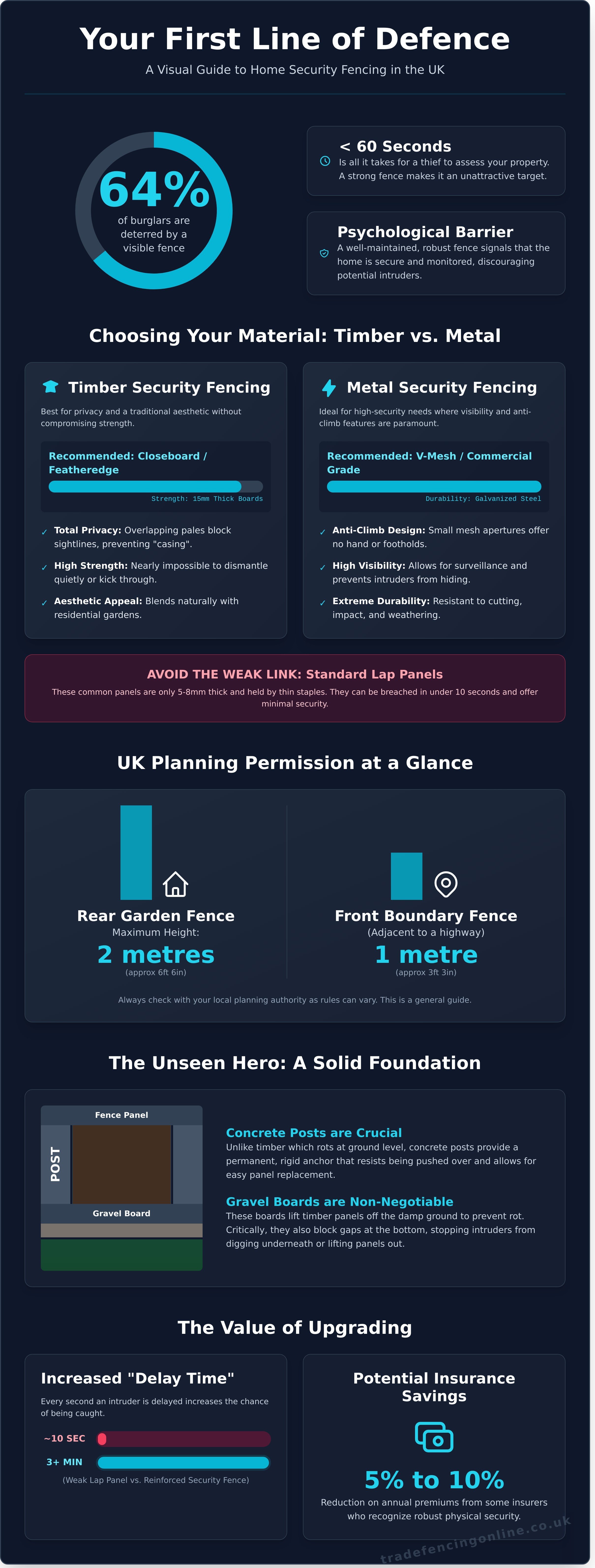
The difference between a standard lap panel and a high-security option is significant. A basic overlap panel is often only 5mm to 8mm thick and held together by thin staples. These are easily kicked through or lifted. In contrast, professional options like Traditional Closeboard or V Mesh offer superior structural integrity. Closeboard uses individual overlapping pales nailed to horizontal arris rails, making it nearly impossible to dismantle quietly. When planning your boundary, understanding the role of a perimeter security fence helps you identify which materials actually stop intruders and which ones are merely visual screens.
Psychological deterrence is just as vital as physical strength. A thief usually spends less than 60 seconds deciding whether to target a property. If they see a 1.8m tall, well-maintained fence with no obvious footholds, they'll likely move on to an easier target. You want your home to look difficult to enter. A sturdy fence sends a clear message that the property is protected and monitored.
The Core Benefits of Upgrading Your Home Perimeter
Upgrading your security fencing for home provides a measurable increase in "delay time." Security experts at the Master Locksmiths Association often highlight that every extra second an intruder spends trying to breach a boundary increases their risk of being caught. A reinforced fence can delay an entry attempt by up to 3 minutes compared to the 10 seconds it takes to bypass a broken lap panel. This delay is often enough to trigger a neighbor's intervention or allow a home alarm system to alert the authorities.
This delay is even more effective when coupled with modern electronic deterrents. For homeowners looking to create a complete security solution, specialist firms like Quartz Empire Fire & Security Ltd provide professional installation of both fire and security alarm systems, ensuring your property is protected from multiple threats.
Privacy is another major advantage. Solid fencing prevents "casing," which is when a criminal observes a home from the street to identify valuable items or entry points. By blocking the line of sight, you remove the temptation. Additionally, while not all providers offer a flat discount, many UK insurance firms like Aviva or AXA recognize that robust physical security reduces your risk profile. This can lead to a 5% to 10% reduction in annual premiums if the installation meets their specific security criteria.
Security Ratings and Standards for UK Homeowners
You don't need to be an engineer to understand security classifications. For residential use, look for "anti-climb" features. This usually means the fence has no horizontal bars on the outside that could be used as a ladder. It's the most requested upgrade in 2025 because it addresses the most common method of entry. Vertical pales with pointed or rounded tops make scaling the fence painful and difficult without specialized equipment.
The role of concrete posts cannot be overstated. Timber posts can rot at the ground line over 10 to 15 years, making the entire fence easy to push over. Concrete posts provide a permanent, rigid anchor. Crucially, they allow for the use of gravel boards at the base. These prevent the fence panels from touching the damp ground and, more importantly, stop intruders from digging under the fence or lifting the panels out of their slots. A panel slotted into a concrete post is significantly harder to remove than one nailed to a wooden post.
The Best Types of Security Fencing for Residential Properties
Selecting the right security fencing for home protection involves balancing physical strength with your property's specific layout. A fence shouldn't just mark a boundary; it needs to act as a functional deterrent that prevents unauthorised access. Professional installers generally categorise residential security into timber-based systems for privacy and metal-based systems for high-visibility surveillance.
Timber Security: Traditional Closeboard and Featheredge
Traditional closeboard fencing is the gold standard for timber security in the UK. Unlike cheap lap panels that use thin 5mm slats, closeboard systems rely on vertical featheredge boards. These boards are typically 15mm thick at the leading edge, making them significantly harder to kick through or break. You'll find that the overlapping design leaves no gaps for prying tools to gain leverage.
Structural integrity depends on the framework behind the boards. You should always use two or three triangular arris rails, depending on whether the fence is 1.5 metres or 1.8 metres tall. These rails provide the lateral strength needed to resist heavy impacts. For an added layer of protection, many homeowners install 300mm trellis toppers. These look decorative but serve a pragmatic purpose; they're physically fragile and will break under the weight of an intruder, creating a loud noise and removing any stable handhold for climbing.
Metal Security: V Mesh and Twin Wire Systems
Metal systems are increasingly popular for modern UK driveways, particularly in urban areas like London where visibility is a priority. V Mesh fencing uses 5mm thick steel wires welded into a tight grid pattern. The "V" shape pressed into the mesh adds rigidity without needing bulky support bars. One of the primary benefits is natural surveillance. Because the mesh is see-through, intruders have nowhere to hide, and your CCTV cameras can maintain a clear line of sight beyond the boundary.
Longevity is a major factor for metal systems in the damp UK climate. Quality V Mesh is galvanised to BS EN ISO 1461 standards and finished with a polyester powder coating. This prevents rust for up to 25 years. These systems are difficult to climb because the mesh apertures are too small to provide a foot or handhold. If you're looking for a professional-grade barrier, you can browse high-specification security mesh options that suit residential settings.
Palisade and Reinforced Decorative Options
For larger estates or properties bordering public land, palisade fencing offers the most aggressive deterrent. It uses "W" or "D" profile steel pales that are nearly impossible to scale or cut without specialized power tools. While traditionally industrial, many residential versions now come in dark greens or blacks to blend with hedging.
The principles of durability and efficiency from the industrial sector are increasingly influencing residential choices. Companies in the industrial automation space, such as InstroDirect, focus on providing equipment that offers long-term reliability and value—a mindset homeowners are now adopting for their security upgrades.
For those interested in the broader world of industrial supplies for construction, you can visit Mobel Suministros to see how professionals source materials for large-scale projects.
If aesthetics are your main concern, reinforced decorative panels are an excellent middle ground. These panels look like standard garden fencing but feature hidden security features like steel-reinforced horizontal rails or integrated wire mesh behind the timber. Before starting any installation, check the UK fence planning permission rules. Most residential areas limit rear fences to 2 metres in height. Exceeding this without a permit can lead to enforcement notices from your local council, regardless of your security needs.
- Closeboard: Best for privacy and solid boundary strength.
- V Mesh: Ideal for CCTV visibility and modern aesthetics.
- Palisade: The highest level of physical deterrent for large boundaries.
- Trellis Toppers: An effective and affordable anti-climb solution.
Choosing the correct security fencing for home use isn't just about height. It's about selecting materials that resist force and remove the "blind spots" that opportunistic burglars rely on. Whether you choose the traditional look of 15mm featheredge or the industrial strength of 5mm steel mesh, ensure your posts are set at least 600mm deep in concrete to provide a stable foundation.
Comparing Timber vs. Metal: Which Security Fence Wins?
Choosing the right security fencing for home protection depends on your specific site requirements and long-term budget. Timber provides a traditional look and total privacy. Metal offers superior strength and clear lines of sight. Over a 10-year period, the value of each material shifts significantly. Timber usually costs less upfront but requires regular staining and repairs. Metal systems like V Mesh have higher initial costs but require zero maintenance for 25 years or more. Property resale value often increases when a fence looks professional and secure. Timber panels offer a "soft" security feel that suits suburban streets. In contrast, metal fencing signals a high-security perimeter that can deter intruders immediately.
Visibility is a critical factor for modern home security. Solid timber screens block the view of your property, which prevents "window shopping" by thieves. However, this also creates blind spots where intruders can hide once they've breached the perimeter. Metal mesh systems allow your CCTV cameras to see through the fence line. This visibility aligns with Police-approved security standards, which often recommend clear sightlines to reduce crime. Trade professionals usually find timber easier to cut on-site to fit awkward corners. Metal requires specialized tools like grinders and specific clips, making it a better choice for advanced DIYers or professional contractors.
Durability and Maintenance Requirements
Timber fence life depends entirely on the treatment process. Dip-treated panels are the budget option but need annual retreating to stay rot-free. Tanalised or pressure-treated timber is a better investment; it's infused with preservative and often lasts 15 years without major issues. High-quality metal fencing is a "set and forget" solution. It is galvanised and powder-coated to prevent rust for 25 to 30 years. You must use concrete gravel boards with timber. These boards keep the wood 150mm off the damp ground. This simple addition can extend a timber fence's lifespan by 5 or 6 years. Metal posts should be set in at least 600mm of Postmix to ensure the structure remains rigid against physical force.
Cost Analysis: Budgeting for Home Protection
Price points vary based on the height and specification of the security fencing for home use. A standard 1.8m high Closeboard fence costs roughly £35 to £50 per linear metre for materials. A comparable V Mesh system ranges from £40 to £60 per metre. You need to account for hidden costs that many DIYers overlook. Ironmongery, heavy-duty hinges, and Postmix add £15 to £25 per bay to your total. Professional installation fees in the UK typically range from £40 to £85 per metre depending on ground conditions. Buying trade-direct from Romford Fencing Ltd eliminates middleman markups. This saves you roughly 15% to 20% compared to high-street retail prices. We provide the same professional-grade materials used by commercial contractors directly to your door, ensuring you get the best price for a secure home.
UK Planning Permission and Fencing Height Regulations
You don't need planning permission for most rear garden fences if they stay under 2 metres. This height includes any trellis or gravelboards added to the base. If your property borders a public highway, road, or footpath, the limit drops to 1 metre. These rules fall under Permitted Development rights. Check if your home is subject to an Article 4 direction. Local councils use these in conservation areas to restrict changes and preserve the local character. If you live in a listed building, you'll always need listed building consent for any new security fencing for home projects. Ignoring these rules leads to enforcement notices and the costly removal of your new fence.
Planning applications for residential fences cost £258 in England as of April 2024. You'll need to submit scaled drawings and a site plan to your local authority. Expect a decision within 8 weeks. Councils often approve taller fences if you can prove a specific security need or if the design matches the local street scene. Always talk to your neighbours before submitting an application. A formal objection from a neighbour is the most common reason for a planning refusal. Once you have approval, you're legally protected against future complaints and can proceed with your installation confidently.
The "Height Loophole" and Security Add-ons
Adding a trellis to a 2-metre fence doesn't bypass the law. The council measures the total height from the highest natural ground level. If the combined structure exceeds 2 metres, it's illegal without permission. Defensive planting is a smarter alternative. Species like Pyracantha or Berberis provide a natural deterrent without strict height caps. If you use anti-climb paint, you must display clear warning signs. Place these signs at every point of entry and every 3 metres along the boundary. This ensures you comply with the Occupiers' Liability Act 1984 and avoid legal claims from injured trespassers who might come into contact with the product.
Sourcing high-quality, weather-resistant signs is crucial for compliance. For custom warning signs and safety decals that remain legible for years, specialist companies like Graphic Cabin provide durable solutions.
Installation Best Practices for Maximum Security
Security starts in the ground. Dig your post holes to a minimum depth of 600mm. For a standard 1.8-metre fence, this ensures the structure survives high winds and physical force. Use 100mm x 100mm pressure-treated posts for maximum durability and fill the holes with rapid-set post-mix. Secure your panels with stainless steel security screws instead of standard nails. This prevents intruders from prying the panels out of the grooves. Your gate is the primary access point and requires heavy-duty ironmongery. Install a steel brenton bolt and a high-quality padlock to ensure this entrance isn't the weakest link in your security fencing for home.
Tackling a project like this requires the right skills, whether you're a DIY enthusiast or a professional. For those interested in gaining hands-on experience and qualifications across various construction trades, you can learn more about YTA Training.
Beyond traditional padlocks, modern digital locks offer an even higher level of security for both gates and main doors. For those interested in exploring these advanced options, you can read more on the latest technologies.
Of course, locks are only as strong as the doors and windows they are fitted to. To ensure all entry points are secure, investing in high-quality uPVC and aluminium frames is a crucial step. For homeowners considering this upgrade, Custom Trade Systems Ltd provides and installs a range of robust window and door solutions.
Get the right gear for a secure boundary. Order your heavy-duty fence panels and posts today for fast local delivery.
Choosing a Security Fencing Supplier in Essex and London
Selecting the right supplier is just as vital as picking the fence itself. Local expertise in Romford and across Essex matters because ground conditions vary significantly. Many parts of Essex sit on heavy clay soil. This requires specific post depths and high-quality concrete to prevent leaning over time. When you install security fencing for home use, you need a foundation that stands firm against both the elements and potential intruders. We understand these local variables and provide materials suited for the regional environment.
Efficiency is key to any home improvement project. We operate as a one-stop-shop for panels, posts, and ironmongery. This approach eliminates the frustration of sourcing components from multiple vendors. You won't have to worry if the hinges fit the gate or if the gravelboards match the panels. Everything is designed to work together. Buying your complete kit from a single source also simplifies your delivery and ensures a consistent finish across your entire perimeter.
Romford Fencing Ltd supports a diverse range of clients from our 178 Crow Lane base. We provide the same professional-grade materials to DIY homeowners as we do to large-scale trade contractors. If you're tackling a small residential garden or a massive housing development, our stock levels remain consistent. We've built our reputation on reliability and practical advice for over 25 years in the industry. We don't just sell wood; we provide the components for a more secure property.
Timing is often the biggest hurdle in security upgrades. A broken fence is a vulnerability that needs fixing immediately. That's why we offer fast delivery options across East London, Essex, and the surrounding areas. Our fleet is equipped to handle heavy loads of timber and concrete. Most local orders are processed and delivered within 3 to 5 working days. This speed ensures your home doesn't stay exposed for longer than necessary.
Why Trade Fencing Online is the Trusted Local Choice
We provide direct access to the same quality materials used by professional installers. You're getting trade-standard durability at competitive prices. Our physical location at 178 Crow Lane has served the Romford community for years, giving us a face-to-face accountability that online-only retailers lack. We pride ourselves on transparent pricing. The price you see is the price you pay. Our 5-star customer service ratings reflect our commitment to helping every customer find the right security fencing for home protection without the fuss.
Next Steps: Planning Your Security Upgrade
Start by measuring your perimeter accurately. Don't guess the length; use a steel tape measure and account for every corner. Calculate your materials by dividing the total length by the width of your chosen panels, usually 1.83m. Remember to add an extra post for the end of the run. If you're a developer or a regular installer, setting up a trade account provides access to streamlined ordering and volume benefits. Take control of your property's safety now. Order your security fencing online today for fast Essex delivery and get the job done right.
Secure Your Property for 2026 and Beyond
Choosing the right security fencing for home is a practical investment in your property's long-term safety. You've seen that navigating the 2-metre height regulations is essential to avoid legal issues with local councils. Whether you select reinforced timber or 3mm thick metal mesh, the goal remains the same: total peace of mind. High-quality materials ensure your perimeter meets 2026 standards for durability and resistance.
Trade Fencing Online is your one-stop-shop for professional-grade supplies. We're a trusted Essex supplier with over 450 5-star reviews, proving our commitment to reliability. We offer trade-quality materials at competitive prices, helping you save on your total project costs. Use our free local delivery options across London and Essex to simplify your installation process. We've built our reputation on providing no-nonsense service and dependable products that stand the test of time.
Browse Our High-Security Fencing Range & Get Free Local Delivery
Get your security project started today and protect what matters most.
Frequently Asked Questions
What is the most secure type of fencing for a residential house?
Steel palisade fencing is the most secure option for residential properties requiring maximum protection. It features vertical steel rails that are difficult to climb and nearly impossible to cut without heavy machinery. For a more domestic look, traditional closeboard fencing using 100mm pressure-treated timber and 2.4m concrete posts provides a solid, sight-proof barrier. These systems offer 100% privacy and act as a significant physical deterrent against intruders.
Do I need planning permission for a 2-metre high security fence?
You generally don't need planning permission for a 2-metre high fence in a rear garden under the Town and Country Planning Order 2015. However, if the fence borders a highway used by vehicles, the height limit drops to 1 metre. Always check with your local council if your property is a listed building or sits within a conservation area. Breaking these rules can result in an enforcement notice requiring you to remove the structure within 28 days.
Is metal fencing more secure than wooden fencing for a home?
Metal fencing is more secure than wooden fencing because it cannot be easily kicked through or sawed. While a quality closeboard fence is sturdy, steel mesh or palisade systems offer superior resistance to forced entry. Metal panels often last over 25 years with minimal maintenance. In contrast, wooden panels require restaining every 24 months to prevent rot and maintain structural integrity. Choosing metal ensures a long-term security fencing for home solution that resists decay.
How can I make my existing garden fence more secure?
Secure your existing fence by installing 150mm concrete gravel boards to prevent bottom-entry and rot. Replace standard nails with 50mm stainless steel screws to stop intruders from quietly removing individual slats. You should also check that all gates have heavy-duty ironmongery and a high-quality padlock. Adding a trellis top can also help as it is too fragile to support a person's weight, making it a natural deterrent for climbers.
What are anti-climb fence toppers and are they legal in the UK?
Anti-climb fence toppers like spinning spikes or Prikka-strip are legal in the UK if you display clear warning signs. Under the Occupiers' Liability Act 1984, you have a duty of care to anyone on your property, including trespassers. You must place warning signs at 3-metre intervals to avoid legal liability for injuries. Ensure these toppers are installed at a minimum height of 2 metres to prevent accidental contact by children or passers-by.
Does security fencing reduce home insurance costs?
Installing professional security fencing for home can reduce your annual insurance premiums by approximately 5% to 10%. Insurance providers view high-quality perimeter protection as a lower risk for burglary claims. You should inform your provider once the installation is complete to see if you qualify for a rate reduction. Using a trusted supplier ensures the materials meet the standards required by most UK underwriters for residential security.
How long does a professional security fence installation take?
A professional team can typically install 10 to 15 linear metres of fencing per day. For a standard 30-metre garden perimeter, the job usually takes 2 to 3 days from start to finish. This timeframe includes digging post holes to a depth of 600mm and setting them in rapid-set concrete. Weather conditions and ground hardness can affect this schedule, but an efficient crew keeps disruption to a minimum.
Where can I buy trade-quality security fencing in Romford?
You can buy trade-quality security fencing at Trade Fencing Online, operated by Romford Fencing Ltd. We are a trusted supplier with 5-star reviews, offering unmatched prices on closeboard panels, concrete posts, and ironmongery. Order online today for fast, reliable service across the region. We provide free local delivery options to ensure you get your materials without unnecessary fuss. FOR QUALITY FENCING, CALL ROMFORD FENCING LTD TODAY OR EMAIL OUR TEAM.