


A professional-grade closeboard fence is only as strong as its smallest component. Most builders focus on the timber boards but overlook the specific ironmongery that prevents sagging and premature rot. It's a common mistake that leads to wasted time and unnecessary stress. You need a comprehensive closeboard fencing components list to ensure you have every bracket, nail, and rail required before the first post goes into the ground.
We understand the frustration of ordering the wrong rail type or forgetting gravel board cleats mid-build. This guide removes the guesswork by providing a definitive checklist for your 2026 project. You'll learn which materials offer the best longevity and how to distinguish between essential structural elements. We're providing a complete, error-free shopping list so you can start your installation with the confidence of an established local expert.
Key Takeaways
- Identify the structural differences between arris and cant rails to choose the most efficient horizontal framework for your specific post type.
- Utilise our professional closeboard fencing components list to verify you have the exact galvanised fixings and brackets required to prevent rust and sagging.
- Increase the longevity of your installation by correctly fitting gravel boards and capping rails to shield timber from damp ground and vertical water ingress.
- Ensure total privacy and structural stability by mastering the 25mm overlap standard for trade-quality feather edge boards.
Primary Structural Components: Posts, Rails, and Boards
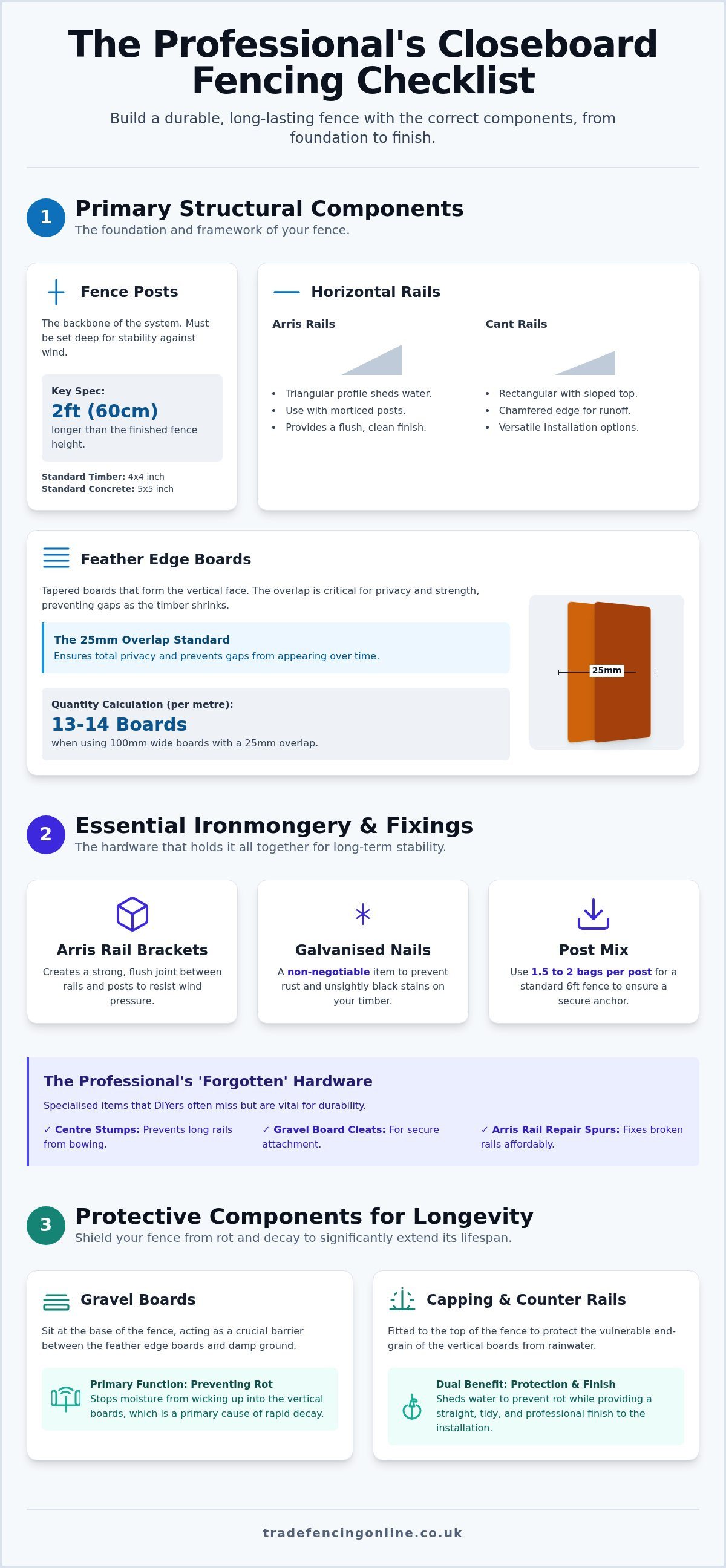
Building a durable boundary starts with selecting the right timber and concrete foundations. Your closeboard fencing components list must begin with heavy-duty posts. These are the backbone of the system, available in both timber and concrete varieties. To ensure a secure anchor that resists high winds, posts must be at least 2ft longer than the finished fence height. This extra length allows for a deep, stable setting in the ground. Standard 4x4 inch timber posts or 5x5 inch concrete variants are the industry standard for domestic installations.
The horizontal framework consists of either arris or cant rails. Arris rails feature a triangular profile, specifically shaped to encourage water runoff and prevent moisture from sitting on the timber. Cant rails are rectangular with a chamfered top edge. Your choice depends on the installation method; arris rails are traditionally used with morticed fence posts, providing a flush, trade-quality finish.
Feather edge boards form the vertical face of the fence. These boards are tapered, allowing them to overlap easily. A standard 25mm overlap is essential. This prevents gaps from appearing when the timber naturally shrinks in warmer weather, maintaining total privacy for the property. Using a smaller overlap might save on material costs, but it compromises the structural integrity and privacy of the screen over time.
Calculating Feather Edge Board Quantities
Boards are typically sold in 100mm or 125mm widths. When using 100mm boards with the recommended 25mm overlap, you'll need 13 to 14 boards for every linear metre of fencing. This calculation provides a dense, sturdy screen. Always include a few extra boards in your closeboard fencing components list to account for cuts at the end of the run or potential timber knots. Precise planning at this stage prevents mid-project delays and ensures you have all materials on-site from day one.
Essential Ironmongery and Fixings for Structural Integrity
A comprehensive closeboard fencing components list isn't just about timber boards; it's about the hardware that keeps them standing. Arris rail brackets are critical for connecting horizontal rails to wooden posts. They create a flush, sturdy joint that effectively resists wind pressure. Using these brackets ensures the rails don't pull away from the posts during the natural movement of the timber. It's a trade-standard method that offers far more stability than simple toe-nailing.
Your choice of nails determines the long-term appearance of your project. Galvanised nails are non-negotiable. Standard steel fixings will rust almost immediately, leaving unsightly black streaks across your feather edge boards. These stains are impossible to remove and ruin the professional finish you're aiming for. For the foundation, post mix is the essential component for setting your posts securely. For a standard 6ft fence, plan for 1.5 to 2 bags per hole. This provides the weight and density needed to prevent the fence from leaning or shifting in soft ground.
The Forgotten Hardware Checklist
Professionals always include specialized items that DIYers often miss. Centre stumps are vital for supporting the middle of long rail spans, preventing the framework from bowing under the weight of the timber. You'll also need cleats for secure gravel board attachment. If you're extending the life of an existing structure, arris rail repair spurs are a vital component. These allow you to fix snapped rail ends without the cost of a full replacement. You can find all these specialist ironmongery items ready for local delivery.
Protective Components: Gravel Boards and Capping Rails
Protective components are the difference between a fence that lasts five years and one that lasts fifteen. Gravel boards sit at the base of the structure. They act as a barrier between the timber feather edge boards and the damp ground. Without them, moisture wicks up into the vertical slats, causing rapid decay. Adding these to your closeboard fencing components list is a small investment that significantly extends the lifespan of the entire system.
At the top of the fence, capping rails and counter rails provide vital protection. These components are designed to shed rainwater away from the boards. Vertical slats are particularly vulnerable to end-grain rot; capping rails seal these exposed edges and provide a tidy, professional finish. Counter rails sit behind the capping rail to provide additional support and a fixing point, ensuring the top of the fence remains straight. During the assembly process, you must apply timber treatment or preservatives to all cut ends of the components. This practice ensures your installation meets 2026 warranty standards and remains structurally sound for years to come.
Concrete vs Wooden Gravel Boards
Choosing between materials depends on your priority. Concrete gravel boards offer superior durability and will never rot, making them the pragmatic choice for wet areas or heavy soil. Wooden versions provide better aesthetic cohesion, matching the rest of the timber framework for a traditional look. It's a decision that impacts both the maintenance schedule and the final closeboard fencing components list required for the job. For a deeper look at these options, read our guide on what are gravel boards and why you need them.
Start Your 2026 Fencing Project Today
Executing a high-quality boundary installation requires precision and the right materials. You now have the definitive closeboard fencing components list to guide your procurement process. By selecting trade-grade timber, galvanised ironmongery, and essential protective layers like gravel boards, you'll ensure a professional finish that stands the test of time. Focus on structural integrity from the foundation up to avoid common project delays.
Romford Fencing Ltd provides every component required for a successful build. We combine Romford-based local expertise with trade-quality materials for both public and professional projects. Our fast delivery service operates across Essex and East London to get your materials on-site exactly when you need them.
SHOP NOW
Build your fence with the confidence of a professional installer.
Frequently Asked Questions
What is the difference between arris rails and cant rails?
Arris rails have a triangular profile and usually fit into pre-cut mortice holes in your posts for a flush finish. Cant rails are rectangular with a chamfered top edge, designed to be nailed directly to the front of the posts. Arris rails are the traditional choice for high-end closeboard projects, while cant rails offer a quicker surface-mount installation for standard garden boundaries.
How many feather edge boards do I need for a 6ft wide section?
For a standard 6ft (1.83m) wide section using 100mm wide feather edge boards, you'll need 24 to 26 boards. This assumes the industry-standard 25mm overlap. If you're using wider 125mm boards, the requirement drops to roughly 18 to 20 boards. Including a 5% wastage allowance in your closeboard fencing components list is a smart move to cover any accidental splits or necessary end-cuts.
Do I need a gravel board for my closeboard fence?
You absolutely need a gravel board if you want your fence to last. It creates a protective barrier between the vertical boards and the damp ground. This prevents moisture from soaking into the end-grain of the timber, which is the primary cause of rot. You can select concrete for ultimate durability or timber for a cohesive look across the entire installation.
What size nails should I use for feather edge fencing?
We recommend using 50mm galvanised nails for the boards and 75mm or 100mm nails for the heavier framework components. Galvanised fixings are essential because they won't rust when exposed to the elements. Standard steel nails will quickly corrode, causing black streaks to run down your new timber. This hardware is a small but critical part of your closeboard fencing components list for a professional finish.