


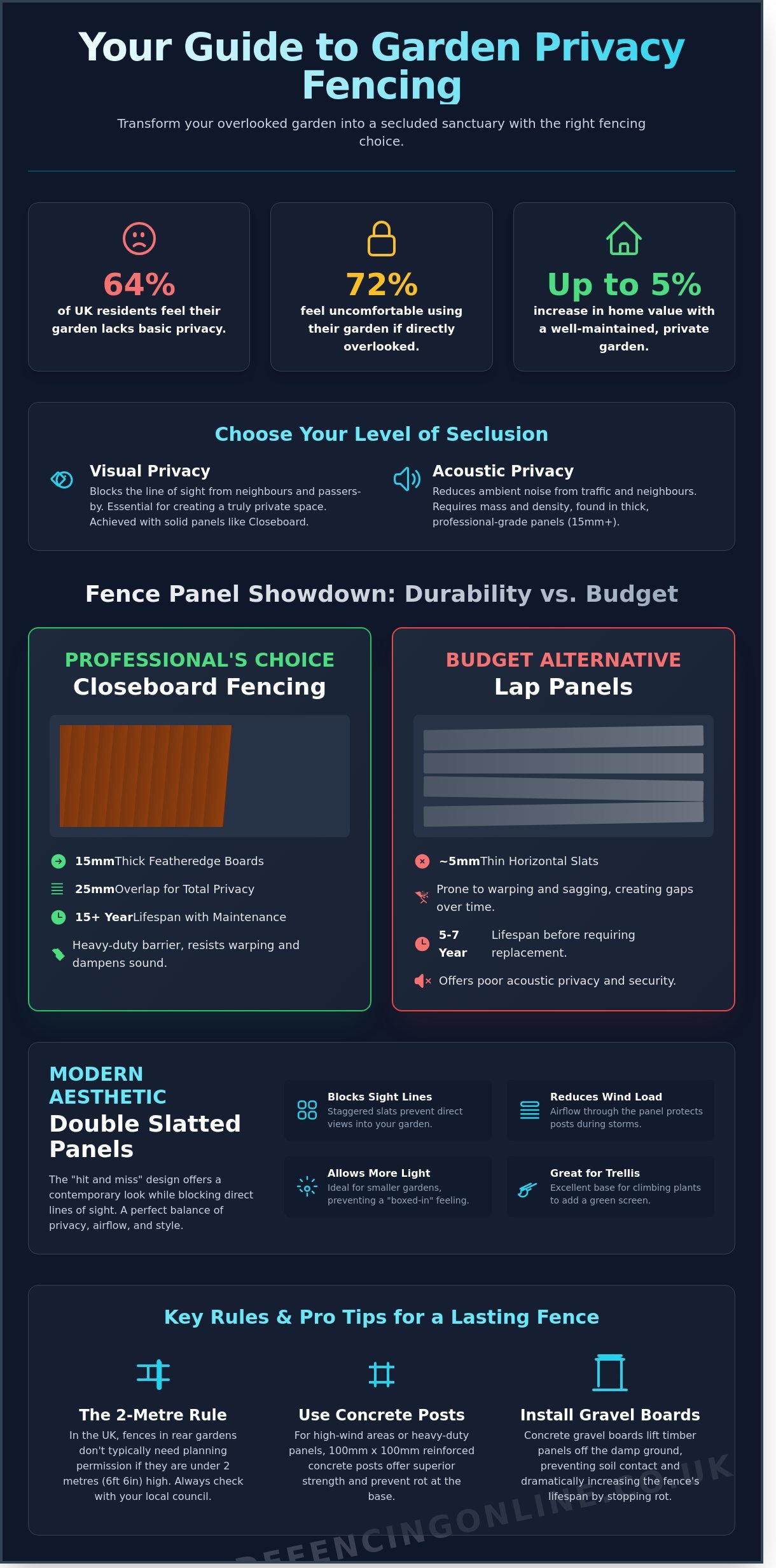
Last Saturday, a homeowner in Chelmsford stepped into their garden and immediately felt the gaze of three different neighbours. It's a frustrating reality for 64% of UK residents who feel their outdoor space lacks basic privacy. You bought your home to have a private retreat, not to provide a live performance for the street. We agree that a garden should be a secluded sanctuary where you can relax in peace without feeling "on display" to the entire terrace.
This guide delivers professional privacy fence ideas for garden projects that combine security with high-end style. You'll discover exactly which timber panels, such as traditional closeboard or decorative hit-and-miss designs, offer the best screening for your specific layout. We also clarify the 2-metre UK height regulations to ensure your new boundary doesn't trigger a local planning dispute or a disagreement with the people next door. From choosing the right gravelboards to booking free local delivery options across Essex, we provide the practical facts you need to secure your perimeter and transform your garden today.
Key Takeaways
- Identify the crucial differences between visual and acoustic privacy to create a truly quiet, secluded outdoor space.
- Compare the top five privacy fence ideas for garden projects, including traditional closeboard and contemporary double slatted panels.
- Master the use of trellis toppers to add height and style to existing boundaries while maintaining airflow.
- Navigate UK planning permission rules, including the "2-metre rule" and specific restrictions for front garden boundaries.
- Learn why trade-quality supplies and concrete gravel boards provide better long-term value than standard DIY store alternatives.
Understanding Garden Privacy: Why Your Fence Choice Matters
Garden privacy is a functional requirement, not a luxury. A 2023 UK homeowner survey revealed that 72% of residents feel uncomfortable using their outdoor space if they are directly overlooked. This "goldfish bowl" effect prevents you from enjoying a quiet morning coffee or hosting a private dinner without feeling watched. High-quality privacy fence ideas for garden projects transform these exposed areas into secure zones. Beyond the immediate comfort, a secure boundary adds tangible value to your property. Real estate data from 2022 suggests that a well-maintained, private garden can increase a home's valuation by up to 5%.
You must distinguish between visual and acoustic privacy. Visual privacy blocks the line of sight from neighbours or passers-by. Acoustic privacy reduces the decibel level of traffic and ambient noise. Budget lap panels, often only 5mm thick, fail to block sound effectively. They also tend to warp within 24 months, creating gaps that compromise your seclusion. Professional-grade closeboard fencing uses 15mm thick featheredge boards that overlap by 25mm. This adds the mass needed to dampen noise and ensures no gaps appear as the wood seasons over time.
Assess your garden layout before buying materials. Corner plots are exposed to higher wind speeds and more public footfall. These require 100mm x 100mm reinforced concrete posts to prevent storm damage. Terraced boundaries often have shared responsibilities and strict 2-metre height limits. Exceeding this without planning permission can lead to enforcement notices from your local council. For a comprehensive overview of fencing regulations and construction standards, you should review the technical specifications of different materials to ensure they meet British Standards for wind loading.
The Different Levels of Privacy
Choose your screening level based on how you use the space. Full screening provides 100% visual blockage, which is the standard for hot tub areas or sunbathing spots. Partial screening uses slatted or "hit and miss" designs. These allow 25% more airflow and light than solid walls, making them ideal for small, dark gardens where you don't want to feel boxed in. Security-focused privacy combines height with strength. Use 1.8m high panels with integrated gravel boards to prevent intruders from digging under the boundary or identifying valuables kept in your garden shed.
Of course, a secure perimeter is only one part of home security. Ensuring your gates, shed, and home doors have high-quality locks is just as important. As an example of the professional services available for emergency lockouts or security upgrades, you can check out Expert Deblok.
Evaluating Your Current Boundary
Inspect your current fence for structural failure before deciding on a new style. Check the point where the post meets the ground. If you find soft, dark wood, rot has set in. This usually happens within 7 to 10 years for non-treated timber. Look for "weak spots" where neighbours have a direct line of sight from their upstairs windows. You don't always need a full £1,500 replacement. If the posts are solid, adding 300mm of trellis or replacing individual 6ft panels can fix the problem for under £200. Ensure your gravel boards are level to prevent soil dampness from reaching the main timber panels and causing premature decay.
Top 5 Privacy Fence Panel Styles for UK Gardens
Choosing the right materials is the first step toward a secure perimeter. For homeowners researching privacy fence ideas for garden layouts, the choice usually comes down to durability versus initial cost. We recommend focusing on trade-quality timber that withstands the 60mph wind gusts common during British winters. These five styles represent the most effective solutions for total screening and long-term value.
Traditional closeboard fencing remains the industry standard for a reason. Built from vertical featheredge boards that overlap by 25mm, these panels create a solid timber wall with zero visibility from the outside. Each 1.8m panel typically uses 15mm thick boards, providing a heavy-duty barrier that resists warping. It is the most reliable way to ensure total seclusion in a busy residential area.
Closeboard vs Lap Panels: The Privacy Debate
While lap panels are a cheaper entry-point, they don't offer the same security. Lap panels use horizontal slats that often sag, creating small gaps over time. Trade-quality closeboard fencing lasts 15 years or more when maintained, compared to the 5 to 7-year lifespan of budget lap alternatives. Investing an extra £15 to £20 per panel now prevents the need for a full replacement after the next big storm.
Double slatted panels provide a modern aesthetic for those who want privacy fence ideas for garden spaces without sacrificing airflow. These use a "hit and miss" design where slats are fixed to both the front and back of the panel. You get the contemporary look of a horizontal fence, but the staggered slats block the direct line of sight. This design also reduces wind resistance, which protects your posts during high winds.
Modern Slatted Designs
These panels are perfect for creating a "room" feel in your outdoor space. They work best in natural wood or modern grey finishes. We only supply pressure-treated timber for these designs to ensure they reach a 10 to 15-year service life. Using UC4 treated posts with these panels ensures the entire structure remains stable against ground rot.
Tongue and groove panels offer the most premium finish available. The boards interlock tightly, leaving no gaps for light or eyes to pass through. This 12mm thick interlocking system creates a flat, uniform surface that looks identical on both sides. It's a high-end choice for gardens where the fence is a primary design feature rather than just a boundary.
Adding a trellis topper to a standard 1.5m closeboard panel is a smart way to balance height and light. You maintain total privacy at eye level while the lattice work allows sunlight into your flower beds. Remember to check UK fence height rules before installation. Most residential properties are limited to a total height of 2 metres without specific planning permission.
Acoustic fencing is a necessary upgrade for gardens near busy Essex roads like the A12 or A127. These heavy-duty panels use 120mm thick timber sections and a specific profile to reflect sound waves. Standard panels do little to stop traffic noise, but dedicated acoustic barriers can reduce sound levels by up to 28dB. This makes a massive difference to the usability of your garden. Check our latest deals on fence panels to find the right fit for your budget and privacy needs.
Clever Privacy Hacks: Using Trellis and Toppers
Increasing the height of your boundary shouldn't involve replacing every panel. Adding a 300mm or 600mm (1ft or 2ft) trellis is a pragmatic way to upgrade your security. Most standard UK installations use 1.83m (6ft) panels. Adding a topper provides that extra screening without the cost of a full rebuild. Before you start, check the UK fence height planning rules. Generally, any fence over 2 metres in height requires planning permission from your local authority. A 1.8m panel paired with a 150mm gravel board and a 300mm trellis stays within these legal limits while blocking the view from neighbouring windows.
Choosing the right pattern is essential for effective screening. Square trellis usually features 100mm or 150mm gaps. It looks traditional but offers limited privacy. For better results, select a diamond pattern with 20mm to 40mm holes. The tighter weave creates a much stronger visual barrier. This is one of the most effective privacy fence ideas for garden layouts where houses are built in close proximity. Diamond trellis also provides more "grip" points for climbing plants, making the structure more stable in high winds.
Every professional installation should include gravel boards. A standard 150mm concrete or pressure-treated timber gravel board lifts the main panel off the damp ground. This prevents the bottom of your timber from rotting, extending the life of your fence by up to 5 years. It also adds 6 inches of height to the overall structure. Using gravel boards is a direct, value-oriented decision that protects your investment and ensures your privacy screen remains solid for a decade or more.
Decorative Fence Toppers
Fixing a topper requires the correct ironmongery for a professional finish. Use galvanised U-clips or 60mm stainless steel screws to secure the trellis to your existing timber posts. If you're using concrete posts, you'll need trellis post extensions or specialised metal brackets. Convex trellis, which curves upwards, or concave trellis, which dips in the middle, adds visual interest to a flat line. These shapes break up the monotony of a long boundary while maintaining height at the most critical points. It's a simple way to get a premium look at a trade price.
Living Privacy Additions
Trellis serves as a support system for versatile privacy fence ideas for garden boundaries. Fast-growing climbers like Star Jasmine or Ivy provide year-round green screening. To speed up growth, integrate 2.4m railway sleepers at the base to create raised planters. This brings the soil level up, giving plants a head start. You'll see full coverage 30% faster than planting at ground level. Maintenance is straightforward. Apply a high-quality spirit-based stain every 24 months. This ensures colour consistency across your panels and toppers while protecting the wood from UV damage and moisture.
Planning Permission: UK Fence Height Rules Explained
UK law is direct regarding boundary heights. You don't need planning permission for a rear garden fence up to 2.0 metres (approximately 6 feet 6 inches) from ground level. This height includes any gravel boards or trellis toppers you install. If your property borders a highway used by vehicles, the legal limit drops to 1.0 metre. These regulations fall under "permitted development rights." If you plan to exceed these limits, you must submit a formal application to your local council. In busy London boroughs or across Essex, planners strictly enforce these rules to maintain driver visibility and street character. Ignoring these limits results in enforcement notices. You'll be forced to dismantle the structure at your own cost.
Specific locations have tighter restrictions. Listed buildings and Conservation Areas often have "Article 4 Directions" in place. These directions remove your standard permitted development rights. You might need permission for even a standard 1.8-metre fence in these zones. Always check your local authority's planning portal before you start looking at privacy fence ideas for garden upgrades. A quick search on the Havering or Epping Forest District Council websites can save you thousands in legal fees and wasted materials.
Common Fence Height Loopholes
Many homeowners believe adding a trellis to the top of a 2-metre fence is a legal loophole. It isn't. The 2-metre rule applies to the entire structure from the highest natural ground level. If the total height exceeds the limit, it's a breach of planning law. Don't rely on the "removable" argument for trellis panels; councils view them as permanent fixtures. If you're concerned about future disputes, apply for a Lawful Development Certificate. This document currently costs £103 in England. It provides written proof that your fence was legal at the time of construction, which is vital when you come to sell your home.
Neighbourly Relations and Boundaries
Check your title deeds before you dig any post holes. Look for "T-marks" on the plan. A 'T' on your side of the line indicates you own the fence and are responsible for its upkeep. If you see an 'H' mark (two T-marks joined), the boundary is shared. You cannot legally alter a shared fence without your neighbour's consent. Even if you own the boundary, talk to your neighbours before increasing the height. It's the pragmatic way to avoid "spite fence" accusations or legal claims under the Rights of Light Act 1959. This Act allows neighbours to take action if a new structure significantly reduces the light they've enjoyed for 20 years or more. Clear communication prevents 90% of fencing disputes.
When you're ready to build, choose a supplier that understands these local requirements. We provide the durable, high-quality materials you need to stay within the law while securing your property. For reliable advice and trade prices, order your quality fence panels from Trade Fencing Online today.
- 2.0 Metres: Maximum height for rear and side fences without permission.
- 1.0 Metre: Maximum height for fences adjacent to a highway or footpath.
- £103: Current cost for a Lawful Development Certificate in England.
- Article 4: Local directions that can override your right to build fences.
Selecting the right privacy fence ideas for garden projects means balancing your need for seclusion with these strict legal realities. Stick to the 2.0-metre rule for rear gardens to ensure your project stays hassle-free. If you need more height, consider using vertical planting or trees, which are often exempt from these specific fencing height regulations.
Sourcing Quality Fencing Supplies in Essex and East London
Choosing the right materials is as vital as the design itself. High-street DIY stores often stock mass-produced panels that lack the structural integrity required for long-term exposure. These budget options frequently use thinner slats, often only 8mm to 10mm thick, which can warp or split during a single wet winter. In contrast, trade-quality supplies provide the durability needed for effective privacy fence ideas for garden projects. You need timber that handles the British weather without failing after two seasons.
Professional-grade timber is pressure-treated to UC4 standards. This specific treatment ensures the preservative penetrates deep into the wood fibres, protecting against fungal decay and insect attack. When you install a permanent boundary, you want it to stand for decades. Using concrete posts and gravel boards is the most effective way to achieve this. Timber posts eventually rot at the ground level where moisture sits. Concrete alternatives are completely impervious to damp and soil acidity. A standard 1.8m concrete post combined with a 150mm gravel board creates a solid foundation that resists high winds and prevents the bottom of your fence panels from touching wet earth.
Romford Fencing Ltd is the primary local expert for Romford, Essex, and East London. We understand the specific requirements of urban and suburban gardens in the South East. We don't just sell products; we provide the same heavy-duty materials used by professional contractors. Our delivery network covers the entire region, ensuring your supplies arrive on-site without the hassle of hiring a van or damaging your own vehicle.
The Trade Fencing Online Advantage
Trade Fencing Online gives you direct access to trade prices on traditional closeboard and decorative panels. We believe quality shouldn't be reserved for contractors. Our business model focuses on value and efficiency. We offer several benefits for local residents and tradespeople:
- Direct-to-public pricing: Access the same rates as the professionals on all stock.
- Free local delivery: We provide free delivery for bulk orders over £300 within the RM postcode area.
- Proven reputation: Our team maintains 5-star reviews based on over 30 years of industry experience.
Building Your Privacy Project
Planning your installation is simple with our digital tools. You can use our online shop to calculate exactly how many panels, posts, and bags of Postcrete your specific boundary requires. It's the fastest way to turn your privacy fence ideas for garden into a reality. Don't overlook the essential ironmongery that completes the job. We stock heavy-duty T-hinges, ring latches, and decorative post caps that add a professional finish while protecting the end grain of your timber.
Ordering online is straightforward and secure. Once your order is placed, our team schedules a reliable delivery slot that fits your timeline. We keep our stock levels high so you don't have to wait weeks for your materials to arrive. Whether you are replacing a single broken panel or installing a completely new perimeter, we have the stock ready for immediate dispatch. Call Romford Fencing Ltd today for a quote or order your supplies online!
Secure Your Garden Privacy Today
Finding the right privacy fence ideas for garden spaces requires a balance of aesthetics and legal compliance. Most UK homeowners must keep boundary fences under 2 metres to follow standard planning rules without a permit. High-quality closeboard panels or added trellis toppers provide the best screening for overlooked gardens while maintaining a professional look. We supply trade-quality materials at competitive prices directly to your door. Our service is backed by 5-star customer reviews and a reputation for reliability in the trade. We provide free local delivery across Essex and East London to keep your project on budget and on schedule. It's the most efficient way to source durable timber that stands up to the British weather. Don't settle for flimsy alternatives when professional-grade supplies are just a click away. Get your garden project started with a trusted supplier that understands the local market requirements. Your new, private outdoor space is closer than you think.
Browse our range of high-privacy fence panels and order online today
Frequently Asked Questions
How can I make my fence higher for privacy without replacing it?
You can add fence toppers like trellis or decorative panels to your existing structure. Use post extenders or "fence post sleeves" to secure the additional height to your current posts. This is a cost-effective way to implement privacy fence ideas for garden spaces without the labour costs of a full reinstall. Ensure the total height stays within the 2-metre legal limit to avoid planning issues.
Do I need planning permission for a 7ft fence in my back garden?
Yes, you usually need planning permission for any fence exceeding 2 metres in height. If the fence is adjacent to a highway used by vehicles, the limit drops to 1 metre. Check with your local council's planning department before installation. Unauthorised structures can lead to an enforcement notice and mandatory removal within 28 days.
What is the best fence for blocking out noisy neighbours?
Acoustic fencing or heavy-duty closeboard panels are the best options for noise reduction. These panels use thick, interlocking timber with no gaps to reflect sound waves back. A standard 1.8-metre closeboard fence can reduce noise levels by up to 30 decibels compared to thin lap panels. Stop sound leaks at the bottom by using 150mm concrete gravelboards.
Can I put trellis on top of a 6ft fence to make it 8ft?
You can physically attach the trellis, but it will likely breach UK planning laws. Any garden boundary over 2 metres requires formal planning permission from your local authority. Adding a 600mm trellis to a 1.83-metre fence brings the total height to over 2.4 metres. This is significantly over the standard 2-metre permitted development limit.
Which fence panels are the most private?
Closeboard and tongue and groove panels offer the highest level of privacy. These designs feature overlapping or interlocking timber boards that eliminate all sightlines. While standard lap panels can warp over time and create small gaps, tongue and groove boards provide a solid, seamless barrier. They are the most reliable privacy fence ideas for garden projects where total seclusion is the priority.
How do I stop neighbours from looking over my fence?
Install 1.8-metre high solid panels and add a 300mm trellis topper to reach the 2-metre legal limit. You can also plant fast-growing evergreens like Laurel or Red Robin behind the fence line. These plants can legally grow higher than 2 metres, providing a natural screen that blocks views from first-floor windows without breaching height regulations.
Is it cheaper to build a closeboard fence or buy panels?
Buying pre-assembled panels is generally 15% to 20% cheaper for the average DIY project. A standard 6ft closeboard panel costs around £45 to £60, whereas buying individual pales, rails, and nails often totals more in small quantities. Building from scratch is only cost-effective for large-scale professional installs or awkward, sloping boundaries where standard 1.83-metre widths won't fit.
Does a privacy fence increase property value in the UK?
A high-quality privacy fence can increase a property's value by an average of 2% to 5%. Homebuyers in the UK often prioritise secure, enclosed gardens for children and pets. A professional installation using pressure-treated timber and concrete posts suggests the property is well-maintained. This reduces future maintenance costs for the new owner and adds immediate kerb appeal.