


Choosing the right picket fencing panels shouldn't be a guessing game. While many homeowners desire the classic, open-pale look to boost kerb appeal, concerns often arise regarding wood treatments and rot resistance. Navigating the technical side of timber-especially ensuring your boundary can withstand a wet Essex winter or high winds-can feel overwhelming. You need a reliable, professional solution that balances traditional aesthetics with long-lasting performance without the unnecessary fuss.
At Trade Fencing Online, we believe in straightforward, quality products and direct advice. This guide provides a clear roadmap for your next project, from calculating the exact number of panels and posts needed to selecting the right timber grade for your environment. You will discover how to choose, install, and maintain the perfect picket fencing panels to enhance your property’s kerb appeal and define your boundaries with confidence. Stop worrying about complicated measurements and start building a durable, light-filled boundary that is built to last. We provide the facts you need to secure your garden with a trusted, traditional finish.
Key Takeaways
- Understand how picket fencing maintains visibility and airflow while creating a welcoming, traditional boundary for your property.
- Learn why pressure-treated (Tanalith E) slow-grown softwood is the trade standard for durable, long-lasting picket fencing panels.
- Discover how to choose the correct heights and standard 6ft widths to simplify your project planning and calculations.
- Master the installation essentials, from marking 1.83m post centres to digging 600mm deep holes for professional-grade stability.
- Find out why sourcing trade-quality materials directly from a trusted Romford specialist ensures the best value and 5-star results.
What are Picket Fencing Panels and Why Choose Them?
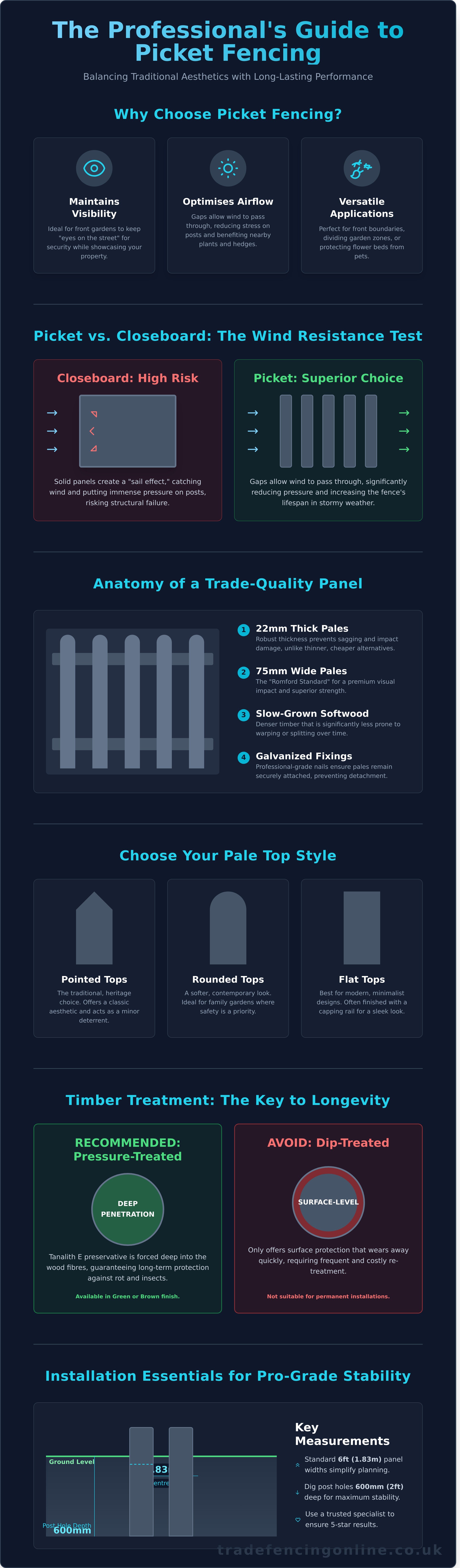
Picket fencing, often referred to as paling fencing, is a traditional boundary solution consisting of vertical boards (pales) attached to horizontal supporting rails. This design is a staple of the British landscape, offering a clear boundary that defines property lines without creating a solid, imposing wall. For many UK homeowners, picket fencing panels are the go-to choice for creating a welcoming aesthetic that complements both modern suburban homes and classic cottage-style properties.
There are several pragmatic reasons to opt for this style over solid fencing:
- Maintains Visibility: Ideal for front gardens where you want to keep "eyes on the street" for security while showcasing your property.
- Optimises Airflow: The gaps between the pales allow wind to pass through freely, which is essential for the health of nearby plants and hedges.
- Versatile Applications: Beyond front boundaries, these panels are perfect for dividing garden zones, such as separating a vegetable patch or protecting flower beds from pets.
The enduring popularity of this style is rooted in its balance of function and form. Exploring the History of Picket Fences reveals how this design became a symbol of domestic stability and traditional British kerb appeal.
The Anatomy of a Quality Picket Panel
A high-quality panel relies on three core components. First are the pales; these vertical slats define the fence’s character and come in various finishes, such as rounded, pointed, or flat tops. Second are the horizontal rails, which provide the structural backbone to prevent sagging. Finally, "Trade Quality" fixings are essential. We use professional-grade, galvanized nails to ensure pales remain securely attached over time, preventing the detachment often seen in inferior, budget-grade products.
Picket vs. Closeboard: When to Choose Palings
While closeboard fencing is designed for total privacy, picket fencing panels are the superior choice for non-private boundaries. One major technical advantage is wind resistance. In stormy UK weather, solid panels can suffer from the "sail effect," where they catch the wind and put immense pressure on the fence posts. The gaps in picket panels allow the wind to blow through, significantly reducing the risk of structural failure. Choose pickets when you value durability, visibility, and a classic decorative finish over total seclusion.
Selecting Materials and Pale Styles for Durability
To ensure your picket fencing panels withstand the British weather, material selection is the most critical factor. We recommend slow-grown softwood as the trade standard. Unlike faster-growing species, slow-grown timber is denser and significantly less prone to warping or splitting over time.
Durability is also a matter of dimensions. At Trade Fencing Online, we prioritise a 22mm pale thickness. While cheaper alternatives use thinner wood to cut costs, a 22mm profile provides the structural integrity needed to prevent sagging and impact damage. Furthermore, we adhere to the "Romford Standard," using 75mm wide pales. This width offers a premium visual impact and superior strength compared to narrow, flimsy alternatives found in big-box retail stores.
Pale Top Styles: Pointed, Rounded, or Flat?
The profile of your pales defines the garden’s character and functionality:
- Pointed tops: The traditional choice. They offer a classic heritage aesthetic and provide a minor deterrent against climbing.
- Rounded (Cambered) tops: A softer, more contemporary look. These are ideal for family gardens where safety is a priority.
- Flat tops: Best for modern, minimalist designs. These are often finished with a capping rail to create a sleek, framed appearance and protect the end grain from rain.
Creating a safe and engaging garden for children often involves more than just secure fencing. For those looking to build a complete play area, you can learn more about SoftplayToys4kids and their range of equipment.
Timber Treatment and Rot Prevention
For long-term ground-contact longevity, pressure-treated timber is essential. We use Tanalith E, a high-quality preservative forced deep into the wood fibres under vacuum pressure. This is the only way to guarantee protection against fungal decay and insect attack.
When ordering your picket fencing panels, consider the finish:
- Green Treatment: Leaves a natural wood finish with a slight green tint that silver-ages over time.
- Brown Treatment: Offers a darker, more traditional timber hue from the outset.
Avoid dip-treated panels for permanent installations; they only offer surface-level protection and will require frequent retreating. To maximise the lifespan of your pressure-treated fence, we recommend applying a UV-resistant oil or high-quality stain every 2-3 years to prevent the timber from drying out or silvering excessively.
Picket Fence Panel Dimensions and Height Selection
In the UK, the standard width for most picket fencing panels is 6ft (1.83m). This universal sizing is the industry benchmark for a reason: it simplifies project planning and ensures that calculations for posts and gravelboards remain straightforward. Using a standard 6ft width also means that if a panel is damaged in the future, sourcing a matching replacement from a trusted supplier is quick and cost-effective.
Standard Height Guide for Picket Panels
Selecting the correct height is essential for balancing aesthetics with functionality. Most domestic projects fall into two categories:
- 3ft (900mm) Panels: The most popular choice for front gardens. This height provides a clear, traditional boundary that enhances kerb appeal without obscuring the property. It is also an effective height for keeping small pets contained.
- 4ft (1200mm) Panels: A more substantial option often used for side boundaries or dividing garden sections. It offers a stronger sense of enclosure while still allowing for social interaction with neighbours.
While big-box retailers often limit you to these stock sizes, trade suppliers provide more flexibility. Custom heights are often necessary for properties with significant gradients or specific local planning constraints, ensuring a professional, level finish across the entire run.
Open-Pale vs. Double-Sided Picket Designs
The spacing between the pales (the vertical slats) dictates both the privacy level and the wind resistance of the fence. A traditional open-pale design typically features gaps of 50mm to 75mm. This allows for maximum light and airflow, which is critical for maintaining healthy garden borders and reducing wind loading on the posts during storms.
For those requiring more privacy without sacrificing the picket aesthetic, double-sided (hit-and-miss) picket fencing panels are the ideal solution. By staggering the pales on both sides of the support rails, you create a "blind" that obscures the view while still allowing air to pass through. While the cost-to-privacy ratio is higher due to the extra timber used, the added durability and seclusion often justify the investment.
Finally, consider the silhouette of your panels. You can choose a standard flat top for a clean look, or opt for convex (arched) or concave (scalloped) tops to add a decorative, premium finish to your boundary. Arched panels provide extra height at the centre, while scalloped designs create a soft, undulating line between fence posts.
Installation Essentials for Essex and London Gardens
Installing picket fencing panels requires precision to ensure a professional, long-lasting finish. Follow these five essential steps to secure your garden perimeter:
- Step 1: Set out your line using string and mark post centres at 1.83m intervals to match standard panel widths.
- Step 2: Dig post holes to a minimum depth of 600mm. This depth is vital for stability against wind loading.
- Step 3: Select your supports. Use wooden posts for a seamless, traditional look or concrete for maximum service life.
- Step 4: Secure your picket fencing panels using galvanized clips or stainless steel screws to prevent rust streaks.
- Step 5: Install gravel boards. These provide a sacrificial barrier between the timber pales and the damp ground.
Choosing the Right Posts and Gravel Boards
Your choice of support depends on your ground conditions and maintenance preferences. Wooden 3x3 or 4x4 posts offer a classic aesthetic but require extra care. Always treat the "vulnerable zone"-the section at the ground line-with additional preservative to prevent decay. In areas like Romford and across Essex, the heavy clay soil retains significant moisture. For these conditions, concrete posts are the superior choice as they cannot rot. Regardless of post type, always fit gravel boards. They prevent "wicking," where moisture travels up the grain, and are the most cost-effective way to stop premature rot at the base of your fence.
Local Delivery and Logistics in Romford
Reliable logistics are key to a smooth project. Navigating the narrow access points of East London and suburban Essex requires specialized knowledge. Our local delivery fleet is designed for these tight spaces, offering a level of service that national couriers cannot match. We provide same-day and next-day delivery options for trade customers throughout the RM postcode area. By using our "One-Stop-Shop" service at tradefencingonline.co.uk, you can get your panels, post-mix, and ironmongery in a single, efficient drop. This reduces downtime and ensures you have every component needed to complete the job on schedule.
Why Trade Fencing Online is Your Trusted Picket Supplier
Trade Fencing Online is The Home Of Quality Garden Fencing. We are committed to providing "Trade Quality" materials to both the general public and professional landscapers across the UK. As a Romford-based specialist with a consistent record of 5-star reviews, we focus on delivering high-grade timber that stands the test of time. Our pragmatic approach ensures you get exactly what you need without unnecessary fuss or inflated costs.
When you buy picket fencing panels from us, you are buying direct from the experts. We ensure every batch meets strict quality controls to guarantee a professional finish on every project. Our service includes:
- Consistent pale spacing: We maintain rigorous manufacturing standards so that every panel matches, ensuring a uniform fence line.
- High-grade timber: All our wood is pressure-treated to protect against rot and decay in the British climate.
- A complete ecosystem: We provide everything required for a full installation, from matching picket gates to arris rails and heavy-duty ironmongery.
We pride ourselves on being a reliable, no-nonsense supplier. Whether you are replacing a single garden border or fencing an entire housing development, we provide the same level of dependable service and value.
Trade Accounts and Bulk Savings
Local contractors and developers benefit from our specialized trade pricing and priority delivery schedules. Backed by the Romford Fencing Ltd heritage, we provide a consistency of supply that is vital for large-scale Essex developments. We support local businesses by offering reliable stock levels and dependable value, ensuring your projects stay on schedule and within budget. We are the trusted partner for professionals who demand quality without compromise.
Ordering Your Picket Fencing Today
Our streamlined 3-step online process is designed for maximum efficiency: select your picket fencing panels, schedule your delivery, and receive your goods. If you require bespoke advice regarding Essex planning rules or specific site requirements, contact our expert team for direct, authoritative guidance. We also offer Free Local Delivery Options to ensure our prices remains unmatched.
FOR QUALITY FENCING, CALL ROMFORD FENCING LTD TODAY OR ORDER ONLINE VIA OUR SHOP.
Order Your Quality Picket Fencing Panels Today
Picket fencing panels are a timeless and practical solution for any British garden. They provide a clear boundary without blocking light or views, making them ideal for front gardens and internal partitions. By choosing trade-grade, pressure-treated timber, you guarantee a fence that is built for durability and resistant to rot. Whether you are based in Essex or East London, selecting the right dimensions and pale styles is the first step toward a professional and long-lasting installation.
Trade Fencing Online is your one-stop-shop for everything fencing. We are proud to be a 5-star trusted supplier, offering unmatched value and exceptional customer service. We provide trade-quality materials designed to last. Take advantage of our free local delivery options across Essex and East London to save time and money on your next project. Our goal is to provide a straightforward, efficient service that gets your materials to your site without any unnecessary fuss.
Shop Quality Picket Fencing Panels for Fast Local Delivery
Upgrade your garden boundary with confidence and rely on the local experts for all your fencing needs.
Frequently Asked Questions
Do I need planning permission for a picket fence in the UK?
In most cases, you do not need planning permission for a picket fence under 2 metres in height. However, if the fence is adjacent to a highway used by vehicles, the height limit is 1 metre. Different rules apply to listed buildings or conservation areas, so always check with your local planning authority before installing new picket fencing panels.
How many pales are usually on a standard 6ft picket fence panel?
A standard 6ft (1.83m) wide panel typically features between 11 and 15 pales. The exact number depends on the width of the individual pales and the desired gap size. Most professional-grade panels are spaced to provide a traditional aesthetic while maintaining a sturdy, reliable structure for your garden boundary.
Can I install picket fencing on a sloped garden?
Yes, you can install picket fencing on a slope using the "stepping" method. This involves keeping the panels level and creating steps between the posts to follow the gradient of the land. For a more bespoke look, you can fix individual pales to rails on-site, allowing the fence to follow the ground's contour precisely.
How long do pressure-treated picket fence panels last?
Quality pressure-treated picket fencing panels typically last between 10 and 15 years. The pressure-treatment process forces preservative deep into the timber to protect against rot, decay, and insect attack. To maximise the lifespan of your fencing, we recommend using gravel boards to prevent the pales from making direct contact with damp soil.
What is the best way to secure a picket fence against high winds?
The most effective way to secure your fence is to set your posts at least 600mm deep into the ground using high-quality Post Mix. Because picket panels have gaps between the pales, they naturally allow wind to pass through. This reduced wind resistance makes them far more stable in stormy conditions than solid fence panels.
Should I use nails or screws to fix my picket panels to the posts?
We recommend using galvanised or stainless steel screws for a more secure and professional finish. Screws provide a stronger grip than nails and prevent the timber from pulling away over time due to natural movement. Using screws also makes it much easier to remove and replace individual panels or pales if they become damaged.
Is a picket fence suitable for keeping dogs in the garden?
Picket fencing is a reliable choice for containing many dog breeds. You must ensure the height is appropriate for your pet and that the gaps between the pales are narrow enough to prevent them from squeezing through. For smaller dogs, a gap of 50mm or less is usually sufficient to keep them safely contained within your property.
What is the difference between green and brown pressure treatment for pickets?
The difference is purely aesthetic and does not affect the level of protection. Green treatment (Tanalised) has a natural wood appearance with a slight green tint that fades to honey brown over time. Brown treatment includes a pigment to provide a darker, more traditional look immediately. Both options offer the same high-quality protection against rot.