Picket Fencing: A Complete Guide to Styles, Costs, and Materials

Picket Fencing: A Complete Guide to Styles, Costs, and Materials

Planning a new garden boundary? A traditional picket fence is a classic choice for any UK home, but navigating the details can be a challenge. Are pre-made panels more cost-effective than building from individual pales? What is the real difference between a pointed or a rounded top, and which one suits your property? And how can you be sure you have budgeted for all the necessary posts, rails, and fixings? These questions often lead to project delays and unexpected costs.

This complete guide provides the clear, practical answers you need. We break down everything from choosing the right timber and style to creating a complete shopping list for your installation. You will learn how to accurately calculate the cost per metre in pounds (£), understand maintenance requirements for long-term durability, and gain the knowledge to select and build a sturdy, high-quality picket fence. Get your project started with confidence today.

What is a Picket Fence? The Classic Choice for British Gardens

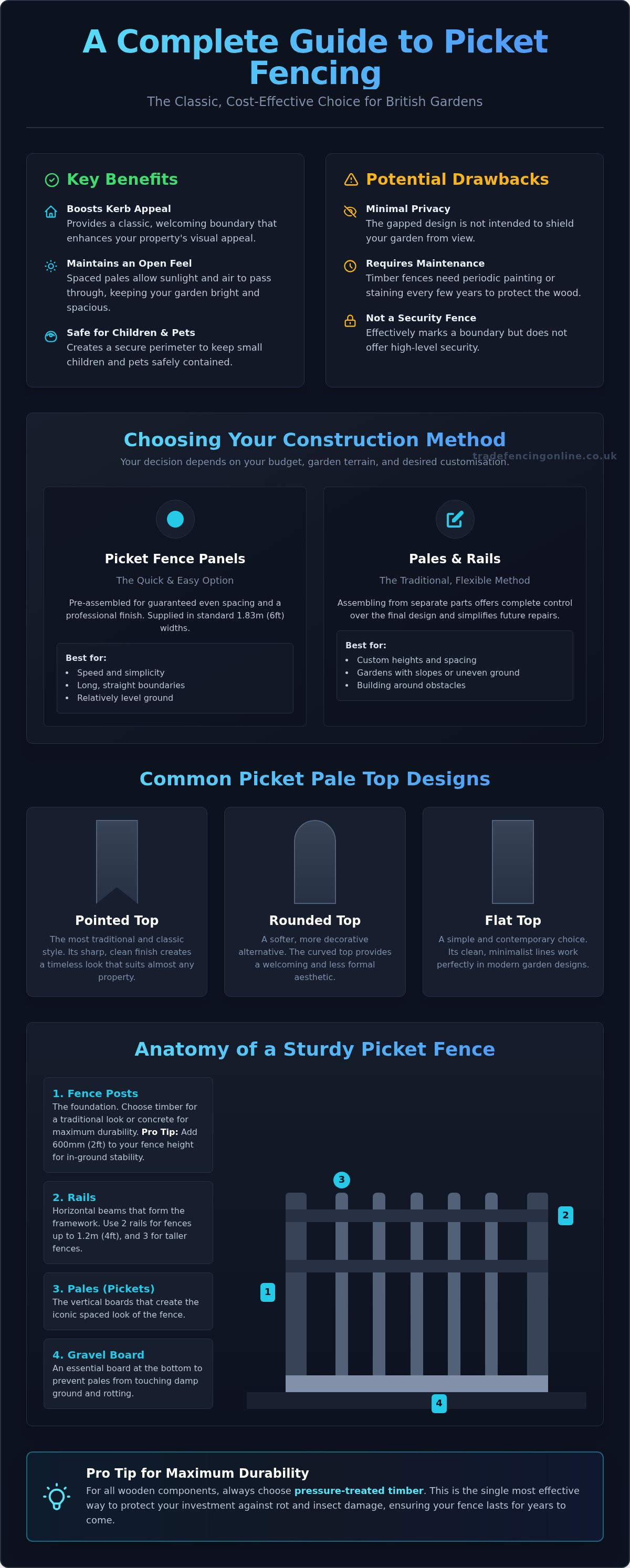
A picket fence is a traditional style of fencing constructed from spaced vertical boards, known as pales or pickets, attached to horizontal rails. Its primary purpose is decorative and for boundary demarcation, rather than providing high levels of privacy or security. This timeless design has been a staple in British gardens for generations, offering a clean and welcoming aesthetic. The classic Picket fence is instantly recognisable and remains a popular, cost-effective choice for homeowners looking to add character to their property.

This type of fencing is perfectly suited for front gardens, where creating an open, friendly boundary is often preferred over total seclusion. It is the quintessential choice for cottages and period properties, enhancing their traditional charm. A quality picket fence is also a highly practical solution for sectioning off areas within a larger garden, such as protecting a vegetable patch or creating a designated play area without casting large shadows.

Key Benefits of Picket Fencing

  • Boosts Kerb Appeal: Provides a classic, welcoming boundary that significantly enhances the visual appeal of your property from the street.
  • Maintains an Open Feel: Unlike solid panels, the spaced pales allow sunlight and air to pass through, keeping your garden feeling bright and spacious.
  • Safe for Children and Pets: Creates a secure perimeter to keep small children and pets safely contained without obstructing views of your garden.
  • Highly Customisable: Available in a range of styles, heights, and pale top designs. It can be painted or stained to match your home’s exterior.

Potential Drawbacks to Consider

  • Minimal Privacy: The design is not intended to shield your garden from view. For privacy, consider closeboard or lap panels instead.
  • Requires Maintenance: To protect the timber and maintain its appearance, a wooden picket fence will require periodic painting or staining every few years.
  • Not a Security Fence: While it effectively marks a boundary, it is not designed to offer high-level security for a property.

Choosing Your Style: Picket Fence Panels vs. Individual Components

When planning your new picket fence, you have two primary construction methods to choose from: installing pre-made panels or building from individual components. Your decision will depend on your budget, the terrain of your garden, and the level of customisation you require. Whichever route you take, remember that both methods require fence posts and the correct fixings to ensure a secure and long-lasting installation.

Picket Fence Panels: The Quick and Easy Option

For speed and simplicity, nothing beats pre-assembled picket fence panels. With the pales already fixed to horizontal rails, you are guaranteed consistent, even spacing for a professional finish. This makes them the ideal choice for long, straight boundaries on relatively level ground. Panels are typically supplied in standard 1.83m (6ft) widths, which simplifies project planning and ordering. If you need a quality fence erected quickly, panels are the most efficient solution.

Shop our range of quality picket fence panels.

Building with Pales & Rails: The Traditional, Flexible Method

Assembling your fence from separate pales (the vertical boards) and rails offers complete control over the final design. This traditional method allows you to set your own pale spacing, create custom heights, and easily build around obstacles. It is the best solution for gardens with slopes or uneven ground, as you can 'step' the fence by fixing the rails at different heights on each post. Furthermore, repairs are often simpler and more cost-effective, as you only need to replace a single damaged pale instead of an entire panel.

Common Picket Pale Top Designs

The profile of the pale top is a key design feature that defines the character of your fence. While there are many variations, most designs fall into one of three popular styles:

  • Pointed Top: This is the most traditional and classic picket style. Its sharp, clean finish creates a timeless look that suits almost any property.
  • Rounded Top: A softer, more decorative alternative to the pointed design. The curved top provides a welcoming and less formal aesthetic, making it popular for front gardens.
  • Flat Top: For a simple and contemporary look, the flat top pale is an excellent choice. Its clean, minimalist lines work perfectly in modern garden designs.

Essential Materials for a Sturdy Picket Fence Project

A successful picket fence installation relies on a complete system of quality components. While the pales define the classic look, it is the supporting structure that ensures your fence is strong, straight, and built to last. Using the correct materials from the start prevents future problems and protects your investment. For maximum durability, always choose pressure-treated timber for all wooden components to resist rot and insect damage.

Posts: The Foundation of Your Fence

Fence posts provide the essential vertical support for the entire structure. They must be installed securely to withstand wind and ground movement. You have two primary options:

  • Wooden Posts: Offer a traditional, seamless look and are simple to attach rails to. Pressure-treated timber is essential for in-ground use.
  • Concrete Posts: Provide maximum durability and are completely rot-proof, offering the longest service life.

To choose the right length, add at least 600mm (2ft) to your desired fence height. This extra length is buried in the ground to create a solid foundation. View our range of timber and concrete fence posts to find the ideal solution for your project.

Rails and Gravel Boards

Rails, also known as arris or cant rails, are the horizontal beams that run between posts. They provide the framework to which the individual pickets (pales) are attached. For a standard fence up to 1.2m (4ft), two rails are sufficient. For taller fences, a third rail is recommended for added strength.

A gravel board is a non-negotiable component for any quality timber fence. This board runs along the bottom, preventing the pales from making direct contact with the damp ground. This simple addition is the most effective way to prevent premature rot and significantly extend the life of your picket fence.

Fixings and Foundations

The right hardware and foundation materials ensure a secure and professional finish. Key items include:

  • Post Mix / Postcrete: A fast-setting concrete mix designed specifically for setting fence posts quickly and securely.
  • Screws and Nails: Always use galvanised or stainless steel fixings. Standard steel will rust and leave unsightly stains on your timber.
  • Brackets and Clips: Metal fence brackets offer a strong and straightforward method for attaching rails to posts, simplifying the installation process.

Picket Fence Costs: A Practical Price Breakdown

A transparent breakdown of costs is essential for any garden project. The final price of your picket fence depends on whether you choose pre-made panels or build it from individual components. Key factors like timber quality, fence height, and finishing touches will also influence your budget. We provide a clear guide to help you plan effectively.

Costing Picket Fence Panels

Using pre-made panels is the fastest way to install a new fence. A standard 1.8m wide panel typically costs between £30 and £55, depending on its height and picket style (e.g., pointed or rounded top). To calculate your total, simply measure your boundary and divide by the panel width (1.8m) to determine how many you need.

Remember to budget for these essential extras:

  • Fence Posts: You need one for each panel, plus one to finish the run. Expect to pay £15 - £25 per post.
  • Gravel Boards: These protect the fence from ground moisture. Costs are around £10 - £15 per 1.8m length.
  • Postcrete: Plan for at least one bag per post, costing approximately £6 - £8 each.

Costing a Component-Built Fence

Building from individual parts offers greater customisation. For a traditional look with 75mm wide pales and a 75mm gap, you will require 6-7 pales per metre. This method allows you to control spacing and design precisely. The main component costs are:

  • Pales: £1.50 - £3.00 each, depending on height and finish.
  • Rails: £6 - £10 per 3.6m length. You will need at least two rails between each post.
  • Posts and Gravel Boards: Priced as above, with posts required every 1.8m to 2.4m for stability.

Hidden Costs and Long-Term Value

Always factor in additional expenses. A quality tin of fence paint or stain will cost £20 - £40 and is vital for protecting untreated timber. If you are not installing the fence yourself, professional labour costs can range from £150 to over £300 per day.

For the best long-term value, choose pressure-treated timber. While the upfront cost is slightly higher, it is protected against rot and insect attack, saving you significant time and money on future maintenance. You can browse our full range of quality, pressure-treated fencing supplies at tradefencingonline.co.uk to get precise pricing for your project.

Installation and Maintenance for a Long-Lasting Fence

A quality picket fence is an investment in your property's security and kerb appeal. To ensure it stands for decades, correct installation and simple, regular maintenance are non-negotiable. A well-fitted fence will remain strong and straight, delivering excellent long-term value and performance.

While we recommend professional fitting for a guaranteed finish, these steps outline the process for a competent DIY installation.

Key Installation Steps

Achieving a professional result starts with a solid foundation. Follow these core principles for a structure that is built to last.

  • Set Your Fence Line: Use timber stakes and a taut string line to mark the exact position for your fence. This is critical for achieving a perfectly straight boundary.
  • Dig Post Holes: The industry standard is that one-third of your fence post should be in the ground. For a 1.8m (6ft) post, you should dig a 0.6m (2ft) deep hole.
  • Secure the Posts: Place the post in the hole and use a fast-setting concrete mix like Postcrete to fix it in place. Use a spirit level on two adjacent sides of the post to ensure it is perfectly vertical before the mix sets.
  • Attach Rails and Pales: Once the posts are completely solid (allow 24 hours), you can fix the horizontal rails between them. Finally, attach your individual pales or pre-made panels to the rails.

Essential Maintenance Tips

Protecting your investment is straightforward. An annual maintenance routine will keep your wooden picket fence looking its best and prevent the need for future repairs. This simple schedule is all that is required.

  • Inspect Annually: Walk the fence line and check for any loose fixings, tightening them as needed. Replace any split or damaged pales immediately to prevent further issues.
  • Clean Regularly: Once a year, use a stiff brush and a bucket of soapy water to scrub away any build-up of green algae, moss, or general dirt.
  • Re-coat as Needed: To protect the timber from moisture and UV damage, apply a fresh coat of quality wood paint or stain every 3-5 years.
  • Maintain Ground Clearance: Keep soil, compost, and dense vegetation from making direct contact with the base of the pales. This prevents moisture from seeping into the timber and causing rot.

By following these guidelines, you ensure your fence remains a durable and attractive feature of your property. For all the quality timber, posts, and ironmongery required for your project, visit us at tradefencingonline.co.uk.

Your Quality Picket Fence Starts Here

As we have explored, creating the perfect garden boundary comes down to a few key decisions. Whether you opt for the convenience of ready-made panels or the custom-fit of individual components, choosing the right materials is crucial for a durable and attractive result. With a clear understanding of the costs and installation steps, you are now fully equipped to plan your new picket fence project with confidence.

When you are ready to begin, Romford Fencing Ltd is your one-stop-shop. As a trusted local supplier for Essex and East London, we stock a wide range of quality panels, posts, and fixings. Take advantage of our fast, reliable local delivery service to get your materials on-site and on time. Find everything you need to bring your vision to life.

Shop our complete range of picket fencing supplies online

We are here to supply the quality materials you need to get the job done right. Your classic new fence is just a few clicks away.

Frequently Asked Questions

What is the best height for a picket fence?

The most common heights for a picket fence are 3ft (0.9m) and 4ft (1.2m). A 3ft fence is ideal for decorative front gardens where you want to mark a boundary without obstructing the view. For a more substantial perimeter or to deter casual entry, a 4ft height is a better choice. The best height ultimately depends on your specific requirements, balancing aesthetic appeal with practical function. Consider the scale of your property when making your selection.

How far apart should you space picket fence pales?

A standard rule for spacing picket fence pales is to leave a gap equal to the width of one pale, typically between 2 to 3 inches (50-75mm). This creates the classic, balanced appearance associated with this fencing style. For increased privacy, you can reduce this gap. Conversely, a wider gap can be used, but this may compromise the fence's uniform look and structural integrity. Consistent spacing is key to a professional finish.

Can you paint a pressure-treated picket fence?

Yes, you can paint a pressure-treated picket fence, but it is essential to wait for the wood to dry completely. The treatment process leaves moisture in the timber, which can take several weeks or months to evaporate. Painting too soon will trap this moisture and cause the paint to peel. Test the wood by sprinkling water on it; if it soaks in, it is ready to be painted. Always use a quality exterior wood primer and paint for a durable finish.

Is a picket fence a good option for keeping dogs in?

A picket fence can be effective for containing small to medium-sized dogs that are not prone to jumping. A 4ft high fence is generally sufficient for this purpose. However, it is not the most secure option for larger, more athletic dogs who could clear the height. You must also consider the gap between the pales, as small dogs or puppies could potentially squeeze through. For high-security needs, a taller, solid fence panel may be a better solution.

How long does a wooden picket fence last?

A quality, pressure-treated wooden picket fence can last for 15 to 20 years with proper installation and maintenance. The lifespan is influenced by the quality of the timber, the climate, and how well it is maintained. To maximise its durability, you should conduct regular inspections for any signs of rot or damage and apply a fresh coat of paint or wood preservative every few years. This protects the wood from moisture and UV damage, ensuring a long service life.

Do I need planning permission for a picket fence?

In the UK, you generally do not need planning permission for a picket fence. Permitted development rights allow you to erect a fence up to 2 metres in height, or up to 1 metre if it is adjacent to a highway. As most picket fences are 1.2 metres (4ft) or less, they typically fall within these limits. However, if your property is a listed building or in a conservation area, different rules may apply. Always check with your local planning authority to be certain.