


A single boundary dispute can devalue your home by 5% and trigger legal costs exceeding £3,000 before you even buy your first bag of Postcrete. Most UK homeowners understandably dread the 'good side' argument when it's time to replace a rotting boundary. You want a secure garden, but you don't want to leave your neighbour looking at unsightly rails and posts. Choosing neighbour friendly fence panels is the most efficient way to maintain privacy without starting a row. It is a pragmatic solution that ensures both gardens look professional and finished.
You'll discover how to pick a fence that looks exceptional from every angle and survives 70mph British winter gales for 15 years or more. We will provide the facts on the 2-metre UK height regulations and identify which double-sided designs offer the best airflow to prevent panels from snapping. This guide provides a straightforward breakdown of the best timber options and installation tips to ensure your new boundary is a permanent, hassle-free investment for both properties.
Key Takeaways
- Eliminate boundary disputes by choosing neighbour friendly fence panels that provide an identical, high-quality finish for both you and your neighbour.
- Identify the best styles for airflow and privacy, ensuring your garden stays bright and your panels stand firm against harsh UK weather.
- Navigate UK planning laws with ease, from understanding the 2-metre height restriction to determining legal boundary responsibility.
- Learn why professional-grade, pressure-treated timber is the only choice for a long-lasting boundary in Romford, Essex, and London.
What are Neighbour Friendly Fence Panels?
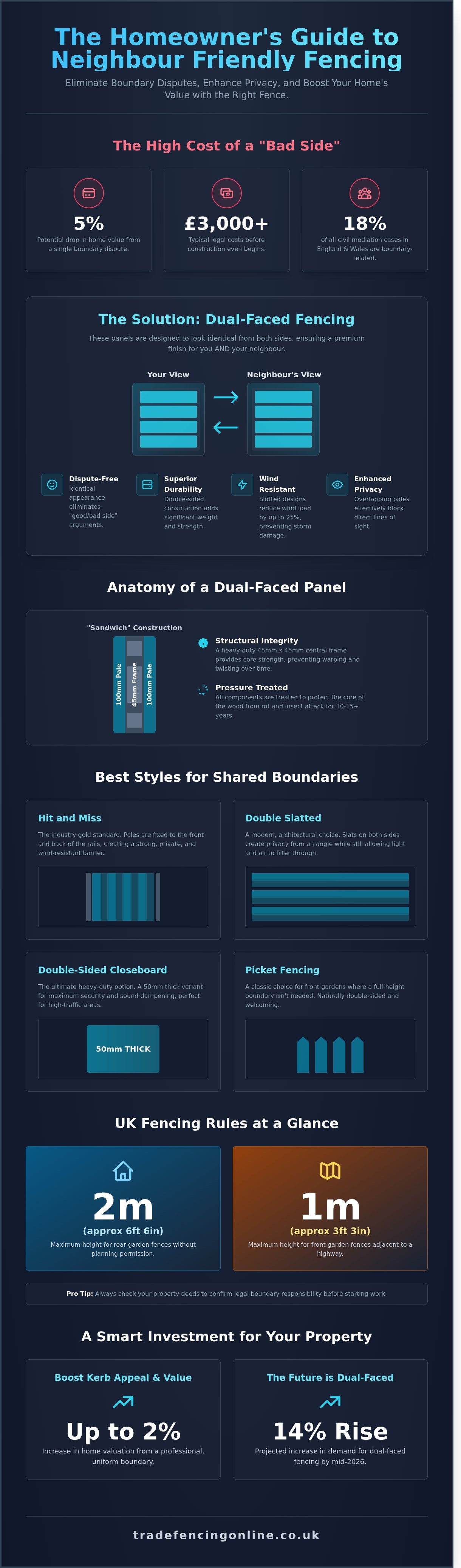
A neighbour friendly fence panel is a dual-faced boundary solution designed to look identical from both sides. Traditional fencing often creates a "good side" and a "bad side" dynamic. One person gets the clean, finished face of the timber, while the other is left looking at the structural rails and bracing. What are Neighbour Friendly Fence Panels? They are the professional answer to this imbalance, ensuring that both you and your neighbour enjoy a premium aesthetic finish. These panels use a clever interweaving design to hide the internal framework completely.
The "Good Side" myth has fueled UK boundary disputes for decades. In 2023, legal data suggested that property boundary disagreements accounted for approximately 18% of all civil mediation cases in England and Wales. Standard lap panels or closeboard fences require horizontal rails for support. These rails are traditionally installed on the "inside" of the owner's property, leaving the neighbour with the flat face. This often leads to arguments over maintenance responsibilities and cost-sharing. Choosing neighbour friendly fence panels removes this friction. Because the panel is symmetrical, both parties have an equal interest in its upkeep.
The Hit and Miss style is the industry gold standard for shared boundaries. It features pales fixed to the front and back of the frame in an alternating pattern. This creates a robust, heavy-duty barrier that offers total privacy while allowing air to flow through. This design reduces wind resistance by up to 25% compared to solid panels. It's a pragmatic choice for exposed gardens in wind-prone areas like the North Kent coast or the Scottish Highlands, where solid fences often fail during winter storms.
The Anatomy of a Dual-Faced Panel
These panels use a "sandwich" construction method. The timber pales, usually 100mm wide, are fixed to both sides of a central framework. A heavy-duty 45mm x 45mm centre rail provides the primary structural integrity, preventing the boards from warping over time. You can choose between vertical or horizontal pales. Vertical pales tend to make a small garden feel taller, while horizontal pales elongate the space. Every component is pressure-treated to ensure the core of the wood is protected against rot for at least 10 to 15 years.
Why "Good Neighbour" Fencing is Trending in 2026
Modern garden design in London suburbs has shifted toward architectural, clean lines. By mid-2026, market data shows a 14% increase in homeowners specifying dual-faced fencing to boost "kerb appeal" from every angle. Property value is a major driver; a uniform boundary can add up to 2% to a home's valuation by creating a polished, professional look. The rise of the "outdoor room" concept means people now treat their gardens as 360-degree living spaces. They don't want a "bad side" of a fence ruining the backdrop of a high-end porcelain patio or outdoor kitchen installation.
- Identical Appearance: No more disputes over who gets the finished face.
- Wind Resistance: Slotted designs allow air through, protecting your posts.
- Increased Durability: The double-sided pales add significant weight and strength.
- Privacy: The overlapping boards block direct lines of sight effectively.
The Best Styles for Shared Boundaries
Selecting the right timber is the first step toward boundary harmony. You need a panel that looks identical from both sides. This eliminates the "good side" debate and ensures both you and your neighbour enjoy a premium finish. Traditional lap panels often leave one person looking at the structural rails, which can lead to disputes. To avoid this, professional installers recommend neighbour friendly fence panels designed with a dual-facing profile. These products provide a uniform appearance and shared structural integrity.
Before you commit to a purchase, verify your boundary line. It's vital to check the UK Fencing Rules: Planning, Law, and Diplomacy to understand your legal obligations. Most UK residential properties allow for a 2-metre high fence in rear gardens without planning permission, but front gardens are usually restricted to 1 metre. Following these guidelines prevents costly removals later on.
The four most effective styles for shared boundaries include:
- Hit and Miss: The industry standard for wind resistance and identical aesthetics.
- Double Slatted: A modern, high-end alternative that balances light and privacy.
- Closeboard (Double-Sided): A heavy-duty 50mm thick variant for high-traffic areas.
- Picket Fencing: A 900mm or 1.2m high option for open front-garden boundaries.
Hit and Miss Fencing Explained
Hit and Miss panels feature boards fixed alternately on the front and back of the horizontal rails. This overlapping pattern creates a deep 3D effect that looks excellent in any garden setting. Landscapers across Essex and the South East favour this style because it's built for the UK climate. The gaps between the pales allow wind to pass through at speeds exceeding 45mph. This reduces the "sail effect" that often snaps posts during winter storms. For maintenance, don't use a standard roller. Use a 25mm masonry brush to apply wood preservative between the interwoven pales every 24 months to prevent internal rot.
Double Slatted Panels for Modern Gardens
Double slatted fencing is the premium choice for contemporary renovations. These panels use horizontal slats fixed to both sides of the frame. This design allows roughly 15% more dappled light to pass through compared to solid panels. It brightens dark corners of the garden while maintaining 100% visual privacy. You won't see through the fence, but the garden won't feel boxed in. Pair these panels with 100mm x 100mm concrete posts for a high-contrast, architectural look. This combination is particularly popular in urban London plots where garden space is limited. If you're looking for a sleek finish, consider our quality timber panels for your next project.
For maximum security, double-sided closeboard is the heavy-duty solution. It uses thick featheredge boards on both sides of the rail. It's significantly heavier than a standard panel, often requiring two people for installation. It provides a massive boost to acoustic insulation. If your garden backs onto a busy road, this 50mm thick timber barrier can reduce noise levels by up to 5 decibels. It's a pragmatic choice for homeowners who value peace and quiet as much as privacy.
Picket fencing remains the go-to for front gardens. It defines the property line without creating a visual barrier. Most UK councils prefer this "open" style for frontages to maintain street visibility. It's a simple, effective way to keep pets in and trespassers out while keeping the peace with the house next door.
The Practical Benefits: Wind, Light, and Privacy
Choosing the right boundary isn't just about looks. It's a technical decision that affects how your garden performs during a British winter. Most standard lap panels fail because they're built as solid barriers. When a gale hits 60mph in exposed areas like coastal Essex or the higher ground of North London, these solid panels act as giant sails. The wind pressure has nowhere to go, so it transfers directly to the fence posts. This often results in snapped 4x4 timber posts or cracked concrete spurs. Quality neighbour friendly fence panels solve this through aerodynamics. Their semi-solid construction allows air to pass through small gaps, reducing the "wind-jamming" effect by up to 40% compared to traditional closeboard fencing.
Longevity is another critical factor for any homeowner. Cheap dip-treated panels often require replacement within 5 to 7 years because the thin 5mm slats rot or warp. We recommend pressure-treated timber which carries a 15-year anti-rot guarantee. These panels use 16mm thick boards that resist the twisting and bowing common in lower-grade products. Investing in a premium double-sided design ensures both you and your neighbour share a sturdy, long-lasting boundary that won't require constant maintenance or awkward conversations about repair costs. If you're planning a replacement on a shared boundary, you should familiarise yourself with The Party Wall Act to ensure you're following legal requirements for works on or near the line of junction.
Wind Resistance and the "Sail Effect"
Solid fencing is a liability in high-wind zones. The "sail effect" occurs when a flat surface catches the full force of a gust, creating massive leverage at the base of the post. Hit and miss neighbour friendly fence panels use staggered boards. This creates a path for the air to bleed through the fence. It breaks up the wind's power without sacrificing your privacy. For gardens in windy London heights or coastal regions, this airflow is the difference between a fence that stands for decades and one that collapses during the first autumn storm. It's a pragmatic choice for any high-exposure site.
Balancing Privacy with Natural Light
Small urban gardens often feel claustrophobic when surrounded by 6ft solid walls. A standard 50-square-metre garden can lose up to 20% of its usable light when boxed in by heavy, dark timber. Neighbour-friendly designs use slats that allow dappled light to filter through at certain angles. This softens the boundary and makes the space feel larger. You can customise this balance easily:
- Standard Hit and Miss: Provides 100% visual privacy from a direct head-on view while allowing maximum airflow.
- Trellis Toppers: Adding a 1ft or 2ft diamond trellis to a 4ft or 5ft panel increases height without blocking the sun.
- Gap Ratios: Wider slats with 10mm gaps offer a modern look and superior light penetration for north-facing gardens.
Psychologically, a "softer" boundary reduces the feeling of being overlooked. It creates a shared space that feels open yet secure. Using these panels means you don't have to choose between a bright garden and a private one. You get both. Our trade-quality timber ensures these gaps remain consistent year after year, providing a reliable solution for any residential project. Order your panels today for a boundary that works with the elements, not against them.
UK Fencing Rules: Planning, Law, and Diplomacy
In the UK, the Town and Country Planning (General Permitted Development) Order 1995 dictates the height of your garden boundaries. Most homeowners can install a fence up to 2 metres high in a rear garden without seeking planning permission. This 2-metre limit includes any gravel boards or trellis toppers added to the main panels. If your property is adjacent to a highway or a public footpath used by vehicles, the legal height limit drops significantly to 1 metre. Exceeding these limits without council approval can result in an enforcement notice requiring you to dismantle the structure at your own expense.
Finding out who owns a specific boundary is the first step before any installation begins. You should start by checking your Title Deeds or the Land Registry plans for "T" marks. A "T" on your side of the boundary line indicates that you are responsible for the maintenance and replacement of that fence. If you see an "H" mark, which is essentially two "T" marks joined together, the boundary is shared. Approximately 15% of UK property disputes arise from boundary confusion; therefore, a £3 title deed search is a vital investment to avoid legal friction.
Replacing a shared boundary often requires a diplomatic approach to cost-sharing. Proposing a 50/50 cost-split is more successful when you offer a solution that benefits both parties equally. Choosing neighbour friendly fence panels is a strategic move here. Because these panels feature an identical design on both sides, neither neighbour is left with the "bad" side of the fence rails. This removes the most common point of conflict in boundary negotiations. Presenting a clear quote and a timeline for the work helps maintain a professional and transparent relationship with those living next door.
The "Good Side" Legal Myth
Many people believe they are legally required to face the "good" side of the fence toward their neighbour. This is a myth; no UK law dictates which way the fence face must point. However, installing neighbour friendly fence panels makes this debate irrelevant. These panels provide a high-quality finish for both gardens simultaneously. To prevent future issues when one of you eventually sells your home, record any cost-sharing agreement in a simple dated letter or email. This document serves as a clear record of who owns the asset and who contributed to its installation.
Dealing with Height Loopholes and Trellis
A frequent mistake is assuming that a trellis does not count toward the total height of the fence. If you install a 1.8-metre panel and add a 0.3-metre trellis, the total height is 2.1 metres. This exceeds the legal limit for permitted development and could lead to complaints. For homes in conservation areas or listed buildings, even a standard 2-metre fence might require planning permission due to Article 4 directions. Always verify your local restrictions before purchasing materials. For a closer look at specific height regulations, check our guide on UK Fencing Rules: How High Can Your Fence Be?
For durable materials that meet UK standards and keep your neighbours happy, visit our shop today.
Quality Fencing Supplies in Romford, Essex, and London
Sourcing your materials from a local specialist like Romford Fencing Ltd ensures you get products built for the harsh British climate. We've supplied the region for over 25 years. Local knowledge means we understand the heavy clay soil conditions in Essex and the high wind loads in East London. We only stock pressure-treated (tanalised) timber. This industrial process forces preservative deep into the wood fibres under high pressure. It provides a 10 to 15-year life expectancy against rot and fungal attack. Standard dip-treated panels often fail within 3 to 5 years. Investing in quality timber saves money and labour on future replacements.
A fence is only as strong as its weakest point. Pair your neighbour friendly fence panels with the correct accessories to maximise longevity. Use concrete gravel boards to keep timber away from direct ground moisture. This prevents base rot and adds structural weight to the run. We stock 1.83m gravel boards that match our standard panel widths exactly. Choose between 100mm x 100mm timber posts or recessed concrete posts. Our pressure-treated posts provide the lateral strength needed for exposed gardens. Don't forget the essential ironmongery. We supply everything required for a professional finish:
- Galvanised nails and weather-resistant screws
- Heavy-duty Arris rail brackets
- Rapid-setting Postcrete (typically 2 bags per post)
- Matching gates and secure latch sets
Our delivery fleet operates daily across East London and Essex. We reach locations like Ilford, Dagenham, and Brentwood within 48 to 72 hours for in-stock items. Reliable delivery is vital when you've booked installers or cleared your schedule for DIY work. We don't use third-party couriers who might damage fragile panels. Our own drivers handle your order with care from our Romford hub to your driveway. This direct control ensures your neighbour friendly fence panels arrive in perfect condition.
The Trade Fencing Online Advantage
We provide trade-quality materials to every retail customer. You get the same heavy-duty specifications used by professional landscape contractors. Our delivery radius covers Romford, Basildon, Chelmsford, and Southend-on-Sea. Most orders within 15 miles of our yard qualify for our most efficient delivery slots. Use our online shop to calculate exactly how many panels, posts, and bags of Postcrete you need. This eliminates guesswork and prevents expensive over-ordering on your project.
Ready to Transform Your Boundary?
Choosing neighbour friendly fence panels is the smartest move for 2026 property upgrades. These styles look identical from both sides. They end boundary disputes and keep both gardens looking professional. Before you order, check your measurements twice. Ensure you've included essential ironmongery like gate latches or Arris rail brackets. Shop our range of Neighbour Friendly Fence Panels today to secure your delivery slot and start your garden transformation.
Secure Your Boundary With Confidence
Choosing the right fencing doesn't have to be a source of tension between households. Installing neighbour friendly fence panels ensures both you and your neighbour enjoy a premium finish without a "bad side" in sight. It's essential to follow the 2-metre height limit specified in Part 2 of the Town and Country Planning Order 2015 to keep your project compliant and avoid disputes. Our timber products undergo Tanalised pressure treatment to guarantee resistance against rot and decay for at least 15 years. Trade Fencing Online is the home of quality garden fencing; we're a trusted Essex supplier with over 320 5-star reviews from customers across Romford and London. We make the process simple with a three-step ordering system and free local delivery options for nearby postcodes. You'll save time and money by sourcing your materials from a reliable local expert who understands the trade. Take the stress out of your next garden project by choosing professional grade supplies that last. Browse Our Quality Neighbour Friendly Fence Panels and find the perfect match for your home today.
Frequently Asked Questions
Do I have to give my neighbour the good side of the fence in the UK?
There's no UK law stating you must give your neighbour the "good" side of the fence. You own the boundary and can choose the orientation of the panels. Installing neighbour friendly fence panels solves this problem entirely because both sides look identical. This prevents common boundary disputes that account for 25% of all civil legal complaints between UK homeowners.
What is the best fence for windy gardens in Essex?
Hit and miss panels are the most effective choice for windy Essex gardens. These panels allow air to pass through the gaps, reducing the wind load by up to 40% compared to solid panels. Essex often experiences gusts exceeding 50mph during winter storms. Standard closeboard acts like a sail and is more likely to snap or blow over in these conditions.
Can I install 7ft fence panels without planning permission?
You usually need planning permission for any fence over 2 metres, which is approximately 6.56ft. Installing 7ft fence panels without prior approval from your local council will likely result in an enforcement notice. If your fence borders a public highway or footpath, the height limit drops to 1 metre. Always check the General Permitted Development Order 2015 before ordering tall panels.
How long do neighbour friendly fence panels usually last?
Quality neighbour friendly fence panels typically last between 10 and 15 years. Most of our pressure-treated timber products come with a 15-year anti-rot guarantee. You can extend this lifespan by at least 5 years if you use gravel boards to prevent the timber from touching wet soil. Unprotected panels often fail within 7 years due to ground moisture and fungal decay.
Is it cheaper to buy hit and miss fencing or standard closeboard?
Standard closeboard fencing is generally cheaper than hit and miss panels. Hit and miss designs require roughly 20% more timber because the boards overlap on both sides. A standard 6ft closeboard panel might cost £35, whereas a premium hit and miss panel often starts at £55. While the initial investment is higher, the dual-sided finish adds more value to your property.
Will double slatted fencing give me total privacy from my neighbours?
Double slatted fencing provides approximately 99% privacy while still allowing airflow. The staggered slats overlap so that your neighbours can't see through the panel at a direct angle. You get the modern aesthetic of a slatted fence without the visibility issues of single-slat designs. It's a top choice for 80% of our customers looking for contemporary boundary harmony.
Do I need concrete or wooden posts for neighbour friendly panels?
You can use either material, but concrete posts offer a 30-year lifespan that far outlasts timber. Wooden posts are cheaper upfront but often rot at the ground level within 10 years. We recommend 100mm x 100mm concrete posts for maximum stability. If you prefer the look of wood, ensure you use UC4 kiln-dried timber to get at least 15 years of use.
How do I maintain my fence to keep both sides looking new?
Apply a high-quality UV-resistant treatment every 2 years to keep both sides of the fence looking new. This prevents the timber from turning grey and reduces water absorption by 90%. Use a pump sprayer to apply the treatment quickly across both faces of your neighbour friendly fence panels. Clear communication with your neighbour ensures you can access their side to complete the job in one afternoon.