


Choosing the right fence for your garden can be a challenge. You need a boundary that provides privacy, stands up to unpredictable British weather, and represents the best value for your budget. With terms like 'waney edge' and 'closeboard' often causing confusion, it’s difficult to know which option is the right fit. For many UK homeowners, traditional lap panel fencing remains a popular choice, known for its classic look and cost-effective price point.
But is it durable enough for your needs, and how can you tell a quality panel from one that will fail in a few years? This guide delivers the straightforward answers. We cover the essential pros and cons, show you exactly what to look for to ensure durability, and provide clear advice on installation and maintenance. You’ll gain the confidence to decide if lap panel fencing is the best investment for your garden boundary.
Key Takeaways
- Understand the balance between cost and durability to decide if traditional lap panel fencing is the right choice for your garden boundary.
- Identify a quality, long-lasting panel by checking for pressure treatment and a sturdy frame construction before you purchase.
- Discover why installing gravel boards is a non-negotiable step to protect your fence from ground-level moisture and prevent premature rot.
- Learn simple maintenance tips that can significantly extend the lifespan of your fencing, protecting your investment for years to come.
What is Lap Panel Fencing? The Anatomy of a UK Favourite
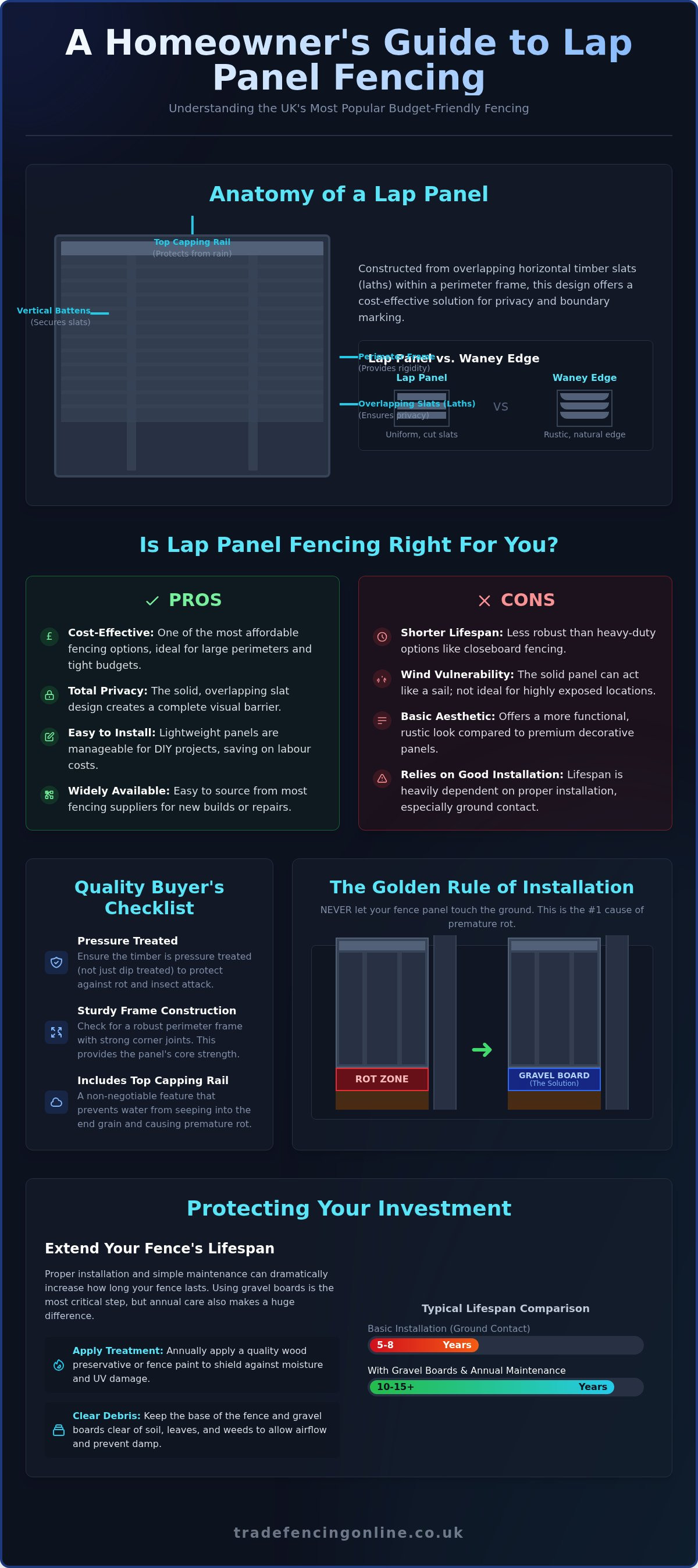
Lap panel fencing is one of the most popular and traditional fencing solutions across the United Kingdom, valued for its low cost and straightforward, effective design. While there are many different types of fencing available, this style provides excellent value and remains a go-to choice for homeowners and tradespeople alike. It is constructed from horizontal timber slats that overlap, creating a solid and private barrier.
Often confused with 'waney edge' panels, the key difference lies in the slats. Lap panels use uniformly cut timber slats, known as laths, for a neat finish. In contrast, waney edge panels use slats with one straight edge and one naturally curved, rustic edge left by the bark. Lap panels are manufactured from treated softwood, like pine or spruce, and come in standard 6ft (1.83m) widths with common heights of 6ft, 5ft, and 4ft.
How Lap Panels Are Constructed
The construction of a lap panel is simple yet robust. The design centres on the horizontal timber slats which are layered to overlap one another, ensuring no gaps for complete privacy. These slats are contained within a perimeter frame that provides the panel with its core strength and rigidity. To hold the slats securely in place, vertical battens are fixed to the front and back. Quality panels are finished with a top capping rail, a crucial feature that adds structural integrity and helps protect the panel from water ingress.
Common Uses for Lap Panel Fencing
Due to its practical design and budget-friendly price point, lap panel fencing is a versatile choice for a wide range of domestic and commercial applications. Its most common uses include:
- Garden Boundaries: An ideal and economical solution for clearly marking property lines between neighbouring gardens.
- Privacy and Screening: Perfect for creating a private, enclosed space in back gardens or for screening off unsightly areas such as bins or compost heaps.
- Large-Scale Projects: A popular choice for housing developments or large perimeters where keeping costs down is a key factor.
While excellent for privacy and demarcation, it is important to note that these panels are not intended for high-security applications. For more robust security needs, a heavy-duty closeboard panel is recommended.
The Pros and Cons: Is Lap Panel Fencing Right for You?
Lap panel fencing is a UK garden staple for a reason. It offers a practical, low-cost solution for marking boundaries and ensuring privacy. However, it's essential to weigh its benefits against its limitations to decide if it's the right choice for your property. This straightforward guide covers the key factors to help you make a practical decision.
For a quick overview, here is a direct comparison of the main advantages and disadvantages:
| Pros of Lap Panel Fencing | Cons of Lap Panel Fencing |
|---|---|
| Excellent value and low initial cost. | Shorter lifespan than closeboard panels. |
| Provides complete privacy with its solid design. | Less resistant to damage from strong winds. |
| Simple and fast to install for DIY projects. | A more basic, rustic aesthetic. |
| Widely available from most fencing suppliers. | Requires good installation to maximise lifespan. |
Key Advantages of Lap Panels
- Cost-Effectiveness: This is the primary reason many choose lap panels. They are one of the most affordable fencing options on the market, allowing you to secure a large perimeter for a modest budget.
- Privacy: The horizontal, overlapping slat design creates a solid barrier. This makes lap panel fencing an excellent choice for screening overlooked gardens and creating a private outdoor space.
- Ease of Installation: Their lightweight construction makes them manageable for competent DIYers. Before starting, however, it is essential to check the official UK planning permission rules regarding fence height to ensure your project is compliant.
- Wide Availability: As a popular, traditional style, these panels are stocked by almost every fencing supplier, making them easy to source for new projects or to find a match for repairs.
Potential Disadvantages to Consider
- Durability: While perfectly adequate for many gardens, lap panels are generally less robust than heavy-duty options like closeboard fencing. The frame-and-slat construction is not designed to withstand severe impacts.
- Wind Resistance: The solid design that provides privacy can also act like a sail in high winds. For exposed, windy locations, a stronger fence type like closeboard or a slatted panel that allows air to pass through is a more suitable choice.
- Lifespan: A lap panel's lifespan is heavily dependent on its treatment and installation. To prevent rot, it is vital they are installed with timber or concrete gravel boards and are regularly treated if not pressure-treated from the supplier.
- Aesthetics: The appearance is functional and rustic. While ideal for traditional gardens, it may not suit modern or architectural property styles where a more refined finish is desired.
How to Choose Quality Lap Panels: A Buyer's Checklist
When selecting lap panel fencing, the initial price tag only tells part of the story. A cheap, poorly constructed panel will cost more in the long run through frequent repairs and early replacement. This checklist will help you identify a quality panel that offers genuine value, durability, and a longer service life for your property boundary.
Understanding Wood Treatment: Dip vs. Pressure Treated
The single most important factor for a fence panel's longevity is its wood treatment. There are two common methods:
- Dip Treatment: This is a surface-level application where the panel is briefly submerged in a preservative. It offers basic protection but is less durable and will require regular re-treatment to prevent rot. These panels often have a golden brown colour.
- Pressure Treatment (Tanalised): Here, preservative is forced deep into the wood's grain under high pressure. This provides robust, long-lasting protection from the inside out against rot and insect attack. For assurance of quality, treatments should adhere to standards set by authorities like the Wood Protection Association. Pressure-treated panels typically have a faint green or light brown tint and represent a far better long-term investment.
The Importance of the Frame and Capping
A panel's strength comes from its frame. A flimsy frame will quickly lead to bowing and weakness. When inspecting a panel, check for a thick, substantial frame that provides rigidity. Look for a top capping rail; this is a critical feature that prevents rainwater from seeping into the end grain of the vertical slats, which is a common point of failure. Finally, check that the frame is securely fixed with galvanised nails or staples and reject any panels with split or badly warped timbers.
Standard Sizes and Compatibility
To ensure your new panels fit existing posts, it's vital to confirm the dimensions. The standard UK width for fence panels is 6ft (approximately 1.83m). This size is designed to fit perfectly between standard concrete or timber fence posts. Common heights available include:
- 3ft (0.9m)
- 4ft (1.2m)
- 5ft (1.5m)
- 6ft (1.8m)
Choosing a standard size makes installation straightforward and cost-effective. Browse Romford Fencing Ltd's range of quality, treated lap fence panels.
Installation Essentials: Posts, Gravel Boards, and Fixings
A successful fence installation depends on more than just the panels. The right posts, gravel boards, and fixings provide the essential foundation for a strong, long-lasting boundary. Choosing quality components ensures your investment in lap panel fencing is protected from the outset and delivers a professional finish.
Wooden vs. Concrete Posts
Your choice of fence post determines both the final look and the long-term maintenance requirements of your fence. Each type offers distinct advantages.
- Wooden Posts: Offer a classic, seamless appearance that blends perfectly with timber panels. To ensure longevity, always choose pressure-treated (tanalised) timber posts to resist rot and insect attack.
- Concrete Posts: Provide maximum durability and are completely maintenance-free, making them a fit-and-forget solution. Slotted concrete posts are an extremely popular choice as they make installation and future panel replacement incredibly simple.
For post length, a simple rule applies: add 2 feet (approx. 600mm) to the desired height of your fence. This extra length is for securing the post in the ground. For a 6ft high fence, you will need an 8ft post.
Why You Should Always Use a Gravel Board
A gravel board is the single most important component for extending the life of your fence panels. This board, made of either treated timber or reinforced concrete, sits between the bottom of the fence panel and the ground.
This creates a vital protective barrier, preventing direct contact with damp soil and standing water. This is the best way to prevent moisture from seeping into the panel, which is the primary cause of premature rot and decay. It is a small additional cost that delivers a significant return by maximising the lifespan of your fence.
Fixing Panels to Posts
The method for securing your panels depends on your choice of post. Using the correct fixings is essential for a secure and durable installation.
- For Wooden Posts: You can use galvanised fence clips (U-brackets) for a strong and neat finish. Alternatively, you can screw the panel directly to the post through its vertical side battens.
- For Slotted Concrete Posts: Installation is straightforward. The panels simply slide down into the groove within the post, requiring no additional fixings.
- Important: Always use exterior-grade, galvanised or stainless steel screws and nails for any timber-to-timber fixing. This prevents rust, which can weaken the connection and cause unsightly stains on your fence.
Ensuring you have the correct posts, gravel boards, and fixings is crucial for a professional result. You can find a complete range of quality fencing components at Trade Fencing Online.
Maintenance and Lifespan: Protecting Your Investment
Lap panel fencing is a cost-effective solution, and with simple, regular maintenance, you can ensure it provides privacy and security for many years. A small investment in time protects your fence from the UK weather, preventing rot and damage while keeping it looking its best. Taking these practical steps will maximise the lifespan of your fencing.
Annual Fence Care Routine
A yearly check-up is the most effective way to extend the life of your fence. We recommend a simple routine, ideally carried out in spring after the worst of the winter weather has passed.
- Inspect for Damage: Check each panel for any slats that have become loose or cracked during winter storms.
- Clean Surfaces: Use a stiff brush and water to gently scrub away any build-up of dirt, algae, or moss. Avoid high-pressure washers, as they can damage the timber.
- Check Fence Posts: Firmly grip each post and check for excessive movement. A wobbly post can compromise the entire fence line and should be re-secured.
- Clear Gravel Boards: Ensure soil, leaves, and other debris are not piled up against your gravel boards, as this traps moisture and accelerates rot.
Treating, Staining, and Painting
Timber is a natural material that needs protection from the elements. Applying a quality wood treatment every 2-3 years is essential for sealing the wood against moisture ingress, which is the primary cause of rot and decay. This simple action is key to a long-lasting fence.
For additional protection and a fresh look, you can use a specialist fence paint or stain. This not only adds a layer of weather resistance but also allows you to customise the colour of your boundary. Before applying any product, always ensure the fence panel is clean and completely dry for the best possible finish and adhesion.
Simple Repairs
Most common issues with lap panel fencing are straightforward to fix. Addressing minor damage promptly prevents it from becoming a larger, more costly problem.
A single loose slat can be easily re-secured using a galvanised nail or screw. If an entire panel feels flimsy after a storm, you can often strengthen it by fixing an extra vertical batten to the rear face. For more significant damage, replacing a single panel is a simple task. The old panel can be unclipped and removed from the posts, and a new one slotted into its place.
Need replacement panels or posts? Order online for fast local delivery.
Secure Your Garden with Quality Lap Panel Fencing
Lap panel fencing remains a top UK choice for a reason: it delivers privacy and value in one straightforward package. Remember, the key to a long-lasting fence is selecting quality, pressure-treated panels and installing them correctly with gravel boards to protect your investment. By focusing on these fundamentals, you ensure your new boundary will stand strong against the British weather for years to come.
When you’re ready to build, Trade Fencing Online is your trusted local supplier for Essex and East London. We stock high-quality, durable lap panel fencing and offer fast delivery options to get your project moving. We provide the materials you need, with the reliable service you expect.
Shop our full range of quality lap fence panels online.
Build a better boundary today and enjoy the privacy and security you deserve.
Lap Panel Fencing: Frequently Asked Questions
How long do lap fence panels typically last?
A well-maintained, pressure-treated lap panel fence can last for 10-15 years. The lifespan depends heavily on the quality of the initial treatment and ongoing care. Using concrete or timber gravel boards is essential as they prevent the panel from having direct contact with damp ground, which is the primary cause of rot. Regular treatment with a quality wood preservative every few years will significantly extend the life of your fencing.
What is the difference between lap panels and waney edge panels?
The main difference is construction. Lap panels are made from straight-cut horizontal timber slats that overlap and are fully enclosed within a perimeter frame, giving a neat, uniform finish. Waney edge panels use slats cut from the edge of a log, leaving one wavy, bark-covered edge. They are often a more rustic, lower-cost option and may not be as robust as a fully-framed lap panel.
Are lap panel fences strong enough for windy areas?
Lap panels offer adequate strength for most sheltered residential gardens. However, in highly exposed locations prone to strong winds, they are not the most robust choice. For these areas, we recommend a more durable option like closeboard (featheredge) fencing. The strength of any fence is also dependent on using high-quality, correctly installed fence posts set securely in concrete.
Can you paint or stain lap panel fencing?
Yes, you can paint or stain lap panel fencing. This not only allows you to customise the colour to suit your garden design but also adds an extra layer of protection against moisture and UV damage. For new, pressure-treated panels, it is best to let the timber weather for a few months before applying any paint or stain. This ensures the treatment has fully dried and the new finish will adhere properly.
How heavy is a standard 6x6 lap fence panel?
A standard 6ft x 6ft (1.83m x 1.83m) lap fence panel typically weighs between 20kg and 25kg. The exact weight can vary depending on the timber density and its moisture content. A newly treated, wet panel will be at the heavier end of this range. This is an important consideration for transport and installation, as it is often a two-person job to handle the panels safely.
Do I need planning permission to erect a lap panel fence?
In the UK, you generally do not need planning permission to erect a new fence that is up to 2 metres (approx. 6ft 6in) high in a rear garden. However, if the fence is adjacent to a highway used by vehicles, the maximum height is 1 metre. These rules can vary for listed buildings or in conservation areas. If you are in any doubt, it is always best to check with your local council planning authority first.