


The quickest way to straighten a leaning fence can be the wrong one. Before pushing a panel upright or adding a brace, find out whether the post has rotted, the fixings have failed or the ground has shifted. Knowing how to straighten a leaning fence starts with diagnosing the cause, not forcing it back into place.
Check the post, panel and soil before deciding what to do. This guide explains how to tell whether the fence needs stabilising, a post reset or a replacement. You’ll also find practical guidance on choosing the right supplies and when fencing installation is the sensible next step.
Key Takeaways
- Use the movement pattern and condition of the fence to distinguish loose ground, a failing post and a damaged panel.
- Learn how to straighten a leaning fence by choosing whether to stabilise, reset or replace the post.
- Support the fence temporarily and check alignment during the repair, adjusting your approach to the site conditions.
- Inspect the finished fence and surrounding ground, then match replacement posts and postmix to the repair.
How to Straighten a Leaning Fence: Find the Cause Before Repairing It
The right repair depends on what has moved or deteriorated. A fence leaning after heavy rain may have loose soil around a post. If the post stays upright while the panel sags, the fault may be at the panel’s connection points instead. Check the structure before bracing it or digging. For a general overview of types of fences and their construction, consider how the panel and its supports work together.
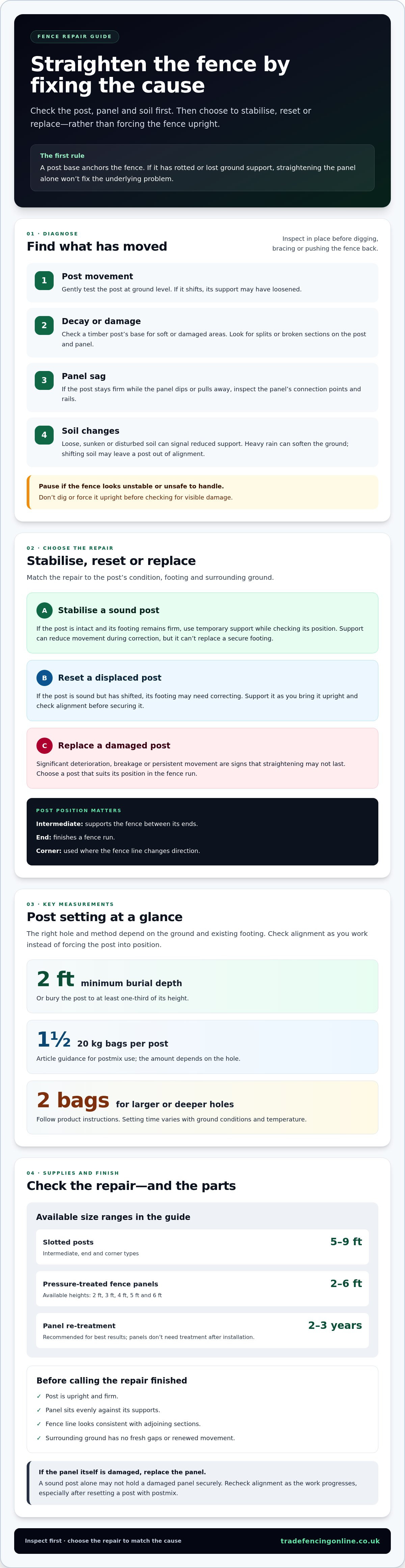
The post base anchors the fence. If it has rotted or lost support in the ground, pushing the panel upright won’t fix the underlying problem.
How to tell whether the post, panel or ground is causing the lean
Inspect the fence in place first. Look at the post, panel and soil around the base. This checklist can help you narrow down the cause:
- Post movement: Gently test the post at ground level. If it shifts, its support may have loosened.
- Visible decay or damage: Check the base of a timber post for soft or damaged areas. Look for splits or broken sections on the post and panel.
- Panel sag: If the post remains firm but the panel dips or pulls away, inspect its connection points and rails.
- Soil changes: Look for loose, sunken or disturbed soil around the post. Heavy rain can soften the ground, while shifting soil may leave a post out of alignment.
These clues help distinguish a panel problem from a post or ground issue. Don’t dig or force the fence upright until you’ve checked for visible damage. If the fence appears unstable or unsafe to handle, stop and arrange fencing installation. If inspection points to a damaged or unsuitable post, browse fence posts for replacement options. Romford Fencing Ltd supplies intermediate, end and corner posts, with heights from 5 ft to 9 ft.
How to Straighten a Leaning Fence Post: Stabilise, Reset or Replace
Once you’ve identified the post as the problem, choose a repair that matches its condition. A small correction may be suitable for a sound post, but a damaged post or one that keeps shifting needs more than a quick push back into place. The footing, soil and adjoining fence also affect the repair.
- Stabilise a sound post. If the post is intact and its footing remains firm, use temporary support to hold it steady while you check its position. Support can reduce movement during the correction, but it can’t replace a secure footing.
- Reset a displaced post. If the post is sound but has shifted, its footing may need correcting. Support the post as you bring it upright and check its alignment before securing it. Postmix can set timber, metal or concrete posts. Setting time varies with ground conditions and temperature.
- Replace a damaged post. Significant deterioration, breakage or persistent movement are signs that straightening may not provide a lasting repair. Choose the right post for its position in the fence run: intermediate, end or corner.
When can you straighten a post, and when should it be replaced?
A firm, intact post may be suitable for correction if its footing and the surrounding ground can support it. Don’t assume a brace will solve recurring movement. If the post is badly deteriorated, broken or unstable, replacement may be the better option. For a repair that needs more than a straightforward DIY correction, Romford Fencing Ltd offers fencing installation.
There’s no single hole size or method that suits every fence. Ground conditions and the existing footing affect the work, so check alignment as you go instead of forcing the post into position. When setting a post, bury it at least 2 ft or one-third of its height. Postmix use depends on the hole: the guidance is about 1½ 20 kg bags per post, or 2 bags for larger or deeper holes. Follow the product instructions, as setting time varies with ground conditions and temperature.
Finish the Fence Repair: Check the Result and Get the Right Supplies
Before packing away, inspect the whole repaired section. Check that the post is upright and firm, the panel sits evenly against its supports, and the fence line looks consistent with adjoining sections. Look at the surrounding ground too. Fresh gaps, disturbed soil or renewed movement can indicate that the footing needs more attention. Don’t consider the repair finished if the fence still shifts.
Knowing how to straighten a leaning fence includes checking the repair, not just moving the post. If you’ve reset it with postmix, remember that setting time varies with ground conditions and temperature. Recheck alignment as the work progresses and follow the product instructions.
What fencing supplies may be needed after inspection?
Choose replacement parts to suit their position in the fence run. Intermediate posts support the fence between its ends, end posts finish a run, and corner posts are used where the fence line changes direction. These roles aren’t interchangeable. Romford Fencing Ltd supplies slotted posts in these types, with heights from 5 ft to 9 ft. If inspection shows the panel itself is damaged, replace it rather than relying on a sound post to hold it securely. Pressure-treated fence panels are available in 2 ft, 3 ft, 4 ft, 5 ft and 6 ft heights. They don’t need treatment after installation, though re-treating every 2 to 3 years is recommended for best results.
Postmix is a practical supply when resetting or installing a replacement timber, metal or concrete post. Romford Fencing Ltd’s 20 kg Rapid Set Postmix Cement is £6.00 per bag. If the repair involves several unstable sections or is beyond a straightforward DIY correction, fencing installation is another option.
Fast local delivery is available across Essex, East London and Kent. Free delivery on fencing products is subject to a minimum spend. You can also get 10% off your first order with code WELCOME10.
Keep Your Fence Secure with the Right Next Step
A lasting result starts with a repair that suits the fence, not a quick fix that only hides movement. Keep an eye on the repaired section after heavy rain or strong winds, and act if you notice fresh movement. Early attention can help you plan the right next step before the problem spreads along the fence line.
Use what you’ve learned about how to straighten a leaning fence to decide whether you’re equipped to continue or whether you need installation support. Choose the option that fits the condition of your fence and your confidence handling the work. Romford Fencing Ltd supplies fence panels, posts, postmix and other fencing materials, and offers fencing installation.
Frequently Asked Questions
Can you straighten a leaning fence without replacing the post?
Yes, if the post is intact and its footing can be stabilised or reset. How to straighten a leaning fence depends on whether the post can hold its position once corrected. If the post is sound but has shifted, resetting may be possible. If it’s rotted through or keeps moving, replacement is more appropriate.
Can postmix cement be used when resetting a leaning fence post?
Yes. Postmix cement can be used to set a replacement post or reset a suitable existing one. Rapid Set Postmix Cement is suitable for timber, metal or concrete posts, and its setting time varies with ground conditions and temperature. Follow the product instructions rather than relying on a fixed wait time for every site.
Should I replace the fence panel if the fence is leaning?
Not necessarily. Replace the panel if it’s cracked, broken or too distorted to sit securely. A sound panel may not need replacing if the post or its footing caused the lean. Check whether the panel fits its supports without force after correcting the post. If it remains damaged or won’t align, Romford Fencing Ltd supplies pressure-treated fence panels in heights of 2 ft, 3 ft, 4 ft, 5 ft and 6 ft.
When should I stop trying to straighten a fence myself?
Stop if the fence shifts unpredictably, looks unstable or can’t be supported safely while you work. Persistent movement, a badly damaged post or several affected sections may need more than a simple DIY correction. Don’t keep pushing or bracing a structure that won’t hold steady. Romford Fencing Ltd offers fencing installation when the repair is beyond your confidence or capability.