


Is your garden entrance a security asset or a structural liability? Most homeowners treat a trellis gate as a simple decorative afterthought, but a cheap expanding version will likely snap the first time a gale hits the Essex coast. You need a boundary that provides airflow and supports heavy climbing plants without compromising the privacy of your property.
It's a common frustration to see flimsy timber fail or to feel confused about whether your new entrance exceeds the 2m height limit for permitted development. You deserve a professional finish that matches your existing fence panels and stands up to the unpredictable London weather. We understand that trade-grade durability is the only way to ensure your investment lasts more than a single season.
This guide explains how to select, install, and maintain high-quality gates that offer both security and style. You'll learn the specific planning rules for 2026, how to avoid common installation pitfalls, and why local Romford supply chains are the best choice for fast, reliable delivery. We'll also look at the best ways to secure your ironmongery for a professional, long-lasting result.
Key Takeaways
- Learn how square lattice frameworks provide a professional finish and allow for easy customisation to fit bespoke garden openings.
- Discover why pressure-treated (tanalised) timber is the trade standard for achieving up to 15 years of rot resistance in the UK.
- Identify the heavy-duty galvanised ironmongery needed to prevent your trellis gate from sagging or developing rust streaks over time.
- Master the installation requirements, from accurate measuring to selecting 100mm posts for maximum structural stability.
- Navigate UK planning regulations to ensure your gate height complies with permitted development rules for 2026.
Understanding Trellis Gates: Style Meets Functionality
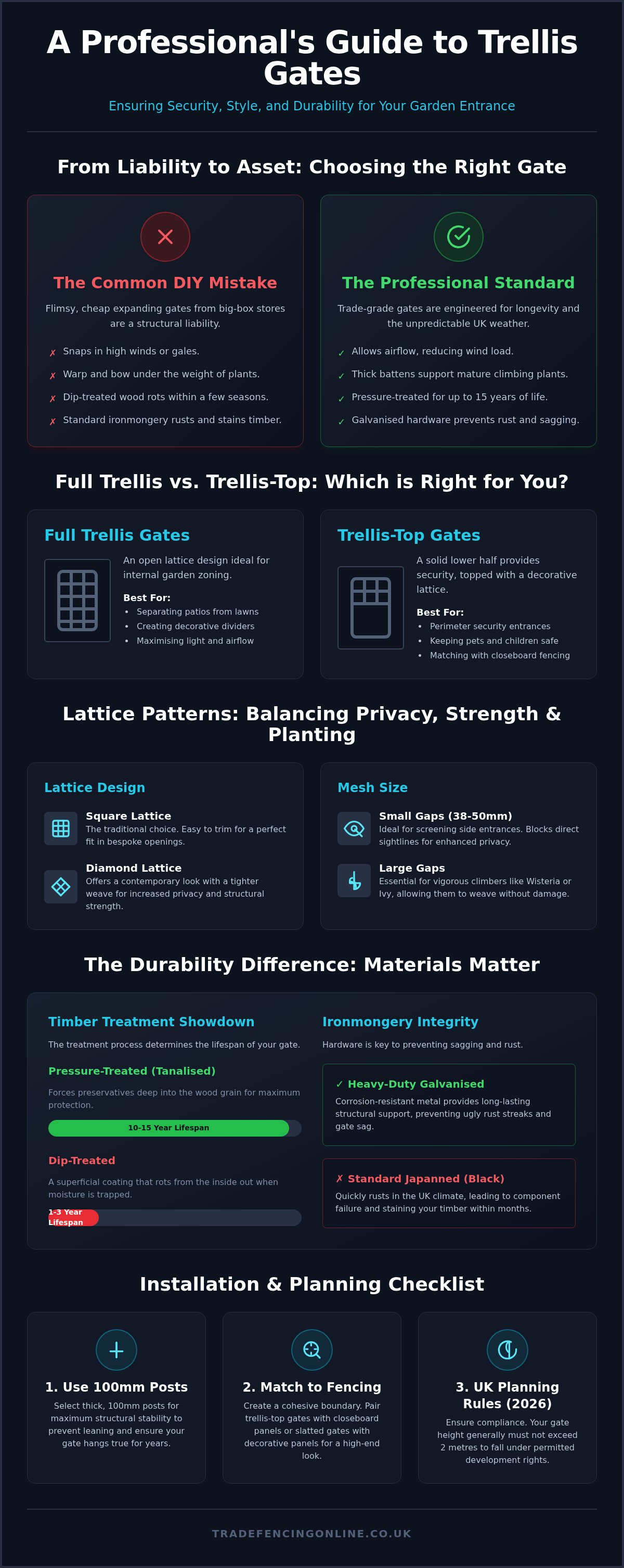
A trellis gate is defined by its open lattice framework. Historically, the Trellis (architecture) has served as both a support for flora and a structural boundary. For modern UK gardens, these gates are an essential alternative to solid timber panels. They allow light to penetrate dark corners while maintaining a clear perimeter. Trade-grade gates differ significantly from cheap DIY store versions. We use thicker timber battens to ensure the frame doesn't warp or bow under the weight of mature climbing plants.
Square lattice designs are the industry standard for traditional gardens. They're easy to trim, making them perfect for bespoke openings where a standard width doesn't fit. Diamond lattice options offer a tighter weave. This provides a contemporary look and increased privacy. You'll find that diamond patterns are generally stronger due to the diagonal bracing inherent in the design.
Full Trellis vs. Trellis-Top Gates: Which is Right for You?
Full trellis gates are specialized tools for internal garden zoning. A full-height trellis gate allows you to separate a patio from a vegetable patch without blocking the view or the breeze. If security is your priority, trellis-top gates like the S-gate or Crest-top are better. They feature a solid lower half to keep pets and children secure, topped with a decorative lattice for ventilation and style.
Selecting the Best Lattice Pattern for Privacy
Privacy depends on mesh size. Smaller gaps between 38mm and 50mm act as an effective screen for side entrances. They block direct lines of sight while still allowing airflow to prevent wind damage. If you plan to grow vigorous climbers like Wisteria or Ivy, choose larger gaps. This gives the plant room to weave through the timber without snapping the battens. It's about matching the structure to your specific landscaping goals.
Choosing the Right Trellis Gate for Your Garden Project
Selecting a gate involves more than just picking a design. You must prioritise material integrity to withstand the British climate. A trade-grade trellis gate is specifically designed to handle high wind loads. In exposed areas across Essex and East London, solid gates often act like sails, putting immense pressure on posts. The open lattice of a trellis allows wind to pass through, significantly reducing the risk of structural failure during winter storms. Always ensure your installation complies with UK planning regulations for gates regarding height and placement.
Ironmongery is another critical factor. Never settle for standard japanned (black) hardware. It will rust within months, leaving unsightly streaks across your timber. We recommend heavy-duty galvanised hinges and latches. These components resist corrosion and provide the structural support needed to prevent the gate from sagging under its own weight. If you're unsure which kit fits your project, you can browse our professional ironmongery range for compatible hardware.
Why Trade-Grade Pressure-Treated Timber is Essential
Material quality determines the lifespan of your entrance. We only supply pressure-treated (tanalised) timber. This process forces preservatives deep into the wood grain under high pressure. It provides 10 to 15 years of resistance against rot and insect attack. This is vital for gates supporting heavy climbing plants. Moisture often gets trapped between the lattice and the plant stems, which causes "dip-treated" wood to rot from the inside out within just a few seasons.
Matching Your Gate to Existing Fencing
A cohesive boundary design increases property value. You should match your gate style to your current fence panels for a seamless look. If you have a traditional perimeter, pair trellis-top gates with closeboard fence panels. This combination offers high security at the base with an elegant finish at the top. For contemporary urban gardens, horizontal slatted gates are the best choice to complement decorative fence panels.
Installation, Security, and UK Planning Regulations
Installation quality is the deciding factor in how long your trellis gate remains functional. Accurate measurement is the first step. You must calculate the total opening width and then subtract the thickness of your fence posts and a 10mm to 15mm allowance for hardware clearance. Without this gap, the gate will bind against the posts during wet weather when the timber naturally expands. Trade-grade timber is heavy, so don't cut corners on support. We recommend using 4x4 (100mm) timber posts or slotted concrete posts to provide the necessary stability for a swinging structure.
Security shouldn't be an afterthought for side entrances. A flimsy latch won't stop an intruder or hold during a storm. Install a heavy-duty brenton bolt that allows for a padlock or a galvanised ring latch to keep the entrance firmly closed. These professional-grade fittings ensure your garden remains a private, secure sanctuary while resisting the corrosive effects of the London climate.
Fitting Your Trellis Gate: A Trade Approach
- Step 1: Set your gate posts at least 600mm deep. Use professional-grade post-mix to ensure they don't shift under the weight of the gate over time.
- Step 2: Attach heavy-duty tee hinges to the gate frame before you attempt to hang it. This ensures even weight distribution across the pressure-treated timber battens.
- Step 3: Test the swing clearance. Adjust the hinges until the gate opens smoothly without dragging on the ground or catching on uneven paving.
Navigating UK Height Rules and Planning
Compliance with UK planning permission for gates is essential for any homeowner in Essex or London. The standard maximum height for rear garden boundaries under permitted development is 2 metres (approximately 6.5ft). A common mistake is adding a decorative trellis topper to a standard 6ft gate, which often pushes the total height over the legal limit. If your property is in a conservation area or is a listed building, these rules are even stricter. Check with your local council in Romford or your specific London borough before installation to avoid costly enforcement notices.
Secure Your Garden Boundary Today
Selecting the right entrance involves more than just aesthetics. You've seen why trade-grade pressure-treated timber is the only way to ensure your boundary lasts 10 to 15 years against the British weather. Combining heavy-duty galvanised ironmongery with a professional trellis gate ensures your installation remains secure and sag-free. You now have the knowledge to navigate planning rules and select the best lattice pattern for airflow and climbing plant support.
We provide fast local delivery across Romford, Essex, and East London to keep your project on schedule. As a specialist local supplier, we focus on durability and structural integrity that national DIY chains often overlook. You can depend on our professional reputation for high-quality timber and expert advice. Our products are designed for the trade and available to the public for a superior finish.
Frequently Asked Questions
Do I need planning permission for a 6ft trellis gate?
You don't need planning permission for a 6ft trellis gate in a rear garden because it stays under the 2-metre height limit for permitted development. However, if the gate is next to a public highway, road, or footpath, the limit is usually 1 metre. You should always check with your local council if your property is in a conservation area or subject to an Article 4 direction.
Can I attach a trellis topper to my existing garden gate?
You can attach a topper to an existing gate, but it's rarely a good long-term solution for your boundary. The added weight of a trellis gate extension often causes standard hinges to fail and the main frame to sag. It's better to buy a gate specifically engineered with a lattice top to ensure the structure remains stable and secure under the weight of heavy climbing plants.
What is the best wood for a garden trellis gate?
Pressure-treated (tanalised) softwood is the trade standard for a high-quality trellis gate. It provides 10 to 15 years of rot resistance by forcing preservatives deep into the timber grain under high pressure. While hardwoods like Oak are durable, they're much heavier and more expensive. Tanalised timber offers the best performance and value for the specific weather conditions in the Essex and London area.
How do I stop my trellis gate from sagging over time?
Stop sagging by using heavy-duty galvanised tee hinges and mounting the gate to 100mm timber posts set in 600mm of concrete. Ensure the gate has a diagonal brace running from the bottom hinge corner up towards the top latch corner. This transfers the weight back to the hinges and prevents the frame from dropping and catching on the ground over time.