


A standard 1.8-metre fence panel is no longer enough to stop the gaze of a neighbour in a modern three-storey townhouse. You've likely felt the frustration of a quiet afternoon ruined by the feeling of being watched from an overlooking window. Privacy in British gardens is becoming harder to secure as housing density increases, leaving many homeowners feeling exposed in their own backyards. You need a solution that does more than just look good on day one; it must stay standing when the first 50mph autumn gale hits your postcode.
This guide delivers professional-grade garden screening ideas for privacy that balance aesthetic appeal with the rugged durability required for the UK climate. We'll show you how to achieve a secluded, secure outdoor space using materials that won't warp, rot, or buckle under pressure. You will also get a clear breakdown of UK planning laws, specifically the 2-metre height limit, so you can install your screening with confidence and avoid costly council disputes. We'll examine the best heavy-duty timber panels, composite options, and reinforced trellis systems available for 2026 to ensure you get the best value for your project.
Key Takeaways
- Learn how to transform your garden into a secure "outdoor room" by effectively blocking lines of sight in urban environments.
- Discover professional **garden screening ideas for privacy** using durable timber solutions, from traditional closeboard to modern slatted designs.
- Compare natural and alternative screening materials to find the perfect balance between aesthetic appeal and long-term maintenance.
- Navigate UK planning regulations regarding maximum height limits and ensure structural integrity by using trade-grade fence posts.
- Understand why sourcing quality materials from a trusted Romford supplier provides better value and superior durability for your project.
Understanding Garden Screening Ideas for Privacy
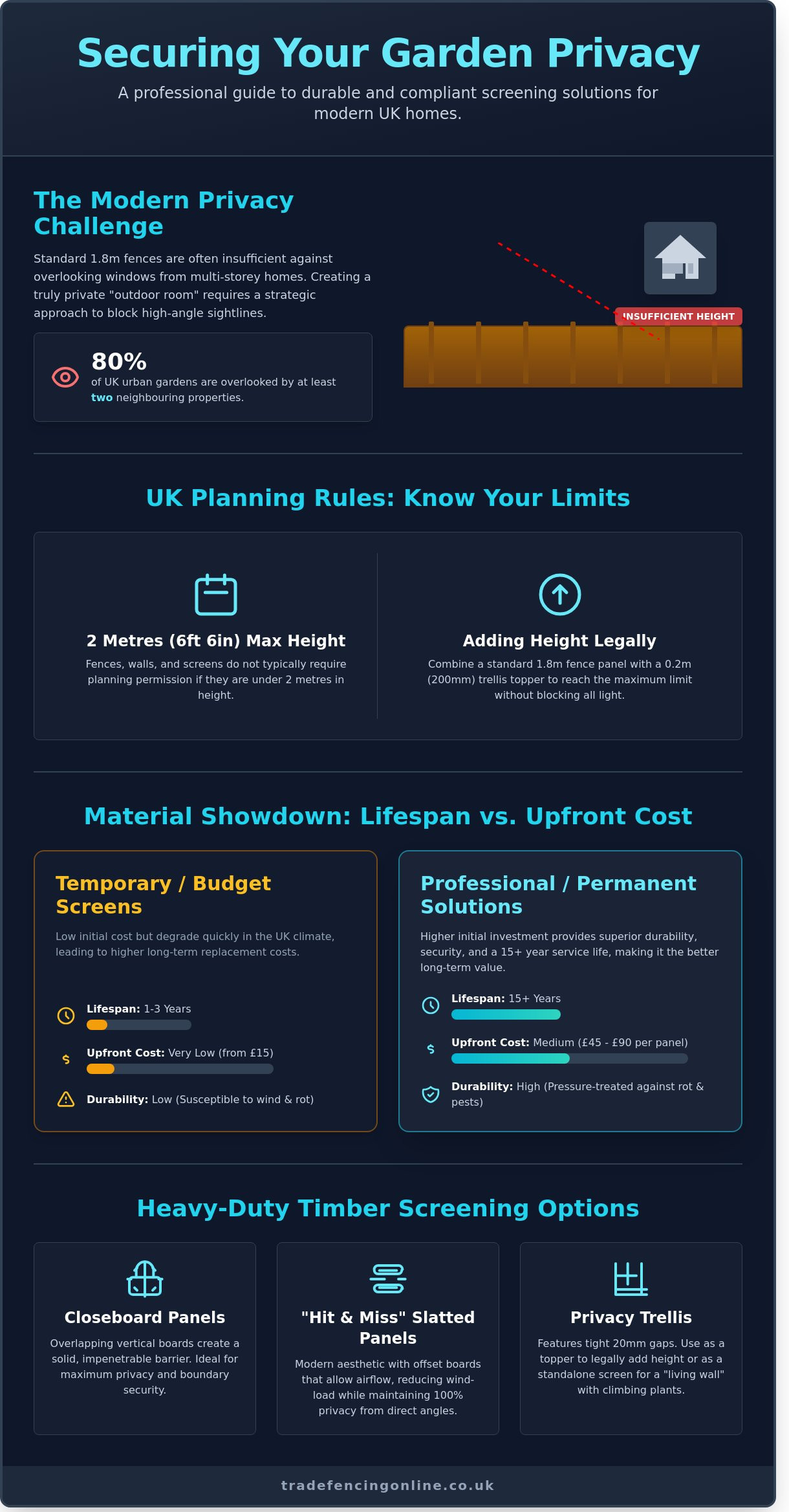
Garden screening refers to any vertical structure or planting used to block direct lines of sight into your property. In UK urban environments, where 80% of residential gardens are overlooked by at least two neighbouring properties, these barriers are essential for creating a private outdoor room. Effective garden screening ideas for privacy turn an exposed patch of grass into a functional extension of the home. This shift provides both emotional security and practical wind protection for your seating areas.
You must distinguish between decorative and structural screening. A trellis provides a frame for climbing plants but offers minimal immediate privacy. Solid timber panels provide a total block. From a trade perspective, durability always beats initial style. A cheap £15 reed matting might hide a fence for one summer, but a professional-grade pressure-treated panel provides a 15-year service life. Investing in quality materials reduces the long-term cost-per-year significantly and ensures your boundary stays secure.
Permanent vs. Temporary Privacy Solutions
Choosing between materials depends on your required lifespan. Bamboo rolls are affordable but typically degrade within 36 months in wet British winters. In contrast, timber slatted panels using UC4 treated wood often carry 10 to 15-year guarantees against rot. While modular screens offer flexibility for renters, a fixed fence remains the most reliable option for high-wind areas. Professional-grade timber costs more upfront, usually around £45 to £90 per panel, but its durability makes it the cheaper choice over a decade.
Assessing Your Garden’s Privacy Gaps
Identify sightlines by standing in your primary seating area and looking toward neighbouring upstairs windows. Most privacy issues occur from a 45-degree angle above the fence line. When planning garden screening ideas for privacy, measure the height needed to block these views without exceeding the standard 2-metre UK planning limit. Consider the sun's path carefully. A solid 2-metre barrier on the southern boundary can cast a 4-metre shadow across your lawn by mid-afternoon in October. This blocks essential light and can affect plant growth across your entire plot.
Timber Screening Solutions: Panels and Trellis
Timber remains the primary choice when exploring garden screening ideas for privacy because it balances cost with long-term performance. It's durable, easy to install, and fits almost any landscape. For homeowners in the wet Essex climate, choosing the right wood is vital. Always opt for pressure-treated timber. This industrial process forces preservative deep into the wood grain. It protects your investment from rot and wood-boring insects for up to 15 years. Without this treatment, standard panels often fail in less than 5 years due to constant ground moisture.
You need to choose between traditional and modern styles based on your specific needs. Traditional closeboard fencing offers total seclusion with overlapping vertical feathers. It's a robust, heavy-duty option for boundary security. If you want to increase height legally, use trellis toppers. UK planning regulations generally allow fences up to 2 metres high without a permit. Adding a 300mm or 600mm topper to an existing 1.8m fence provides extra privacy without blocking all the natural sunlight.
Slatted Fence Panels for Contemporary Privacy
Horizontal slatted panels create a clean, designer look that makes smaller gardens feel wider. The "hit and miss" style is particularly effective for 2026 garden designs. It features boards fixed to the front and back in an offset pattern. This design provides 100% privacy from a direct angle while allowing air to flow through the gaps. It's a pragmatic choice because it reduces wind resistance, preventing panels from acting like sails and blowing over during winter storms. For a premium finish, choose kiln-dried timber to ensure the slats don't warp over time.
Using Trellis as a Decorative Privacy Screen
Trellis works as a standalone screen or a decorative extension to existing walls. You can choose between square, diamond, or privacy trellis styles. Privacy trellis features much tighter spacing, usually around 20mm, to block views more effectively than standard 100mm gaps. It's the ideal support for climbing plants like Clematis or Jasmine, which creates a "living wall" effect. You can browse our full range of trellis panels to find the right density for your project. If you're planning a full garden overhaul, it's often more cost-effective to order your fencing supplies in bulk to take advantage of our current trade prices.
Natural and Alternative Garden Privacy Solutions
Standard timber panels aren't the only way to block a neighbour's view. Natural rolls and synthetic screens offer flexible garden screening ideas for privacy that work with your existing setup. These materials allow you to create a tiered effect by layering different heights. For example, a 1.8m bamboo screen placed against a 1.2m brick wall adds instant height without the cost of a full rebuild. Maintenance levels differ significantly. Natural fibres require replacement every 4 to 7 years. Artificial screens are a fit-and-forget solution that stays green year-round. You can also mix materials to soften the look of a hard perimeter. Placing a willow roll in front of a standard closeboard fence adds texture and extra sound dampening.
Bamboo and Willow Rolls
Natural rolls are the most budget-friendly way to hide an old fence or a concrete wall. Installation is straightforward. You should use 1.2mm or 1.6mm galvanised wire to secure the rolls to your existing posts or a tensioned wire frame. This prevents the material from sagging or pulling away during winter storms. Willow is a sturdy choice for the British climate because it handles damp conditions better than thinner reed mats. Bamboo offers a thicker, more modern aesthetic. It provides roughly 80% visual blockage. This is enough to stop prying eyes while still letting some light filter through to your plants. Most rolls come in 3m or 4m lengths, making them easy to transport and fit.
Artificial Hedges and Greenery
Artificial hedging is a standard choice for UK balconies and small urban yards. These panels provide 100% privacy immediately. You don't have to wait three years for a hedge to grow. Quality is key here. Ensure your chosen greenery has a UV-stability rating of at least 5 years to prevent fading. This ensures the plastic doesn't turn blue or brittle under the summer sun. Most panels come in 50cm x 50cm squares that click together. They're perfect for covering railings or creating a "living wall" effect on a flat surface with zero watering or pruning required. For a 10m run of fencing, artificial hedging can be installed in under two hours. This makes it a highly efficient option for garden screening ideas for privacy in 2026.
This trend of using durable, synthetic materials in creative ways isn't just for the garden. Inside the home, designers are also finding innovative applications for materials traditionally used elsewhere. For more ideas on this, you can check out Home Expo Asia and their exploration of using vinyl on walls.
Planning Your Privacy: Rules and Structural Integrity
"How high can I actually go?" is the first question every homeowner asks. In the UK, the standard height limit for rear garden boundaries is 2 metres. If your garden screening ideas for privacy involve structures taller than this, you must apply for planning permission from your local Essex or London council. Front gardens are even stricter. Any screen or fence over 1 metre tall facing a highway usually requires a formal application. Ignoring these rules often leads to enforcement notices and the costly removal of your new installation.
UK Planning Rules for Privacy Screens
The 2-metre rule applies to the total height from the ground up. If you add a 60cm trellis on top of a 1.8-metre fence, you've exceeded the limit. Properties in Conservation Areas or those involving listed buildings have even tighter restrictions. Always check your local authority website, such as Havering or Redbridge council portals, before you start digging. It's cheaper to verify the rules now than to pay for a retrospective application later.
Wind Loading and Post Support
A screen is only as good as the posts holding it up. In high-wind areas across East London, solid panels act like sails. They catch the wind and transfer massive pressure to the base. For any screen over 1.2 metres, 4x4 inch (100mm) timber posts or heavy-duty concrete posts are essential. Concrete is the most durable choice, as it won't rot or snap during a winter storm.
You must also use gravel boards. These provide a sacrificial barrier between the damp ground and your timber panels. Using a 150mm concrete or pressure-treated gravel board can extend the life of your screen by 7 to 10 years. For stability, follow the one-third rule. If your screen stands 1.8 metres above ground, the post needs to be at least 600mm deep in a hole filled with high-strength Postcrete.
Checklist for a secure installation:
- Confirm boundary ownership with your title deeds.
- Use 100mm x 100mm posts for all screens taller than 1.5 metres.
- Sink posts to a minimum depth of 600mm for standard 1.8m heights.
- Install gravel boards to prevent ground-level rot.
- Use galvanised or stainless steel fixings to prevent rust streaks.
- Leave a 50mm gap at the bottom of screens for airflow and hedgehog movement.
Don't compromise on the foundations of your project. Order trade-standard fence posts and gravel boards for a professional, long-lasting finish.
Selecting Quality Materials for Your Privacy Project
Choosing the right supplies is the final step in executing your garden screening ideas for privacy. Cheap timber from big-box retailers often warps or splits within 24 months. Trade-quality materials save you money because they don't require constant replacement. We focus on providing durable, professional-grade stock that stands up to the UK's wet winters and high winds. Investing in better materials at the start means your garden stays private for years without the need for expensive repairs.
Why Trade-Grade Timber Lasts Longer
The difference between DIY store timber and trade supplies comes down to thickness and treatment. Standard retail panels often use thin 8mm slats that rattle and bow. Our Traditional Closeboard panels are built for maximum privacy and structural strength. They feature heavy-duty vertical slats that overlap, ensuring no gaps appear as the wood seasons. Trade Fencing Online offers a no-fuss ordering process. You won't find confusing jargon here; just clear product descriptions and honest pricing. Our pressure-treated timber is designed to last over 15 years, providing a reliable boundary for your home.
Getting Your Supplies in Essex and East London
We operate as a one-stop-shop for the Romford, Essex, and East London areas. Getting heavy materials to your site is often the hardest part of a project. We solve this with free local delivery options that keep your costs down. You can order everything required for a complete "privacy kit" in a single transaction. This ensures all components, from the posts to the fixings, are compatible and arrive at the same time.
A standard kit usually includes:
- Heavy-duty Traditional Closeboard or Larch Lap panels.
- Concrete or timber posts for a secure foundation.
- Rapid-setting postcrete for easy installation.
- Gravel boards to protect your panels from ground moisture.
- Galvanised ironmongery and high-quality fixings.
Building a secure perimeter shouldn't be complicated. Whether you need panels or railway sleepers for garden borders, we have the stock ready for dispatch. Order your privacy screening materials today to secure your garden with trade-quality supplies. For specific project advice or custom requirements, contact Romford Fencing Ltd directly. Our team provides the practical guidance you need to get the job done right the first time.
Secure Your Garden Privacy Today
Securing your outdoor space requires the right balance of durability and design. Timber panels and trellis remain the most reliable structural solutions for 2026; they provide immediate results compared to slower-growing hedges. You'll need to remember the standard 2-metre height regulations to avoid planning issues with your local council. Choosing premium materials prevents premature rot and ensures your boundary holds its integrity against unpredictable UK weather. Implementing these garden screening ideas for privacy doesn't have to be complicated when you source from an established expert. We're a trusted local supplier in Romford with a consistent record of 5-star customer reviews. Our team focuses on providing high-grade timber that lasts for years. We offer free local delivery options to get your materials on-site without any fuss. Shop our range of quality fence panels and trellis now to start your project. You'll soon have a secure, quiet space that adds real value to your home.
Frequently Asked Questions
How high can garden screening be without planning permission in the UK?
You can install garden screening up to 2 metres high without seeking planning permission. This height limit applies to the total structure from the ground level. If your property borders a public highway or a footpath, the legal limit for a screen or fence is reduced to 1 metre. Properties in conservation areas or listed buildings often have specific restrictions that apply to 100% of the external boundaries.
What is the cheapest way to screen a garden for privacy?
Reed or willow screening rolls are the most cost-effective garden screening ideas for privacy. A standard 4-metre roll typically costs between £20 and £35, making it significantly cheaper than timber panels. You can attach these rolls to existing fences or wires using galvanised garden wire. This method provides an instant visual barrier for about 10% of the price of a new closeboard fence installation.
Can I put a privacy screen on top of an existing fence?
You can add a screen to the top of an existing fence as long as the total height stays under 2 metres. Use trellis toppers or timber battens to extend your current posts safely. It's vital to check that your original fence posts are sturdy and not rotting. Adding a 600mm topper increases the wind load, so ensure the base structure can handle the extra pressure.
Which is better for privacy: slatted panels or solid panels?
Solid panels like closeboard or lap fencing are better for total privacy because they have no gaps. These designs block 100% of the line of sight into your garden. Slatted panels offer a more modern aesthetic but usually have 10mm to 15mm gaps between the wood. If you want a contemporary look with total seclusion, choose a "hit and miss" slatted design that staggers the boards on both sides.
Do I need my neighbour's permission to put up a privacy screen?
You don't need permission if the screen is on your land and doesn't exceed the 2-metre height limit. Always check your Title Deeds to confirm which boundary you own before starting work. If the existing fence belongs to your neighbour, you can't fix anything to it without their consent. Many homeowners build a free-standing screen 50mm inside their own boundary to avoid any potential legal disputes.
How do I stop my privacy screen from blowing over in the wind?
Install your posts at least 600mm deep into the ground and use 2 bags of post-mix per hole. For a standard 1.8-metre screen, one-third of the post should be below the surface for maximum stability. If your garden is in an exposed area, choose hit and miss panels. These allow air to pass through the gaps, which reduces the wind load on the posts by roughly 30% compared to solid boards.
Is bamboo screening better than timber for small gardens?
Bamboo is often better for small gardens because the rolls are only 20mm thick. Standard timber fence panels are usually 40mm to 50mm thick, which can make a tiny space feel even more cramped. Bamboo is lightweight and easy to install in awkward corners where a heavy timber panel won't fit. However, pressure-treated timber lasts up to 15 years, while natural bamboo typically needs replacing after 5 years.
What are the best plants for a living privacy screen?
Cherry Laurel and Photinia 'Red Robin' are the most reliable plants for a fast-growing living screen. Cherry Laurel is a hardy evergreen that grows up to 60cm per year, providing a thick wall of foliage. Photinia offers a 10/10 privacy rating once the red leaves mature and fill in the gaps. Space your plants 600mm apart to ensure they knit together quickly to form a solid green barrier within 2 or 3 seasons.