


What if the weak point in your garden boundary isn’t the fence panel, but the post or gate beside it? Feeling secure in my back garden starts with checking the whole boundary, not just choosing a taller fence. If you’re unsure where privacy is being lost or which parts need attention, a simple inspection can help you decide what to tackle first.
This guide explains how to assess your boundary, choose compatible fencing components and improve privacy without expecting a fence to guarantee security. You’ll learn what to check on panels, posts, gravel boards and gates, and how to plan a sensible next step for your garden.
Key Takeaways
- Feeling secure in my back garden starts with spotting gaps, loose sections, damaged panels and overlooked access points.
- Set priorities before choosing fencing components so panels, posts and gravel boards work together as part of a considered boundary.
- Use fencing to support privacy, not as a guarantee of safety. Check gates and the condition of the whole boundary, too.
- Compare the roles of timber panels, concrete posts and gravel boards, then plan a suitable installation or maintenance step.
Feeling secure in my back garden starts with checking the boundary
It’s understandable to want more privacy and reassurance in your garden. A sound fence can define the boundary and screen parts of the garden, but it can’t guarantee safety. Start with a slow visual check. Look for gaps, loose sections, damaged panels and access points that may be easy to overlook.
Privacy limits what can be seen; boundary condition shows whether the fence is intact; security is broader and can’t be guaranteed by fencing alone. A basic overview of different types of fencing can help you understand the options, but first identify what needs attention on your own boundary.
Which garden boundary weak points should you check first?
Walk the full boundary and inspect it from both sides where you can. Look for panels that have shifted or feel loose, posts that appear damaged, and gaps where the fence meets the ground. Check whether the gate closes properly and whether planting or stored items obscure access points or your view of the boundary.
- Check panels for movement, visible damage and gaps between sections.
- Look over the posts and the lower edge of the fence for damage or gaps.
- Check that the gate closes properly and note any less visible access points.
Write down what you find before choosing replacement components. If panels need attention, compare them with suitable fence panels. For a wider overview, see Fencing: The Complete UK Guide to Choosing & Installing Your Garden Fence.
How to make a back garden feel more private and secure
Turn your boundary check into a practical plan. Feeling secure in my back garden can start with clear priorities, not a full fence replacement. Work through these steps:
- Assess the boundary. Note damage, movement, gaps, areas overlooked from nearby properties and any gate that doesn’t close properly.
- Set priorities. Decide whether your main concern is privacy, a damaged section or access. This helps you focus on the work that matters to your garden.
- Choose compatible components. Match panels to suitable posts, and consider gravel boards if they form part of your boundary design. Check the existing layout before selecting replacements.
- Plan installation. Confirm which parts need replacing and whether you’ll do the work yourself or arrange fencing installation.
How should panels, posts and gates work together?
Panels form the visible boundary surface. Posts support the panels, while gates provide access. These parts need to suit the layout and work together. Replacing a panel alone may not solve a problem with a loose or damaged post. Gravel boards can form the lower edge where they’re part of the chosen setup. To compare options, browse garden fence panels and see a separate guide to choosing the right fence panels. Include the gate’s position and closure in your plan.
Check the boundary periodically and after noticeable damage. UK home security and property guidance also recommends maintaining sturdy fences and gates as part of general outdoor safety. Use best practices to help maintain garden fencing with Romford Fencing Ltd. A well-matched boundary can support privacy and order, but it can’t guarantee security.
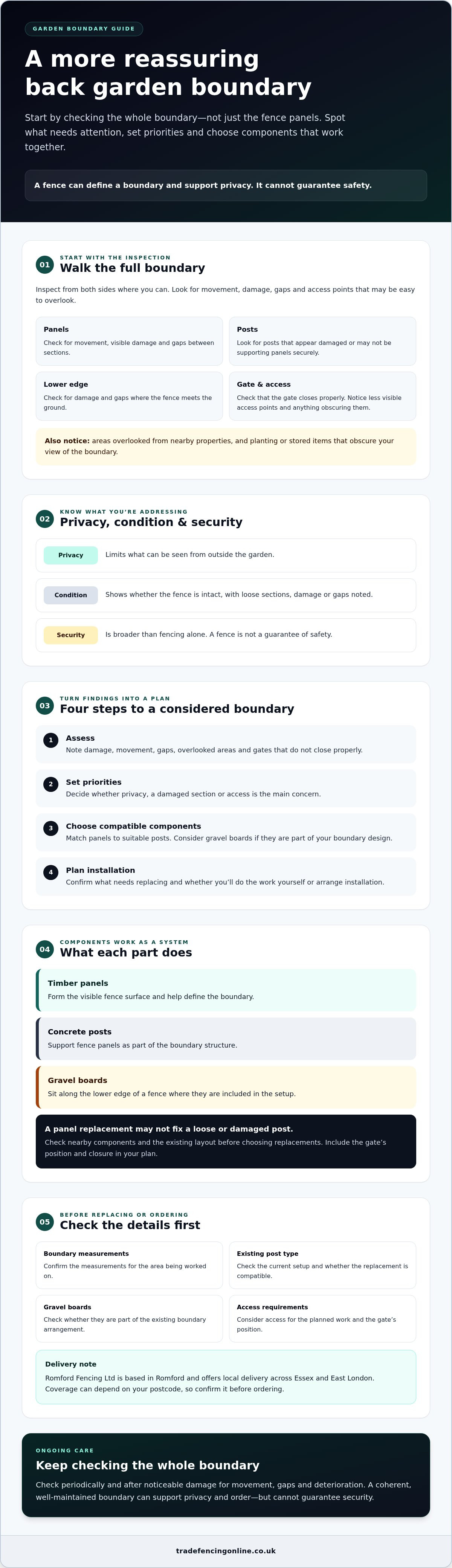
Choose and maintain garden fencing for a more reassuring boundary
For feeling secure in my back garden, the aim is a coherent, well-maintained boundary, not a promise of guaranteed security. Each component has a different role:
| Component | Role |
|---|---|
| Timber panels | Form the visible fence surface and help define the boundary. |
| Concrete posts | Support fence panels as part of the boundary structure. |
| Gravel boards | Sit along the lower edge of a fence where included in the setup. |
Check the fence over time for movement, damage and gaps. When replacing a component, check that it suits the existing layout and whether nearby parts also need attention. This can help you avoid ordering a panel without checking the condition or type of the post supporting it.
What should you consider before ordering replacement fencing?
Confirm the boundary measurements, existing post type, access requirements and compatibility of the products you’re considering. Compare concrete fence posts with your current setup and check whether gravel boards are part of it. For more guidance, consult Fence Posts: The Complete UK Buyer’s Guide. Check delivery coverage for your postcode before placing an order.
Romford Fencing Ltd is based in Romford and offers local delivery across Essex and East London. Delivery coverage can depend on your postcode, so confirm it before ordering.
Take the next step towards a better-planned boundary
Feeling secure in my back garden starts with knowing what needs attention. Check the whole boundary for weak points, then set priorities before replacing anything. Panels, posts, gravel boards and gates each play a different part, so consider how they fit together and check their condition over time. Fencing can support privacy and create a more reassuring boundary, but it can’t guarantee safety.
Romford Fencing Ltd supplies fence panels, posts, gravel boards and gates, and offers fencing installation. The Romford-based supplier serves Essex and East London. Check delivery coverage for your postcode before ordering, then browse the fencing supplies that match your plans.
Start by reviewing the boundary and the components it needs. Then browse Romford Fencing Ltd’s online store to find fencing supplies for your plans.
Frequently Asked Questions
Can a garden fence make my back garden feel more secure?
A garden fence can define your boundary and provide privacy, which may help you feel more comfortable using the space. Feeling secure in my back garden also means recognising what fencing can’t do: it can’t guarantee safety or prevent crime. Check the condition of the whole boundary, including the gate, and consider your other practical needs alongside any fencing work.
What should I check if my garden fence feels insecure?
Walk the boundary and look for visible damage, loose panels, posts that appear unstable and gaps, including along the ground. Check whether the gate closes properly and whether any access points are easy to overlook. Note each issue before deciding what to repair or replace. A clear inspection helps you focus first on the sections that need attention.
Which fence panels are best for privacy in a back garden?
The right panels depend on your boundary layout, privacy needs and the components already in place. Check how panels will fit with the posts and whether gravel boards form part of your setup. Identify the areas you want to screen, then compare suitable options. Don’t assume a particular panel will guarantee privacy or security in every garden.
Do I need to replace the whole fence if one section is damaged?
Not necessarily. First assess the damaged panel, its supporting posts and the adjoining sections. If the problem is limited, replacing only the affected part may be an option, provided the replacement is compatible with the existing setup. Check for wider wear or movement before deciding. If several connected components are damaged, plan the work around the full affected section.