


The constant cycle of repairing and replacing rotten fence panels is a frustrating and costly problem for any property owner. Damp soil and ground-level moisture are the biggest enemies of timber fencing, leading to premature decay that weakens your boundary. The most effective and durable solution is to install quality concrete gravel boards. They provide a solid, impenetrable barrier, lifting your panels away from the ground and stopping rot before it can start, saving you significant time and money in the long run.
This complete guide provides the direct, practical information you need to get the job done right. We will cover the different types and sizes available, from recessed to smooth-faced options, ensuring you can select the correct product for your project. You will learn the proper installation methods for both concrete and timber posts and understand exactly why concrete offers superior, long-term value over wooden alternatives. Get ready to build a fence that is built to last, with the confidence that you have made the best investment for your property.
Key Takeaways
-
Protect your fence panels from ground-level moisture and rot by installing a gravel board as a solid, protective barrier.
-
Choose the correct size for your project by understanding the key differences between standard 6-inch (150mm) and 12-inch (300mm) board heights.
-
Learn the essential steps for a secure installation, including why accurate levelling is critical and why this is always a two-person job.
-
Discover the versatility of steel-reinforced concrete gravel boards for other garden projects, such as creating durable raised beds or path edging.
Table of Contents
What Are Concrete Gravel Boards and Why Are They Essential?
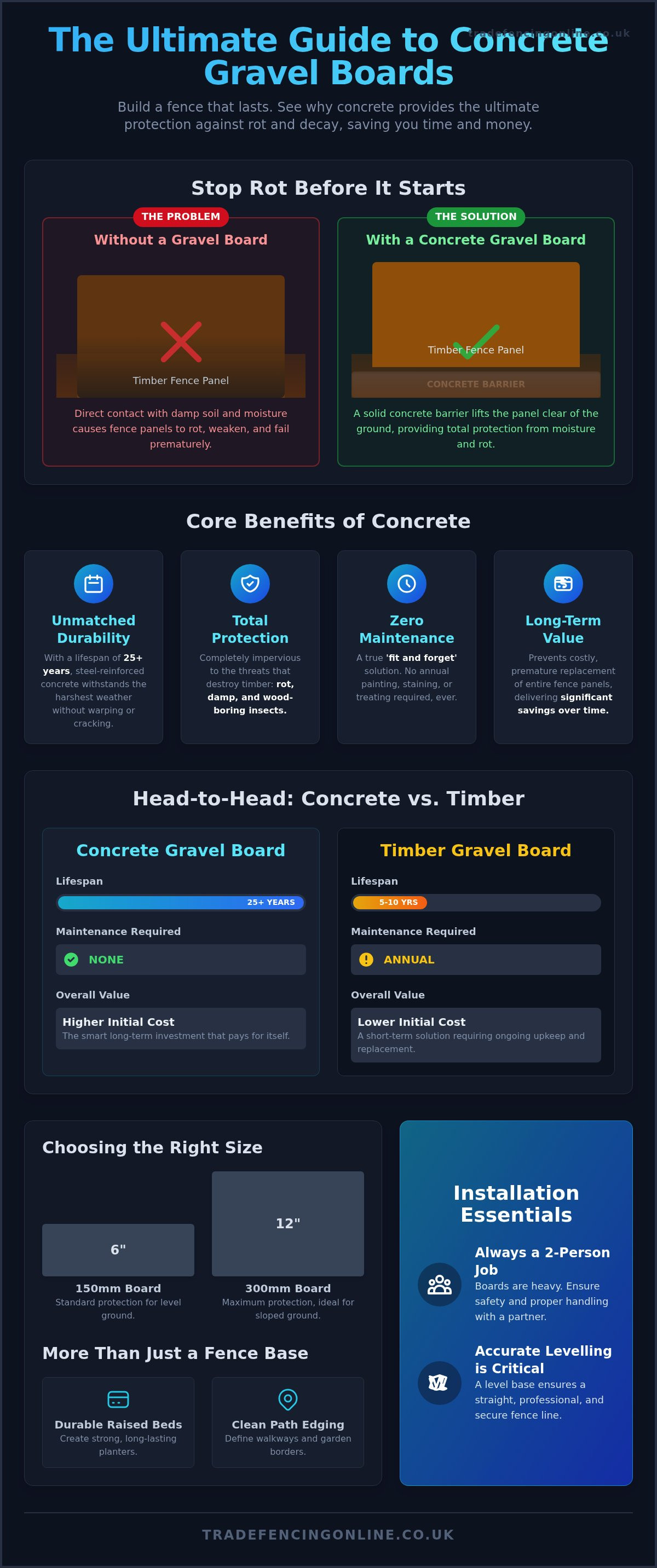
A concrete gravel board is a solid, steel-reinforced concrete barrier installed at the base of a fence, sitting between the ground and the bottom of your timber fence panel. Its primary function is to create a physical separation that lifts the wooden panel clear of the soil, wet grass, and debris that accumulate at ground level. This simple but critical function directly combats the number one cause of fence failure in the UK: rot and moisture damage.
Beyond rot prevention, these boards provide essential structural integrity. They create a solid, level foundation that locks fence panels securely in place, preventing them from bowing or shifting over time. This reinforcement helps the entire fence line resist ground movement, frost heave, and minor impacts. On sloped or uneven ground, they also act as a small retaining wall, helping to manage soil levels and ensure a clean, professional finish that lasts for decades.
The Core Benefits: Durability, Protection, and Low Maintenance
The advantages of choosing concrete gravel boards are straightforward and deliver significant long-term value. Their core benefits make them a wise investment for any new fence installation.
-
Unmatched Durability: Manufactured from high-strength concrete with steel reinforcements, they are built to withstand the harshest UK weather without cracking, warping, or degrading.
-
Total Protection: Concrete is completely impervious to the threats that destroy timber. It cannot rot, is unaffected by damp, and offers no home for wood-boring insects.
-
Zero Maintenance: Once installed, they are a 'fit and forget' solution. There is no need for the annual cycle of painting, staining, or applying preservative treatments required for timber.
-
Long-Term Value: While the initial cost is slightly higher than a wooden gravel board, they prevent the premature and costly replacement of entire fence panels, saving you significant money and hassle over the lifespan of your fence.
Concrete vs. Timber Gravel Boards: A Head-to-Head Comparison
While traditional timber gravel boards have their place, a direct comparison highlights why concrete is the superior choice for performance and longevity. The following table breaks down the key differences:
.table-container { overflow-x: auto; } table.comparison-table { width: 100%; border-collapse: collapse; margin: 1em 0; } table.comparison-table th, table.comparison-table td { border: 1px solid #ccc; padding: 8px 12px; text-align: left; } table.comparison-table th { background-color: #f2f2f2; font-weight: bold; } table.comparison-table td { vertical-align: top; }
| Feature | Concrete Gravel Board | Timber Gravel Board |
|---|---|---|
| Lifespan | 25+ years | 5-10 years (requires treatment) |
| Maintenance | None | Annual treating/staining required |
| Initial Cost | Higher | Lower |
| Aesthetics | Functional, uniform appearance | Natural wood grain, traditional look |
Although a timber board might be chosen for a specific garden aesthetic or on a very tight initial budget, it is fundamentally a short-term solution. For a robust, reliable, and cost-effective fence boundary, concrete is the professional's choice and the smartest investment for the vast majority of UK fencing projects.
Types of Concrete Gravel Boards Explained
When choosing concrete gravel boards, the main differences come down to the face finish and profile. While the core function remains the same-protecting your fence from ground-level moisture and debris-the style you select can significantly impact your fence's final appearance. All quality boards are manufactured with internal steel reinforcement for maximum strength and durability.
They are produced to a standard length of 6ft (1.83m) to fit perfectly within standard UK fence bays, slotting neatly between concrete posts. Your choice will ultimately depend on your fencing type, budget, and desired aesthetic.
Plain Face (Smooth) Gravel Boards
The plain or smooth face gravel board features a simple, flat surface that provides a clean and functional finish to any fence line. Due to its straightforward design and excellent value, it is the standard choice for projects using pre-made lap panels or closeboard fence panels. It offers robust protection without any unnecessary decorative elements.
Recessed Gravel Boards
A recessed gravel board is the most common and cost-effective option available. They feature a recessed panel centre, also known as ‘dished’, which helps reduce the weight while retaining strength and durability. Designed for use with concrete fence posts.
Decorative Face Gravel Boards (Rock, Brick, Wood Effect)
For gardens where appearance is a top priority, decorative face gravel boards offer a premium alternative. These boards feature textured finishes designed to mimic the look of natural materials like rock, brick, or even wood grain. While providing the same structural protection as plain boards, they add a stylistic flair to the base of your fence. They are the ideal choice for complementing patios, walling, or specific garden designs where a standard smooth finish would look out of place.
Choosing the Right Size: 6-inch vs. 12-inch Gravel Boards
Selecting the correct size for your concrete gravel boards is a critical step in any fencing project. The "size" refers to the height of the board, with the industry standard options being 6 inches (150mm) and 12 inches (300mm). Your choice depends entirely on your specific site conditions, including the ground level, the desired fence height, and the board's primary purpose. These dimensions are often specified within the official British Standard for fencing, ensuring products are fit for purpose. A key consideration is weight; a 12-inch board is substantially heavier than its 6-inch counterpart, which can impact handling and installation.
When to Use 6-inch (150mm) Gravel Boards
The 6-inch gravel board is the go-to choice for the vast majority of domestic fencing projects on level ground. Its 150mm height provides ample protection for timber fence panels, keeping them clear of ground moisture, soil, and splashes from rain. This prevents rot and significantly extends the life of your fence. Due to their lighter weight, 6-inch boards are much easier to handle and install, making them the preferred option for DIY enthusiasts and professionals seeking an efficient, standard solution.
When to Use 12-inch (300mm) Gravel Boards
A 12-inch (300mm) gravel board is a specialist product used to solve specific site challenges. It is the ideal solution for fences built on sloping or uneven ground, where it can be used to "step" the fence panels up or down the gradient while retaining soil. This creates a clean, level finish. They are also used to create a more substantial, high-impact base for a fence or when you need to gain extra height without opting for a taller, non-standard fence panel.
Combining Boards and Panels with Concrete Posts
To ensure a secure and long-lasting fence, you must match your components to the correct concrete post height. The calculation is straightforward. As a general rule, allow for at least 2 feet (600mm) of the post to be secured in the ground.
Use this simple formula:
Fence Panel Height + Gravel Board Height + Depth in Ground = Total Post Height
For example, to install a standard 6ft fence panel on top of a 1ft (12-inch) gravel board:
- 6ft (Panel) + 1ft (Gravel Board) + 2ft (In Ground) = **9ft Concrete Post Required**
Getting this calculation right ensures your fence is stable, secure, and built to last. View our range of concrete fence posts for any project.
How to Install Concrete Gravel Boards: A Step-by-Step Guide
Correct installation is key to ensuring your fence is strong, level, and built to last. Fitting concrete gravel boards is a straightforward process, but their weight makes it a two-person job. Precision is crucial-taking the time to ensure your posts and boards are perfectly level will guarantee a professional finish.
Before you begin, always prioritise safety. We recommend the following personal protective equipment (PPE):
-
Heavy-duty gloves to protect your hands.
-
Steel-toe boots to prevent injury from dropped posts or boards.
-
Safety glasses to shield your eyes from debris.
Step 1: Setting the First Concrete Post
Your first task is to set a single concrete post securely. Dig the post hole to the correct depth, which is typically 2ft (around 60cm), to provide a stable foundation. Place your slotted concrete post into the hole and use timber offcuts to brace it in position. Pour a fast-setting concrete mix, such as Postcrete, into the hole and add water according to the manufacturer's instructions. Use a spirit level on two adjacent sides of the post to ensure it is perfectly plumb. Allow it to begin setting before proceeding.
Step 2: Fitting the Gravel Board and Second Post
Once the first post is firm, carefully slide one end of the concrete gravel board into its slot. Place your second concrete post into its pre-dug hole and guide its slot onto the other end of the board. Now, place your spirit level on top of the gravel board. This is a critical step; a level board ensures the entire fence line looks uniform and prevents uneven stress on the panels. Adjust the height of the second post until the board is perfectly level, then secure it with Postcrete.
Step 3: Installing the Fence Panel
With the posts and gravel board secure, fitting the fence panel is simple. Lift the panel and slide it down into the vertical slots on both posts until it sits snugly and securely on top of the gravel board. This method creates a solid barrier with no gaps at ground level, effectively protecting any type of timber panel, whether it's a traditional closeboard or a decorative design. Repeat this process for each section of your fence.
By following these steps, you can build a robust and durable fence with maximum protection. For all the quality fencing supplies you need, from posts to panels, visit us at tradefencingonline.co.uk-your one-stop-shop for everything fencing.
Advanced Uses: More Than Just a Fence Base
The core function of a concrete gravel board is to protect your fence panel from ground-level moisture and rot. However, their inherent strength, durability, and uniform shape make them a highly versatile material for a range of other landscaping and garden construction projects. By thinking beyond the fence line, you can leverage this cost-effective product to create robust, long-lasting garden features.
Here are three practical, advanced applications that showcase the versatility of this essential fencing component.
Building Low-Level Retaining Walls
For gardens with sloped or uneven ground, concrete gravel boards offer a simple and effective solution for creating low-level retaining walls. By setting slotted concrete posts into the ground, you can stack boards horizontally between them to terrace a slope or build solid, rot-proof raised flower beds. For most domestic applications, stacking up to three boards high (approximately 900mm) creates a strong and stable structure. For any walls intended to retain significant weight or built higher, professional structural advice is recommended.
Creating Solid Concrete Fencing
When maximum security, privacy, and durability are the priority, gravel boards can be stacked to the full height of the fence posts. This method creates a solid concrete panel fence that is incredibly strong, impenetrable, and completely maintenance-free. This system is a popular choice for commercial or industrial properties, but it is also an excellent solution for residential boundaries where noise reduction and ultimate security are required. The result is a formidable barrier that will last for decades without any need for treatment or repair.
Durable Garden and Driveway Edging
Forget flimsy plastic or timber edging that quickly rots and breaks. For a permanent and professional finish, concrete gravel boards can be installed vertically and partially buried to create clean, sharp edges around your property. This is the ideal way to:
-
Define the border between a lawn and flowerbeds.
-
Contain gravel or decorative stone on a driveway or path.
-
Create neat mowing strips for easy lawn maintenance.
This provides a heavy-duty, stable edge that will not shift, warp, or decay over time, ensuring your garden design remains pristine. To see the full range of options for your next project, view our selection of quality fencing products at tradefencingonline.co.uk.
Fortify Your Fence for the Future
Ultimately, a fence is only as strong as its foundation. This guide has shown that concrete gravel boards are the essential component for ensuring longevity, protecting your timber panels from the constant threat of damp and decay. From choosing between 6-inch and 12-inch options to mastering the installation, you now have the knowledge to build a fence that stands strong against the elements for years to come. This simple addition is a cost-effective investment, preventing frequent repairs and premature replacements.
Ready to build a fence that lasts? As a trusted local supplier serving Essex and East London, Trade Fencing Online provides the high-quality components you need. All our gravel boards are steel-reinforced for maximum strength and durability, guaranteeing a superior foundation for any fencing project. Don't let your investment weaken over time; secure it from the ground up. With fast delivery available for all our fencing supplies, your project can get underway without delay.
Shop our full range of quality concrete gravel boards and build with confidence today.
Frequently Asked Questions
How heavy is a concrete gravel board?
A standard 6ft (1.83m) by 6-inch (150mm) concrete gravel board typically weighs between 25kg and 30kg. The weight increases with size; a 12-inch (300mm) high version can weigh up to 50kg. Always check the specific product details before purchasing. Due to their substantial weight, we recommend a two-person lift for safe handling and installation. This ensures both personal safety and prevents damage to the product during positioning.
Can you cut concrete gravel boards to a shorter length?
Yes, you can cut concrete gravel boards to size. The most effective tool for this task is an angle grinder fitted with a diamond-tipped blade designed for masonry. It is essential to take safety precautions. Always wear appropriate personal protective equipment (PPE), including safety goggles, gloves, and a dust mask, as cutting concrete generates significant dust. Measure carefully and score the line before making the final cut for a clean, professional finish.
Do you need to paint or seal concrete gravel boards?
No, one of the main advantages of concrete gravel boards is that they do not require painting or sealing for protection. They are manufactured to be highly durable and resistant to moisture and rot. However, you can paint them to match your fence panels or garden design if you wish. Use a quality exterior masonry paint for the best results and longevity, ensuring the surface is clean and dry before application.
Can I use concrete gravel boards with wooden fence posts?
Yes, you can use concrete gravel boards with wooden posts, although concrete posts are recommended for a fully rot-proof system. To attach them to timber posts, you will need to fix galvanised or stainless steel cleats to the posts for the gravel board to sit on. Alternatively, specialised metal brackets can be used. This setup protects the base of your timber fence panels, but remember the wooden posts themselves will still be susceptible to ground moisture.
Are all concrete gravel boards reinforced with steel bars?
High-quality concrete gravel boards are reinforced with internal steel bars. This reinforcement provides essential structural strength, preventing the board from cracking or snapping under pressure from the ground or the weight of the fence panels. Cheaper, unreinforced alternatives may exist but are not recommended as they lack the durability required for a long-lasting fence. Always choose steel-reinforced products for maximum strength and longevity for your fencing project.
How do I stop fence panels from rattling on top of the gravel board?
Fence panel rattling is a common issue caused by a small gap between the panel and the post. An effective solution is to use fence panel grips or anti-rattle clips, which are small metal or plastic clips designed to wedge into the gap and secure the panel tightly. Alternatively, you can insert small, treated timber wedges into the gap. For a permanent fix, a bead of clear, exterior-grade silicone sealant can also be applied to cushion the panel.