


Choosing the right garden fence can be a challenge. You're faced with confusing terms like 'featheredge' and 'arris rail', all while worrying if your investment will withstand the next British storm. Finding a balance between cost, strength, and longevity is crucial, but it shouldn't be complicated. For a durable, private, and secure boundary, high-quality closeboard fence panels are the trusted choice for thousands of UK homeowners, offering a superior long-term solution.
This complete buyer's guide is your straightforward resource. We will break down everything you need to know, from the robust construction that makes these panels so resilient to choosing the correct size for your project. We'll also provide a clear checklist of all the essential components-from posts to gravel boards-needed for a professional installation. By the end, you will have the confidence and knowledge to invest in a quality fence that offers lasting value and security for years to come.
Key Takeaways
- Learn why the overlapping featheredge board construction makes closeboard fence panels the UK's most durable choice for privacy and security.
- Understand the key factors for selecting the right panels, including size, treatment type, and compatibility with posts and gravel boards.
- Use our complete project checklist to ensure you have all the essential components for a successful and efficient fencing installation.
- Discover simple maintenance tips to maximise the lifespan of your new fence, ensuring it remains a quality boundary for years to come.
What Are Closeboard Fence Panels? An Anatomy of Strength
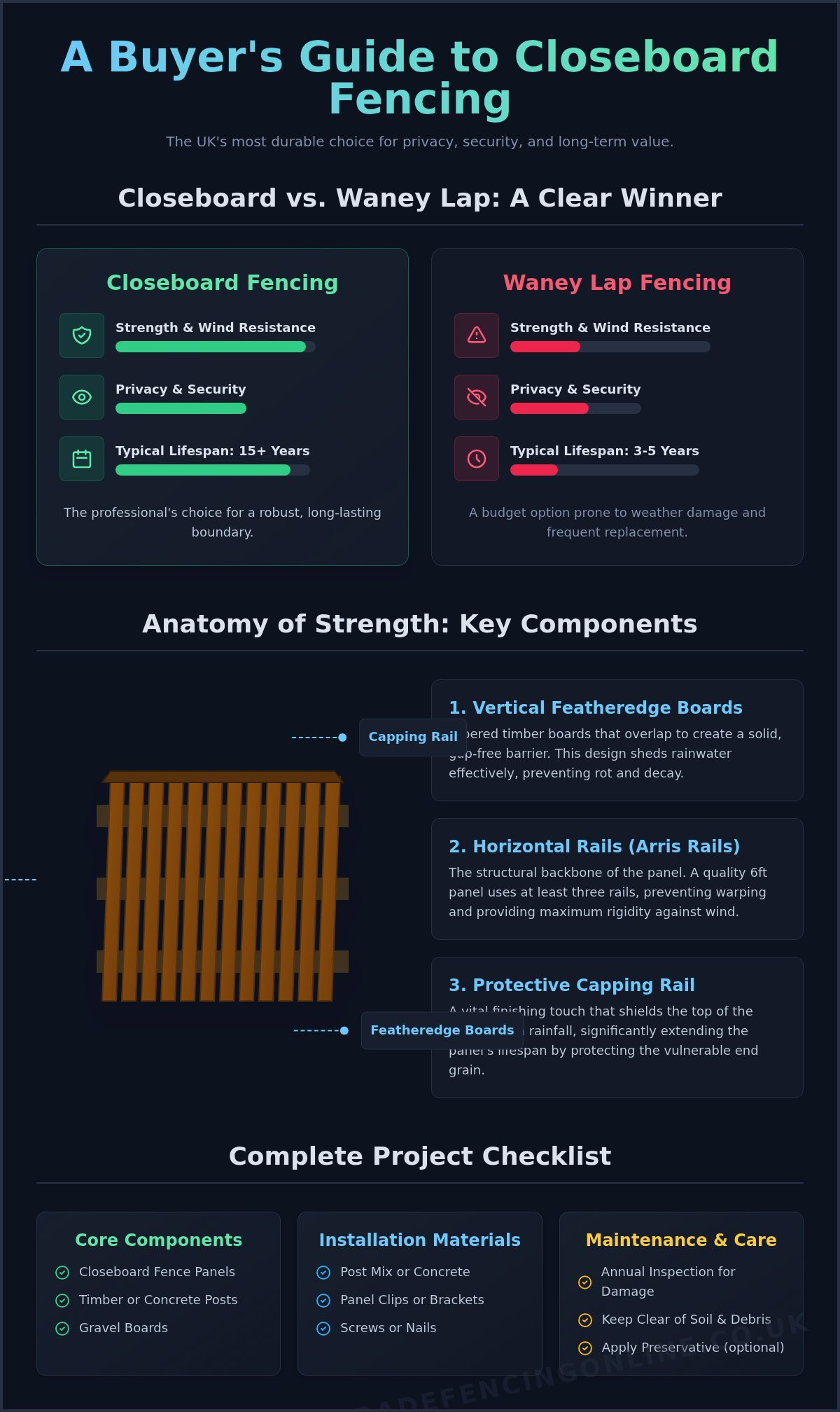
When selecting a new boundary for your property, strength and durability are the primary concerns. In the UK, no fencing solution meets these needs better than closeboard fencing. Regarded as the strongest and most popular panel type available, it offers a significant upgrade in quality and lifespan compared to cheaper, weaker alternatives like waney lap panels. Understanding the basic principles of What is Fencing? helps clarify why this construction method is so effective.
Also known as featheredge fencing, the design is built for resilience. Its robust construction provides excellent privacy and security, creating a solid, gap-free barrier that stands up to harsh British weather. The initial investment is higher than for a basic lap panel, but the long-term value delivered through superior strength and longevity makes it the professional's choice.
The Core Structure: Vertical Featheredge Boards
The strength of closeboard fence panels originates from their core components: individual vertical timber boards. Each board is sawn to a taper, making it thicker on one edge and thinner on the other. During assembly, these featheredge boards are overlapped, creating a solid screen that effectively sheds rainwater downwards. This design prevents water from sitting between the boards, which is a common cause of rot in lesser panels.
The Backbone: Horizontal Rails and Supports
The vertical boards are fixed to a sturdy horizontal framework. These backing rails, often called arris rails, form the panel's backbone. A key indicator of quality is the number of rails used. For example, a standard 6ft high panel should have at least three horizontal rails for maximum rigidity. This robust frame prevents the panel from warping or bowing under pressure from high winds, ensuring it remains straight and secure for years.
The Finishing Touch: Why a Capping Rail Matters
A quality closeboard panel is finished with a protective capping rail along the top edge. This simple component serves a vital purpose: it shields the vulnerable top-grain of the vertical boards from direct rainfall. By preventing water from soaking into the timber from above, a capping rail significantly reduces the risk of rot and decay, directly extending the operational life of the entire fence panel and protecting your investment.
The Key Benefits: Why Choose Closeboard Fencing?
When selecting a boundary for your property, closeboard fencing stands out as the best long-term investment. While other options might have a lower initial price, they cannot match the combination of strength, privacy, and durability that quality closeboard fence panels provide. This makes them a practical, cost-effective solution for any homeowner seeking a reliable and long-lasting garden fence.
The core advantages are clear:
- Strength: Built to withstand harsh weather conditions.
- Privacy: Solid construction offers complete screening.
- Durability: Pressure-treated timber ensures a long service life.
Unmatched Strength and Wind Resistance
The heavy-duty construction of closeboard fencing is its primary advantage. Built with thick, vertical featheredge boards overlapping on a robust frame with multiple horizontal rails, it creates a formidable barrier. This design is exceptionally resistant to high winds, making it the ideal choice for exposed gardens, coastal properties, or open areas that bear the brunt of British weather. Unlike weaker lap panels, which can flex and break under pressure, a closeboard fence remains rigid and secure, providing peace of mind year after year.
Superior Privacy and Garden Security
For homeowners who value their privacy, closeboard fencing is the superior option. The overlapping vertical boards create a completely solid screen with no gaps, blocking all sightlines from neighbours or public footpaths. This solid construction not only enhances seclusion but also improves security. The height and robust build act as a significant physical deterrent to intruders. Furthermore, the dense structure provides a degree of sound dampening, helping to reduce noise from nearby roads or adjacent gardens for a more peaceful outdoor space.
Excellent Longevity and Value for Money
While the initial cost of closeboard fence panels is higher than lap panels, their extended lifespan offers far better value for money. Our panels are pressure-treated to protect against rot and insect attack, giving them a typical service life of 15 years or more with minimal maintenance. This durability means you avoid the recurring expense and hassle of repairing or replacing cheaper, less robust fencing every few years. Investing in closeboard fencing is a one-off cost that pays for itself over time, making it the most economical choice for a permanent garden boundary.
How to Choose the Right Closeboard Panels for Your Project
Once you have decided on the superior strength of closeboard fencing, selecting the right components is the next critical step. Getting the size, treatment, and accessories correct from the start ensures your new fence is not only effective but also built to last. This straightforward guide will help you specify the exact materials for your project.
Selecting the Correct Panel Size
While the standard width for UK fence panels is almost always 6ft (1.83m), the height you choose depends entirely on the panel's purpose. Consider what you want to achieve with your new boundary.
- 6ft (1.83m): The most popular choice for rear gardens. This height offers maximum privacy and security, creating a secluded space.
- 5ft (1.5m): A great all-rounder, providing substantial privacy without making a garden feel too enclosed. Ideal for most residential boundaries.
- 4ft (1.2m): Commonly used to divide different sections within a garden or for boundaries where some visibility is still desired.
- 3ft (0.9m): The perfect height for front gardens. It creates a clear, smart-looking boundary without blocking light or views from your property.
Pressure Treated vs. Dip Treated: A Crucial Choice
The treatment of your timber is the single most important factor in its lifespan. We strongly recommend pressure-treated timber for all closeboard fence panels. During this process, a high-quality preservative is forced deep into the wood's grain under immense pressure. This provides robust, long-term protection from the inside out against rot and insect attack.
While dip-treated panels may have a lower initial cost, they only have a surface-level coating. For a fence that offers genuine, long-lasting value and minimal maintenance, pressure-treated is the only professional choice.
Why You Must Use a Gravel Board
A gravel board is not an optional extra; it is an essential component for protecting your investment. This timber or concrete board is installed to sit between the bottom of your fence panel and the ground. Its function is simple but vital: it creates a protective barrier that stops the fence panel from absorbing moisture from the damp soil.
Without a gravel board, the base of your panels will be vulnerable to premature rot, significantly shortening the life of your entire fence. We supply both timber and concrete options to match your posts and budget. Browse our range of wooden and concrete gravel boards.
A Complete Checklist for Your Closeboard Fencing Installation
A successful fencing project starts with having the right materials on hand. To ensure a smooth and professional installation, use this checklist to gather all the necessary components. As your one-stop-shop for everything fencing, we provide all the quality supplies you need, delivered directly to you.
The Core Components: Panels, Posts, and Gravel Boards
These are the foundational elements of your new fence. Ensure you have the correct quantity of each before you begin.
- Closeboard Fence Panels: The core of your fence, providing strength and privacy. Measure your boundary carefully to calculate the number of panels required.
- Fence Posts: Choose between timber posts for a traditional, seamless look or concrete posts for maximum durability and lifespan. Crucially, your posts must be at least 2ft (600mm) longer than the desired fence height to allow for secure anchoring in the ground.
- Gravel Boards: These sit beneath your fence panels, protecting them from ground moisture and rot, which significantly extends the life of your timber.
Essential Fixings and Ironmongery
The small details make a big difference. Using the correct fixings ensures your fence is secure and long-lasting.
- Panel Clips (U-Brackets): The recommended method for attaching panels to posts. They provide a secure hold and make it simple to replace a single panel in the future without disassembling the entire fence run.
- Exterior-Grade Screws: Always use galvanised or stainless steel screws. Standard screws will rust when exposed to the elements, leading to weakness and unsightly stains on your timber.
You can find all necessary components in our Fencing Ironmongery section.
The Foundation: Post Mix and Tools
A solid foundation is non-negotiable for a fence that will withstand the British weather. We recommend a specialist fast-setting concrete mix for a quick and robust installation.
- Post Mix Concrete: A rapid-setting mix like Postcrete is the most efficient way to set your posts. As a guide, you will need 1-2 bags per post depending on the hole size.
- Basic Tools: You will need a spade or post-hole digger, a spirit level, a tape measure, and a string line to ensure your fence is straight and level.
With the right materials, your new closeboard fence panels will provide a strong, durable, and attractive boundary for years to come.
Maintenance and Care: How to Maximise Your Fence's Lifespan
Investing in a quality fence is the first step; ensuring it lasts is the second. While all our fence panels are pressure-treated for long-term protection against rot and insect attack, a small amount of annual care will significantly extend their lifespan. These simple, actionable steps will protect your investment and keep your boundary secure and looking its best for years to come.
A little effort once a year ensures your fence remains a durable and effective feature of your property. This is particularly true for robust solutions like our heavy-duty closeboard fence panels, which are built to last.
Annual Inspection and Cleaning
A quick annual check-up is the most effective way to prevent minor issues from becoming major problems. We recommend a simple inspection, ideally after the winter storms have passed.
- Check for Damage: Look for any loose boards, cracked posts, or damaged panels. Pay close attention to the fixings and brackets.
- Clear the Base: Remove any soil, fallen leaves, or debris piled up against the bottom of the fence. Keeping the base clear prevents moisture from being trapped against the timber, which is a primary cause of rot. Using gravel boards provides an excellent protective barrier.
- Wash Down: Use a stiff brush and a bucket of water to scrub away any algae, moss, or general grime. Avoid using a high-pressure jet wash, as it can damage the surface of the wood.
Applying Treatments and Stains
Because our timber is pressure-treated, there is no need for immediate staining or treatment after installation. The initial treatment provides robust protection for many years. However, to maintain the fence's original colour and add another layer of weather defence, you may choose to apply a treatment after the first few years.
Applying a UV-resistant, water-repellent fence stain every 3-5 years will help prevent the timber from weathering to a silvery-grey colour and will bead rainwater off the surface, further enhancing its durability.
Dealing with Common Repairs
Damage can happen, but repairs are often straightforward. Addressing them quickly maintains the fence's structural integrity.
- Replacing Boards: A key advantage of closeboard fence panels is that individual featheredge boards can be prised off and replaced if one gets damaged, a far more cost-effective solution than replacing a whole panel.
- Securing Loose Panels: If a panel becomes loose in its posts, it can often be re-secured using new or additional fence panel clips and screws.
- Tighten Fixings: Periodically check that all screws and fixings are tight, as timber can shrink and expand with the seasons.
For quality replacement parts, panels, and expert advice, visit us at tradefencingonline.co.uk - your one-stop-shop for everything fencing.
Your Next Step: Secure Your Property with Quality Fencing
This guide has shown that for robust security and lasting durability, closeboard fencing is the definitive choice. By selecting the right materials and ensuring proper installation, you are not just building a boundary; you are making a long-term investment in your property's privacy and protection. The foundation of a great fence is always quality.
At Romford Fencing Ltd, we supply the materials you need to get the job done right. As the trusted local supplier for Essex and East London, we offer heavy-duty, pressure-treated closeboard fence panels built for maximum durability. Benefit from our fast, reliable local delivery service and build with confidence. Shop our full range of quality closeboard fence panels to start your project today.
Frequently Asked Questions
How long do closeboard fence panels last?
A quality pressure-treated closeboard fence panel can last for 15 to 20 years, or even longer with proper care. The key to longevity is ensuring the panel is not in direct contact with the ground. Using a concrete or timber gravel board is essential to prevent moisture from causing premature rot. Regular treatment every few years will also help to maximise the fence's lifespan and maintain its appearance, providing excellent long-term value for your property.
Are closeboard panels better than lap panels?
Yes, closeboard panels are superior to lap panels in terms of strength and durability. They are constructed with thicker, overlapping vertical boards and a more robust frame, making them significantly more resistant to wind and impact damage. While lap panels are a cost-effective option for sheltered areas, closeboard fencing provides a longer-lasting and more secure boundary, representing a better investment over time for most gardens and commercial properties.
Can I attach a trellis to the top of a closeboard fence panel?
Yes, attaching a trellis to a closeboard panel is straightforward. The strong top rail of the panel provides a secure fixing point. You can easily attach the trellis using specialised trellis clips or by screwing brackets directly into the top rail. This makes closeboard fencing a versatile choice if you plan to grow climbing plants or want to add a decorative touch to your boundary without compromising the fence's structural integrity.
What is the difference between closeboard and featheredge fencing?
The terms are often used for the same product, but there is a technical difference. "Featheredge" refers to the individual tapered boards used in construction. "Closeboard fencing" typically refers to the finished, pre-constructed panel made from these featheredge boards. So, when you buy our quality closeboard fence panels, you are getting a ready-to-install product built with durable, overlapping featheredge boards for maximum strength and privacy.
How do you fix closeboard panels to concrete posts?
Fixing closeboard panels to concrete posts is a simple slot-in system. First, ensure a gravel board is placed between the posts at the bottom. Then, the panel is lifted and slides down into the grooves on either side of the concrete posts until it rests securely on the gravel board. No brackets or screws are required to fix the panel to the post itself, making it a quick and secure installation method that is popular with professionals.
Are closeboard panels difficult to install for a DIY project?
For a competent DIYer, installing closeboard panels is a manageable project. The main challenge is the weight of the panels and ensuring the posts are perfectly level and securely set in concrete. The installation process itself-slotting the panels between posts-is straightforward. We always recommend having two people for the job to handle the heavy lifting safely. With careful measurement and preparation, a professional finish is achievable.